 Skip to content

How Does Answer Engine Optimization Work in 2026?
How does answer engine optimization work? A 2026 breakdown of how AI answer engines retrieve, ground, and cite sources, and how to make your content the one they quote.
Quick Answer
How does answer engine optimization work? A 2026 breakdown of how AI answer engines retrieve, ground, and cite sources, and how to make your content the one they quote.
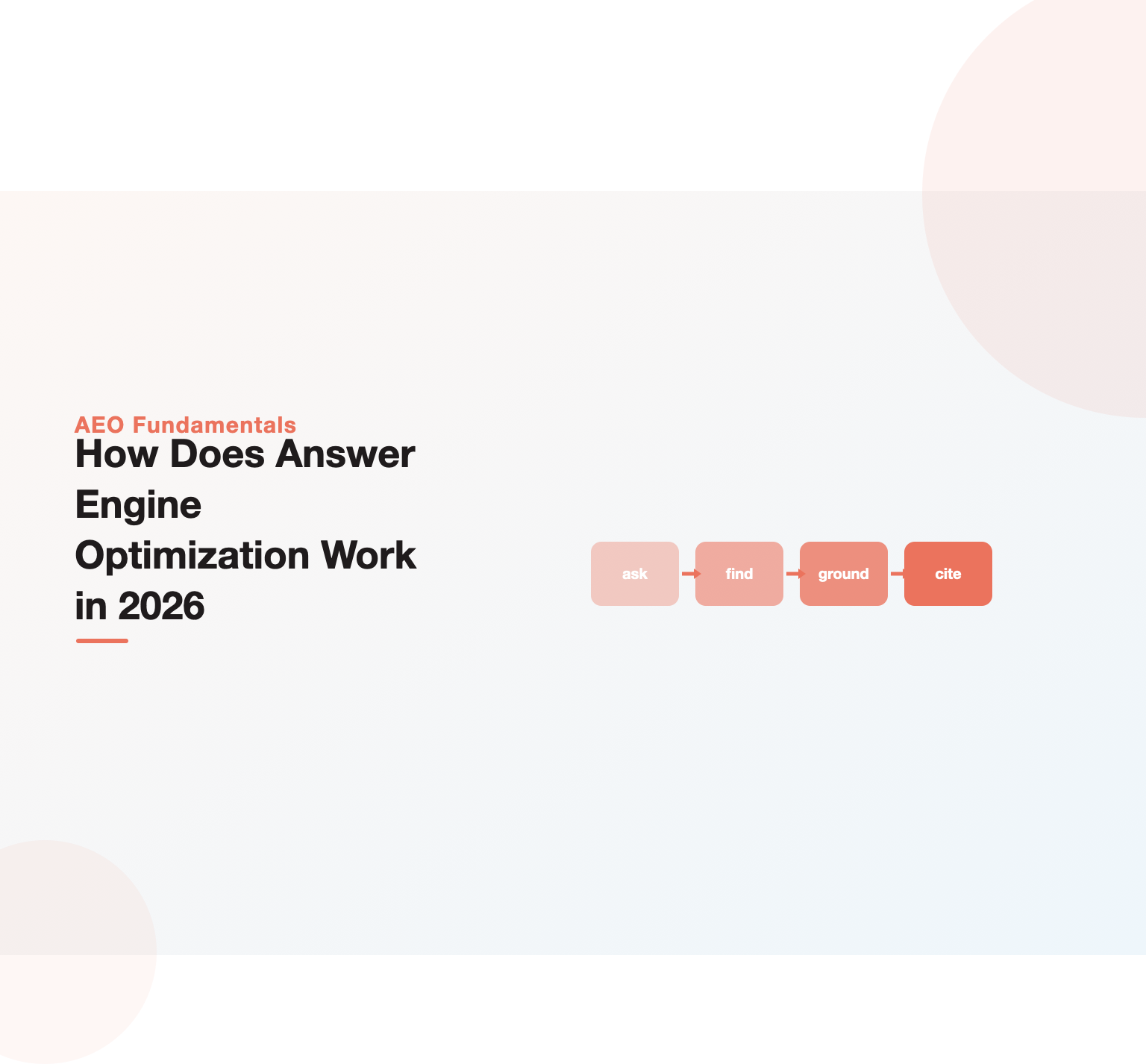
Answer engine optimization works by making your content easy to retrieve, simple to extract a clean answer from, and credible enough to trust, so that when an AI answer engine builds a response it pulls from your page and names you as the source. In 2026 that process runs through three moving parts: the engine retrieves relevant passages from the live web, grounds its answer in the strongest ones, and cites the sources it trusted most. Understanding each part shows you exactly where to influence the outcome, which is what this guide walks through.
How answer engine optimization works, step by step
So how does answer engine optimization work once you look under the hood? It helps to follow a single question through the system, because the answer arrives in five distinct steps, and each one is a place you can influence.
- Interpretation. The engine reads the natural-language question and works out intent, often rewriting it into several cleaner search queries behind the scenes.
- Retrieval. It searches the live web and its index for passages relevant to those queries, assembling a set of candidates.
- Ranking. It scores those candidates for relevance and reliability, deciding which few are worth putting in front of the model.
- Grounding. It feeds the strongest passages to the model as context, so the answer is built from real retrieved text rather than memory alone.
- Generation and citation. The model composes the answer and names the sources it leaned on, which is the citation you are competing for.
Your job in answer engine optimization is to make your content the passage that survives every one of those steps: retrievable at step two, ranked well at step three, clean enough to ground cleanly at step four, and trusted enough to be named at step five. A weakness at any single step quietly removes you from the final answer, which is why AEO rewards getting the whole chain right rather than any one tactic.
The mechanism behind most answer engines is called retrieval-augmented generation, usually shortened to RAG. Rather than relying only on what the model memorised during training, the engine augments the model with fresh, retrieved information at the moment of the question. This matters for two practical reasons. First, a well-structured, current page can be cited even for topics the underlying model never saw in training, so you are not waiting years for a model to learn about you. Second, because retrieval happens live, improvements you make to a page can influence citations in weeks rather than the long horizon people assume. AEO is therefore something you can actively steer, not a fixed property of the model.
The two gates: being retrieved, then being trusted
Two separate gates stand between your content and a citation, and they reward different things. The first gate is retrieval: your page has to be found and judged relevant to the question. That rewards clear topical focus, clean structure, and strong classic search visibility, since many engines lean on established search signals to retrieve. The second gate is trust: once retrieved, your passage has to be judged reliable enough to quote, which rewards authority, accurate claims, and corroboration from other credible sources.
Most content fails at one gate or the other. A thin, keyword-stuffed page might never be retrieved. A well-optimised page from an unknown source might be retrieved but passed over for a more trusted competitor. Diagnosing which gate you are failing is the fastest way to improve, and it is exactly the lens our guide to how AI search engines choose which brands to cite applies, alongside what makes content citable.
The two gates also explain a pattern that confuses many teams: strong search rankings that do not turn into citations. Ranking well helps you clear the retrieval gate, but it does nothing for the trust gate on its own. If your top-ranked page is anonymous, makes claims nothing else corroborates, or buries its answer, an engine can retrieve it and still choose to quote a lower-ranked but more trustworthy source. Conversely, a page that does not rank on page one can still be cited if it states a clean, well-supported answer that the engine trusts. Rankings and citations are correlated but not the same, and AEO is the work of closing the gap between them.
A worked example: how a citation actually happens
Picture a buyer asking, what is the best way to reduce cart abandonment for a Shopify store? Here is how the process plays out. The engine rewrites that into a few queries about cart abandonment, Shopify checkout, and conversion. It retrieves a dozen candidate passages, including a well-known platform’s help doc, two agency blog posts, and a forum thread. It ranks them, favouring sources it recognises and passages that answer directly. It grounds its reply in the three strongest and writes a short answer that names two of them as sources.
Now ask why those two were named and the others were not. The cited passages opened with a clear answer, came from sources the engine recognised, and made claims that the other retrieved passages broadly agreed with. The forum thread was retrieved but ignored, because it was anecdotal and uncorroborated. One agency post was retrieved but skipped, because its answer was buried three paragraphs down under a generic introduction. If that agency had led with the answer and shored up its authorship, it would very likely have been the third citation. That is the entire game of AEO, visible in one query.
What changed in 2026
The mechanics above are not brand new, but several shifts have made them decisive in 2026. AI Overviews moved from an experiment to a default part of Google for a large share of queries, so answer-style results now front many searches rather than sitting to one side. More engines matured at once, with ChatGPT, Perplexity, Gemini, and Copilot all doing live retrieval, which means being citable now pays off across several destinations, not one. And engines leaned harder on entity understanding, favouring brands they can recognise and verify. The net effect is that the reward for getting AEO right grew, and the cost of ignoring it grew with it. Our overview of how AI Overviews are changing Google search and the data in AEO statistics for 2026 go deeper.
The role of structure and schema
Structure is how you win the first gate. Answer engines extract passages, so a page that states its answer in the opening sentence of a section, uses headings that match real questions, and keeps each idea self-contained is far easier to lift from than a page that buries its point. Schema markup reinforces this by labelling what each block of content means, so an engine parses your FAQ, article, or organisation details correctly rather than guessing. None of this is about tricking a machine; it is about removing ambiguity so the right passage is easy to quote.
In practice a handful of schema types do most of the work. FAQ schema marks up question-and-answer pairs so each is cleanly extractable. Article schema identifies the headline, author, and publish date, which feeds both freshness and authorship signals. Organization schema states who you are, tying your content to a recognised entity. Product, HowTo, and Review schema help where they genuinely fit. The rule is to use schema that accurately describes real content on the page, never to fabricate structure the page does not support, because engines increasingly detect and discount mismatched markup.
Structure and schema reinforce each other. A section that opens with a one-sentence answer, followed by the supporting detail and wrapped in the right schema, gives an engine a passage it can lift with confidence and attribute correctly. That combination, clarity for humans and labels for machines, is the practical core of the first gate. Our guide to answer-first content that AI engines extract covers the writing side in depth.
The role of authority and entities
Authority is how you win the second gate. Answer engines build an understanding of your brand as an entity from information spread across the whole web, not just your own site, and they lean toward sources they recognise and can verify. That recognition, sometimes called model familiarity, grows from consistent brand information, credible mentions, presence in knowledge bases, and genuine expertise expressed through named authors. When an engine already knows who you are and trusts the topic to you, your passages clear the trust gate more easily. This is where model familiarity, knowledge graphs, and E-E-A-T do their work.
Authority is also the slowest of the factors to build, which is precisely why it is the most defensible. Anyone can restructure a page in an afternoon, but a recognised brand presence, consistent information across the web, and a track record of accurate, corroborated content accumulate over months. Once an engine has learned to trust you on a topic, that trust is hard for a competitor to displace quickly, so the authority you build today keeps paying off long after the work is done.
How different answer engines work
The broad process is shared, but engines differ in emphasis, and it helps to know how. Google AI Overviews lean heavily on its search index and established ranking signals, so classic SEO strength feeds your AEO there. Perplexity is retrieval-first and openly cites its sources, which rewards clearly attributable, well-structured pages. ChatGPT blends its trained knowledge with live search, so both brand familiarity and fresh, retrievable content matter. Gemini and Copilot sit closer to Google and Bing respectively. You do not optimise separately for each; you build the shared foundation of authority, structure, and corroboration, and it carries across all of them, which is the same principle behind broader AI search optimization and generative engine optimization work.
How to tell whether it is working
Because the mechanics are invisible, you need a way to see the result, and the result is simply whether you get cited. The most reliable check costs nothing: take your priority questions, ask each one in the major answer engines, and record whether you were named, who else was, and how your answer compared to the one that got quoted. Do this on a fixed schedule and you have a working measurement system before you buy any tool.
Three signals are worth tracking over time. Citation rate is how often you are named across your target questions, and it is the headline number. Share of answer is your slice of citations versus competitors on a topic, which tells you whether you are the default source or an occasional mention. And downstream, watch branded search and direct referral traffic from AI engines, because being cited tends to lift both as people who saw you named look you up afterward. Treat any single answer as noisy, since engines vary run to run; the trend across a month is the signal that matters.
A common mistake is to judge AEO by classic rankings alone. You can hold position one and still be absent from the answer, or rank modestly and be cited often. Measure the thing you actually want, which is inclusion in the answer, and let that guide which pages you improve next. The direction of the citation-rate trend, not any one query, is how you know the work is compounding.
Why answer engine optimization stops working
When AEO underperforms, the cause is almost always traceable to one of the five steps failing quietly. Knowing the common failure points lets you diagnose rather than guess:
- Never retrieved. The page has thin or off-topic content, or no search visibility, so it is not even a candidate. Fix relevance and structure first.
- Retrieved but out-ranked. Stronger, more recognised sources crowd you out at the ranking step. Build authority and topical depth so you become the recognised source.
- Hard to ground. The answer is buried, hedged, or spread across paragraphs, so the engine cannot lift a clean passage. Lead with the answer and keep each idea self-contained.
- Not trusted to cite. The claim is uncorroborated or the source is anonymous, so a safer competitor is named instead. Add authorship and align with what other credible sources say.
- Stale. The content is outdated, so engines favour a fresher source. Maintain and revisit key pages on a schedule.
Because the failure is usually one specific step, the fix is usually one specific change rather than a wholesale rewrite. That is what makes answer engine optimization tractable: it is diagnosable, and a small set of targeted edits often moves a page from ignored to cited.
How to work with the process, not against it
Once you see the process, the practical moves are clear. Start from the real questions your buyers ask, answer each one first and cleanly, and make the passage self-contained. Add the schema that fits, and put a credible named author behind it. Shore up your entity information so engines recognise you, and keep the content current so it stays eligible for retrieval. Then measure: ask your target questions in the major engines and see whether you appear. That loop, informed by the complete AEO checklist and an AI citation readiness audit, is how you move from understanding the mechanics to actually earning citations. For the strategic picture, the pillar guide on answer engine optimization ties it together.
We run answer engine optimization programs end to end, from retrieval and structure to the authority signals that clear the trust gate, measured by citation rate and share of answer.
Explore our AEO services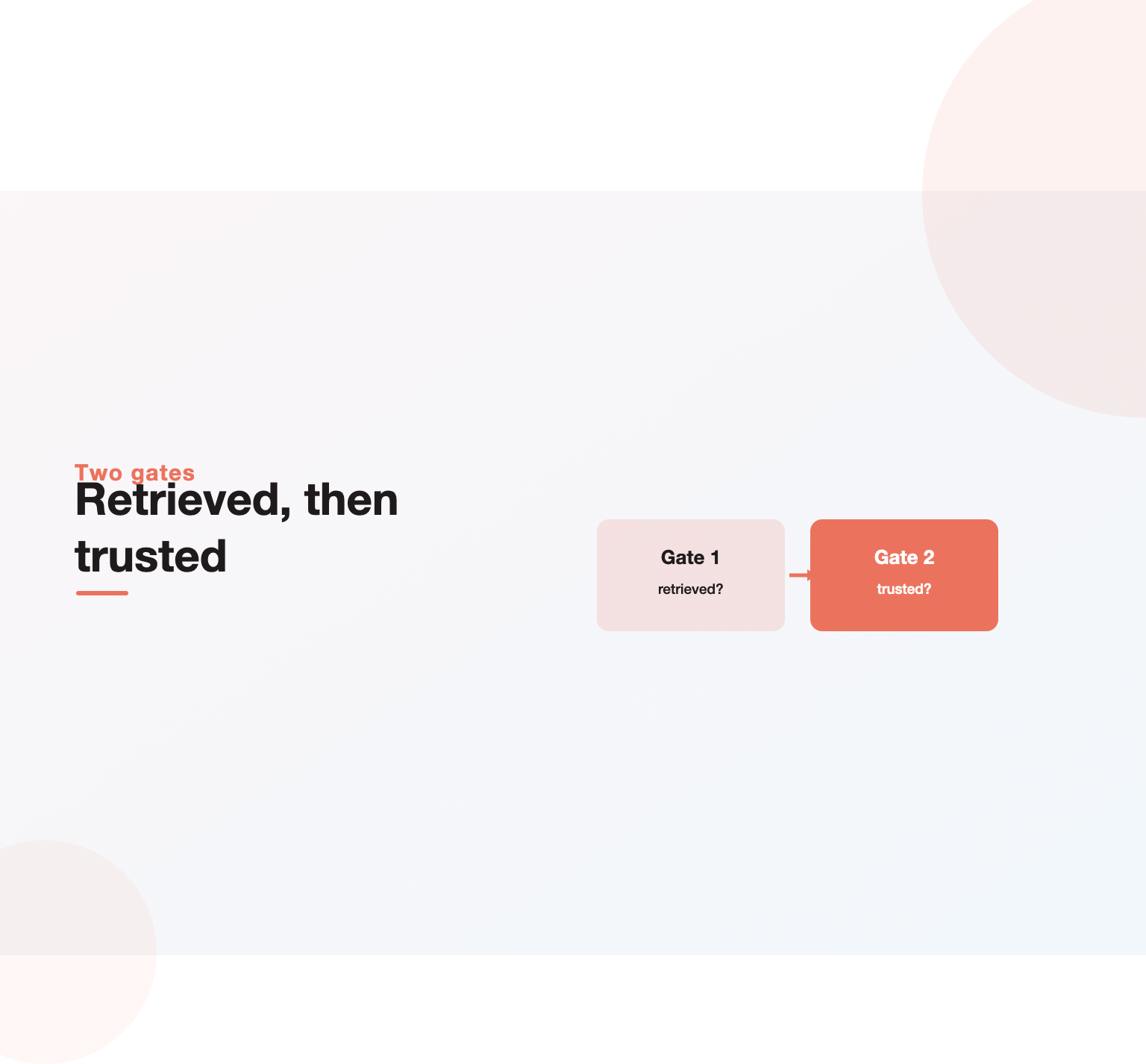
Frequently asked questions
How does answer engine optimization actually work?
An answer engine retrieves relevant passages from the web, grounds its answer in the strongest ones, and cites the sources it trusts most. AEO works by making your content retrievable, easy to extract a clean answer from, and credible enough to be that cited source.
What is retrieval-augmented generation?
It is the method most answer engines use: instead of relying only on training data, they retrieve fresh, relevant passages at the moment of the question and have the model compose an answer grounded in them, citing the sources used.
Why do some pages get retrieved but never cited?
They clear the first gate (relevance and structure) but fail the second (trust). The source is not recognised or corroborated enough, so the engine quotes a more trusted competitor instead.
Does classic SEO still help with AEO?
Yes. Several engines, especially Google AI Overviews, use established search signals to retrieve candidates, so strong SEO improves your chance of being retrieved and then cited.
Do I need to optimise separately for ChatGPT, Perplexity, and Gemini?
No. They differ in emphasis, but the shared foundation of authority, clean structure, and corroboration carries across all of them, so you build it once and benefit broadly.
What changed for AEO in 2026?
AI Overviews became a default part of Google for many queries, more engines matured with live retrieval at once, and engines leaned harder on recognising brands as entities, raising both the reward for doing AEO and the cost of ignoring it.
Ready to put this into practice?
Talk to the team that runs SEO, AI search and paid growth programs every day.
Book a Strategy Call →