 Skip to content
Unified Platforms
AI Application Development Services
Unified Platforms provides AI application development services for businesses that want working software, not slideware: copilots that answer from your own knowledge, automations that erase hours of manual work, and AI features built into the systems your team already uses. Scoped around a business outcome, shipped in weeks, and measured in hours saved and revenue moved.
- Outcomes first, models second
- Built into your existing systems
- Weeks to working software
Our Clients
Brands that have worked with us
From global giants to fast growing startups, teams trust Unified Platforms with their growth.








What AI Application Development Services Covers
- AI copilots and assistants
- Workflow automation with AI judgment
- Retrieval and knowledge systems
- AI features inside your products
- Integrations and orchestration
- Evaluation, guardrails, and operations
Overview
AI Application Development That Answers to a Number
Every business now has the same two AI problems: everyone senses the leverage, and almost nobody has turned it into working software. Between the demo that impressed the board and a tool your team actually uses on Tuesday sits the real work, picking the process where AI pays, wiring models to your data and systems, handling the failure cases, and shipping something reliable enough to trust. AI application development is that work, and it rewards builders who care more about the outcome than the model.
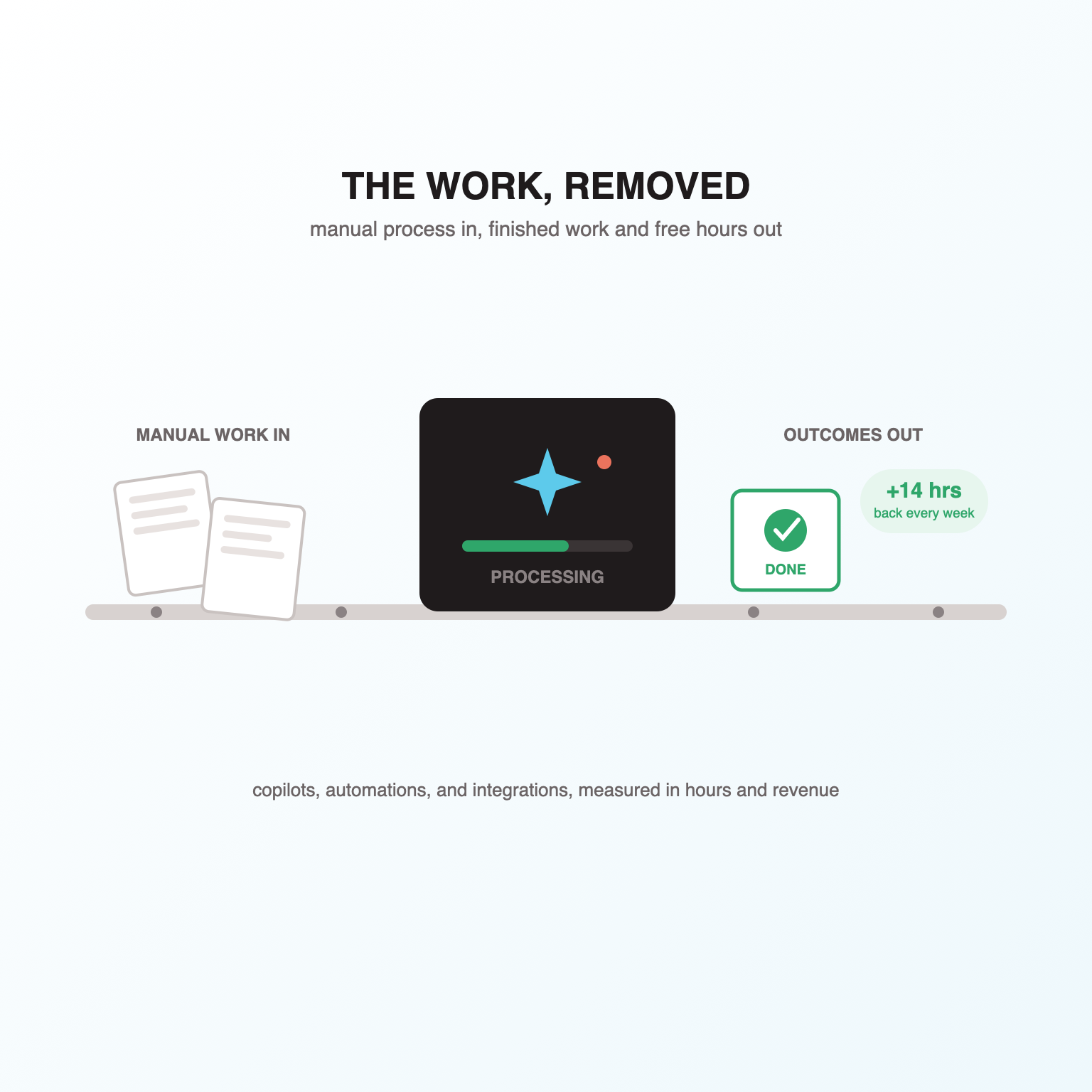
Our approach starts from the business problem, not the technology. The best AI applications we have shipped are rarely glamorous: an operations assistant that eliminated fourteen hours of weekly manual work, an invoicing flow cut from days to four hours, a booking pipeline automated end to end. Each began the same way, mapping a process, finding the steps where judgment is cheap and volume is high, and building the smallest system that removes them. The model is an ingredient; the application is the recipe, the plumbing, and the guardrails around it.
The toolkit spans what modern AI applications actually need. Large language models for understanding, generation, and reasoning, chosen per task and swapped as the market moves. Retrieval systems that ground answers in your documents, policies, and product data, so the assistant answers from your truth instead of hallucinating industry averages. Integrations with the software running your business, CRMs, ERPs, WordPress and Shopify stores, spreadsheets, WhatsApp, because an AI feature that lives outside your workflow is a browser tab nobody opens twice. And the unglamorous engineering, queues, logging, fallbacks, permissions, that separates a prototype from a product.
We build with the pragmatism of a team that also runs marketing systems in production. The same practice that built the web platforms, automations, and API integrations in our case studies builds these applications: ship a working slice early, measure it against the hours or revenue it was scoped to move, then extend what proves itself. AI projects die from scope, not from technology, and the discipline of starting small and measuring honestly is most of what separates our delivered systems from the industry's graveyard of pilots.
Cost and control get engineered, not hoped for. Model spend is budgeted per transaction and monitored, sensitive data is scoped, masked, and kept out of training, outputs that matter get human checkpoints, and everything logs enough to audit later. You own the code, the prompts, the data pipelines, and the documentation, so the system survives us, extends with your team, and never becomes a black box you rent from your own vendor.
Timing matters here the way it mattered for websites in 2005: the technology has crossed from experimental to dependable faster than most organisations have adjusted their plans, and the gap is a competitive window. Model costs have fallen hard while capability climbed, which means automations that were uneconomical eighteen months ago now pay back in a quarter, and the businesses building their second and third applications are compounding operational advantages their competitors still describe as futuristic. None of this requires betting the company; it requires picking one process, building one working system, and letting the scoreboard argue for the next one.
The results band shows what this looks like delivered: fourteen hours of weekly manual work eliminated and client response rates up sixty percent for an engineering firm, invoice generation cut to four hours, and a property platform running one hundred percent booking automation. Real systems, in production, measured in the units that matter, and every one of them started with the same free scoping conversation this page ends with.
AI copilots and assistants. Internal copilots that answer from your documentation, policies, and data; customer-facing assistants that handle the questions your team answers on repeat; sales support that drafts, summarises, and preps from your CRM. Each one grounded in your knowledge with retrieval, scoped to what it may and may not say, and instrumented so you can see what it handled and where humans took over.
Workflow automation with AI judgment. The processes that eat your team's week, triage, data entry, document processing, report assembly, follow-ups, rebuilt as pipelines where AI handles the judgment steps rules could never cover: reading the email, classifying the request, extracting the fields, drafting the response. The fourteen hours a week we erased for Envigaurd came from exactly this pattern, applied to operations that had always been manual.
Retrieval and knowledge systems. Your documents, tickets, product data, and institutional knowledge made queryable: RAG pipelines with proper chunking, permissions that respect who may see what, citations back to sources, and evaluation that catches drift before users do. This is the foundation under every serious assistant, and doing it well is the difference between answers your team trusts and confident nonsense with a chat interface.
AI features inside your products. Search that understands intent, recommendations that reflect real behaviour, generation features that fit your product's voice, and summarisation where your users drown in text. Everything lands inside your existing stack, web platforms, WordPress, Shopify, custom applications, with the performance discipline of our development practice, because an AI feature that slows the product taxes every user to serve some.
Integrations and orchestration. AI earns its keep where your systems meet: CRM to email to WhatsApp to spreadsheet to ERP, orchestrated with queues, retries, and audit logs. Our API integration work, the invoicing flow cut from days to four hours among it, is the backbone here, now with models handling the steps that used to need a person: reading, matching, reconciling, drafting, routing.
Evaluation, guardrails, and operations. Production AI needs adult supervision: output evaluation against golden sets, hallucination and safety checks appropriate to the stakes, human approval gates where errors are expensive, cost monitoring per feature, and fallbacks for when providers wobble. The operations layer goes in from the start, because trust is the actual product and it is lost in one bad week.
The Difference
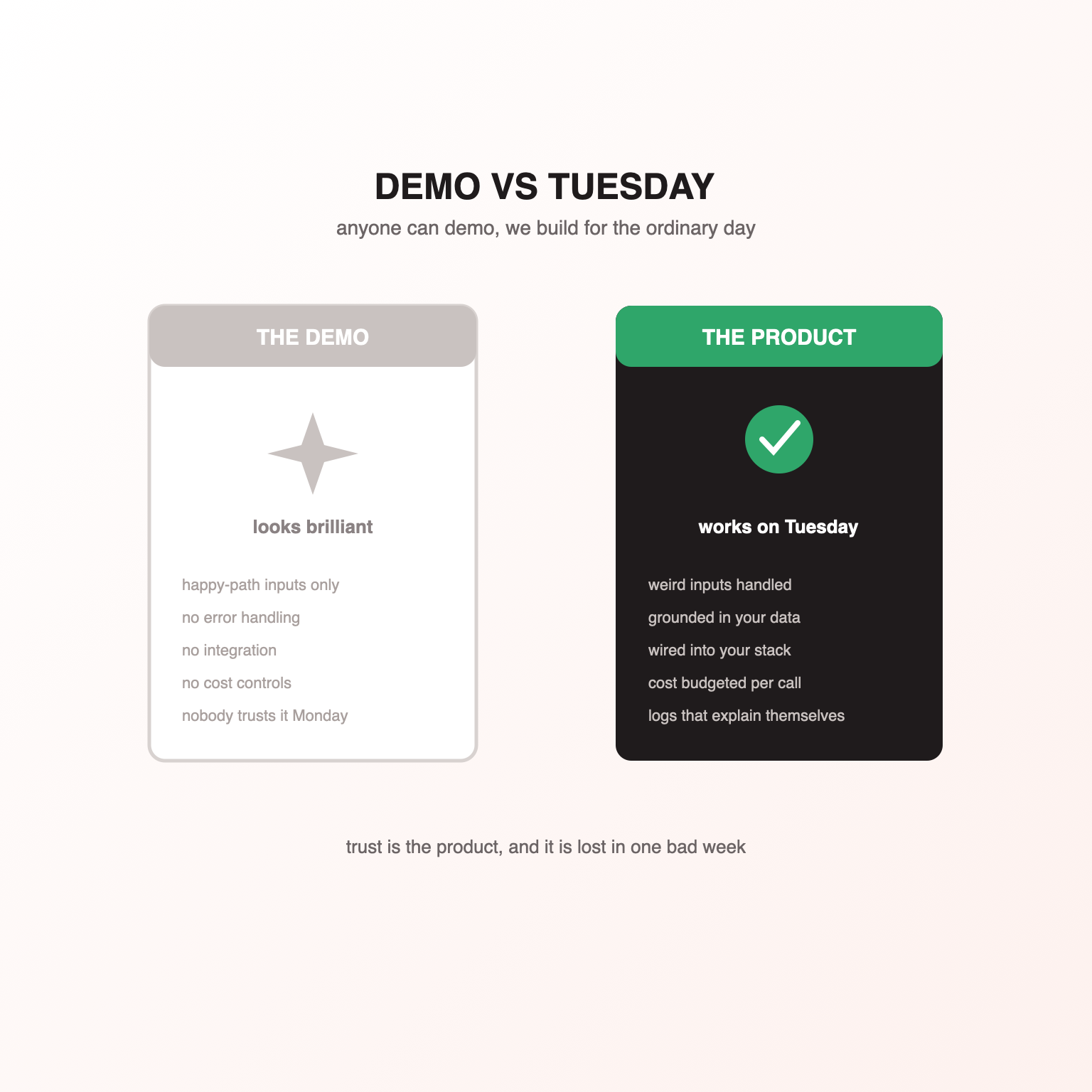
The Demo Is Easy. Tuesday Is the Test
Any team can make a model look brilliant for five minutes in a meeting. The craft is the application that still works on an ordinary Tuesday: weird inputs handled, costs under control, answers grounded in your data, failures caught and routed to humans, logs that explain themselves. We build for Tuesday, and the systems in our results band have had a great many of them.
Book a Strategy CallOur Process
How We Take an AI Application From Idea to Production
A disciplined sequence, adapted to your competitive landscape. Open each step.
01Opportunity scoping
02Design and data groundwork
03Working slice in weeks
04Harden and extend
05Handover and operate
Why Unified Platforms
Why Teams Choose Us to Build Their AI Applications
The working habits behind every engagement.
Outcome economics before technology
Every engagement starts by pricing the problem, hours, error costs, revenue at stake, so the application answers to a number from day one. It keeps us from building clever systems nobody needed, and it gives you a clean verdict at every stage: is this paying? The graveyard of enterprise AI pilots is full of projects that skipped that question.
Production systems, not demos
The difference between a demo and a product is everything that happens when inputs get weird: our systems ship with evaluation, fallbacks, logging, permissions, and human gates matched to the stakes. The automation running Envigaurd's operations and RentMyStay's bookings runs daily without ceremony, which is the only compliment production software needs.
Marketing-grade understanding of your stack
We already build and run the systems most businesses want AI wired into, WordPress and Shopify platforms, CRMs, analytics, WhatsApp and email flows, because they are our daily tools as a marketing company. That fluency shortens integration weeks into days and means your AI application lands inside your operations instead of beside them.
Model-agnostic and swap-ready
The model market moves monthly, so we architect for replacement: provider abstractions, prompt libraries under version control, and evaluation sets that let us test a new model against your actual workload in an afternoon. You get today's best economics without marrying anyone, and upgrades become routine maintenance instead of rebuilds.
Honest about what AI cannot do yet
Some processes need reliability current models cannot honestly promise, and we say so in scoping rather than discovering it on your budget. The applications we recommend are the ones where the technology is ready and the economics are proven, which is why our delivered systems stay in production instead of joining the pilot graveyard.
Proof in production
Fourteen hours of weekly manual work eliminated, sixty percent better client response rates, invoicing cut from days to four hours, bookings automated end to end: the results band is delivered systems, not projections, and we will walk you through the architecture and the before-and-after of any of them, screens and logs included. Ask for the unvarnished version; it is more convincing anyway.
Industries
Industries We Work With
Deep experience across the sectors we serve, with strategy tailored to each.
Scope Your First Application Free
Bring us the process that eats your team's week, the report nobody enjoys building, the inbox that needs triage, the questions answered on repeat, and we will scope it honestly: what an AI application could remove, what it would cost to build and run, and what the payback looks like in hours and rupees. The scoping conversation takes under an hour and usually surfaces two or three candidates you had not considered, because the best automations hide in work so routine nobody thinks to question it. If the honest answer is that a simple automation or a better form beats an AI build, you will hear that too, and the scoping is free either way.
Book a Strategy CallQuestions
Frequently Asked Questions
Straight answers before you ever get on a call.
AI Application Basics
How is this different from just giving our team ChatGPT subscriptions?
What are AI application development services?
What kinds of AI applications pay back fastest?
Do we need our own data or a data science team for this?
Build and Technology
Which AI models do you build with?
How long does an AI application take to build?
Can you integrate with our existing CRM, ERP, or WordPress and Shopify stack?
Trust and Operations
Will our team actually use it, or will it become another ignored tool?
How do you prevent hallucinations and bad outputs?
What about data privacy and security?
What does it cost to run an AI application after launch?
Use Cases
What AI applications make sense for marketing and sales teams?
Can AI applications handle customer support?
What about document-heavy operations like quotes, invoices, and compliance?
Do you build customer-facing AI products, not just internal tools?
Working With Us
What does the engagement structure look like?
Can you rescue a stalled AI pilot our team or another vendor started?
Our team wants to build AI capability internally. Do you help with that?
Turn AI Intent Into Working Software
Somewhere in your operations is a process everyone hates, a queue that grows on weekends, a report that eats a morning, questions answered for the hundredth time, and for the first time the technology to remove it is genuinely ready. The companies quietly compounding right now are not the ones with AI strategies in slide decks; they are the ones with three working applications and a scoreboard of hours returned. Book a free strategy call, bring the process you would most like to never do again, and we will tell you what removing it takes, and whether it is worth it, in numbers you can check.
Book a Strategy CallExplore more