 Skip to content

Answer Engine Optimization Best Practices: The 2026 Guide
The answer engine optimization best practices that get you cited by AI: the AEO techniques, structure and E-E-A-T signals that work in 2026, with a practical checklist.
Quick Answer
This guide covers AEO end to end: what it is, how engines choose sources, the content and authority that earn citations, and how to measure success. It is the pillar for turning AI visibility into a repeatable practice.
Answer engine optimization (AEO) is the practice of structuring your content, authority, and data so that AI answer engines like ChatGPT, Google AI Overviews, Perplexity, and Gemini cite your brand directly inside the answers they generate. Where classic search optimization competes for a blue link on a results page, AEO competes to be the source an AI quotes when it responds to a question. This guide explains what answer engine optimization is, why it matters in 2026, how answer engines decide which brands to cite, the framework we use to earn those citations, and the practical steps to make your own site citation-ready. The answer engine optimization best practices in this guide show how to do that consistently.
Key Highlights
- AEO structures your content, authority and data so AI engines cite your brand in their answers.
- It matters in 2026 because a growing share of research happens inside AI answers, not link lists.
- Engines cite brands they recognise, trust and can extract a clean answer from.
- The ASE framework, authority, structure and engagement, organises the whole discipline.
- Measure it by citations and share of answer across ChatGPT, Perplexity, AI Overviews and Gemini.
What is answer engine optimization?
Answer engine optimization is the discipline of earning citations inside AI-generated answers. An answer engine is any system that reads a question, gathers information from across the web, and returns a single synthesised response instead of a list of links. ChatGPT with search, Google AI Overviews, Perplexity, Microsoft Copilot, and Gemini are all answer engines. Each one decides which sources to pull from and which brands to name, and that decision is what AEO sets out to influence.
The simplest way to picture the shift is to compare the two questions each discipline asks. Classic SEO asks, will this page rank highly enough that someone clicks it? AEO asks a harder question: when an AI writes the answer, will it quote us as the source? A page can rank on the second results page and still be the passage an answer engine lifts, and a page can rank first and never be cited at all. The two outcomes have drifted apart, and the gap is where AEO lives.
Traditional SEO optimises for a ranking position. AEO optimises for inclusion in the answer itself, whether or not the user ever clicks through. If you are new to the topic, our complete beginner explainer of what AEO is walks through the definition from scratch, and how answer engine optimization works in 2026 covers the mechanics end to end.
Why answer engine optimization matters in 2026
Buyers increasingly start with an AI assistant rather than a search box. They ask a full question, read the synthesised answer, and often act on the brands named there without visiting a results page at all. If your brand is not in that answer, you are invisible at the exact moment a decision is forming, no matter how well you rank in classic search. That is why answer engine optimization best practices now sit alongside classic SEO in most marketing plans.
Consider how a buyer now researches a purchase. Instead of typing two keywords and scanning ten links, they ask something like, which tools do this well for a team my size, and what are the trade-offs? The answer engine returns a short, opinionated response that names a handful of brands and summarises each. Those named brands enter the shortlist; everyone else is simply absent. There is no page two to fight your way onto, because there is no page at all, only the answer.
Two shifts make this urgent. First, zero-click behaviour: a growing share of questions are resolved inside the answer, so the click you used to earn never happens. Second, AI Overviews now sit above the traditional results for many queries, reframing what the top of search even looks like. The uncomfortable implication for marketers is that traffic and visibility have partly decoupled. You can lose sessions to zero-click answers while still gaining influence, if your brand is the one being quoted. AEO is how you make sure the visibility you keep is visibility that converts. We cover the stakes in depth in why AEO matters for every business, the data in AEO statistics for 2026, and the Google shift in how AI Overviews are changing Google search.
How answer engines decide which brands to cite
In practice, answer engines do not rank pages the way a classic search index does. They retrieve candidate passages, ground their response in those passages, and cite the sources they trust most. Three things drive that trust: whether the model already recognises your brand as an entity, whether your content is structured so a passage can be lifted cleanly, and whether independent signals corroborate what you claim. A page that states a clear answer in the first sentence, backs it with evidence, and comes from a recognised source is far more likely to be quoted than a long, unstructured article.
It helps to understand the retrieval step. Most answer engines use some form of retrieval-augmented generation: they search for relevant passages, feed the strongest ones into the model as context, and the model composes an answer grounded in that context, citing what it used. This means two gates stand between you and a citation. Your content has to be retrieved in the first place, which rewards clear topical relevance and clean structure, and it then has to be chosen as trustworthy enough to quote, which rewards authority and corroboration. Miss the first gate and you are never in the running; miss the second and you are retrieved but passed over for a source the engine trusts more.
Corroboration deserves special attention. In many cases, answer engines are cautious about stating something only one source claims. When several independent, credible sources agree, the claim becomes safe to assert, and the sources that state it most clearly tend to get named. Practically, that means being the clearest voice on a claim that others also support beats being the lone voice on a claim nobody else makes. We break the mechanics down further in how AI search engines choose which brands to cite and what makes content citable to AI search engines.
Is your brand missing from ChatGPT, Gemini and Perplexity answers?
Our team reviews your current setup and shows you where the opportunities are. See how our AEO services work.
The ASE framework: authority, structure, engagement
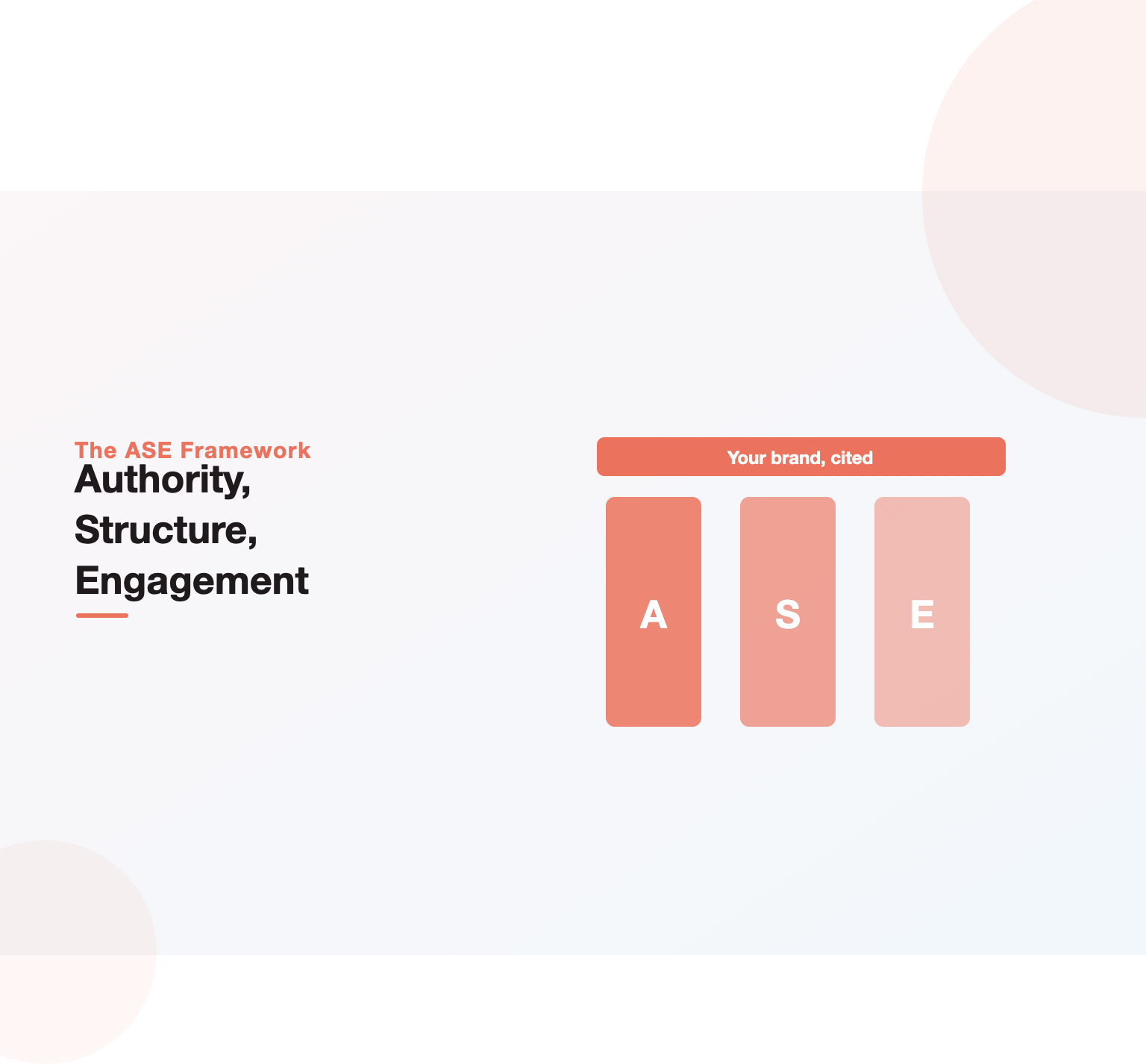
We organise every AEO engagement around three pillars we call the ASE framework: Authority, Structure, and Engagement. Authority is whether answer engines recognise and trust your brand as an entity. Structure is whether your content and markup let a machine extract a clean, correct answer. Engagement is whether real people and the signals they generate confirm the answer was useful. Get all three right and you become a default source; miss one and citations stay rare. The framework is explained in full in what is the ASE framework and a breakdown of the three pillars.
Authority
Authority here is entity-level, not page-level. It grows from consistent brand information across the web, credible mentions, a presence in knowledge bases, and demonstrable expertise. An answer engine builds a picture of who you are from everywhere you appear, not just your own site, so conflicting or thin information anywhere weakens the whole. The work is to make your brand legible: one consistent description of what you do, real named experts behind your content, and mentions from sources the engine already trusts. This is where topical authority, E-E-A-T, and Wikipedia and Wikidata come in.
Structure
Structure is how you make an answer extractable: an answer-first opening, clear headings that map to real questions, concise definitions, tables for comparisons, and schema markup that labels what each block means. The test is simple. Could a machine read one section of your page, lift a single self-contained passage, and present it as a correct answer without the surrounding paragraphs? If yes, you are structured for citation. If the meaning only emerges after reading three paragraphs of build-up, you are not. Our guide to answer-first content that AI engines extract is the practical companion here. Applying these answer engine optimization best practices to every key page is what turns structure into citations.
Engagement
Engagement signals tell an answer engine the response actually helped: people spend time, return, and act. Thin content that games structure without earning engagement does not hold its citations for long. Engagement is also the pillar most people forget, because it cannot be faked with markup. You earn it by answering the real question completely enough that the reader stops looking.
Answer engine optimization best practices: the core building blocks
Underneath the framework sit a handful of concrete building blocks. You do not need all of them on day one, but a mature AEO program touches each:
- Answer-first content. Lead with the answer, then support it. Machines and impatient humans both reward it, and it is the single highest-leverage change most sites can make.
- Structured data. Schema markup (FAQ, Article, Organization, Product) labels your content so engines parse it correctly and reduce the chance of a passage being misread.
- Entity and knowledge-graph presence. Consistent, corroborated information so models recognise your brand. See how knowledge graphs influence citations and model familiarity.
- E-E-A-T. Real authorship, experience, and credibility, which matter more as answers touch money-and-your-life topics where engines are most cautious about their sources.
- Freshness. In practice, answer engines favour current sources; updating content for AI citations keeps you eligible.
These building blocks reinforce each other. Schema without authority still leaves you untrusted; authority without structure leaves you trusted but hard to quote. A program that advances all of them together compounds, which is why AEO rewards consistency over one-off pushes.
In many cases, answer engine optimization best practices in action
Theory is easy; the day-to-day is where programs succeed or stall. A working cycle looks like this. You start from the questions your buyers actually ask an assistant, in their words, not your keyword list. You group those questions into topics, and for each topic you decide which single page should own the answer, so you are not splitting authority across near-duplicates. You write each answer first, add the schema that fits, and make sure a real, credentialed author stands behind it. Then you check the actual answer engines: ask the target question in ChatGPT, Perplexity, and Google, and record who gets cited today. Following answer engine optimization best practices week to week is what separates programs that compound from those that stall.
That last step is the one teams skip and the one that matters most. Your baseline is not your ranking; it is the current answer. If a competitor is cited, read their passage and ask why it was safer to quote than yours. Usually it is clearer, better corroborated, or attached to a more recognised brand, and each of those is fixable. Repeat the loop topic by topic and the citations follow, first on your narrowest, most specific questions and later on the broad ones.
For most teams, answer engine optimization vs SEO vs GEO
These disciplines overlap but optimise for different outcomes. The short version: SEO wins rankings, AEO wins citations in answers, and GEO (generative engine optimization) focuses specifically on generative AI surfaces. In practice they share a foundation and diverge in emphasis, and a healthy program runs all three rather than treating them as rivals.
| Discipline | Optimises for | What winning looks like |
|---|---|---|
| SEO | Ranking position | Rank and get the click |
| AEO | Citation in the answer | Be the source the answer quotes |
| GEO | Inclusion in generative output | Be named by the model |
The overlap is the good news. The clean structure and genuine authority that earn citations also help you rank, and strong rankings feed the retrieval step that answer engines depend on. You are rarely choosing between them; you are deciding where to place emphasis given how your buyers search today. We compare them properly across our fundamentals cluster as those pieces publish.
How to measure answer engine optimization
You cannot manage what you do not measure, and AEO needs its own metrics because rankings alone miss the point. The ones that matter are citation rate (how often engines name you for target questions), share of answer (your slice of citations versus competitors for a topic), and the referral and branded-search lift that follows being cited. Set a baseline, track target questions across engines, and watch the trend rather than any single answer, which can vary run to run. Measurement is one of the most overlooked answer engine optimization best practices.
A simple starting scorecard beats a complicated dashboard nobody maintains. List your twenty most important buyer questions. Once a month, ask each one in the major answer engines and record whether you were cited, who else was, and how your answer differed from the cited one. That single sheet tells you your citation rate, your share of answer, and exactly which passages to improve next, long before any third-party tool would. Our measurement cluster goes deeper on tools and attribution as those articles publish.
In short, answer engine optimization best practices: mistakes to avoid
Most programs stall for avoidable reasons. The recurring ones are worth naming so you can check yourself against them:
- Burying the answer. A long preamble before the point pushes the extractable passage out of reach.
- Thin, unsupported content. If no independent source corroborates you, engines stay cautious about quoting you.
- Ignoring schema and authorship. Unlabelled content and anonymous articles both cost you trust you did not need to lose.
- Chasing keyword density instead of clarity. Repetition reads as spam to the exact systems you want citing you; natural, authoritative language wins.
- Treating AEO as a project. Equally, answer engines re-evaluate constantly, so a one-off push fades. AEO is a practice, not a launch.
See the mistakes that kill your citation rate for the full list and the fixes for each.
What changes when your brand gets cited
The reason this work is worth doing shows up in ways classic reporting can miss. When an AI assistant names you as the source of an answer, you gain a kind of third-party endorsement at the moment of decision. The buyer did not find an ad or a ranked link; they were told, by a tool they trust, that you are a credible answer. That framing carries weight a paid placement cannot buy.
The compounding effects follow. Branded search tends to rise as people who saw you cited look you up by name. The leads that do arrive are better qualified, because they arrive already informed by the answer that mentioned you. And because citations cluster around clear, authoritative sources, each question you win makes the next related question easier to win. Over a year, a brand that is consistently cited on its core topics builds a moat that is hard for competitors to dislodge, since they must now displace an established default answer rather than simply outrank a page. That durable position, not a short traffic spike, is the real prize.
How to get started with AEO best practices
You can begin without a full re-platform. Pick ten questions your buyers actually ask an AI assistant, answer each one cleanly and first, add the right schema, shore up your authorship and entity information, then track whether engines start citing you. That short loop, repeated, is a working AEO program. To make the first pass concrete, we built a checklist you can work straight through, and our AI citation readiness audit and complete AEO checklist for 2026 go further. Starting small is one of the most practical answer engine optimization best practices for lean teams.
A practical checklist to audit whether your site is ready to be cited by AI answer engines, covering authority, structure, and engagement.
- Answer-first content checks
- The schema markup every page needs
- Entity and E-E-A-T signals to fix first
- How to baseline your citation rate
When to bring in an AEO agency
Plenty of teams run the basics in-house, and they should. It is worth bringing in specialist help when answer engines still are not citing you despite clean content, when your entity and authority signals need coordinated work across many sources, or when you want a measured program with accountable metrics rather than one-off fixes. A good partner should be able to show you your current citation baseline, name the specific gaps in authority, structure, and engagement, and commit to how progress will be measured. That is the work we do day to day, grounded in the ASE framework described above.
We run answer engine optimization programs that earn AI citations across ChatGPT, Google AI Overviews, Perplexity, and Gemini, measured by citation rate and share of answer. Teams based in India can find market-specific advice in our guide to AEO services in India.
Want AI answer engines to cite your brand?
Book a free 30-minute strategy call and leave with a clear next step for your business.
In practice, answer engine optimization best practices, ranked by impact
Not every recommendation deserves the same effort. After auditing sites across SaaS, education and professional services, we see the same order of impact again and again. Use it to decide what to fix first.
1. In many cases, answer the question in the first two sentences
Engines lift short, self-contained answers. Put a direct 40 to 60 word answer directly under each question heading, then expand. Pages that bury the answer under an introduction are skipped even when the rest of the content is excellent. Our guide to writing answer-first content shows the pattern in detail.
2. Make your entity unambiguous
AI systems cite brands they can identify with confidence. Use one consistent company name, link your site to the same profiles everywhere, and add Organization markup as described in Google’s structured data documentation. Inconsistent names and addresses across directories quietly lower the chance of being named.
3. Publish facts other people can quote
Original numbers, clear definitions and named frameworks give an engine something specific to attribute. A page that repeats the consensus has nothing an engine needs to credit. Even a small survey of your own customers creates a citable data point.
4. Keep the page fresh and dated
Show a visible last-updated date and genuinely revise statistics, screenshots and examples. Engines that use live retrieval prefer current sources for anything time-sensitive, as we explain in how often to update content for AI citations.
5. Earn mentions off your own site
Engines cross-check claims against other sources. Reviews, forum discussions, podcasts and trade press that mention your brand alongside the topic make a citation far more likely. This is the slowest of the answer engine optimization best practices, and the one most teams skip.
A 30-day plan to apply these best practices
Week one: list the 20 questions your buyers ask most often, using sales calls, support tickets and the People Also Ask boxes in Google. Week two: rewrite the pages that should answer them so each one opens with a direct answer and uses clear question headings. Week three: fix entity signals, including schema, author pages and consistent profiles. Week four: run the same 20 questions through ChatGPT, Perplexity, Gemini and Google AI Overviews and record who is cited. That baseline turns the work into something you can measure every month.
Teams that follow these answer engine optimization best practices consistently usually see their first citations within one to three months on lower-competition questions. Broad category questions take longer and depend more on off-site authority. If you want help running the program, our For most teams, answer engine optimization services team works through exactly this sequence.
How these practices differ by engine
The fundamentals hold everywhere, but each engine leans on different signals. Google AI Overviews draw mostly from pages that already rank well in organic results, so classic SEO strength still matters there. Perplexity runs live searches and shows its sources openly, which rewards fresh, well-structured pages even from smaller sites. ChatGPT combines what the model learned in training with live browsing, so long-standing brand mentions across the web carry extra weight. Gemini blends Google’s index with the Knowledge Graph, so a clean entity profile helps most. Testing the same questions across all four engines each month shows you where the gaps are, and which fixes will move the most citations for the least effort.
Keep a simple log of every change you make and the date it went live. When citations rise or fall, that log is the only reliable way to connect the result to the work, and it stops the team from repeating experiments that already failed.
Key Takeaways
- Learn how answer engines select and cite sources.
- Build answer-first, evidence-rich content on priority topics.
- Invest in the authority that decides most citations.
- Measure citation presence and iterate on the gaps.
Frequently asked questions
What is answer engine optimization in simple terms?
It is the practice of structuring your content and authority so AI answer engines cite your brand inside the answers they generate, instead of only ranking you on a results page.
How is AEO different from SEO?
SEO optimises to rank a page and earn a click; AEO optimises to be the source an AI answer quotes, whether or not a click ever happens. They share a foundation but reward different things.
Which answer engines does AEO target?
The major ones today are Google AI Overviews, ChatGPT with search, Perplexity, Microsoft Copilot, and Gemini. The techniques generalise as new answer engines appear.
Do I need schema markup for answer engine optimization?
It helps significantly. Schema labels your content so engines can parse and extract it correctly, which makes clean citation more likely, though it is not the only factor.
How long does AEO take to show results?
Structural fixes can influence citations within weeks, but the authority and entity signals that make you a default source build over months of consistent work.
Can small businesses do AEO, or is it only for big brands?
Small and focused businesses often do well, because answer engines reward clear, specific, trustworthy answers on a defined topic rather than sheer size.
Does keyword density matter for AEO?
No. Natural, authoritative language earns citations; repetition works against you. Focus on answering the question clearly rather than hitting a density target.
How do I measure whether AEO is working?
Track citation rate for your target questions, your share of answer versus competitors, and the referral and branded-search lift that follows being cited.
Is AEO the same as GEO?
They overlap heavily. AEO is the broad practice of earning citations in AI answers across all answer engines, while GEO (generative engine optimization) focuses specifically on generative AI surfaces. The techniques share a foundation, so most programs treat them together rather than as separate projects.
Will AEO replace SEO?
No. It extends it. The clean structure and genuine authority that earn AI citations also help you rank in classic search, and strong rankings feed the retrieval step answer engines rely on. The smart move is to run both, weighting effort toward how your buyers actually search.
What kind of content gets cited most often?
Content that answers a specific question directly, is backed by evidence other credible sources also support, carries clear authorship, and is marked up so a machine can lift a clean passage. Original data, clear definitions, and honest comparisons tend to earn citations reliably.
Do I need to be a big brand for answer engines to cite me?
No. Recognition helps, but answer engines reward the clearest, best-corroborated answer on a specific topic. A focused business that owns a narrow subject well is often cited ahead of a larger brand that covers it vaguely.
How does AEO fit with my existing content?
Most of your existing content can be made citation-ready without a rewrite: move the answer to the top, add the right schema, attach a credible author, and tighten the passage a machine would quote. Start with the pages tied to your highest-intent questions.
Ready to put this into practice?
Talk to the team that runs SEO, AI search and paid growth programs every day.
Book a Strategy Call →