 Skip to content
Unified Platforms
Marketing Automation Services
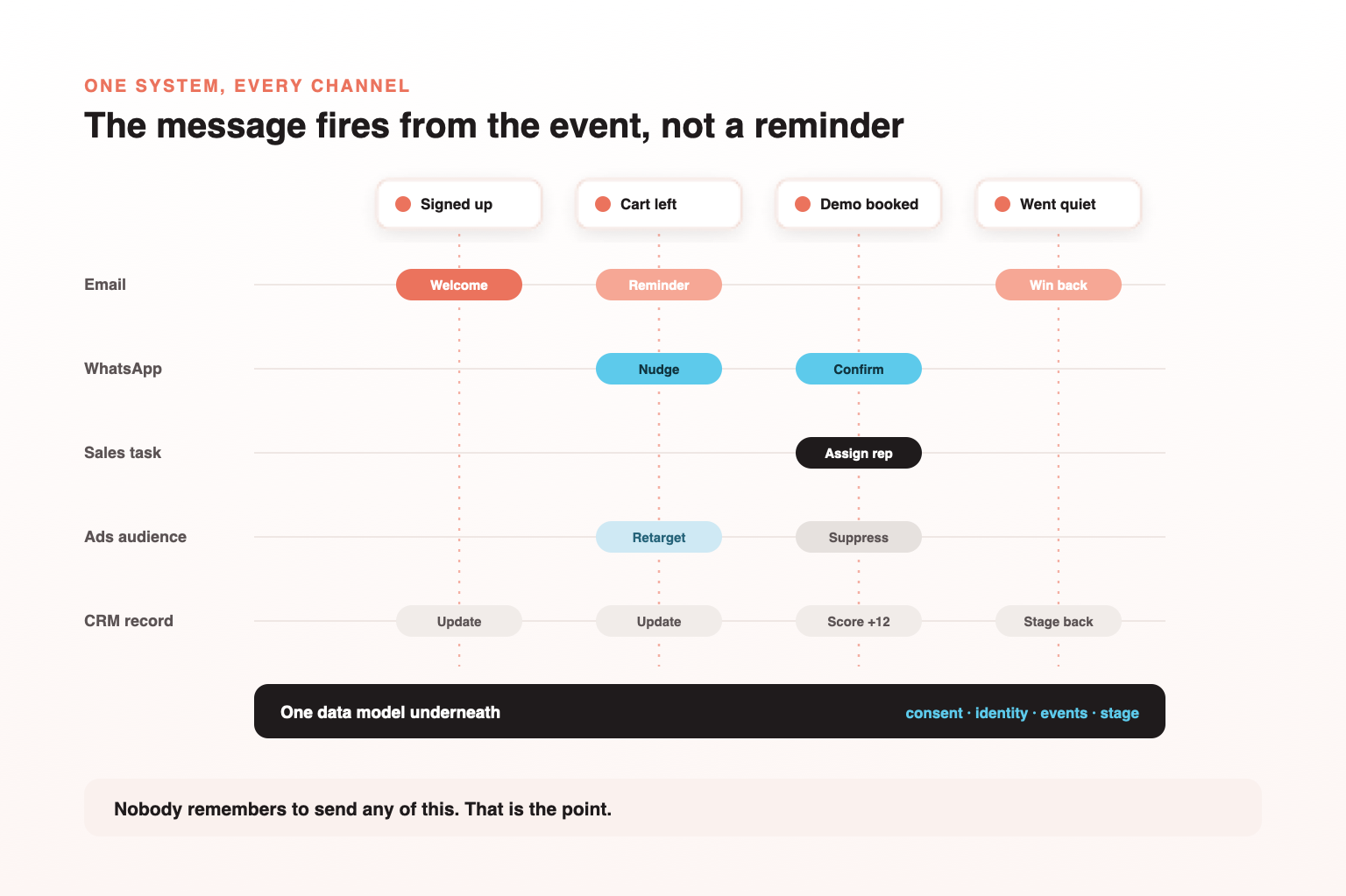
Marketing automation services that connect your platform, your data, and your customer journeys into one system, so the right message fires from a real event instead of somebody remembering to send it.
- Platform agnostic recommendations
- Data model built first
- Journeys tied to real events
Our Clients
Brands that have worked with us
From global giants to fast growing startups, teams trust Unified Platforms with their growth.










What Marketing Automation Services Covers
- Platform audit and selection
- Data model and event architecture
- Lifecycle journey design
- Lead scoring and routing
- Systems integration
- Data quality and database health
- Reporting and attribution setup
Overview
Marketing Automation Services Built on the Layer Underneath
Most companies do not buy marketing automation because they lack ideas. They buy it because the work has outgrown the number of hours available to do it by hand, and because the handoffs between marketing, sales, and support have started dropping people. The platform arrives, a few welcome emails get built, and then the project stalls somewhere between the trial data and the real customer records. Licence renews, usage does not grow, and the tool becomes an expensive way to send newsletters.
The gap is almost never the software. It is the layer underneath: a data model that reflects how your business actually works, events that fire reliably from your product or storefront, definitions everyone agrees on, and journey logic that handles the awkward cases rather than only the happy path. Our marketing automation services concentrate on that layer. We treat the platform as plumbing to be engineered properly, not a canvas to decorate, because the decorating only works once the plumbing does.
Practically, that means auditing what you already own before recommending anything new, designing the lifecycle stages and scoring rules with the people who will act on them, building integrations so records stay consistent across systems, and instrumenting the whole thing so you can see which journeys contribute and which quietly do nothing. Channel execution stays with the channels: our email marketing services and WhatsApp work own what the messages say. Automation owns whether the right person receives them at the right moment with the right data attached.
Platform audit and selection. Choosing a platform before understanding the requirement is how companies end up paying enterprise licence fees for newsletter functionality. Selection work starts with your actual volumes, sales motion, integration needs, and the technical capacity of the team who will run it day to day. Where you already own a platform, the honest answer is usually to make it work rather than migrate, and we will say so. Where a migration genuinely is warranted, the case gets made with costs and timelines attached rather than vendor enthusiasm.
Data model and event architecture. Automation is only as reliable as the records it reads. This work defines the objects, fields, and relationships the platform needs, reconciles them with the sources of truth in your CRM and product, and specifies the events that trigger journeys. Duplicate handling, field validation, and consent flags are designed in rather than patched later. The output is documentation your team can maintain, because an architecture only one agency understands becomes a liability the moment the relationship ends.
Lifecycle journey design. Journeys get mapped against the stages your customers genuinely move through, not a generic funnel diagram. Onboarding, activation, nurture, expansion, renewal, and recovery each get entry criteria, exit conditions, suppression rules, and a defined owner. Edge cases receive as much attention as the main path, since the damage in automation comes from the customer who somehow lands in two journeys at once or keeps receiving a nurture sequence after they have already bought.
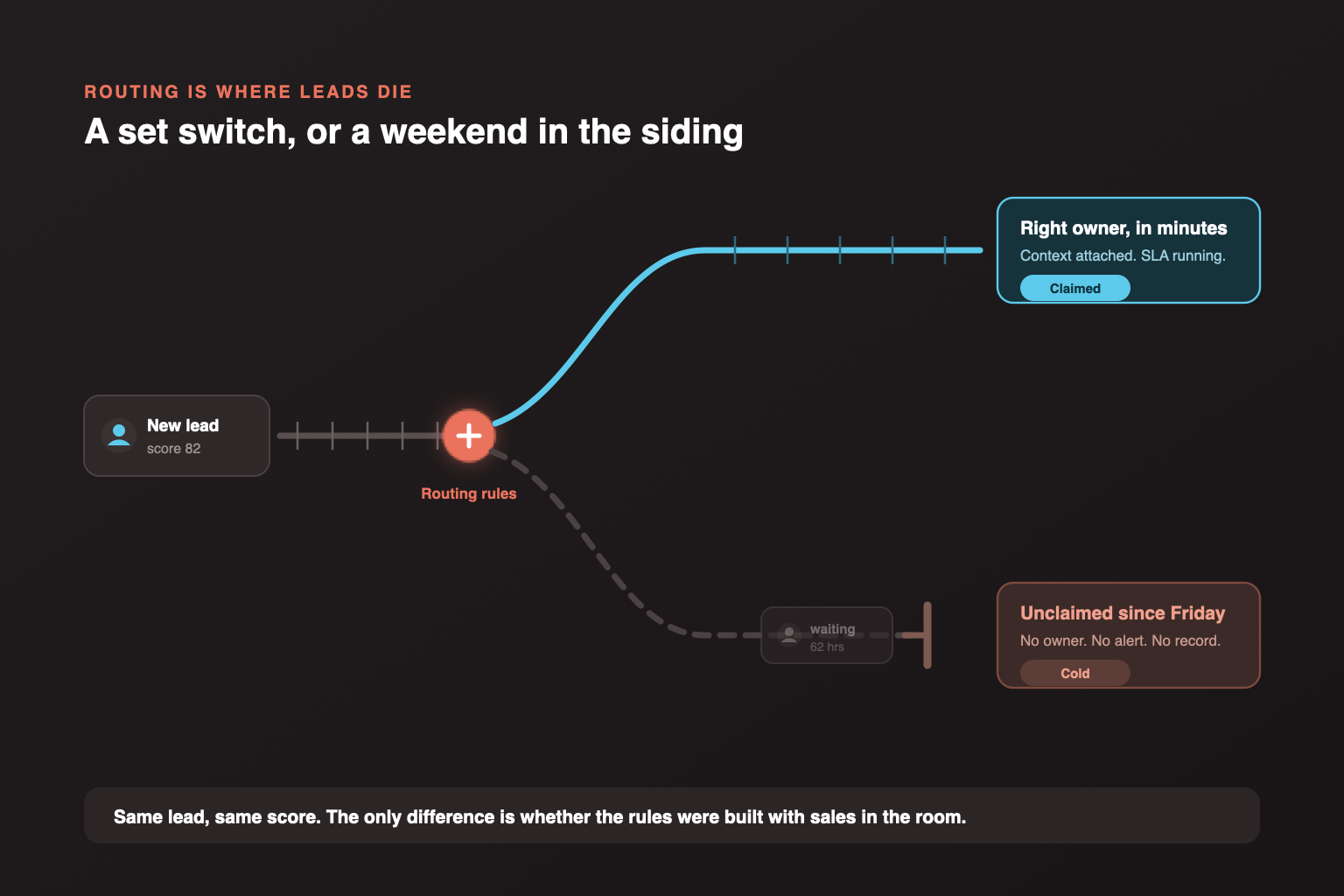
Lead scoring and routing. Scoring models translate behaviour and firmographic fit into a number sales will actually trust, which requires building them with sales rather than presenting them to sales. Thresholds, decay rules, and disqualification criteria are defined explicitly. Routing sends records to the right owner with context attached and service level expectations agreed, so a hot lead does not sit unclaimed over a weekend. Models get reviewed against closed won data, because a score nobody recalibrates drifts into fiction within two quarters.
Systems integration. The value shows up when the automation platform, CRM, product, storefront, support desk, and analytics all agree about who a customer is and what they did. Integration work spans HubSpot, Salesforce, Zoho, and the customer engagement platforms alongside Shopify, WooCommerce, and custom applications. Where a native connector exists and is adequate, we use it. Where it is not, our development team builds against the API directly, including the sync logic and error handling that off the shelf connectors typically leave out.
Data quality and database health. Automation applied to a poor database industrialises the damage, sending the wrong message to the wrong person faster than any human could. This work covers deduplication rules that run continuously rather than as a one off cleanup, validation on the fields journeys depend on, decay handling for contacts who have gone quiet, and suppression logic that holds across every channel at once. Database health gets reported alongside performance, since list size flatters a dashboard while engaged contacts pay the bills.
Reporting and attribution setup. Automation generates enormous amounts of activity data and comparatively little clarity unless reporting is designed deliberately. Dashboards get built around journey level contribution, stage conversion and velocity, list health, and pipeline influenced rather than emails delivered. Attribution is configured with its limitations stated plainly, because a model presented as more certain than it is will eventually be used to justify a bad decision. Reviews focus on which journeys to fix, expand, or switch off.
The Difference
Routing Is Where Leads Die
The journey can be well written and the scoring model sound, and the programme still fails at the handoff. A lead arrives on Friday evening, the rule sends it to a queue nobody owns, and by Monday the buying moment has passed. Routing built with sales in the room, with context attached and a response time everyone agreed to, is unglamorous work that decides whether the rest of the system was worth building.
Our Process
How We Implement Marketing Automation
A disciplined sequence, adapted to your competitive landscape. Open each step.
01Discovery and systems audit
02Requirements and platform decision
03Data model and integration build
04Journey and scoring configuration
05Testing and controlled launch
06Enablement and handover
07Optimisation and expansion
08Ongoing governance
Why Unified Platforms
Why Teams Bring Us In
The working habits behind every engagement.
Architecture before automation
Journeys built on a shaky data model fail in ways that are difficult to diagnose and embarrassing in front of customers. The data model, events, and integrations get built first, every time. That makes early progress look slower than agencies who demo a welcome series in week one, and it is the reason the programme is still working in month eighteen.
Platform agnostic advice
We hold no reseller margin that depends on recommending a particular platform, so the recommendation can be to keep what you have and configure it properly. That is frequently the honest answer and rarely the profitable one. Where a migration is genuinely justified, the case includes the disruption and cost rather than only the upside.
Engineers on the integration work
Most automation projects stall at the integration nobody could build, which is why so many end up running on manual list uploads. Our development team handles the connections that native connectors do not cover, including sync logic, error handling, and the awkward legacy systems that off the shelf tooling ignores. The same team builds the AI applications and web platforms behind our other work.
Built for your team to own
Documentation, naming conventions, training, and admin access sit with you from the start. Agencies that make themselves structurally difficult to replace produce systems that decay the moment the relationship ends, and we would rather be kept because the work is good. Everything we build is designed to be handed over cleanly, whether or not that ever happens.
Connected to channel execution
Automation only matters if the messages moving through it are worth receiving. Because we also run email, WhatsApp, paid, and content programmes, the journey design and the messaging get planned together rather than thrown over a wall. Where you run channels with other partners, we build to that boundary and document the interface clearly.
Honest about what automation cannot fix
Automation multiplies whatever process you already have, including a broken one. If the underlying problem is an unclear offer, a sales team without capacity, or a product that churns for reasons no email will address, we say so during discovery rather than after implementation. That conversation costs us projects occasionally and saves clients considerably more.
Industries
Industries We Work With
Deep experience across the sectors we serve, with strategy tailored to each.
Worth a Look at Your Stack?
Talk to a senior strategist about what your current stack could do properly before anyone suggests replacing it.
Questions
Frequently Asked Questions
Straight answers before you ever get on a call.
Scope and approach
What do marketing automation services include?
Do we need to replace our current platform?
How is this different from your email marketing services?
Platforms and integration
Which platforms do you work with?
Can you integrate with our existing systems?
What happens to our existing data?
Timeline and cost
How long does implementation take?
What does it cost to run?
When should we expect results?
When it goes wrong
Why do so many marketing automation projects underdeliver?
We bought a platform and barely use it. What now?
Our sales team ignores the leads automation sends them. Why?
Measurement and governance
How do you measure whether automation is working?
How do you stop the system decaying over time?
How does automation handle consent and privacy obligations?
Working with us
Who owns the system afterwards?
Can you work with our in-house marketing team?
What if our processes are not ready for automation?
Start With What You Already Own
Good automation is unglamorous. It is a sound data model, events that fire when they should, journeys that handle the awkward cases, and reporting that tells the truth about what contributed. Tell us what you are running today and we will show you what it could do properly before anyone suggests replacing it.
Explore more