 Skip to content

Why Answer Engine Optimization Matters for Every Business
Why answer engine optimization matters: buyers now get answers from AI that name only a few brands, so AEO is a business priority, not a niche SEO tactic.
Quick Answer
AEO matters for every business because buyers increasingly get answers, and recommendations, from AI engines before visiting any website. Being cited in those answers shapes consideration early, so absence from them is a growing competitive risk. For software specifically, see AEO for SaaS.
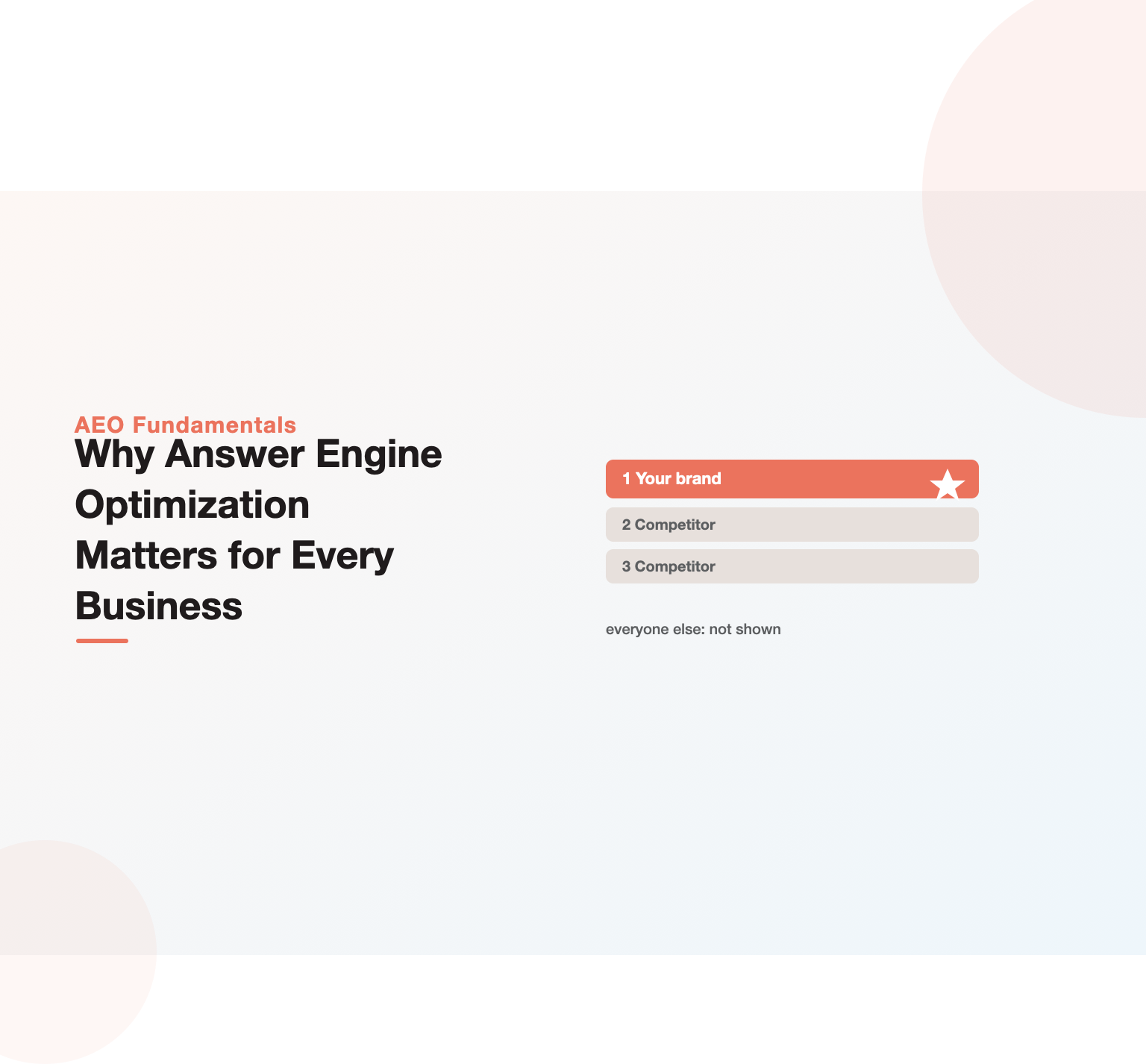
Answer engine optimization matters because buyers increasingly get their answers from AI engines that name only a handful of brands, and if yours is not among them you are invisible at the exact moment a decision is forming. This is not a niche SEO tactic for tech companies; it is a shift in how people discover and shortlist every kind of product and service. This guide explains why AEO has become a business priority, what it costs to ignore it, and why acting early compounds in your favour.
Key Highlights
- AI engines name only a handful of brands in an answer, if yours is not one, you are invisible.
- That invisibility hits at the exact moment a buying decision is forming.
- It matters for every industry, not just tech, because buyers everywhere now ask AI first.
- First-mover advantage compounds, early cited brands become the defaults engines keep returning.
- Waiting is the real risk; being cited builds authority competitors then have to displace.
Why answer engine optimization matters now
Answer engine optimization matters because the front door to discovery has moved. For twenty years, being found meant ranking on a results page full of links, and the buyer chose which to trust. Today a growing share of questions are answered directly by an AI engine that reads the web, decides which sources are credible, and returns a single answer naming a few brands. The buyer often acts on that answer without ever seeing a results page. If your brand is one of the names, you are in the conversation. If it is not, you were never considered, no matter how strong your website or your rankings.
That is the heart of why AEO matters: it decides whether you exist at the moment of decision. Every other marketing investment assumes the buyer can find you. When an AI mediates discovery, being findable now means being citable, and citability does not happen by accident. It is earned by the deliberate work of answer engine optimization. Our pillar guide on answer engine optimization covers the how; this piece is about the why, and why it applies to you specifically.
How buyers decide now that answer engines give AI answers
Watch how a purchase decision forms today and the change is obvious. Instead of typing a keyword and opening several tabs, a buyer asks a full question, in their own words, and reads a synthesised answer. They ask which tool suits a team their size, which provider is best for their city, or how two options compare, and the engine hands back a short, opinionated summary that names a few contenders. That summary becomes the shortlist. The buyer might then research those named brands more deeply, but the field has already been narrowed for them, by a machine, before your marketing ever got a chance to speak. That journey is exactly why answer engine optimization matters for buyers and sellers alike.
This compresses the old funnel. Awareness, consideration, and shortlisting used to be separate stages where you could intervene with content, ads, and search presence. Now they can collapse into a single answer. The brands named in that answer skip to the shortlist; everyone else is filtered out silently. Understanding this is the first step in seeing why answer engine optimization matters so much more than it did even a year ago.
There is a second-order effect worth naming. When the shortlist is handed to the buyer pre-made, the questions they ask next are shaped by it too. They dig into the named options, compare those against each other, and frame their requirements around what the answer told them. A brand that was left out of the first answer is not just missing one impression; it is missing from the entire chain of research that follows, because the buyer never had a reason to add it. Winning the answer is therefore less about a single moment and more about being admitted into the whole consideration set that grows from it.
The real cost of being left out
The danger of the new model is that being left out is invisible to you. When you lose a ranking, you can see it in your analytics. When an answer engine simply never names you, there is no impression, no click, and no obvious signal that you were considered and skipped. You just quietly stop appearing in the conversations that lead to purchases, and you attribute the slow decline to the market rather than to your absence from the answer.
This is compounded by zero-click behaviour, where the buyer gets what they need from the answer itself and never visits anyone’s site. In that world, traffic is no longer the only prize; influence is. Being the cited source shapes the decision even when nobody clicks. A business that measures only sessions will miss this entirely, which is why zero-click search and the rise of AI Overviews are central to the case for AEO.
Why answer engine optimization matters for every business
It is tempting to assume this only affects software or online businesses, but the behaviour is spreading across categories. People ask AI assistants for local service recommendations, for the best clinic or school in their area, for which financial or legal option fits their situation, for travel choices, and for product comparisons of every kind. Anywhere buyers ask questions before they buy, and that is nearly everywhere, answer engines are inserting themselves into the decision.
The industries that feel it first are those with high-consideration purchases and lots of research: software, professional services, finance, healthcare, education, travel, and considered retail. But the direction of travel is universal. A local business that is not the recommended option when someone asks an assistant for the best provider nearby is losing exactly the customers who were ready to act. The specifics differ by sector; the underlying reason answer engine optimization matters does not. Across industries, the reasons why answer engine optimization matters are remarkably similar.
How this plays out across industries
The pattern is easier to feel through concrete examples. A few illustrate how broadly answer engine optimization matters:
- Software: a founder asks an assistant which tools fit a 20-person team. The three named products get evaluated; the rest are never opened. Being cited here is the difference between a trial and total absence.
- Local services: a homeowner asks for the best provider in their city. The assistant names a couple of firms with a line on each. The uncited local competitor, however good, is simply not in the conversation.
- Healthcare and education: a parent or patient asks which clinic, course, or institution suits their situation. These are high-trust decisions where being the source an AI vouches for carries unusual weight.
- Considered retail and ecommerce: a shopper asks for the best option in a category for their needs and budget. The named products enter the basket of consideration; the others do not.
In every case the mechanic is identical: the engine narrows the field to a few names, and being one of them is worth more than any amount of effort spent on channels the buyer now skips. The category changes; the reason answer engine optimization matters does not.
Is your brand missing from ChatGPT, Gemini and Perplexity answers?
Our team reviews your current setup and shows you where the opportunities are. See how our AEO services work.
The first-mover advantage compounds
AEO rewards acting early in a way that classic channels often do not, because citations compound. When an engine learns to trust you on a topic, it tends to keep citing you, and each question you win makes related questions easier to win. Early movers accumulate this trust while competitors are still debating whether AI search is real. By the time the laggards start, they are trying to displace an established default answer rather than competing on a level field.
This is the opposite of a channel you can flip on at the last minute. Paid ads work the moment you fund them, but authority with answer engines is earned over months and cannot be bought overnight. That makes early investment unusually valuable here: the position you build now becomes a moat later, and the cost of waiting is not just lost time but a harder, more expensive climb once your category is crowded with established citations. Building topical authority early is the durable play.
What it means for your marketing mix
None of this means abandoning what works. It means rebalancing. The clean, authoritative, well-structured content that earns citations also strengthens your classic search presence and gives your sales and social efforts better material to point to. AEO is not a separate silo competing for budget; it is an upgrade to the content and authority foundation that most of your marketing already depends on. Money spent making your best answers citable tends to pay off across several channels at once.
The practical question for a marketing leader is not whether to do AEO, but how much of the existing content and SEO investment to redirect toward citability. For most businesses whose buyers have started using AI assistants, the honest answer is more than they are spending today. The reallocation does not have to be dramatic to matter; even making your highest-intent pages answer-first and properly attributed moves the needle, and it complements rather than replaces your existing SEO work.
A useful way to frame the budget conversation is to ask where your next marginal content pound or dollar earns the most. If it goes into another page that ranks but is never cited, you are investing in a channel your buyers increasingly bypass. If it goes into making your best answers citable, you are buying presence in the surface that is capturing those buyers. Framed that way, the reallocation is not a cost centre but a shift toward where attention has already moved.
Why answer engine optimization matters: the risk of waiting
The strongest argument for treating AEO as a priority is the asymmetry of the risk. If you invest and the shift continues, you built a durable advantage. If you invest and the shift somehow stalls, you still improved your content clarity, authority, and search presence, so the work was not wasted. But if you wait and the shift continues, which every indication says it will, you fall behind on a moat that is expensive to reclaim. The downside of acting is small and the downside of waiting is large, which is exactly the situation where moving early is the rational choice.
Consider the two-year view. A competitor who starts making their answers citable today will, over the coming quarters, accumulate citations on the questions that matter in your category, and each one teaches the engines to reach for them by default. If you begin two years from now, you are not starting level; you are trying to unseat a source the engines have already learned to trust, on question after question, which takes far more effort than being early would have. The gap between acting and waiting does not stay constant; it widens on its own. That is the real reason urgency is warranted, and why treating this as a someday project quietly cedes ground you will later pay a premium to win back.
What being cited actually does for your brand
It is worth being concrete about the payoff, because it differs from ordinary traffic. When an AI engine names you as the source of an answer, you receive a form of third-party endorsement at the precise moment a decision is forming. The buyer did not click an ad or scroll to your listing; a tool they trust told them you are a credible answer. That carries a weight paid placement cannot buy, and it arrives earlier in the journey than most of your marketing can reach.
The downstream effects follow naturally. Branded searches tend to rise as people who saw you cited look you up by name. The enquiries that do arrive are better qualified, because they come pre-informed by the answer that mentioned you. And because being cited builds model familiarity, each citation makes the next one easier, turning a single win into a compounding position. This is why the brands investing in topical authority now are quietly building an advantage that will be hard to reverse.
Common objections, and why they do not hold
Three objections come up whenever AEO is raised, and each deserves a straight answer:
- My customers do not use AI to research. Some do not yet, but the trend is one direction, and by the time it is undeniable the early movers will already hold the citations. The safe assumption is that adoption in your category is higher than you think and rising.
- AI answers are not accurate, so this will blow over. Accuracy is improving fast, and engines respond to exactly the trust signals AEO builds. Rather than a reason to wait, imperfect answers are a reason to make sure the accurate, well-sourced version an engine cites is yours.
- It is too early to invest. Because authority compounds over months, early is precisely when the return is highest. Waiting until the shift is obvious means competing against established default answers rather than open space.
Underneath all three objections is a hope that the change is temporary. Every indication, from the spread of AI Overviews to the AEO statistics for 2026, points the other way. Planning as though it is permanent is the lower-risk bet.
How to start treating AEO as a priority
Making AEO a priority does not require a big-bang project. Start by seeing your own gap: ask the questions your best customers ask before buying, in ChatGPT, Perplexity, and Google, and note whether you are named. That single exercise usually turns an abstract worry into an urgent, concrete list. Then make your highest-intent pages answer-first, properly attributed, and well structured, and track whether citations follow. Our AI citation readiness audit and the complete AEO checklist give you the steps.
We help businesses become the answer AI engines cite, across ChatGPT, Google AI Overviews, Perplexity, and Gemini. If being left out would cost you real revenue, let us map your gap and close it.
Why answer engine optimization matters for small and local businesses
It is easy to assume AI visibility only matters for large brands. In practice, small and local businesses may have more to gain, because AI answers often recommend specific providers when people ask questions such as “who is a good family dentist near me” or “what should a boiler service cost”.
These answers draw on the same signals that drive local search: the Google Business Profile, reviews, consistent business information across directories and clear service pages. A small business that keeps those basics in order can appear alongside much larger competitors. One that neglects them may be described inaccurately or not mentioned at all. Google’s guidance on local ranking remains the foundation for this work.
Franchise and multi-location businesses face an extra challenge. Each location needs its own accurate profile and page, and the brand description must stay consistent across all of them. When location details conflict, AI systems may merge or confuse branches, sending customers to the wrong place or omitting locations entirely.
Why businesses fail at answer engine optimization
Most failures follow a few predictable patterns. The first is treating AEO as a one-off project: a burst of FAQ pages and schema, then nothing. AI engines reward consistent, current information, and a program that stops tends to lose ground within months.
The second is focusing only on the website. Engines cross-check what a brand says about itself against reviews, directories, forums and news. A business with a polished website but a neglected reputation elsewhere struggles to be recommended.
The third is writing for keywords rather than questions. Pages built around a phrase but never answering a specific question give engines nothing to extract. Pages that start with a clear answer and support it with facts are far more likely to be quoted.
The fourth is not measuring. Without a fixed list of questions checked regularly across engines, teams cannot see whether anything is working, and the effort is cut at the first budget review.
How answer engines change the role of SEO
Search engine optimization remains the foundation. Engines that search the live web lean heavily on pages that already rank well, and technical health, relevance and links still matter. What changes is the definition of success. A page can now deliver value by being cited in an answer even when nobody clicks, and a brand can win consideration through repeated mentions across AI tools before a buyer ever visits its site.
That shift means SEO teams need new habits: writing answer-first, keeping entity information consistent, earning mentions as well as links, and tracking citations alongside rankings. Teams that make these changes do not abandon SEO; they extend it to cover how people search today.
Want AI answer engines to cite your brand?
Book a free 30-minute strategy call and leave with a clear next step for your business.
What leadership should ask about AI visibility
Executives do not need the technical details, but they should ask a few questions each quarter. When buyers ask AI assistants about our category, are we named? How does that compare with our main competitors? Which questions do competitors own that we should? Are AI tools describing our products and prices accurately? Are we seeing leads that mention finding us through AI assistants?
Clear answers to those questions show whether the company is visible where buying decisions now begin. If nobody in the business can answer them, that is the clearest sign of why answer engine optimization matters for your organization and why it deserves an owner and a budget.
A first step you can take this week
Write down the ten questions your best customers asked before they bought from you. Ask those questions in ChatGPT, Perplexity, Gemini and Google. Note who is named in each answer and whether your business appears. Then pick the three questions where a competitor is named and you are not, and compare their page with yours. The difference, whether it is a clearer answer, better reviews or more specific information, is your first improvement. Repeat the exercise monthly and the gaps will close one by one. If you would like expert support, our AEO services team can help you build the program.
Industry examples of the shift
Healthcare: patients ask AI assistants about symptoms, treatment options and costs before choosing a clinic. Clinics that publish clear, medically reviewed answers, and keep provider profiles accurate, are more likely to be named when patients ask for recommendations.
Financial services: people ask about fees, eligibility and comparisons between products. Firms that state these facts plainly, with current figures, are easier for engines to cite accurately, while vague marketing copy leaves room for outdated or wrong descriptions.
Education: prospective students ask which courses lead to which careers, how long programs take and what they cost. Institutions with structured, up-to-date program pages appear more often in those answers.
Home services: homeowners ask what a repair should cost and how to choose a contractor. Businesses with transparent price ranges, strong reviews and clear service-area information are more likely to be recommended.
Software: buyers ask for the best tool for a specific job and for comparisons between named products. Vendors with honest comparison pages, detailed documentation and a strong presence on review platforms dominate those answers.
Across every one of these sectors, the pattern is the same, and it is the clearest illustration of why answer engine optimization matters: the businesses that answer buyer questions clearly and keep their information consistent are the ones AI tools recommend.
The cost of doing nothing
Inaction has a price even if it does not show up on a dashboard. Every month that competitors are cited and you are not, they build familiarity with buyers who never reach your website. AI systems also tend to reinforce sources they already trust, so the gap can widen over time. Starting now, even with small steps, is far cheaper than trying to displace established competitors later.
Making the case internally
If you need approval to start, keep the proposal small and measurable. Ask for a quarter to improve the ten pages that matter most, fix business information across the main directories and track a fixed list of buyer questions each month. Set a clear success measure, such as being cited for a target share of those questions by the end of the quarter, and agree to review the results before asking for more.
A short, evidence-based pilot is much easier to approve than a large program, and the results usually make the next conversation straightforward. Share the before and after answers from the AI engines with leadership, because seeing competitors named in place of your company tends to be the most persuasive argument of all.
Once the pilot shows results, expand it gradually: more questions, more pages and more markets. Steady expansion, backed by monthly evidence, builds a program that lasts far longer than one launched with a big budget and no proof. It also gives the team time to learn what works in your specific market, which is knowledge competitors cannot easily copy and one more reason the investment pays off over time.
Above all, keep the effort consistent. The businesses that benefit most are not those that start with the biggest budget, but those that keep answering buyer questions clearly, month after month, until AI tools recognise them as a reliable source in their market and recommend them by name.
Start with the questions your customers already ask, answer them better than anyone else, and keep your business information accurate everywhere it appears online. Those three habits are simple, inexpensive and within reach of every organisation, whatever its size or sector, and they form the base on which every other improvement is built.
Key Takeaways
- Recognise that buyers now research via AI answers first.
- Ensure you are cited where your category is discussed.
- Build the authority and content that earn those citations.
- Treat AI visibility as a demand channel, not a curiosity.
Frequently asked questions
Why does answer engine optimization matter for my business?
Because buyers increasingly get answers from AI engines that name only a few brands. If yours is not among them, you are invisible at the moment a decision is forming, regardless of how well you rank in classic search.
Is AEO only relevant for tech or online businesses?
No. People now ask AI assistants for local services, professional advice, healthcare and education options, travel, and product comparisons. Any business whose buyers ask questions before buying is affected.
What does it cost to ignore AEO?
The cost is invisible and therefore dangerous: you simply stop appearing in AI answers that lead to purchases, with no click or impression to warn you. Over time that erodes pipeline while you attribute the decline elsewhere.
Why is acting early important?
Citations compound. Once an engine trusts you on a topic it keeps citing you, so early movers build a moat while competitors wait. Latecomers must displace an established default answer, which is much harder.
Does AEO replace my existing marketing?
No, it upgrades the foundation. The content clarity and authority that earn citations also strengthen SEO and give sales and social better material, so the investment pays off across channels rather than competing with them.
How do I know if my business is already affected?
Ask the questions your buyers ask before purchasing in the major AI engines and see whether you are named. If competitors appear and you do not, the shift is already costing you, and you have found your starting point.
Ready to put this into practice?
Talk to the team that runs SEO, AI search and paid growth programs every day.
Book a Strategy Call →