 Skip to content


How to Build Topical Authority for AI Citations
How to build topical authority for AI citations: choose a topic territory, map the full question space, build an interlinked content cluster, and add entity signals.
Quick Answer
Topical authority is built by covering a well-defined subject deeply and credibly, so engines come to treat you as a default source on it. For AI citations it is often the deciding signal, because engines cite sources they have learned to trust on a topic.
You build topical authority for AI citations by choosing a focused topic you can genuinely own, covering the full set of questions buyers ask about it, interlinking that content into one coherent cluster, and backing it with consistent entity information and real expertise. Answer engines cite the sources they recognise as specialists on a subject, and specialism is demonstrated by depth and breadth of trustworthy coverage, not by a single strong page. This guide is the step-by-step method: how to pick your territory, map the question space, build the cluster, connect it, and earn the external signals that turn coverage into the kind of authority an engine reaches for, along with how long it realistically takes and how to know it is genuinely working over time.
Key Highlights
- Choose a focused topic territory you can genuinely own, not everything at once.
- Map the full space of questions buyers ask about it.
- Build a content cluster that covers that space and interlink it into one authority.
- Add consistent entity and E-E-A-T signals so engines recognise and trust you.
- Earn external corroboration; topical authority compounds over months, it is not instant.
How to build topical authority for AI citations: what it means
Topical authority is the recognition an answer engine gives a source that has demonstrably deep, trustworthy coverage of a subject. Where a single page can win a single question, topical authority is what makes an engine reach for you across many related questions, because it has learned that you are a reliable specialist on the whole area rather than a one-hit source. In practice it is built from the pattern of your content: the range of questions you answer well, how those answers connect, and whether the coverage is consistent and credible enough that an engine treats your brand as an authority on the topic.
This matters because answer engines are conservative about who they quote. Faced with a question, an engine prefers a source it already associates with the subject, since that association lowers the risk of citing something wrong. A brand with genuine topical authority is that lower-risk choice, so it gets cited more often and across more of the topic. Building topical authority is therefore one of the most durable investments in answer engine optimization, and it is the core of the Authority pillar described in the ASE framework.
It also helps to be clear about what this guide is and is not. Learning how to build topical authority for AI citations is not about chasing a single keyword or gaming a metric; it is about becoming, and being recognised as, a genuine specialist on a subject your buyers care about. Everything that follows serves that one goal. The steps are concrete and repeatable, but the underlying move is simple: pick a topic you can honestly own, cover it better than anyone else your buyers would find, and make that coverage legible and credible to the engines doing the citing.
Why topical authority matters more for AEO than for SEO
Topical authority has always helped in classic search, but it matters even more for answer engines, and the reason is how the two surfaces work. Search returns a list, so a single strong page can rank and win a click even if the rest of your site is thin. Answer engines synthesise a response and cite the sources they trust most, and that trust is built at the level of the brand and the topic, not just the page. A lone great page from an otherwise unknown source is a weaker bet for an engine than a comparable page from a recognised specialist, so depth around the page changes whether the page itself gets cited.
There is also the compounding effect. Once an engine associates you with a topic, each question you win reinforces the association and makes the next one easier, so authority builds on itself. That is why brands that commit to owning a focused subject pull ahead over time while those that publish scattered one-off pieces stay invisible. In answer engine optimization, breadth and depth on a defined topic is not a nice-to-have; it is often the difference between being cited and being overlooked, which is why how engines choose what to cite keeps coming back to recognition.
How to build topical authority for AI citations, step 1: choose a territory
The first step is the one most brands get wrong: they choose a territory far too broad to own. You cannot become the recognised authority on marketing, but you might become the recognised authority on answer engine optimization for B2B software, or on Shopify conversion, or on a specific industry’s SEO. The narrower and more specific your territory, the faster you can cover it completely and the sooner an engine sees you as a specialist. Pick a territory where you have genuine expertise, where your buyers actually have questions, and where you can realistically produce deep, credible coverage.
Choosing narrow feels counter-intuitive because it seems to limit your reach, but the opposite is true for AEO. A brand that owns a small territory completely gets cited across all of it, while a brand that spreads thinly across a huge territory is cited nowhere because it is a specialist in nothing. You can always expand into adjacent territories once you own the first, and expansion from a position of authority is far easier than starting broad. Define the territory precisely before you write a single piece, because everything after depends on it.
Step 2: Map the full question space
Once you have a territory, map every question a buyer might ask within it. Start from the real questions people put to an assistant, in their words, and expand outward: the definitional questions, the how-to questions, the comparison questions, the questions about problems and mistakes, and the questions that come up just before a purchase. The goal is a complete map of the topic as your audience experiences it, not a keyword list, because answer engines are answering questions and you want to have the best answer to every one that matters.
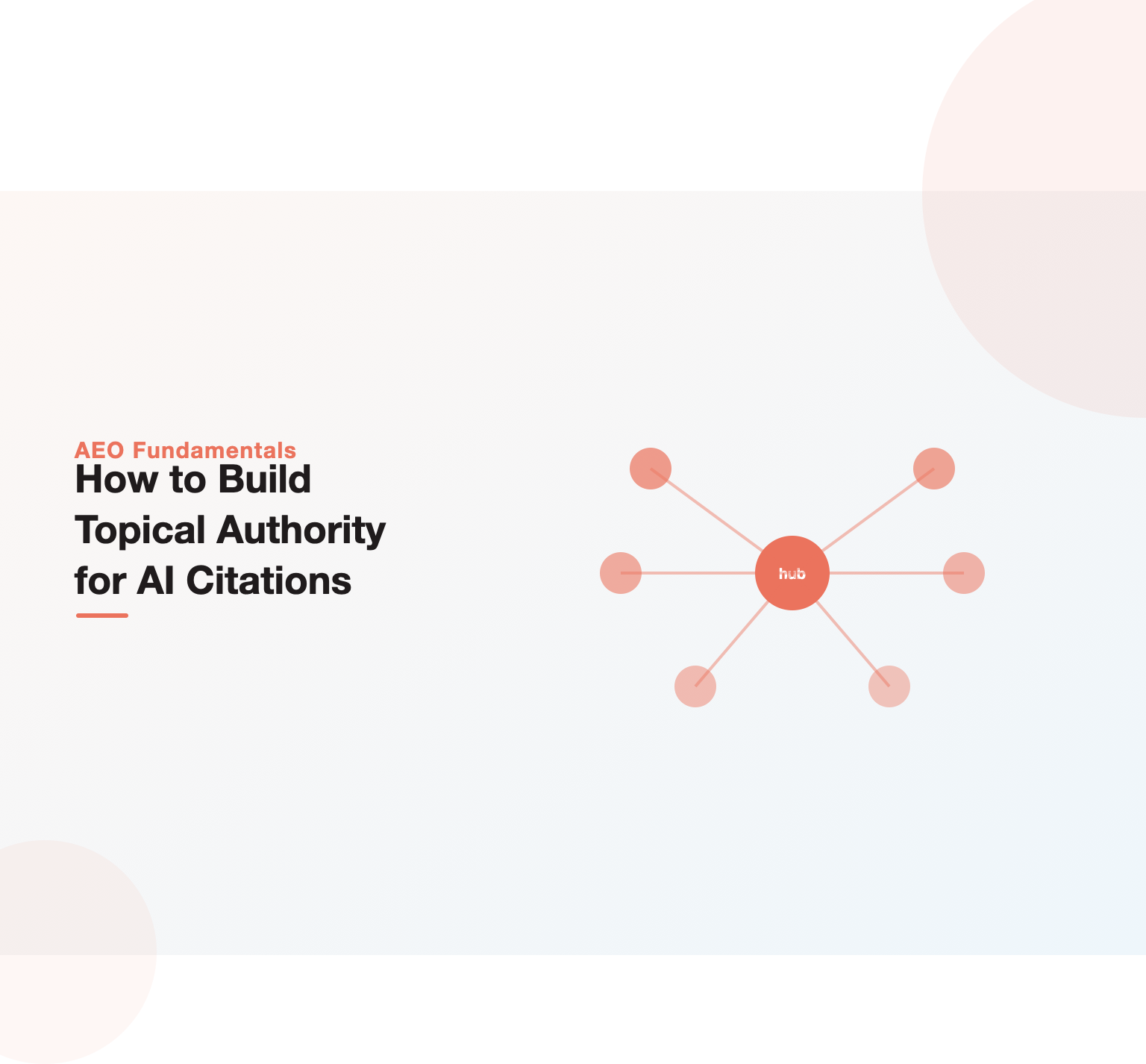
This map becomes your content plan. Group the questions into themes, identify the big anchor questions that deserve comprehensive pillar pages, and note the many specific questions that become supporting pieces. The completeness of this map is what will eventually signal authority: when an engine sees that you have thoughtfully answered not just the obvious question but the whole surrounding space, it reads you as a source that genuinely knows the subject. A hub-and-spoke content architecture, one broad pillar surrounded by focused supporting pieces, is the natural shape this map takes.
Step 3: Build the content cluster
Now build the cluster the map describes. Create a comprehensive pillar page for each major anchor question, and supporting pieces for the specific questions around it, each one genuinely answering its question rather than padding a keyword. Quality per piece still matters enormously; topical authority is built from many good answers, not many thin ones, and a cluster of weak pages signals the opposite of authority. Every piece should lead with its answer, carry the right structure, and be something you would be happy to have cited as representing your brand’s expertise.
Prioritise by intent and impact rather than trying to publish everything at once. Cover the questions closest to a buying decision first, then work outward to the broader informational questions that build recognition. Consistency over time matters more than a single burst: a steady cadence of strong pieces signals an active, maintained authority, whereas a one-time dump that then goes stale signals the opposite. Think of the cluster as something you grow and tend, not a project you finish.
Is your brand missing from ChatGPT, Gemini and Perplexity answers?
Our team reviews your current setup and shows you where the opportunities are. See how our AEO services work.
Step 4: Interlink the cluster into one authority
A pile of related pages is not yet topical authority; the connections between them are what make an engine read the collection as one coherent body of expertise. Link every supporting piece up to its pillar, link the pillar down to its supporting pieces, and link siblings across to each other where the connection is genuinely useful to a reader. This internal linking does two things: it helps engines and readers navigate the topic as a connected whole, and it signals which page is the authoritative anchor for each theme, concentrating authority where you want it.
The links should be contextual and natural, placed where the connection actually helps, not stuffed in for their own sake. A reader on a specific how-to piece should be able to step up to the broad pillar for context, or across to a related question, because that is how someone genuinely exploring the topic moves. When the interlinking mirrors how a curious person would traverse the subject, it reads as authority to both humans and engines. This is the same hub-and-spoke logic answer engine optimization programs use at the site level, applied within your chosen territory.
In practice, step 5: Add the entity and E-E-A-T signals
Coverage earns authority only if the engine also trusts the source behind it, so the cluster must be backed by strong entity and E-E-A-T signals. Make your brand information consistent everywhere it appears so the engine can resolve you to one confident identity. Publish under real, named experts with visible credentials, because expertise attached to a person the engine can verify carries far more weight than anonymous content. Ensure your claims are accurate and, where possible, corroborated by other credible sources, so the engine sees your coverage as reliable rather than merely voluminous.
These signals are what separate genuine topical authority from content-farm volume. An engine can tell the difference between a brand that has deeply and credibly covered a topic and one that has mass-produced shallow pages, and the entity and expertise signals are a large part of how it tells. Our guides to E-E-A-T and model familiarity go deep on building the credibility that makes your coverage count, and knowledge graphs explains how engines verify who you are.
In many cases, step 6: Earn external corroboration
The final step reaches beyond your own site. Topical authority is strongest when other credible sources corroborate that you are a specialist, so earning mentions, references and citations from reputable places in your field materially strengthens the picture an engine builds of you. This is not link-building for its own sake; it is about being genuinely referenced as an authority, which happens when your content is good enough and visible enough that others in the space point to it. Original data, research and genuinely useful resources are the surest way to earn this kind of corroboration.
External corroboration closes the loop: your deep, well-structured, expert-backed coverage becomes something others cite, which in turn tells engines you are the authority, which makes them cite you more. That virtuous cycle is the destination of a topical authority program, and it is why the work compounds. It takes time and genuine quality to start, but once it turns over, it becomes a durable advantage a competitor cannot quickly replicate.
A practical way to prime this cycle is to create something genuinely worth referencing: an original study, a useful framework, a data set, or a definitive guide that others in your field have a reason to point to. Passive coverage rarely earns corroboration; a standout asset does. You do not need many of these, but one or two genuinely citable resources within your territory can seed the external recognition that the rest of your cluster then benefits from.
How to build topical authority for AI citations: timing and measurement
Topical authority is a months-long build, not a quick win, and it is important to set that expectation. Structural improvements to individual pages can influence citations within weeks, but the recognition that comes from comprehensive coverage and external corroboration accumulates over a longer horizon. The upside of that patience is durability: authority earned slowly is hard for a competitor to erode, whereas a quick trick is quickly copied. Treat the program as an ongoing commitment to owning your topic rather than a campaign with an end date.
Measure progress with a few honest indicators. Track your citation rate and share of answer across the questions in your territory, and watch whether both broaden over time as the cluster grows. Notice whether engines describe your brand as associated with the topic when asked. And watch for the external mentions that signal others now see you as an authority. Our AI citation readiness audit and the complete AEO checklist help you turn these into a routine you can run.
Common topical authority mistakes to avoid
A few mistakes repeatedly stall topical authority programs:
- Choosing too broad a territory, so coverage is always thin and specialism never lands.
- Publishing volume over quality, which signals a content farm, not authority, and can actively damage trust.
- Skipping the interlinking, leaving a pile of pages that never read as one coherent body of expertise.
- Ignoring the entity and expertise signals, so even deep coverage is not trusted.
- Treating it as a one-time project, then letting the cluster go stale.
Avoid these and the method is straightforward, if patient: own a focused topic, answer its full question space well, connect the answers, back them with real expertise, and earn corroboration. Done consistently, that is how a brand becomes the source an answer engine reaches for across a whole subject, which is exactly what the pillar guide on answer engine optimization is built to help you achieve.
We build topical authority programs that make your brand the specialist answer engines cite across a whole subject, from cluster strategy to the entity and E-E-A-T signals that earn trust. For page-level tactics, see our guide to LLM content optimization.
A worked example: building topical authority in one quarter
Consider a company that sells employee scheduling software for restaurants. Its blog covered many loosely related topics, and AI engines never cited it. Here is how it focused its effort over one quarter.
First, it chose a territory it could realistically own: restaurant staff scheduling. It was narrower than “workforce management” but large enough to matter to buyers.
Second, it mapped the question space. Sales calls, support tickets and search data produced about 70 questions, grouped into six themes: building schedules, labour cost control, legal requirements, shift swaps and availability, tools and software, and managing staff turnover.
Third, it published a pillar guide on restaurant staff scheduling and six supporting articles, one per theme, each answering the most important questions in its group directly. Each article linked to the pillar and to two related articles.
Fourth, it added evidence: anonymised data from its own customers on average labour cost percentages and scheduling time saved, and expert input from restaurant managers.
Fifth, it earned corroboration by sharing the data with hospitality trade publications and contributing to industry newsletters.
By the end of the quarter, Perplexity and Google AI Overviews were citing several of the articles for specific scheduling questions, and the company’s name began appearing in ChatGPT answers about restaurant scheduling tools.
How to map the question space in practice
Start with your own data. Export queries from Search Console, collect questions from sales and support, and review site search logs. Add People Also Ask results for your core terms, related searches at the bottom of results pages, and questions from forums and communities where your buyers discuss the topic.
Put everything in one spreadsheet and group questions by the underlying need. Some groups will deserve a full article; others can be answered as sections within a broader page. Mark which questions you already answer well, which you answer poorly and which you do not answer at all. That gap analysis becomes your publishing plan. Our guide on how to do keyword research covers the tools and methods in more detail.
Internal linking patterns that signal authority
The way pages connect tells engines how your knowledge fits together. The pillar page should link to every supporting article, using descriptive anchor text that names the subtopic. Each supporting article should link back to the pillar and to the most closely related articles in the cluster. Commercial pages, such as product or service pages, should receive links from the articles that discuss the problems they solve.
Avoid linking every page to every other page; that dilutes the signal. Focus on links that would genuinely help a reader move to the next relevant question. Review the links each quarter as new pages are added.
Want AI answer engines to cite your brand?
Book a free 30-minute strategy call and leave with a clear next step for your business.
Signals of topical authority beyond your site
Engines are more confident citing a source when others treat it as an expert. Look for opportunities to be referenced in the topic, not just anywhere. Contribute expert commentary to trade publications, speak on industry podcasts, share original data with journalists, take part in professional associations and answer questions in communities your buyers use. Each mention connects your brand with the topic in sources that engines and readers trust.
Author credentials matter too. Make sure each article is attributed to a real person with relevant experience, and that their author page lists their background and links to their professional profiles. Google’s guidance on creating helpful content highlights the value of clear authorship and expertise.
Expanding into adjacent topics
Once a cluster is established and earning citations, expand carefully into neighbouring topics. Choose areas that connect naturally to your existing territory and to what you sell. The restaurant scheduling company, for example, might expand into restaurant payroll or hospitality hiring, but not into general marketing advice.
Build each new cluster with the same discipline: map questions, publish a pillar and supporting pages, link them together and add evidence. Expanding too quickly, with thin coverage across many topics, undoes the focus that made the first cluster succeed. Learning how to build topical authority for AI citations is ultimately about patience and depth: owning one territory thoroughly before moving to the next. If you want help planning your clusters, our AEO services team can map the territory with you.
Measuring topical authority over time
Track three things for each cluster. First, coverage: the share of mapped questions you answer well. Second, search performance: impressions, positions and clicks for the cluster’s queries in Search Console. Third, citations: how often AI engines cite your pages or name your brand for a fixed set of the cluster’s questions.
Review these quarterly. Coverage should rise first, then search performance, then citations, usually with a lag of several weeks to a few months at each step. If coverage is high but citations stay low, the gap is often external corroboration or evidence, rather than more content. If you are working out how to build topical authority for AI citations on a limited budget, this measurement is what tells you where the next hour of effort should go.
Keeping a cluster healthy
Clusters decay if left alone. New questions emerge, facts change and competitors publish better answers. Schedule a review of each cluster at least twice a year. Add new questions that have appeared in search data or sales conversations, update outdated facts and examples, combine pages that overlap and refresh internal links. A well-maintained cluster keeps its citations; a neglected one gradually loses them to fresher sources.
Mistakes that slow authority down
Publishing many thin articles on slightly different keywords is the most common one. It spreads signals across near-duplicate pages, confuses engines about which page to trust and wastes effort. One thorough page per question group works better.
Ignoring commercial pages is another. A strong cluster of articles that never links to the products or services it relates to builds visibility without building business. Make sure each cluster connects to the pages that convert.
A third is chasing unrelated trending topics. A viral post outside your territory may bring traffic, but it does little for authority in the topic you want to own and can blur how engines understand your site.
The last is giving up too early. Authority builds over months, not weeks. Teams that keep publishing, updating and earning mentions for a full year typically see far stronger results than those who stop after one quarter because citations have not yet appeared.
A simple starting plan
If you are starting from scratch, keep the first quarter small. Choose one territory, map 40 to 60 questions, publish a pillar page and four to six supporting pages, link them carefully, add at least one piece of original evidence and pitch it to two or three relevant publications. Measure coverage, search performance and citations at the end of the quarter. Then decide whether to deepen the same cluster or begin the next one. A focused plan like this is achievable for a small team and produces evidence that justifies further investment, which matters far more than ambitious plans that never get finished.
Once the first cluster shows results, write down what worked, what did not and how long each stage took. That record becomes your internal playbook, so every new cluster is built faster and with more confidence than the last, and the whole team understands the process rather than depending on one person who remembers how it was done.
Share the playbook with partners and agencies too, so outside help follows the same proven process and every piece of content they produce strengthens the territory you are building rather than scattering effort across unrelated topics that do little for authority.
Depth, consistency and patience are what turn a group of articles into recognised authority that engines trust and cite.
Key Takeaways
- Choose a focused topic and cover it comprehensively.
- Publish genuinely expert, well-evidenced content consistently.
- Earn external mentions and links that corroborate your authority.
- Interlink your coverage so the depth is clear to engines.
Frequently asked questions
What is topical authority in the context of AI citations?
It is the recognition an answer engine gives a source with deep, trustworthy coverage of a subject. That recognition makes the engine reach for you across many related questions, not just one, because it sees you as a reliable specialist on the whole topic.
How do I build topical authority for AEO?
Choose a focused topic you can own, map the full set of questions buyers ask about it, build a cluster of genuinely good pages answering them, interlink that cluster, back it with consistent entity and expert signals, and earn external corroboration.
Why does topical authority matter more for AEO than SEO?
Search can reward a single strong page with a click, but answer engines cite the sources they trust at the brand-and-topic level. Depth around a page changes whether the page itself gets cited, and authority compounds as each win reinforces recognition.
Should I pick a narrow or broad topic?
Narrow. A brand that owns a small territory completely gets cited across all of it, while a brand spread thinly is a specialist in nothing. Own one focused territory, then expand into adjacent ones from a position of authority.
How long does it take to build topical authority?
Months, not weeks. Page-level structure can move citations quickly, but the recognition from comprehensive coverage and external corroboration accumulates over a longer horizon. The upside is durability: authority earned slowly is hard to erode.
How is topical authority different from E-E-A-T?
Topical authority is about the breadth and depth of your coverage of a subject; E-E-A-T is about the experience, expertise, authoritativeness and trust behind it. They work together: coverage without credibility is volume, and credibility without coverage is narrow.
Ready to put this into practice?
Talk to the team that runs SEO, AI search and paid growth programs every day.
Book a Strategy Call →