 Skip to content
Unified Platforms
Conversion Rate Optimization Services
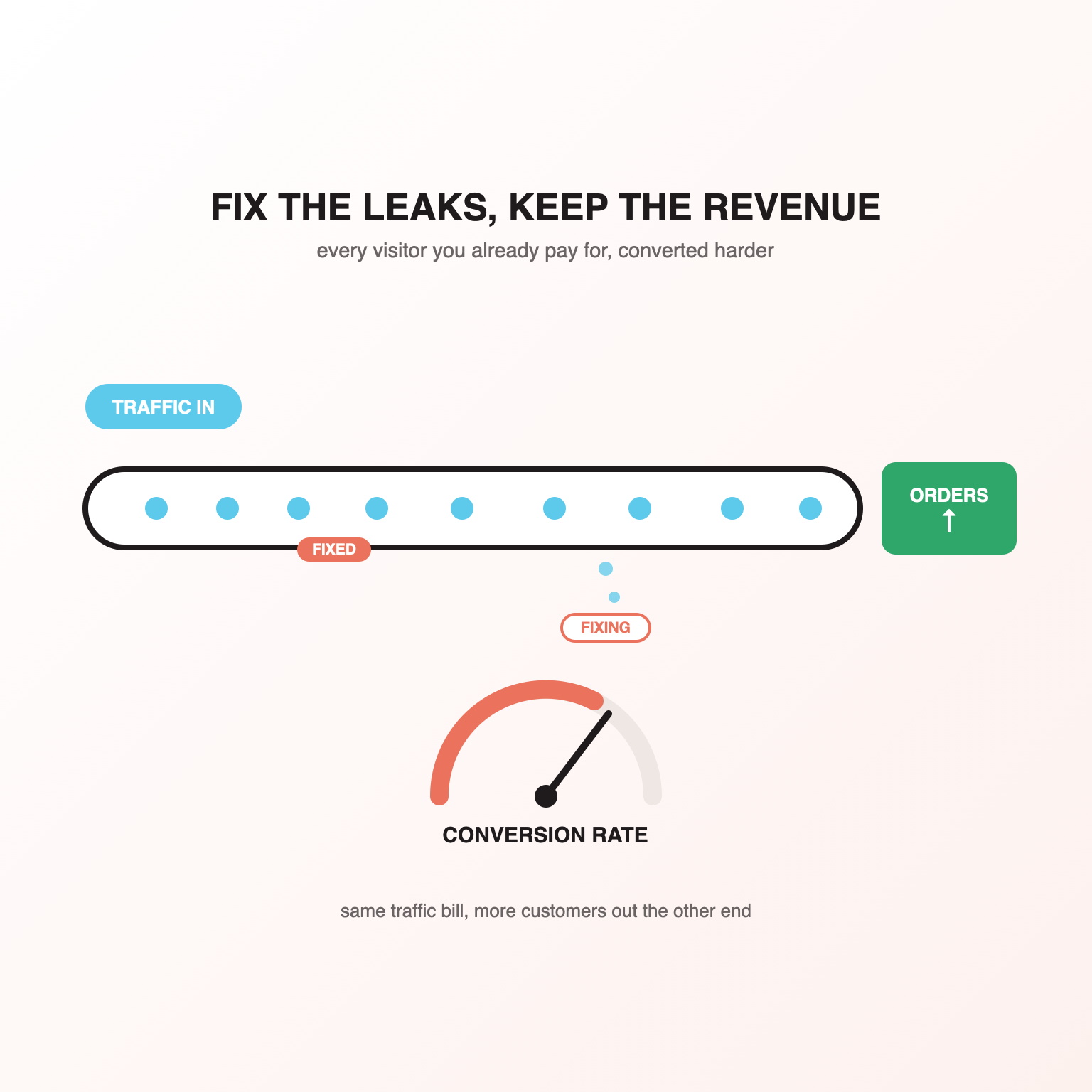
Unified Platforms provides conversion rate optimization services for teams tired of paying more for traffic while their website converts the same as it did two years ago. We find where visitors leak, prove the fixes with disciplined experiments, and compound the wins, because doubling conversion rate is the same as halving every acquisition cost you pay.
- Research first, opinions last
- Experiments, not redesign gambles
- Revenue per visitor as the scoreboard
Our Clients
Brands that have worked with us
From global giants to fast growing startups, teams trust Unified Platforms with their growth.




What Conversion Rate Optimization Services Covers
- Conversion research and diagnosis
- A/B testing and experimentation
- Landing page and funnel optimization
- Ecommerce conversion optimization
- Copy and message testing
- Mobile experience optimization
Overview
Conversion Rate Optimization Services That Answer to Revenue
Every rupee you spend on marketing buys a visit to a website that either converts or wastes it. Most growth teams pour their energy into the buying side, more channels, more budget, better targeting, while the converting side sits untouched, quietly taxing everything. Conversion rate optimization is the discipline of fixing that side: understanding why visitors leave, testing what makes them stay, and banking improvements that make every channel you run cheaper at once. It is the only marketing investment whose returns multiply the returns of all the others.
The catch is that most of what sells as CRO is theatre: button-colour experiments, best-practice checklists applied without diagnosis, and redesigns justified by taste. Real conversion work starts with evidence. Analytics show where visitors leak; session recordings and heatmaps show how they struggle; user research and surveys explain why; and only then do hypotheses earn the right to be tested. Our conversion rate optimization services run on that sequence, and it is remarkable how often the data demolishes what everyone in the room was sure about.
Testing discipline is the second half of the craft. An A/B test that ends early, splits traffic badly, or measures the wrong outcome does worse than nothing: it launders a guess into a fact. We run experiments with proper hypotheses, adequate sample sizes, and honest statistics, and we measure winners in revenue per visitor rather than click-through flattery, because a variant that lifts add-to-carts while flattening orders is a loss wearing a medal.
Where traffic is too thin for statistically sound testing, we say so and switch methods: evidence-led fixes shipped in order of confidence, before-and-after cohort reads, and user testing to catch the failures analytics cannot see. CRO is not only A/B tests; it is the judgment to know which instrument fits the site in front of you. Agencies that sell one tool for every situation end up torturing small sites with tests that will never conclude, and we have cleaned up after enough of those engagements to refuse the pattern.
Good conversion work also changes how the rest of the organisation argues. Once a team has watched a confident redesign lose to the ugly control, or seen a headline built from customer interview verbatims beat the agency's polished tagline, decisions start deferring to evidence instead of seniority. The learning log becomes an institutional memory of what your market actually responds to, tested on your own traffic, and it quietly improves ad creative, email subject lines, sales decks, and product decisions that never touched an experiment. Clients keep telling us this cultural shift outlasted any individual win, and we design the programme, transparent backlogs, shared results reviews, plain-language write-ups, to encourage exactly that.
The numbers in our results band are from real engagements: a 64 percent lift in demo bookings and an 82 percent mobile conversion improvement for Scaler, a 41 percent booking page lift for Ather Energy driven by copy alone, and the 28 percent acquisition cost reduction that followed. That is what compounding conversion work looks like, and the same research-test-bank rhythm that produced it runs every account we take on.
Conversion research and diagnosis. Every engagement starts with evidence: analytics funnel analysis to find where visitors leak, session recordings and heatmaps to see the struggle first-hand, on-site surveys and user interviews to hear the objections, and form analytics to catch the field where patience dies. The output is a diagnosis ranked by revenue impact, not a checklist of cosmetic complaints, and it routinely contradicts what the team assumed was broken.
A/B testing and experimentation. Hypotheses earn tests, and tests get run properly: pre-registered success metrics, sample size maths done before launch, no peeking-driven early stops, and revenue per visitor as the deciding number. We build and run the experiments end to end, from variant design through implementation and analysis, and every result, winner or loser, lands in a learning log that makes the next hypothesis smarter.
Landing page and funnel optimization. Campaign landing pages get treated as the second half of the ad: message match from click to headline, proof placed where doubt peaks, forms trimmed to what the sales motion truly needs, and page speed handled as a conversion feature rather than an engineering afterthought. For multi-step funnels we optimise the sequence, not just the pages, because the leak is often between the steps.
Ecommerce conversion optimization. Product page, cart, and checkout each have their own failure physics: unanswered sizing and shipping questions, surprise costs at checkout, forced account creation, payment friction on mobile. We work the whole purchase path with ecommerce-specific research and tests, and we measure in revenue per session and completed orders, because add-to-cart lifts that die at the payment step flatter dashboards while changing nothing.
Copy and message testing. More conversion problems are language problems than design problems: headlines that describe the company instead of the visitor's problem, value propositions that dissolve into adjectives, CTAs that ask for commitment before giving a reason. We mine research and customer language for the words that actually move people, then test them, and the Ather Energy result in our band, a 41 percent booking lift from copy changes alone, shows how hard words can work.
Mobile experience optimization. Mobile usually carries most of the traffic and the worst of the conversion rate, which makes it the highest-leverage surface on most sites. We optimise for the thumb and the interruption: tap targets, form input types, sticky CTAs, load speed on real devices, and checkout flows that survive a train commute. The 82 percent mobile conversion lift in our results came from exactly this focus.
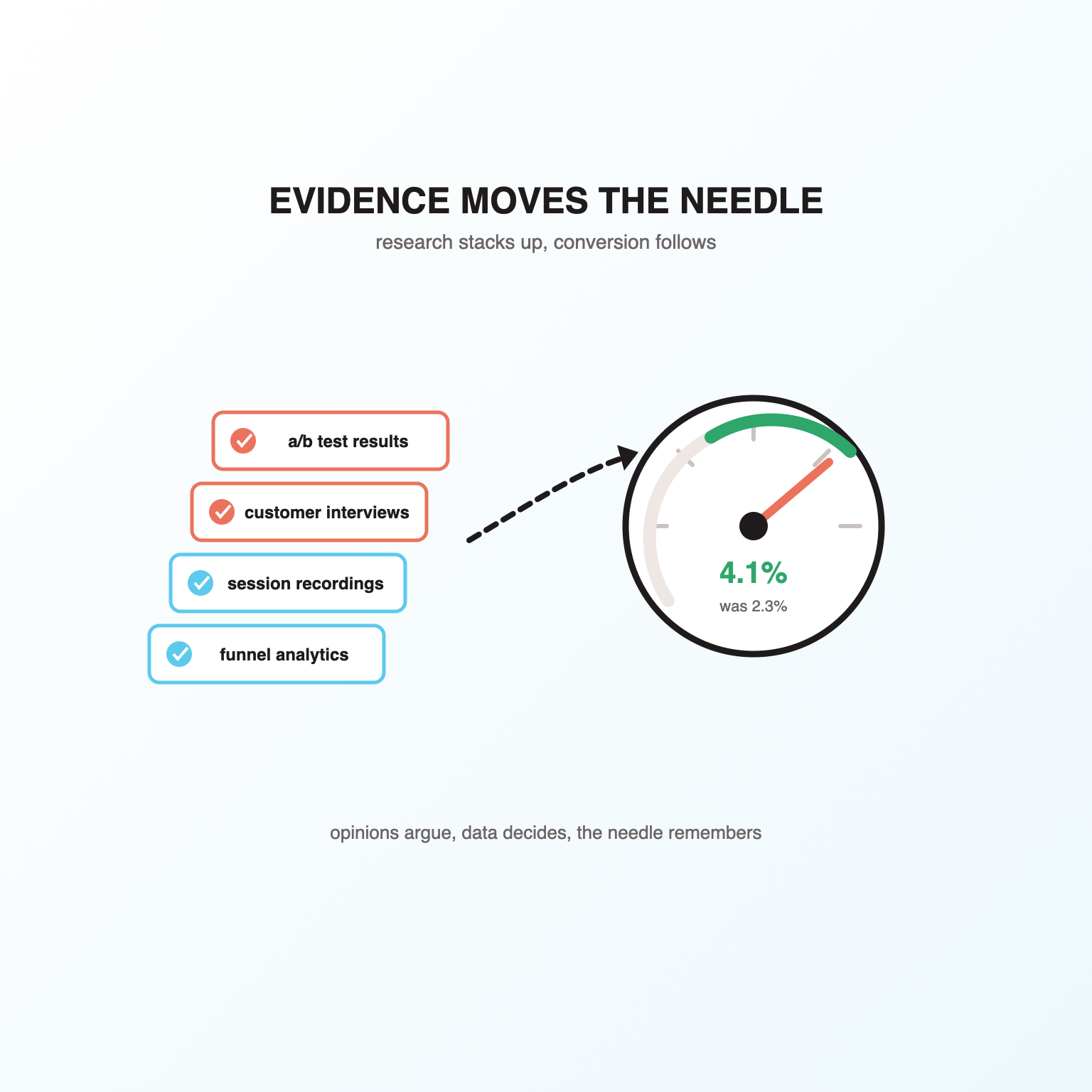
The Difference
Half the Cost Per Sale, Without Touching a Single Ad
Double a funnel's conversion rate and every channel feeding it gets twice as efficient overnight: paid, organic, email, referral, all at once. That is the quiet arithmetic that makes conversion work the highest-leverage spend in marketing, and the reason we measure our programmes in revenue per visitor and acquisition cost, not in test counts. The scoreboard is your P&L, where it belongs.
Book a Strategy CallOur Process
How We Run a CRO Programme
A disciplined sequence, adapted to your competitive landscape. Open each step.
01Baseline and analytics audit
02Research sprint
03Hypothesis backlog and prioritisation
04Test or ship, by the numbers
05Analyse, bank, and iterate
06Compound and expand
Why Unified Platforms
Why Teams Choose Us for Conversion Rate Optimization
The working habits behind every engagement.
Diagnosis before prescription
We do not arrive with a redesign in our pocket. Every recommendation traces to evidence you can inspect: the recording, the survey verbatim, the funnel segment. That discipline is slower than opinion for the first month and faster forever after, because fixes aimed at real causes work the first time instead of the third.
Statistics you can trust
Sample size calculated before launch, success metrics registered up front, no early stopping because a chart looks exciting, and revenue per visitor as the verdict. Half the industry's celebrated wins are peeking artefacts that quietly evaporate; ours are built to survive scrutiny, including yours.
Copy is our power tool
Most CRO shops are design studios that test layouts. Our roots are in messaging, and it shows in the results: the highest-leverage changes on most pages are language changes, made from mined customer words rather than brainstormed cleverness. A 41 percent lift from copy alone is not an anomaly in our book; it is the thesis.
Honest about small traffic
If your site cannot conclude a test in a sane timeframe, we will not sell you a testing programme. You get the evidence-led shipping model instead, prioritised fixes, cohort measurement, faster payback, and we will tell you exactly when your traffic graduates to full experimentation. Method fitted to reality, not reality bent to the retainer.
Proof from real programmes
The 64 percent demo booking lift, 82 percent mobile conversion improvement, and 28 percent CAC reduction on this page came from a programme we ran for Scaler, and the booking page numbers from Ather Energy. Ask about any of them and you get the full story: the research that found the problem, the tests that proved the fix, and the misses along the way.
We multiply your other spend
Every point of conversion improvement cuts the effective cost of every channel you run, which is why CRO pairs so well with our paid media and SEO practices. Insights flow both directions: ad copy that wins informs page copy, page research informs targeting, and the whole acquisition system gets cheaper together rather than channel by channel.
Industries
Industries We Work With
Deep experience across the sectors we serve, with strategy tailored to each.
Get a Free Funnel Leak Assessment
Send us your analytics access and your three most important pages, and we will come back with a straight read: where the biggest leaks are, what they cost you monthly, and whether your traffic supports a testing programme or an evidence-led shipping model. We will also tell you the two or three fixes we would ship first and why, with the evidence attached, so you can sanity-check our thinking against your own knowledge of the business. The first look is free, specific to your funnel, and useful even if you never hire us. Most teams learn something in that first conversation that changes what they ship the following week.
Book a Strategy CallQuestions
Frequently Asked Questions
Straight answers before you ever get on a call.
CRO Basics
When should I hire a conversion rate optimization consultant?
What are conversion rate optimization services?
What is a good conversion rate?
How is CRO different from a website redesign?
Method and Testing
What kinds of changes produce the biggest conversion lifts?
Do you test pricing and offers too?
How much traffic do we need for A/B testing?
What tools do you work with?
Can you run CRO on our mobile app too?
Working With Us
How does your CRO work fit with the paid media you also manage?
Can you fix a funnel before a big traffic push or launch?
How long before we see results?
What does a CRO engagement cost?
Do you implement the changes or just recommend them?
Research Methods
What does conversion research actually involve?
How do you use session recordings without drowning in them?
Do you talk to our actual customers?
What is a heuristic review and why should we trust it?
Measurement and Results
How do you measure success?
What happens when a test loses?
Will CRO changes hurt our SEO?
Stop Renting Growth. Start Compounding It
Your website is already paying for every visitor it receives; the only question is how many of them it converts. While acquisition costs climb across every channel, the businesses that compound conversion improvements are quietly paying less for growth each quarter than the ones that keep buying traffic for a leaking funnel. Book a free strategy call, show us your funnel, and we will show you where the money is leaking and what a disciplined programme would recover. Bring your scepticism; the data enjoys the company.
Book a Strategy CallExplore more