 Skip to content
Unified Platforms
Ecommerce PPC Management Services
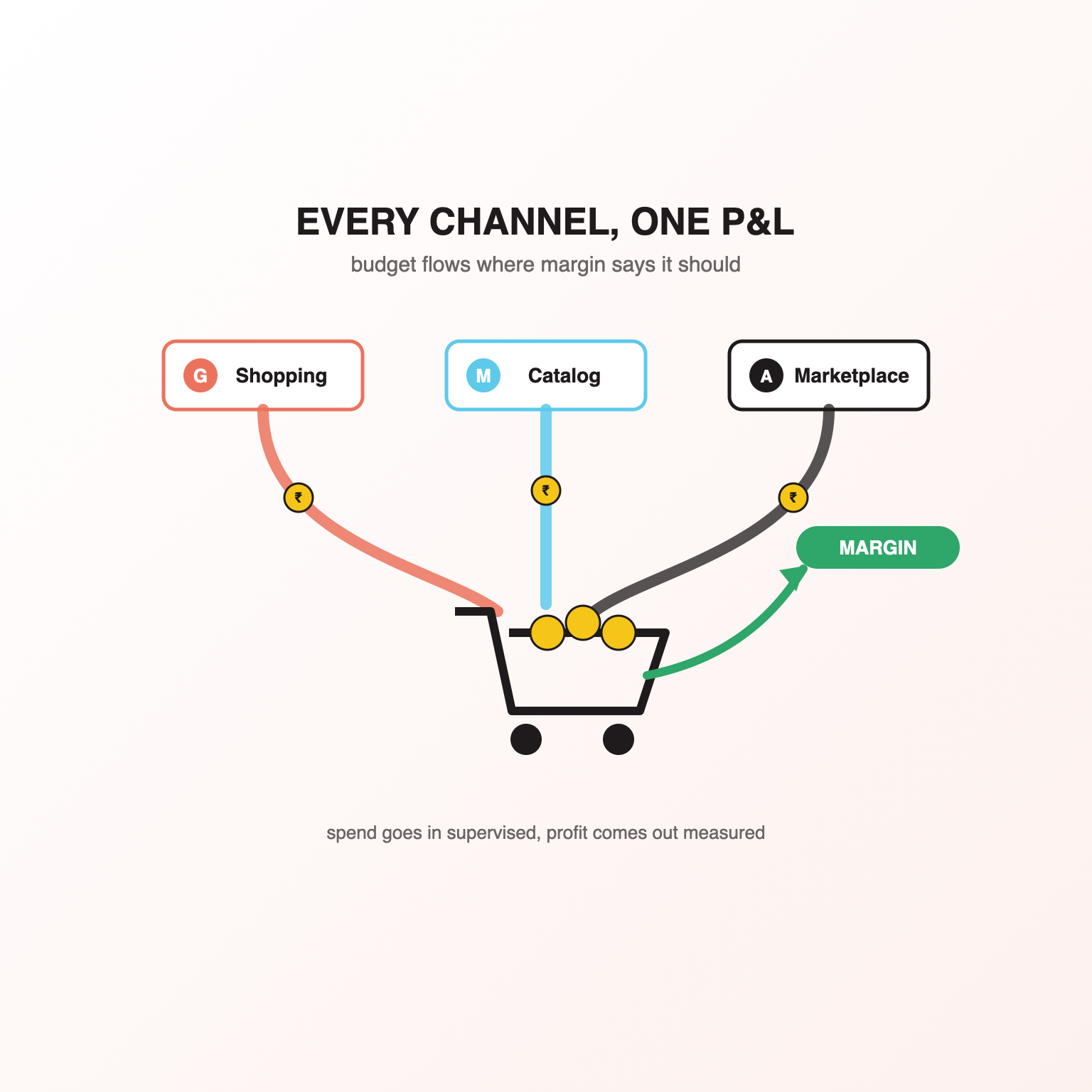
Unified Platforms runs ecommerce PPC management for brands that live and die by ROAS. Google Shopping, Performance Max, marketplace ads, and Meta catalog campaigns, managed as one portfolio with clean feeds, honest measurement, and bids that answer to margin, not to platform recommendations. Ad spend should behave like an investment, and we manage it like one.
- Margin-aware bidding, not vanity ROAS
- Feed quality as a ranking lever
- One portfolio across Google, Meta, marketplaces
Our Clients
Brands that have worked with us
From global giants to fast growing startups, teams trust Unified Platforms with their growth.








What Ecommerce PPC Management Services Covers
- Google Shopping and Performance Max
- Product feed management and optimisation
- Marketplace advertising (Amazon and Flipkart)
- Meta catalog and dynamic product ads
- Measurement, attribution, and incrementality
- Landing experience and conversion alignment
Overview
Ecommerce PPC Management Built on Margin Math
Ecommerce PPC is a different discipline from lead generation advertising. You are not buying form fills; you are pricing thousands of SKUs into auctions in real time, where product feed quality decides which searches you enter, and margin structure decides which ones you can afford to win. An account that ignores those two facts can post a proud platform ROAS while quietly losing money on every discounted, low-margin order it drives. The craft is making the auction serve the P&L, and that craft is what our ecommerce PPC management services deliver.
Most ecommerce accounts we inherit share the same pattern: one Performance Max campaign doing unknowable things, a product feed exported once and never enriched, brand terms subsidising the reported ROAS, and budget spread evenly across products as if every SKU deserved the same bid. The platforms encourage this, because automation without supervision spends more. Our job is to put structure back: segment products by margin and role, feed the algorithms clean data, and measure what the ads actually caused rather than what they claimed credit for.
The work spans every surface where products are bought. Google Shopping and Performance Max for high-intent search, Meta catalog and dynamic product ads for demand creation and retargeting, and marketplace advertising on Amazon and Flipkart where a growing share of product searches now start. Each channel has its own auction logic and its own failure modes, and treating them as one portfolio, with budget flowing to the surface earning the best marginal return, is where most of the gains hide.
Underneath the campaigns sits the unglamorous work that decides results: feed titles rewritten so products enter the right auctions, GTINs and attributes completed, prices and availability synced so ads never sell what the shop cannot ship, conversion tracking rebuilt so bidding algorithms learn from truth. We treat the feed as the campaign, because on shopping surfaces it is: the auction reads your data, not your ad copy.
Timing matters more in ecommerce than in any other paid discipline. Auction prices swing with the retail calendar, competitors discount in waves, inventory runs out mid-flight, and a product that printed money in October can be a budget leak by January. Our management rhythm is built around that volatility: weekly reallocation, sale events planned like campaigns in their own right, and a promotion calendar wired into feeds and creative so the account is always selling what the business actually wants to move. Set-and-forget is how ecommerce budgets die; supervised motion is how they compound.
We report the way an operator would want: revenue, margin after ad spend, new versus returning customer split, and the honest incrementality of brand spend. The numbers in our results band are from real client engagements, and the same discipline that produced them, test, measure, reallocate, is the rhythm we bring to every account. If a channel or a product segment cannot pay for itself, you will hear it from us first, with the data attached.
Google Shopping and Performance Max. We structure Shopping and PMax around product economics: campaigns and asset groups segmented by margin band, price point, and strategic role, with search themes and negatives keeping queries where they belong. PMax gets supervised, not trusted: placement exclusions, brand traffic carved out, and product-level performance pulled into daylight so winners scale and dead SKUs stop draining budget. The result is an account you can actually steer instead of a black box you hope behaves.
Product feed management and optimisation. Feed quality decides which auctions your products enter and at what quality score. We rewrite titles around real query language, complete attributes, fix GTIN and category mapping, build supplemental feeds for promotions and labels, and keep price and stock sync tight so disapprovals never silently switch off your best sellers. Custom labels encode margin and lifecycle into the feed so every campaign decision can be an economic one. It is unglamorous work, and it moves numbers more than any bid change.
Marketplace advertising (Amazon and Flipkart). Marketplaces are where high-intent product searches increasingly start, and their auctions reward different behaviour from Google's. We run sponsored products, brands, and display with keyword harvesting loops, placement bid control, and ACoS targets set per product role, defending your listings on branded terms while attacking category demand where the margin supports it. The 9.6 percent ACoS in our results band came from exactly this discipline on a marketplace portfolio.
Meta catalog and dynamic product ads. Meta earns its budget in ecommerce as a demand engine: catalog sales campaigns, dynamic retargeting that stops at sensible frequency, and broad prospecting fed by creative built around products people actually buy first. We connect the catalog properly, dedupe audiences against purchasers, and judge the channel on incremental revenue rather than view-through claims, so Meta scales when it deserves to and shrinks when it does not.
Measurement, attribution, and incrementality. Bidding algorithms learn from your conversion data, so we rebuild it first: proper purchase tracking with deduplication, server-side events where the stack allows, consent handling, and new-customer conversion goals where acquisition is the aim. Then we separate what ads caused from what they claimed: brand versus non-brand splits, holdout reads on retargeting, and blended MER guardrails alongside platform ROAS so scaling decisions rest on money arithmetic, not dashboard flattery.
Landing experience and conversion alignment. Clicks are only half the trade; the product page and checkout decide the other half. We audit the post-click path for speed, price parity, stock accuracy, and friction, align promotions between ads and pages, and feed conversion findings back into campaign structure, because a losing auction is sometimes a winning auction with a broken page behind it. Where deeper work is needed, our CRO practice picks it up.
The Difference
Platform ROAS Is a Story. Margin Is a Fact
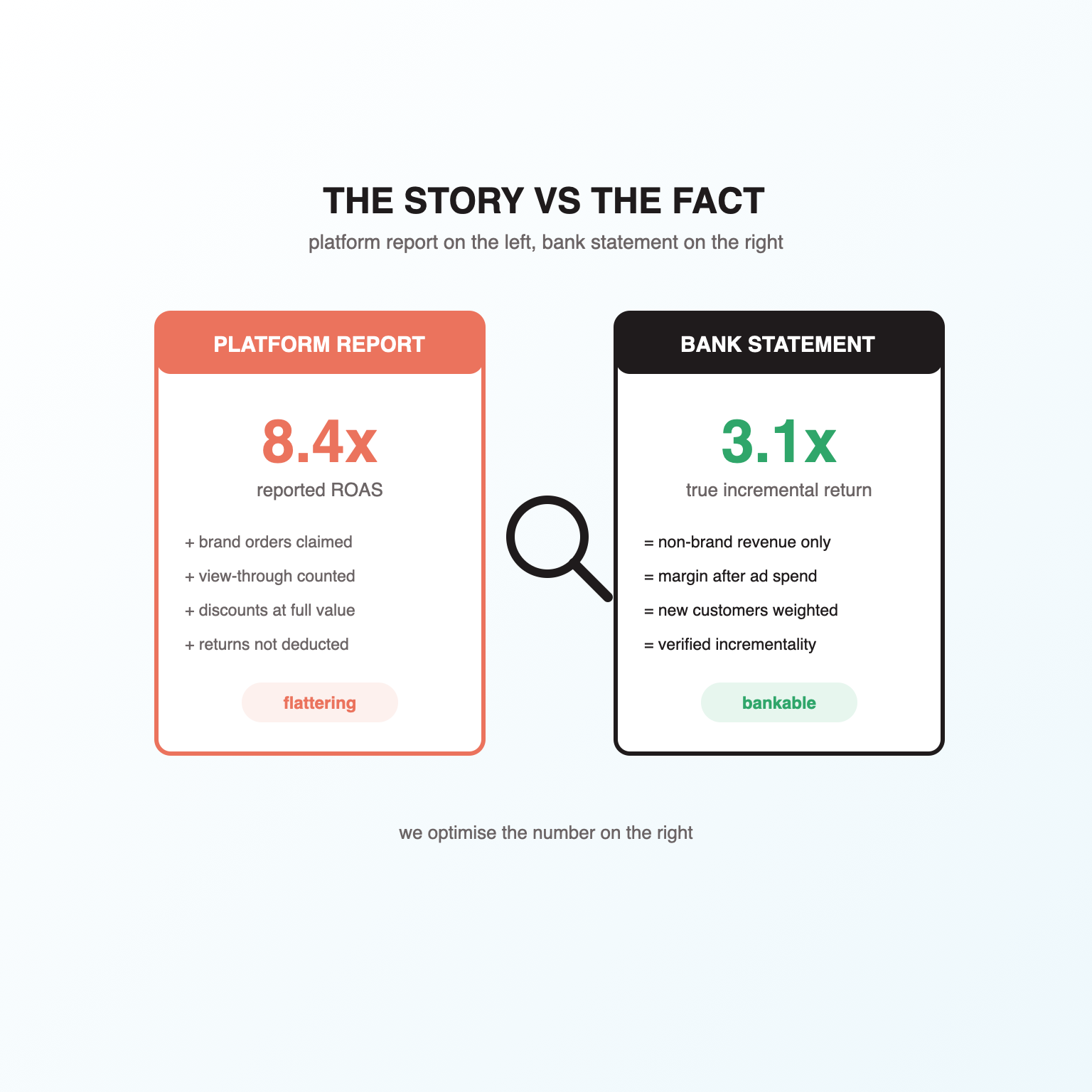
Ad platforms grade their own homework, and they grade generously: brand orders claimed, view-throughs counted, discounts ignored. We rebuild measurement so bids learn from truth, split brand from non-brand, weight revenue by margin, and scale only what is incrementally profitable. Accounts managed this way compound quietly, because every rupee of spend is doing a job the P&L can verify.
Book a Strategy CallOur Process
How We Run an Ecommerce PPC Engagement
A disciplined sequence, adapted to your competitive landscape. Open each step.
01Account and feed audit
02Economics and goal setting
03Restructure and feed rebuild
04Launch and stabilisation
05Optimisation rhythm
06Scale and expand
07Reporting that respects your P&L
Why Unified Platforms
Why Brands Choose Us for Ecommerce PPC
The working habits behind every engagement.
We bid on margin, not on applause
Platform ROAS is a press release; margin after ad spend is a bank statement. Every structure we build encodes product economics, margin bands, new customer value, promo periods, so the algorithms optimise toward orders that are actually worth winning. Accounts run this way sometimes report a lower headline ROAS and reliably bank more money, and we are comfortable explaining that trade to any CFO.
Feed-first, because the auction reads data
On shopping surfaces your feed is your keyword list, your ad copy, and your quality score at once. We invest in it accordingly: title language mined from real queries, attributes completed, labels that carry margin into campaign logic. Most accounts we audit have never had this done, which is also why our first ninety days usually move numbers hard.
Cross-channel budget honesty
Google, Meta, and marketplaces all claim the same orders when you let them. We measure the portfolio as one system with blended guardrails and channel-level incrementality reads, then move budget to the surface earning the best marginal return. The channel teams do not compete for your spend; the arithmetic decides.
Proof from real accounts
A 2.6x ROAS improvement while tripling lead volume, a 9.6 percent ACoS on marketplace spend, 67 percent marketplace revenue growth from unifying a fragmented strategy: the numbers on this page come from engagements we ran, and we will walk you through how each was achieved. Ask for the story behind any figure and you will get the unvarnished version, including what did not work on the way.
Senior operators on the account
The people in the ad accounts are the people in your review calls: senior media buyers with ecommerce scar tissue, not a rotation of juniors executing a checklist. Forty plus years of collective channel experience means fewer expensive lessons learned on your budget, and recommendations that come with a because attached.
Built to be audited
Everything we do sits in your accounts, documented: naming conventions, change logs, measurement definitions, feed rules. If you ever want a second opinion or an internal team to take over, the account will make sense to them in an afternoon. Agencies that fear transparency are usually hiding rework; we sell the absence of it.
Industries
Industries We Work With
Deep experience across the sectors we serve, with strategy tailored to each.
Get a Free, Blunt Account Assessment
Send us read-only access to your ad accounts and your feed, and we will come back with a straight assessment: where spend is leaking, how much of your ROAS is brand traffic wearing a costume, and what a margin-aware restructure would honestly change. No charge for the look, and no theatre in the findings.
Book a Strategy CallQuestions
Frequently Asked Questions
Straight answers before you ever get on a call.
Ecommerce PPC Basics
What is ecommerce PPC management?
Why does the product feed matter so much?
How is it different from regular Google Ads management?
Which platforms do you manage?
Performance and Economics
What ROAS should an ecommerce brand expect?
Why does my account show great ROAS but weak profit?
How long before results show?
Working With Us
Do you work alongside in-house teams?
What do you need from us to start?
Is there a minimum ad spend you work with?
Can you take over an account mid-flight without tanking performance?
How do you charge?
Channels and Strategy
Is Performance Max worth it, or is it just a black box?
Do standard Search campaigns still matter for ecommerce?
How do you decide budget split between Google, Meta, and marketplaces?
What about creative for catalog and shopping ads?
Feeds and Operations
Can you fix a feed with frequent disapprovals?
Do you handle sale events like Diwali, BFCM, or end-of-season?
Do you also run ads for D2C brands selling through their own store and marketplaces?
Make Ad Spend Behave Like an Investment
Every month an ecommerce account runs unstructured, money moves from your margin to the platforms, and the reporting is designed to make that feel fine. It does not have to be. A portfolio built on your economics, fed clean data, and measured without flattery will grow the only number that matters at the end of the quarter. Book a free strategy call, send read-only access, and we will show you, in your own account's data, exactly where the next improvement is hiding. If everything is already tight, we will say so and shake your hand.
Book a Strategy CallExplore more