 Skip to content

LLM Content Optimization: Structure Content AI Can Cite
LLM content optimization structures content so language models can retrieve, understand, and cite it. How models use passages, and how to write self-contained, answer-first, machine-readable content.
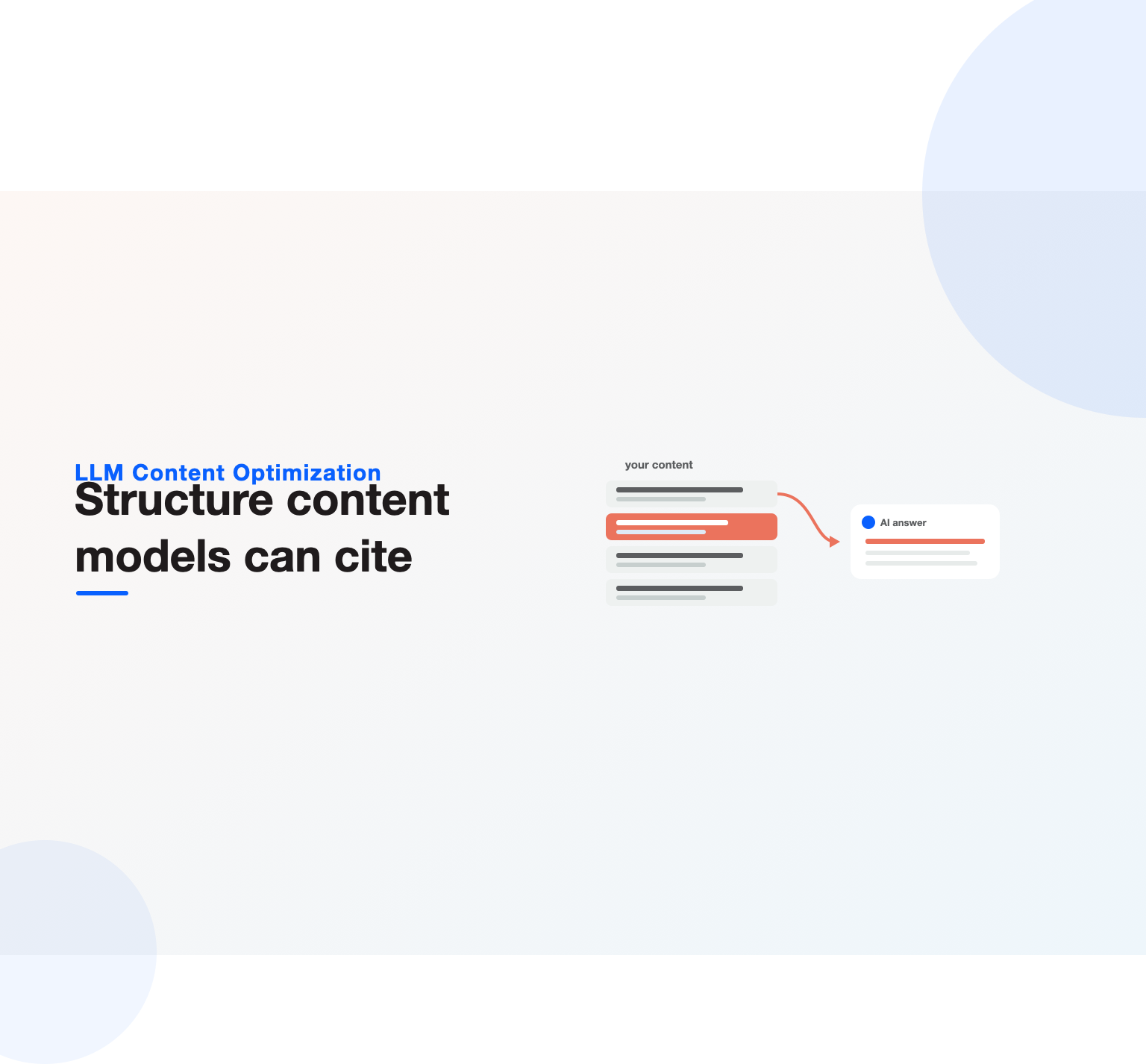
Quick Answer
LLM content optimization is the practice of structuring and writing content so that large language models can easily retrieve, understand, and cite it when generating answers. Because models like ChatGPT, Claude, and Gemini pull in passages of content to build responses, the way you organize information, into clear, self-contained, factually precise sections that each directly answer a real question, largely determines whether your content gets used and cited. It is less about keywords and more about extractability: leading with direct answers, keeping each passage able to stand on its own, using clear headings and accurate facts, and making the content technically accessible. Done well, LLM content optimization makes your genuine expertise easy for a machine to lift and attribute, which is how you earn citations in AI answers.
Key Highlights
- LLM content optimization structures content so models can retrieve and cite it, focusing on extractability rather than keyword density.
- Models work with passages, so each section should be self-contained and make sense on its own when lifted out of the page.
- Answer-first writing, clear headings mapped to real questions, and precise facts make content far easier for a model to use and attribute.
- Comprehensive, accurate, well-structured content is more likely to be drawn on across the many specific questions within a topic.
- Technical accessibility is a prerequisite: if a crawler cannot read the content in the HTML, no amount of structure helps.
What LLM content optimization is
LLM content optimization is the discipline of shaping content, its structure, phrasing, and organization, so language models can retrieve it, understand it accurately, and cite it in their answers. It sits alongside traditional SEO but shifts the emphasis: where classic on-page work targets a keyword and a ranking, this targets extractability and comprehension by a model. The unit of attention changes too, from the page as a whole to the individual passage a model might lift, so the craft is making each part of your content clear and usable in isolation.
It is worth being precise about what this is not. LLM content optimization is not stuffing text with keywords or writing for a crawler at the expense of readers, which fails because models favor genuinely clear, useful content. Nor is it a trick to force citation; models cite what they judge reliable and relevant. Instead it is the practical craft of taking real expertise and organizing it so a machine can find the right passage, understand exactly what it says, and cite it confidently. Understood this way, it is a natural companion to a strong content strategy, applied with an eye to how models actually consume text.
How language models retrieve and use content
To optimize content for models, it helps to understand roughly how they use it, which happens in a few ways. When an assistant browses or draws on a connected knowledge source, it often retrieves relevant passages, chunks of text semantically matched to the question, and uses them to compose an answer, a pattern common to retrieval-augmented systems. Models also carry knowledge from training, where content that was clear and widely represented shaped what they know. In both cases, content that is clearly written and cleanly structured is easier to match, extract, and use.
The passage-level nature of retrieval is the key insight behind LLM content optimization. Since a model often pulls a specific chunk rather than the whole page, a passage that answers a question completely on its own is far more useful than one that only makes sense with the surrounding paragraphs. Semantic matching means the model looks for meaning, not exact keywords, so clear, natural language that genuinely addresses the question matters more than repetition. Designing content as a set of clear, self-contained, semantically focused passages is therefore the foundation of the whole practice, and it connects directly to how LLM SEO and generative engine optimization approach visibility in these systems.
Structuring content into retrievable passages
The most important move in LLM content optimization is structuring content into passages that stand on their own. Each section should open with a clear statement of what it covers and answer that point completely within itself, so that if a model lifts just that chunk, it still makes full sense. Avoid passages that depend heavily on earlier context to be understood, because a retrieved chunk arrives without that context, and a passage that reads as incomplete on its own is one a model is less likely to use confidently.
In practice this means writing self-contained sections under descriptive headings, each addressing a specific question or subtopic fully. Restating the key subject within a passage rather than relying only on pronouns and prior references helps a model understand a chunk in isolation. Keeping each section focused on one clear idea, rather than wandering across several, makes it cleaner to retrieve and cite. This passage-first structure is the difference between content a model can easily use and content that is technically present but hard to extract, and it is the core habit that makes LLM content optimization work in practice.
Semantic clarity and specificity
Since models match on meaning, semantic clarity is central to LLM content optimization. Write in clear, natural language that genuinely and specifically addresses the questions your audience asks, rather than vague or generic prose that gestures at a topic without answering it. A passage that precisely answers a real question is easy for a model to match to that question and cite, while content that is broad and non-specific is hard to place and easy to overlook. Specificity, naming the actual thing, giving the actual detail, is what makes content retrievable.
This rewards genuine depth and expertise over filler. Content that includes real specifics, accurate facts, concrete examples, precise explanations, gives a model clear, reliable material to work with, whereas padding and generalities give it nothing distinctive to extract. The same clarity that helps a model helps human readers, which is the point, since models aim to surface what genuinely helps people. Writing with precision and specificity is therefore both good writing and effective LLM content optimization, and it aligns with the answer-first clarity that strong on-page SEO and a well-planned internal structure already encourage.
Answer-first writing and factual density
Leading with the answer is one of the highest-leverage habits in This practice. When a section opens with a direct, clear answer to its question and then expands on it, a model gets a clean, quotable statement it can lift and attribute, whereas burying the answer several sentences into a meandering paragraph makes extraction harder and citation less likely. The answer-first pattern serves both machines, which get an extractable passage, and readers, who get their answer immediately.
Factual density reinforces this. Content rich in accurate, specific, verifiable facts gives a model reliable material and signals trustworthiness, while vague or promotional text offers little to cite and can read as unreliable. Stating facts clearly and precisely, and making sure they are correct, is both a quality practice and a retrieval advantage, because models built to be helpful favor accurate sources. Combining answer-first structure with genuine factual density produces exactly the kind of clear, reliable, extractable content that Optimizing content for models aims for, and it is the same discipline that earns broader AI visibility across every engine.
Headings, formatting, and extractability
Formatting is not decoration in The discipline; it is part of how a model navigates and extracts content. Clear, descriptive headings that map to real questions act as signposts, helping a model locate the passage relevant to a query and understand what each section addresses. Logical hierarchy, short focused paragraphs, and sensible use of lists where they genuinely fit all make content easier to parse, because a well-organized document is easier for a machine to segment into meaningful chunks.
The goal is a document whose structure mirrors its meaning, so the way it is organized helps rather than hinders retrieval. Headings phrased as the questions people actually ask are especially useful, since they align a section directly with the queries a model might match it to. Avoiding walls of undifferentiated text, and instead giving each idea its own clearly labeled space, turns a page into a set of cleanly retrievable passages. This kind of thoughtful formatting is a simple, controllable lever in This work that makes genuinely good content much easier for a model to use.
Structured data and machine-readability
Beyond prose, structured data strengthens Content optimization for LLMs by giving machines explicit, unambiguous information. Schema markup that describes your content, entities, and facts helps systems understand precisely what a page is about and how its pieces relate, which supports accurate interpretation and citation. While prose clarity does most of the work, structured data adds a layer of machine-readable precision that reduces the chance of misunderstanding, especially for factual, entity-rich content like products, organizations, and how-to information.
The broader principle is to make your content as unambiguous to machines as possible, in both its writing and its markup. Consistent, accurate structured data that matches the visible content reinforces what the prose says, while contradictory or sloppy markup can confuse rather than help. Since this is the same markup that supports rich results in traditional search, it is another case where The practice and good SEO overlap, so implementing it well serves both. Treating machine-readability as a first-class concern, not an afterthought, is part of making content that models can confidently use.
Comprehensiveness and topical coverage
Depth matters in This practice because comprehensive content earns retrieval across many specific questions. A page that thoroughly covers a topic, answering the full range of questions someone might ask about it, gives a model many opportunities to match a passage to a query, so it is drawn on more often, and across more queries, than a shallow page that only touches the surface. Covering a subject genuinely and completely, rather than thinly, is what makes content a reliable, repeatedly-cited source.
This does not mean padding for length, which adds noise rather than value. It means genuinely addressing the real questions and subtopics within your area, each in its own clear, self-contained passage, so the content is both deep and cleanly retrievable. Comprehensive, well-organized content also builds the topical authority that models and search engines alike reward, reinforcing why coverage and structure work together. Aiming for genuine completeness, organized as a set of focused passages, is how Optimizing content for models turns a single page into a resource a model returns to across a whole cluster of related questions.
Technical accessibility for retrieval
None of the structure and writing matters if a model cannot access the content, so technical accessibility is the foundation of The discipline. The crawlers behind AI systems generally work best with content present in the served HTML, so information that only appears after client-side JavaScript executes can be invisible to them even when human visitors see it perfectly. Important content should therefore be server-rendered and readable, not locked behind heavy scripts, which is the same concern our work on JavaScript SEO covers in depth.
The rest of the basics apply too: fast, crawlable pages, clean structure, and robots directives that allow the crawlers you want, all of which a technical SEO checklist helps you verify. Content that is slow, blocked, or dependent on rendering for its core substance will struggle to be retrieved regardless of how well it is written and structured, because the systems never fully see it. Ensuring your content is technically accessible is unglamorous but decisive, since it determines whether all the careful This work work can actually reach the models it was meant for.
Optimizing different content types for LLMs
How you apply this varies a little by content type, though the principles hold. For guides and explainers, the priority is breaking the topic into clearly-headed, self-contained sections that each answer one question fully, so a model can retrieve the exact part relevant to a query. For product and service pages, precise, factual descriptions and clean structured data matter most, since models need accurate specifics to represent what you offer. For FAQ-style content, the format is already close to ideal, a clear question and a direct answer, which is exactly the passage shape models favor.
The common thread is that every content type benefits from being organized into precise, retrievable units. A long unstructured essay hides its answers, while the same information split into clear, labeled, self-contained passages becomes far more usable. Whatever you are writing, ask whether a model could lift any given section and have it stand on its own as a useful answer, and structure accordingly. That single test, applied across guides, product pages, and FAQs alike, is a reliable way to make any content type work harder in AI answers, and it complements the depth-first thinking behind a strong content strategy.
A workflow for optimizing content for LLMs
A repeatable workflow turns this from intuition into practice. Start by identifying the real questions your audience asks in your topic area, since those are what models match passages to. Draft or restructure your content so each of those questions is answered in its own clear, self-contained, answer-first passage under a descriptive heading. Check each passage in isolation: does it make full sense and give a complete answer without the surrounding text? If not, tighten it until it does.
Then layer in the supporting elements: accurate structured data, comprehensive coverage of the subtopics, and a final pass for factual precision. Confirm the content is technically accessible, present in the served HTML and not blocked, so models can actually reach it. Finally, test by asking assistants the target questions and observing whether your passages are used, then refine the ones that are not. Run this loop, question mapping, self-contained passages, machine-readability, and testing, and you have a dependable process rather than guesswork, grounded in the same SEO fundamentals that make content discoverable in the first place.
Why this matters now
The urgency behind optimizing content for models comes from how quickly retrieval-based discovery is growing. As people ask assistants questions instead of typing keywords, the content that gets surfaced is increasingly the content a model can cleanly retrieve and cite, not just the page that ranks first. Being the passage an assistant reaches for, whether that is Claude citing your content or ChatGPT recommending your brand, is becoming a distinct source of visibility that rewards early, deliberate work.
This does not mean abandoning search, which remains large and important; it means extending how you write and structure content so it serves both worlds. The same passage-first, precise, accessible content that models retrieve is also excellent for human readers and traditional rankings, so the investment is not a gamble on one future but an improvement that pays off across all of them. That is the practical reason optimizing for retrieval is worth doing now rather than later, and it is part of why SEO is not dead but evolving toward clarity, structure, and genuine usefulness. Brands that build this habit early accumulate a growing library of retrievable, citable content while competitors are still publishing walls of text a model cannot easily use.
How to measure LLM content optimization
Measuring Content optimization for LLMs means checking whether models actually retrieve and cite your content. The most direct method is to ask the assistants the questions your content addresses and see whether your pages are surfaced or cited, and how accurately your information is represented. Repeating this across a consistent set of questions over time shows whether your content is being used and whether improvements to structure and clarity are making a difference.
That testing points you to specific fixes. If a passage that should answer a question is not being used, its structure, clarity, or accessibility are the things to examine, and often the fix is making the passage more self-contained, more precise, or more directly answer-first. Tracking your presence in AI answers alongside traditional metrics gives a full picture as retrieval-based discovery grows, which is the same measurement discipline described in our approach to AI visibility, and it feeds a full AI search optimization program. Treated as something you test and refine rather than set and forget, The practice becomes a loop that steadily improves how usable your content is.
LLM content optimization versus traditional on-page SEO
It helps to see how This practice relates to classic on-page SEO, because they overlap heavily but differ in emphasis. Traditional on-page work optimizes a page for a keyword and a ranking, focusing on titles, headings, and relevance signals. Optimizing content for models focuses on the passage level, on extractability, semantic clarity, and self-containment, so a model can lift and cite a chunk. The unit shifts from page-and-keyword to passage-and-meaning.
Yet the two are complementary rather than opposed, and much of the work serves both. Clear structure, descriptive headings, answer-first writing, factual accuracy, and technical accessibility help a page rank and help a model retrieve it, so doing this well lifts you across search and AI at once. The differences are in emphasis, more attention to self-contained passages and machine-readability, not a separate content operation. This is why The discipline is best treated as an extension of good on-page SEO within a coordinated generative engine optimization approach, rather than a competing discipline.
Common LLM content optimization mistakes
Several mistakes undermine This work. The first is writing passages that depend on surrounding context, so a retrieved chunk arrives incomplete and hard to use. The second is vagueness, generic prose that never specifically answers a real question, giving a model nothing precise to match or cite. The third is burying answers deep in long paragraphs instead of leading with them, which makes extraction harder. The fourth is neglecting technical accessibility, so crawlers cannot read the content at all.
Two further errors are common. Some publishers chase keyword density or manipulation, which fails because models favor genuinely clear, reliable content over stuffed text. And many do not test whether models actually use their content, so they cannot tell what is working or improve deliberately. Avoiding these traps comes down to writing clearly and specifically, structuring content as self-contained answer-first passages, making it machine-accessible, and testing the results, which is simply the practice of Content optimization for LLMs done with discipline rather than guesswork.
Key Takeaways
- The practice structures and writes content so language models can retrieve, understand, and cite it, focusing on extractability rather than keyword density.
- Because models work with passages, write self-contained sections that make full sense on their own when lifted out of the page.
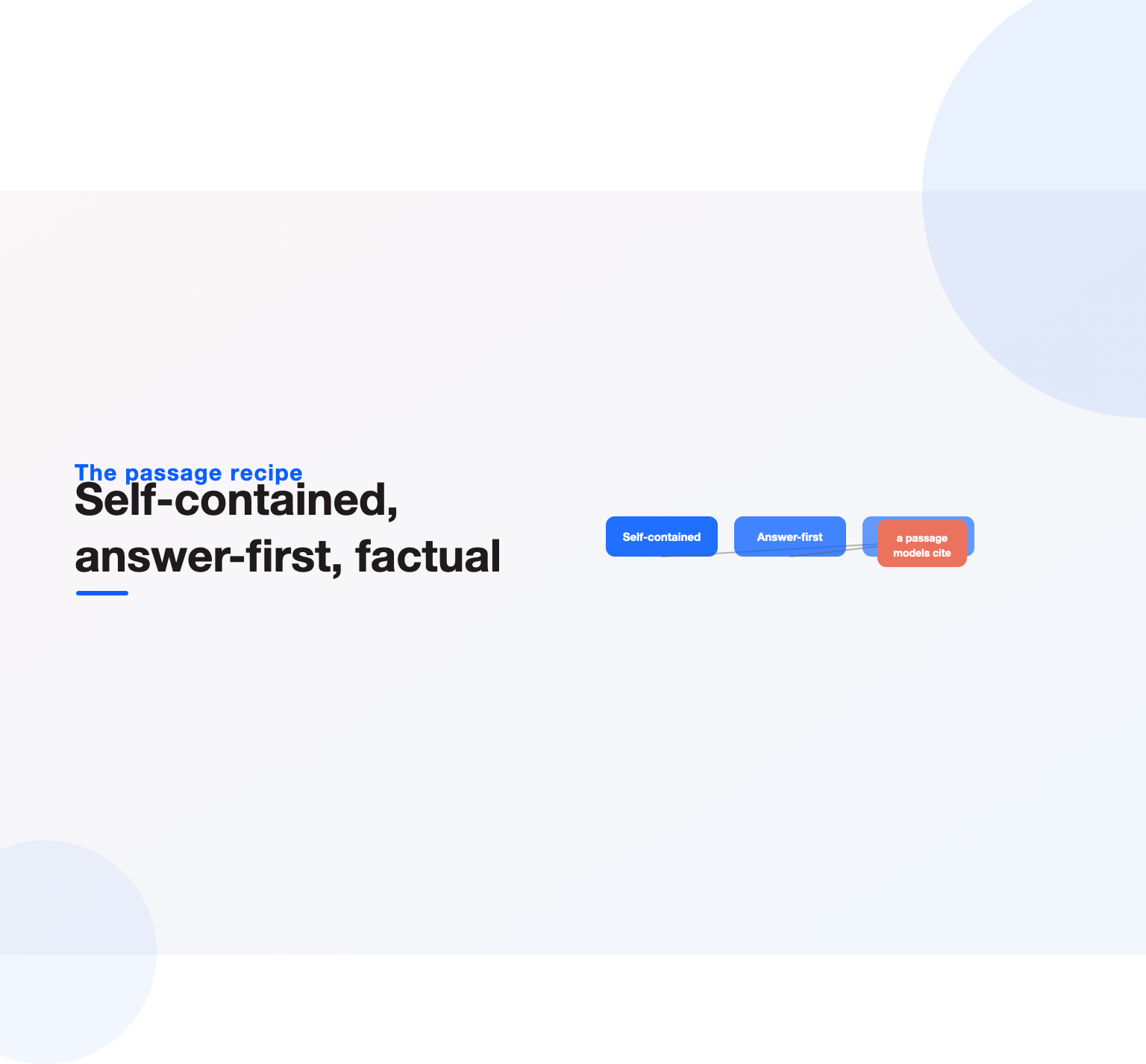
- Lead with direct answers, write with specificity and factual density, and use clear headings mapped to real questions to make content easy to extract.
- Add structured data for machine-readability, cover topics comprehensively, and make sure content is technically accessible in the served HTML.
- Test whether models actually cite your content, and treat the work as an extension of good on-page SEO rather than a separate discipline.
Frequently asked questions
What is LLM content optimization?
This practice is the practice of structuring and writing content so large language models can retrieve, understand, and cite it when generating answers. Since models pull in passages of content to build responses, it focuses on extractability: clear, self-contained sections that directly answer real questions, precise facts, descriptive headings, and technical accessibility. Rather than optimizing for keyword rankings alone, it makes your genuine expertise easy for a machine to lift and attribute accurately.
How is it different from regular SEO?
Regular on-page SEO optimizes a page for a keyword and a ranking, while Optimizing content for models works at the passage level, on extractability, semantic clarity, and self-containment, so a model can lift and cite a chunk. The two overlap heavily, since clear structure, answer-first writing, accuracy, and accessibility help both, but the emphasis shifts from page-and-keyword to passage-and-meaning. It is best treated as an extension of good SEO, not a replacement for it.
How do language models actually use my content?
When an assistant browses or draws on a connected source, it often retrieves relevant passages, chunks semantically matched to the question, and uses them to compose an answer, and it also carries knowledge from training shaped by clear, widely represented content. Because retrieval is passage-level and based on meaning rather than exact keywords, content that is clearly written, self-contained, and specific is far easier for a model to match, extract, and cite.
What makes a passage easy for a model to cite?
A passage is easy to cite when it stands on its own: it opens with a clear answer to a specific question, states the key facts precisely, and makes full sense without depending on surrounding paragraphs, because a retrieved chunk arrives without that context. Restating the subject rather than relying only on pronouns, keeping the passage focused on one idea, and writing accurately all help a model use and attribute it confidently.
Does structured data help with LLM content optimization?
Yes, structured data adds a layer of explicit, machine-readable precision that helps systems understand exactly what your content is about and how its pieces relate, which supports accurate interpretation and citation, especially for factual, entity-rich content. Prose clarity does most of the work, but consistent, accurate schema that matches the visible content reinforces it. Because it is the same markup that supports rich results in search, implementing it well serves both SEO and LLM retrieval.
How do I know if models are using my content?
Ask them. Put the questions your content addresses to assistants like ChatGPT, Claude, and Gemini, and observe whether your pages are surfaced or cited and how accurately your information is represented, repeating this across a consistent set of questions over time. If a passage that should answer a question is not being used, examine its structure, clarity, and accessibility, and make it more self-contained, precise, and answer-first, then re-test.
Is LLM content optimization just for AI, or does it help SEO too?
It helps both, because the practices largely overlap. Clear structure, descriptive headings, answer-first writing, factual accuracy, comprehensive coverage, and technical accessibility improve how a page ranks in search and how easily a model retrieves and cites it. So investing in The discipline strengthens your traditional SEO at the same time, which is why it is best treated as an extension of good content and on-page practice rather than a separate, competing effort.
Do I need to rewrite all my content for LLMs?
Not wholesale. Start with your most important pages and the questions you most want to be cited for, and improve their structure, clarity, and self-containment first, since that is where the return is highest. Many pages need only modest changes, leading with answers, tightening passages so they stand alone, adding specificity, rather than a full rewrite. Treat it as an ongoing refinement of your key content, guided by testing which passages models actually use.
Ready to put this into practice?
Talk to the team that runs SEO, AI search and paid growth programs every day.
Book a Strategy Call →