 Skip to content

GEO Agency: What It Does and How to Choose
A GEO agency does generative engine optimization: getting your brand cited in AI answers. What it does, how it differs from SEO, costs, and how to choose one.
Quick Answer
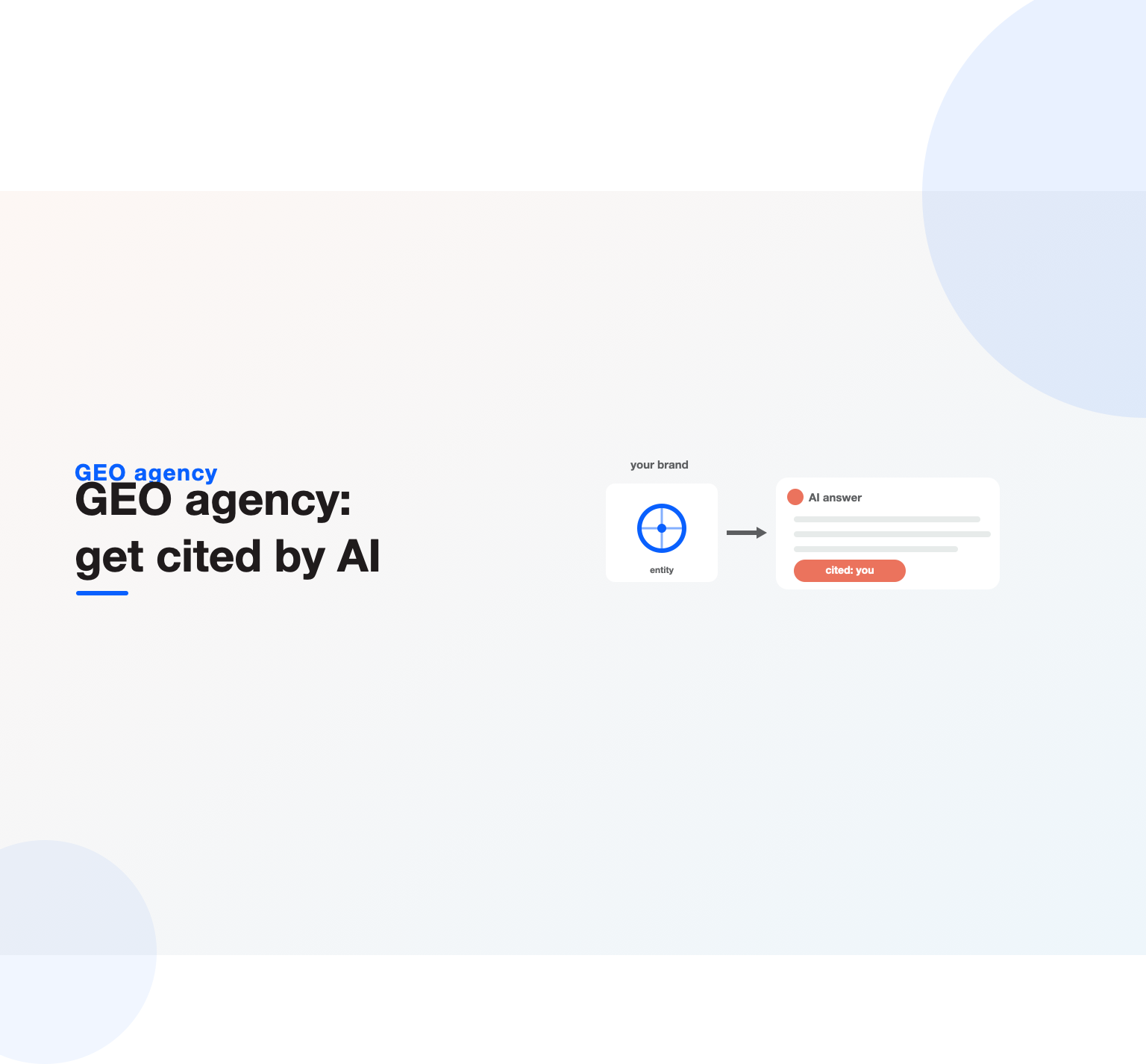
A GEO agency is a firm that specializes in generative engine optimization, the work of getting your brand surfaced and cited inside AI-generated answers from tools like ChatGPT, Perplexity, Gemini and Google AI Overviews. Unlike a traditional SEO agency focused on ranking blue links, such a partner optimizes for the way generative engines assemble answers: it strengthens your entity, structures content so models can extract and quote it, and earns the citations and trust that make an engine recommend you. Businesses hire the agency because buyers increasingly ask an assistant instead of scrolling a results page, and being named in that answer now decides who gets considered.
Key Highlights
- A GEO agency optimizes for being cited inside AI answers, not just ranked in traditional search results.
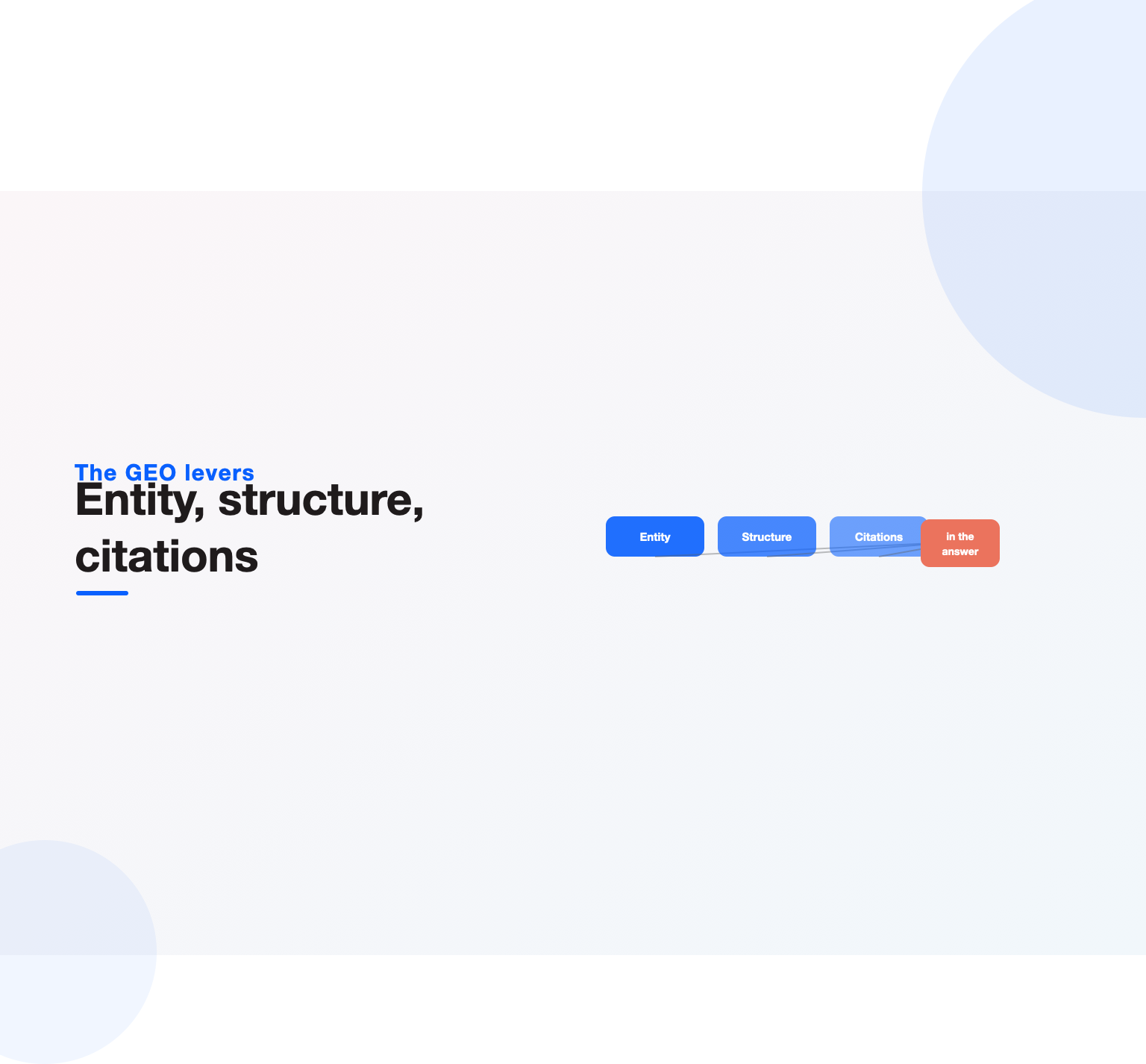
- The levers differ from classic SEO: entity strength, extractable content structure, and citations from trusted sources.
- Generative engines assemble answers from sources they judge authoritative, so a GEO partner builds that authority deliberately.
- Measurement shifts from rankings to citation share and presence in the answer sets for your priority questions.
- Watch for red flags: guaranteed placements in AI answers, secret tactics, and firms that cannot show real citations they earned.
What the firm actually does
The way people find information is shifting from a list of links to a synthesized answer. When someone asks a question, a generative engine reads across many sources, decides which brands and facts to trust, and produces a single response that names a few of them. A GEO agency exists to make sure your brand is among those named, by shaping your presence so the engines understand who you are, judge you credible, and can lift a clean, quotable passage from your content to attribute to you. It is optimization aimed at the answer itself, rather than at a position on a page few people now scroll.
This is a genuinely new discipline, not a rebrand of old tactics. Where a traditional agency works to move a page up the rankings, such a firm works to make a brand extractable and trustworthy to a model. That means auditing and strengthening the entity behind your business, restructuring content so answers can be pulled cleanly, and earning the third-party citations that generative engines weigh when deciding whom to cite. The goal is not a ranking screenshot but a place in the answer, which is a different target requiring different methods.
Businesses turn to a specialist because the category is young and moving fast, and because the cost of being absent is real. If an assistant lists three providers and yours is not one of them, the decision often happens without you, and no amount of traditional ranking necessarily fixes that. A GEO agency brings focused expertise to a surface that is reshaping how buyers research, which is why demand for the discipline has climbed sharply as adoption of AI answers has spread.
Why brands need generative engine optimization now
The urgency behind hiring a specialist comes from a change in behavior that is already well under way. A large and growing share of research now happens inside AI assistants and answer features, where the user reads a summary and acts on it without visiting a traditional results page at all. In that world, visibility means being cited in the answer, and the brands that earn those citations capture consideration while the rest become invisible regardless of their classic rankings.
What makes the moment pivotal is that authority in generative engines is still being decided. Since the surface is new, no incumbent has locked in dominance the way large sites have in classic search, so a brand that invests early in generative engine optimization can establish itself as a cited source before the space matures. That window is exactly why so many companies are engaging the partner now rather than waiting, since the citations and entity strength built today compound as the engines and their user base grow.
There is also a compounding relationship with the rest of search. The clean, authoritative content a capable partner builds tends to help classic rankings too, and the trust it earns supports visibility across answer engines and traditional results alike. Framed properly, generative engine optimization is not a separate silo bolted on but a forward-looking layer of a connected search strategy, which is how the strongest programs treat it.
The levers a GEO agency pulls
Effective generative engine optimization rests on a few foundations, and a competent GEO agency works all of them rather than leaning on one. Knowing the levers helps a business judge whether a prospective partner genuinely understands the discipline.
Entity strength. Generative engines need to understand who you are, what you do and whether you are authoritative on a topic. A GEO agency maps and strengthens your entity, ensuring consistent, accurate information about your brand across the sources engines already read, so a model can confidently identify and trust you as something worth citing.
Extractable content. Models quote content that is easy to lift, so a GEO agency structures pages for extraction: direct answers in the opening lines, question-shaped headings, crisp definitions, comparison tables and clean FAQ blocks. The aim is to make each important passage self-contained and quotable, so an engine can pull it and attribute it to your brand.
Citations and trust. Generative engines weigh what credible third parties say about you, so earning mentions, references and reviews across authoritative sources raises the odds an engine treats your brand as a safe recommendation. This off-site trust building is patient, reputation-driven work, and it is frequently what separates the brands that get cited from those that do not.
Measurement built for answers. Rankings cannot see AI citations, so a GEO agency tracks citation share, presence in the answer sets for your priority questions, and branded lift, querying the engines directly to see where and how your brand appears over time. That answer-focused measurement is what keeps the work accountable, and it sits naturally alongside broader AI search optimization reporting.
GEO agency versus a traditional SEO agency
The two overlap in foundations but differ in target, and understanding the distinction helps a business decide what it needs. A traditional SEO agency optimizes to rank your pages in the classic results, focusing on keywords, links and technical health to climb the list of links. A GEO agency optimizes to get your brand cited inside the generated answer, focusing on entity strength, extractable structure and the citations models trust. Both rely on clean, authoritative content, which is why the disciplines complement each other, but the second adds work aimed specifically at how engines synthesize answers.
In practice the strongest arrangement often combines them, because splitting the effort across two vendors duplicates the shared foundations and invites conflicting guidance. Many businesses are best served by a partner that runs classic SEO services and generative engine optimization as one connected program, so rankings and citations reinforce each other. Whether you engage a dedicated GEO agency or a full-service partner that has genuinely added the capability, the evaluation criteria are the same, since the goal, durable visibility in AI answers, does not change with the label on the door. It is also closely related to answer engine work, so a firm fluent in answer engine optimization is usually well placed to deliver both.
Do AI-generated answers recommend your competitors instead of you?
Our team reviews your current setup and shows you where the opportunities are. See how our GEO services work.
How to choose a GEO agency
With the category young and noisy, a structured evaluation protects you from paying premium fees for a relabeled service. Use the following as a scorecard.
Proof of earned citations. The single best signal is evidence that the agency has already put a brand into AI answers. Ask to see a client the engines now cite and the exact questions where that citation appears, and check it yourself. Live proof beats any deck, and its absence on a surface this measurable is telling.
A named method. A credible GEO agency can explain, in plain language, how it strengthens entities, structures content for extraction, and earns the citations engines trust. Secret or vague tactics are a warning rather than a sign of sophistication.
Engine coverage they will name. A confident partner names the engines it optimizes for and explains how the approach differs across them. A vague answer suggests they have not actually worked the surfaces.
Answer-based reporting. The agency should track citation share and presence in the answer sets for your questions, and show you that dashboard before you sign. Reporting that reverts to blue-link rankings misses the point of generative engine optimization.
Transparent, lock-in-free terms. You should understand exactly what you are buying, on what timeline, and be free to leave if it is not working. A candid consulting conversation should feel educational rather than evasive.
What a GEO agency costs
Pricing varies with competition, scope and goals, much as it does across search, and the structure follows a familiar shape: more effort upfront to audit and strengthen the entity, restructure priority content and set up answer-based measurement, then an ongoing rhythm of content, citation building and reporting. Be wary of two extremes, a suspiciously cheap package that likely means thin, ineffective work, and a premium fee justified only by the phrase generative engine optimization when the underlying service has not actually changed. The fair middle is a scope you can read line by line, priced against defined deliverables, and our broader SEO cost guide explains the models in depth.
Judge the investment by return rather than raw price. Being cited in the answers your buyers read can shape consideration long before a click, so a program that reliably increases your presence in those answers can be worth far more than its fee. A good GEO agency frames it that way and shows you the movement in citation presence, because the value is in the answer, not in a vanity metric.
Doing it in-house versus hiring a GEO agency
Both routes are possible, though the newness of the field pushes many businesses toward specialist help. Building generative engine optimization in-house is viable for a team with the time to learn a fast-moving discipline and the patience to experiment, but the tooling is still maturing and the learning curve is real, so progress can be slow while the team also does its day job. Hiring a GEO agency buys focused expertise and experience navigating a surface that changes quickly, at the cost of a fee and the need to choose a partner who genuinely understands the work.
A blend is common, with the business supplying subject-matter expertise while a partner handles the entity, structure, citation and measurement work. Whatever the split, the decision should rest on total value and the partner’s demonstrable grasp of generative engine optimization, and the evaluation approach in our guide on how to choose an agency for AI visibility applies directly. The through-line is the same: durable presence in AI answers, earned through entity strength, extractable content and genuine trust.
Measuring the results of generative engine optimization
With the target being the answer, measurement looks different from classic search, and a serious GEO agency makes that clear from the start. The core metrics are citation share, how often your brand is named or cited across the engines for your priority questions, presence in the answer sets for those questions, and branded lift as more people encounter your brand in answers. Tracking these means querying the engines directly for your target prompts and logging where and how you appear over time, since a rankings tool simply cannot see this surface. A partner that reports this way is measuring what matters, while one that quietly falls back to positions is not.
The long view matters too. Presence in AI answers builds as your entity strengthens and citations accumulate, so early movement often shows on narrower, lower-competition questions before spreading to broader ones. A GEO agency worth keeping frames the timeline honestly and shows the trend in citation presence, which is the clearest evidence that the investment is compounding on this new and fast-growing surface.
Red flags and how the field is evolving
A few signals reliably mark a GEO agency to avoid. Guaranteed placements in AI answers top the list, because no one controls what a model outputs, and a guarantee betrays a misunderstanding of how answers are sourced. Secret tactics are a second warning, since anything that cannot survive daylight rarely survives a model update. A pitch built entirely on your own website with no plan to earn outside citations misses the trust layer that decides most outcomes, and reporting that reverts to blue-link rankings when you asked about answer presence points the same way. As the field matures, expect measurement and best practices to keep evolving, and expect the brands that invested early in genuine entity strength, extractable content and real citations to hold their advantage. Because the same foundations feed broader AI search visibility, the work a good GEO agency does today prepares a brand for wherever generative search heads next.
Who needs this work, and when
Not every business should rush into the discipline on day one, and an honest partner will say so. The companies that benefit first are the ones whose buyers already ask assistants for recommendations: considered B2B purchases, professional services, software, healthcare and finance, categories where a person researches before they buy and increasingly opens that research with a question to ChatGPT or Perplexity rather than a search box. If your buyers behave that way, being absent from the answer is a quiet, compounding loss you cannot see in your rankings report. If they do not, the work still matters, but it can wait behind more urgent foundations. A candid partner helps you judge which case you are in rather than selling the service regardless, and a firm that also runs SEO consulting is usually comfortable giving that straight read.
Timing matters as much as fit. The advantage of moving while the surface is young is that authority, once earned, tends to persist, so the brands that get cited early keep getting cited as the category matures and competition arrives. Waiting until every rival has a presence means entering a contest that the early movers have already half-won. For a business whose buyers are already in these answers, the sensible move is to start small and deliberately now rather than large and late, an argument our guide on SEO for business makes for search investment generally.
What generative engine optimization looks like in practice
To make the discipline concrete, picture a company that ranks reasonably in classic search yet never appears when a buyer asks an assistant for a shortlist of providers. A specialist would begin by mapping the exact questions those buyers pose to the engines and checking which brands and sources currently get named in the answers. From there the work strengthens the brand entity so a model can confidently identify and trust the company, rebuilds the priority pages so each opens with a clean, quotable answer, and begins earning mentions on the sources the engines already lean on. Within a couple of months, the first citations tend to appear on the narrower, lower-competition questions where the field is thin, and over the following months presence spreads to broader, higher-value questions as authority accumulates. None of it is guaranteed on a fixed date, but the sequence is predictable, and a partner who can narrate it credibly is showing the map it actually uses.
The same example exposes a common failure mode. A firm that only publishes more articles, without touching entities or earning outside citations, produces content that may rank yet never gets cited, present in the index but absent from the answer. Closing that gap between ranking and citation is the entire point of the work, and watching whether a prospective partner addresses it, rather than promising more pages, tells you most of what you need to know. It also underscores why this sits naturally beside classic SEO services rather than replacing them, since the same clean foundations serve both goals at once.
How the work differs across engines
The foundations are shared, yet each generative surface has its own character, and a partner worth hiring can describe the differences without being prompted. Google AI Overviews lean heavily on established authority and on content that already performs in classic search, so strong technical health and topical depth carry real weight there. ChatGPT reflects both its training data and, in browsing modes, live sources, which rewards a durable, consistent presence across the web rather than a single optimized page. Perplexity is citation-first and visibly links its sources, making it the surface where clean, quotable pages and credible references pay off fastest. Gemini sits close to Google’s ecosystem and rewards clarity, structure and entity strength. A team that has genuinely worked these surfaces tailors its emphasis to each, and a firm fluent in AI search optimization understands why a page might get cited in one engine before it appears in another.
You do not need identical results everywhere to know the work is sound. What you want is a partner that understands why the sequence unfolds as it does and plans accordingly, since that judgment is a strong proxy for real experience on these surfaces. A relabeled keyword shop describes every engine the same way, while a genuine specialist speaks to their differences in specifics.
Want to be the brand generative AI recommends?
Book a free 30-minute strategy call and leave with a clear next step for your business.
Fitting the work into your wider strategy
Most businesses are not starting from zero; they already have search efforts, an agency relationship, or an in-house lead. The aim is to add this capability without a turf war or duplicated effort, and since the underlying assets are shared, the cleanest arrangement is one team accountable for both classic and generative visibility, working from a single content standard. If a separate vendor handles traditional search, insist the two coordinate on the same entity model and content structure, because conflicting guidance on those foundations is where budget quietly leaks. A partner that also delivers answer engine optimization is usually well placed to keep everything aligned, since answer engines and generative engines draw on the same signals.
Integration shapes measurement as well. When rankings and citations are reported in separate silos, the reinforcing relationship between them is lost, so a unified view, where classic rankings, citation share and answer presence sit together, makes it far easier to judge whether the investment is compounding. When you evaluate a partner, ask how it would connect the new answer-focused metrics to the search data you already watch, and how it would sequence the work so early wins fund later ones, a discipline our guide on SEO cost explores in depth.
Getting started and what to expect
A sensible engagement moves through recognizable phases rather than promising instant results. The opening weeks go to discovery and foundations: mapping the questions your buyers ask, auditing the entity, checking where engines currently source their answers, and standing up measurement so there is a baseline to improve on. The middle stretch focuses on execution, rebuilding priority pages for extraction, strengthening entity signals, and beginning the patient work of earning outside citations. The closing weeks read the early signals, double down on the questions showing movement, and plan the next cluster. A partner that cannot describe a shape like this, or that promises the finish line in week one, is not grounded in how citations are actually earned, and the evaluation questions in our guide on how to choose an agency for AI visibility help separate the genuine specialists from the rest.
Set expectations on cost and timeline honestly from the outset. This is a compounding investment whose returns build as entities strengthen and citations accumulate, so a first engagement should fund enough runway for the work to show rather than judging it after a single month. If early signals are good, scaling is straightforward; if they are not, a focused start means little was risked while much was learned, which is exactly how a business new to the discipline should approach it, much as our SEO for business guide advises for any considered investment.
Turning the decision into action
Once you have judged fit, timing and a shortlist of credible partners, the move from deliberation to a first engagement should be deliberate but not drawn out. Start by naming the handful of buyer questions where being cited would matter most, since those give any partner a concrete target and give you a clean way to measure progress. Ask each contender to walk through how it would approach exactly those questions, and favor the one whose answer names entities, structure and citations rather than volume of content. A focused first phase against a short list of questions keeps the risk small while the signal is real, and the fastest way to begin is to scope that work directly with a generative engine optimization team that can show its method.
Key Takeaways
- A GEO agency optimizes for being cited inside AI answers, a different target from a traditional agency’s blue-link rankings.
- Its levers are entity strength, extractable content structure, and citations from trusted third-party sources.
- The window is open because generative-search authority is still being decided, so early investment compounds.
- Measurement shifts to citation share and presence in the answer sets for your priority questions.
- Demand proof of earned citations and named methods, and reject guaranteed placements and secret tactics.
Frequently asked questions
Direct answers to the questions businesses ask most about generative engine optimization.
What is the difference between a GEO agency and an SEO agency?
An SEO agency optimizes to rank your pages in classic search results, while a GEO agency optimizes to get your brand cited inside AI-generated answers. They share foundations like clean, authoritative content, but generative engine optimization adds entity work, extractable structure and citation building aimed specifically at how models assemble and attribute answers.
Do I need a GEO agency if I already do SEO?
Increasingly yes, because a growing share of research happens inside AI answers where classic rankings do not guarantee a citation. The good news is that the two overlap, so the best arrangement is often one partner running both as a connected program, ensuring your rankings and your presence in AI answers reinforce each other rather than competing.
How do I know a GEO agency can actually get my brand cited?
Ask for a client it has pushed into AI answers and the exact live questions where that citation appears, then check the engines yourself. Because generative engine optimization is directly observable, genuine proof on live answers is the clearest evidence, and its absence is a reason to keep looking.
Which engines does a GEO agency optimize for?
A capable partner names the major generative surfaces, including Google AI Overviews, ChatGPT, Perplexity and Gemini, and explains how the work shifts across them since each sources answers a little differently. A firm that will not name the engines it targets has likely not worked those surfaces in practice.
How is success in generative engine optimization measured?
By citation share, presence in the answer sets for your priority questions, and branded lift, tracked by querying the engines directly for your target prompts and logging where and how your brand appears over time. Traditional rank tracking cannot see this surface, so answer-based measurement is essential.
How long does it take a GEO agency to show results?
Expect a few months, as entity strength and citations accumulate. Early movement often appears on narrower, lower-competition questions before spreading to broader, higher-value ones. Because presence compounds as the engines and their user base grow, starting early tends to pay off more than waiting.
Are guaranteed placements in AI answers a good sign?
No. No agency controls what a model outputs, so a guaranteed placement signals a misunderstanding of how answers are sourced. Favor a GEO agency that commits to a clear method and measurable movement in citation presence instead of a promise it cannot keep.
Can a small business benefit from generative engine optimization?
Yes. Because the surface is new and authority is still being decided, a focused small business that strengthens its entity, structures content for extraction and earns genuine citations can establish itself as a cited source before larger rivals, especially on the specific questions its ideal customers ask.
Ready to put this into practice?
Talk to the team that runs SEO, AI search and paid growth programs every day.
Book a Strategy Call →