 Skip to content

SEO Content Strategy: How to Build One That Ranks and Converts
An SEO content strategy ties every piece to real search demand and a business goal. Audience mapping, keyword research, topic clusters, the funnel, and the measure-and-refresh loop, step by step.
Quick Answer
An SEO content strategy is a documented plan for creating and organizing content that earns organic traffic and moves people toward becoming customers, built around real search demand rather than guesswork. Instead of publishing posts at random, you map the topics your audience searches, group them into interlinked clusters that build topical authority, decide what to create at each stage of the buyer journey, and set a process for producing, optimizing, measuring, and refreshing it all. A good SEO content strategy connects every piece of content to a keyword with genuine demand and a business goal, so the content library compounds into a durable acquisition channel instead of a scattered blog that never ranks or converts.
Key Highlights
- An SEO content strategy is a documented plan tying every piece of content to real search demand and a business goal, not a random publishing habit.
- Topic clusters, groups of related content interlinked around a pillar, build the topical authority that lets a site rank for competitive subjects.
- Content is mapped to the buyer journey, so you serve research, comparison, and decision stages rather than only top-of-funnel articles that never convert.
- Ranking content has to be genuinely better than what ranks now, answer-first, credible, and complete, because thin or derivative posts no longer compete.
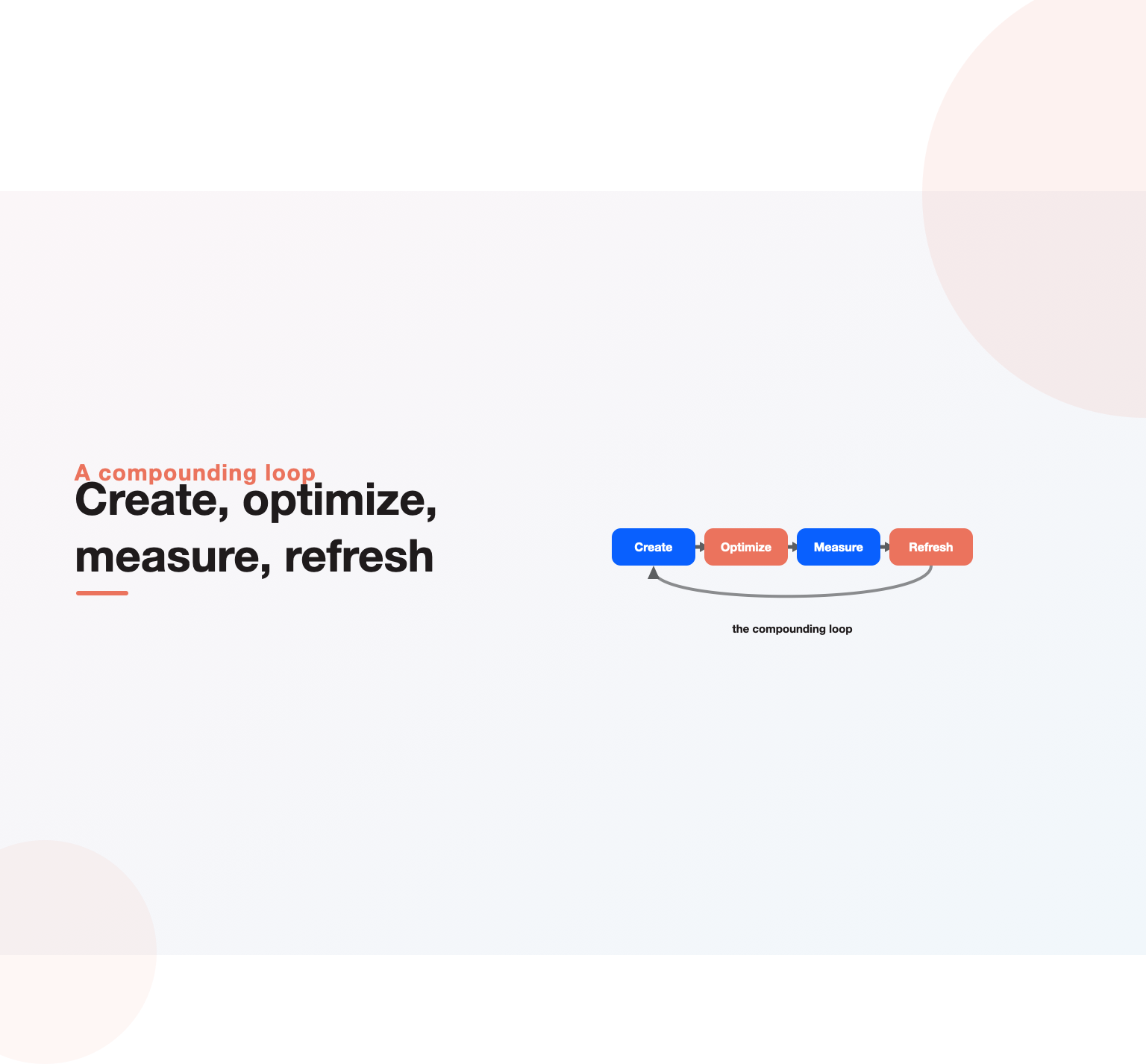
- The strategy is a loop: create, optimize, measure, and refresh or prune, so the library keeps improving instead of decaying.
What an SEO content strategy is
An SEO content strategy is the plan that governs what content you create, why, how it is organized, and how it drives results from organic search. It sits above individual pieces, defining the topics you will own, the audience you serve, the structure that connects everything, and the process for production and improvement. Where ad-hoc content marketing asks “what should we write this week,” a strategy answers “what should we own, in what order, and how will it rank and convert,” which is a completely different way of operating.
The core of any SEO content strategy is the link between search demand and business value. Every planned piece targets a real query people are searching, and every piece maps to a role in the business, whether that is attracting the right audience, building authority, or driving a conversion. That dual anchoring, real demand plus real goal, is what separates a strategy from a content calendar full of topics that felt good but serve no one. It turns content from a series of one-off bets into a system where each piece reinforces the others and the whole library grows in value over time, which is exactly what makes the effort worthwhile as our look at whether SEO is worth it argues.
Why you need a strategy, not just a blog
Publishing without a strategy produces predictable disappointment: scattered posts, no topical authority, no ranking momentum, and no clear line to revenue. Search engines reward sites that demonstrate genuine depth and authority on subjects, and you cannot build that by publishing disconnected articles on unrelated topics. A strategy concentrates effort so your content adds up to something search engines recognize as expertise, rather than a thin spread across topics you never fully cover.
The business case is just as strong. A strategy ensures you create content people actually search for, so the work earns traffic; it maps content to the buyer journey, so that traffic includes people who can become customers; and it ties production to goals, so you can measure return rather than vanity metrics. Without one, content marketing becomes a cost center that produces activity without outcomes. With one, it becomes the compounding channel that keeps delivering traffic and leads long after each piece is published, which is why the strategy is worth building before the writing starts.
Audience, goals, and the buyer journey
A strategy starts with who you are serving and what you want them to do. Define your target audience and the problems they are trying to solve, then map the questions they ask at each stage of their journey, from early research through active comparison to a buying decision. This mapping is the backbone of an SEO content strategy because it tells you not just which topics to cover but what kind of content each topic needs and where it fits in the path to becoming a customer.
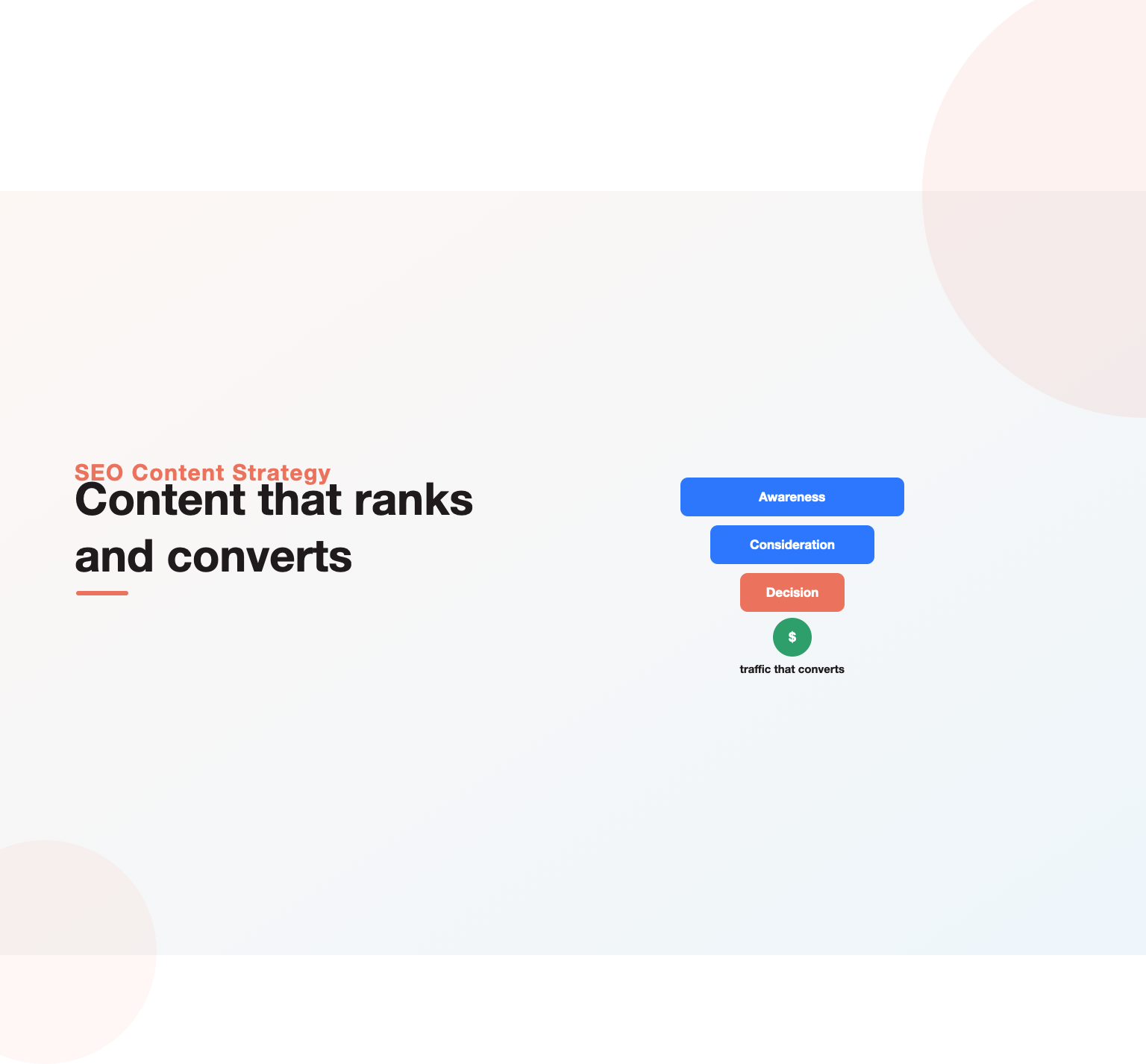
Tie every stage to a business goal so content has a purpose beyond traffic. Awareness content attracts people with a problem, consideration content helps them evaluate options, and decision content converts them, and each should link naturally toward the next step. Being explicit about goals also sets your priorities: a young site with revenue pressure may weight decision-stage and comparison content that converts sooner, while an established site invests more in broad authority-building topics. Either way, grounding the strategy in a real audience and real goals keeps it from drifting into content that is interesting but useless.
Keyword and topic research come first
With the audience mapped, research turns their questions into a concrete list of topics and target keywords with real demand. This is where you discover how your audience actually phrases things, which terms carry meaningful search volume, and which are realistic to rank for given your authority. The output is not a random keyword dump but a prioritized map of topics and the queries within them, grouped by theme and intent, which becomes the blueprint for everything you create.
Prioritization is the skill that matters here. Weigh each opportunity by demand, by how winnable it is given your site’s strength, and by how close it sits to a business outcome, then sequence the work so you pursue achievable, valuable topics first rather than chasing head terms you cannot yet rank for. This demand-first discipline is the foundation of the whole SEO content strategy, and the full method is covered in our keyword research guide. Skipping it is the single most common reason content fails, because content built on assumed rather than validated demand is content nobody was searching for.
Not sure why your pages are not ranking or bringing enquiries?
Our team reviews your current setup and shows you where the opportunities are. See how our SEO services work.
Topic clusters and content architecture
Research gives you topics; architecture decides how they connect. The most effective structure is the topic cluster, where a comprehensive pillar page covers a broad subject and a set of deeper pages each address a specific subtopic, all interlinked so the cluster reads as coherent expertise. This organization is what builds topical authority, signaling to search engines that your site covers a subject thoroughly rather than superficially, which is increasingly what it takes to rank for anything competitive.
Designing the architecture up front prevents the sprawl that undermines most content libraries. Decide which broad topics deserve a pillar, which subtopics each pillar needs, and how they will link together before you produce anything, so every new piece slots into a plan rather than floating alone. The links between pieces are not an afterthought but part of the strategy, which is why a deliberate internal linking approach is inseparable from an SEO content strategy: the clusters only build authority if the links actually connect them. Get the architecture right and each new piece strengthens the whole; get it wrong and you accumulate disconnected posts that never compound.
Matching content types to the funnel
Different goals need different content, so a strategy plans a mix rather than defaulting to blog posts for everything. Top-of-funnel content, guides, how-tos, and answers to broad questions, attracts a wide audience early in their journey and builds authority. Middle-of-funnel content, comparisons, in-depth resources, and use-case pages, helps people evaluating their options. Bottom-of-funnel content, product and service pages, case studies, and decision-focused material, converts people who are ready to act.
The mistake most sites make is producing only top-of-funnel articles, which brings traffic that never converts because nothing serves the people closer to a decision. A complete SEO content strategy deliberately covers all three stages and links them, so a reader who arrives on an awareness article can move to a comparison and then to a decision page as their intent sharpens. Matching content type to search intent also matters within a single topic: a query that wants a quick answer, a comparison, or a purchase each needs a different format, and giving searchers the format their intent implies is a large part of what makes content rank.
Creating content that ranks and converts
Strategy sets the targets; execution has to produce content genuinely better than what already ranks, because thin or derivative pieces no longer compete. That means leading with a clear answer to the query, covering the topic completely enough that a reader needs nothing else, and bringing real expertise, data, or perspective that sets the piece apart. Search engines increasingly reward the demonstrated experience and trustworthiness that Google describes in its helpful content guidance, so content that shows first-hand knowledge and credibility outperforms generic summaries assembled from the same sources everyone else used, and it is also the kind of content that naturally earns the links that lift a whole cluster.
Writing to convert as well as rank means keeping the business goal in view without sacrificing usefulness. Answer the searcher’s question fully and honestly, then guide them naturally toward the relevant next step, a related resource or the service that solves their problem, rather than forcing a sales pitch. Structure the piece so it is easy to read and easy for search engines to parse, with a clear hierarchy and an answer-first opening, and pair that with sound on-page SEO so the quality is legible to search engines, the same fundamentals our guide to how SEO works lays out. Content that is genuinely the best answer and quietly points to the next step is what turns a content library into a pipeline.
Optimization and internal linking
Publishing is the middle of the process, not the end, because content needs on-page optimization and connection to the rest of the site to perform. On-page work aligns each piece with its target query through the title, headings, and natural use of relevant terms, without keyword stuffing, so search engines understand what the page is about. This is craft applied to the strategy’s plan, making sure each piece is actually optimized for the query it was created to win, which is where a technical SEO checklist keeps the mechanics honest.
Internal linking then weaves each new piece into its cluster and routes authority toward priority pages, which is where content strategy and site structure meet. A new article should link up to its pillar, across to relevant siblings, and toward the commercial pages it supports, so it both strengthens the cluster and helps the money pages rank. Treating optimization and linking as integral steps, rather than things done haphazardly after publishing, is what lets a well-planned SEO content strategy actually deliver the authority and rankings the plan promised.
Planning production and cadence
A strategy only works if it gets executed consistently, which is where a content calendar and a realistic cadence come in. Plan what you will publish and when, sequencing pieces so clusters get built in a sensible order, pillars supported by their subtopics rather than published in isolation. Consistency matters more than raw volume: a steady, sustainable pace of genuinely good content outperforms sporadic bursts followed by silence, both for building momentum and for demonstrating an active, maintained site.
Match ambition to capacity so the plan survives contact with reality. It is better to publish fewer, deeper pieces that fully cover their topics than to flood a calendar with thin posts that never rank, so set a cadence you can maintain at quality. Build in time not only for new content but for updating existing pieces, since maintaining what you have published is part of the job. A calendar that balances new clusters with the upkeep of existing ones keeps the whole library healthy rather than letting older content decay while you chase the next post.
Measuring and refreshing
The final step turns the strategy into a loop that improves over time rather than a plan you execute once. Track the outcomes that matter, organic traffic, rankings for target topics, and conversions from content, and review them by cluster and by piece so you can see what is working and what is not. This tells you which topics to expand because they are performing, which pieces to improve because they are underperforming their potential, and which to rethink entirely.
Refreshing existing content is one of the highest-return activities in any Content strategy and the one most teams neglect. Because content decays as information ages and competitors improve, so updating strong pieces to keep them accurate, complete, and competitive often earns more than publishing something new. Prune or consolidate content that never found demand rather than leaving it to dilute the site. Treated as a loop, create, measure, refresh, and prune, the strategy compounds, with each cycle strengthening the library instead of just adding to it.
Tools for building an SEO content strategy
A strategy does not need a big stack, but a few tools make it far easier to ground in reality. Google Search Console shows which queries and pages already earn impressions and where you sit in striking distance, which is the best free signal for what to create and refresh next. A keyword tool such as Ahrefs or Semrush supplies demand and difficulty data so you can prioritize winnable topics, and your analytics platform ties content to conversions so you judge pieces by business outcomes rather than pageviews alone.
The tools serve the strategy rather than replacing it. Their job is to validate demand, reveal gaps, and measure results, but the decisions about which topics to own, how to cluster them, and what to create at each funnel stage remain yours. A common failure is buying a tool and mistaking its keyword export for a strategy, when the export is only raw material. Used well, the data keeps an Strategy honest, pointing effort at real opportunities and away from topics that feel important but have no demand behind them.
Strategy for a new site versus an established one
Where you are shapes what the strategy should prioritize. A newer site with limited authority wins by picking tightly-focused, lower-competition clusters and weighting content toward comparison and decision stages that can convert sooner, building topical authority in one area before expanding. Chasing broad head terms too early wastes effort on rankings the site cannot yet reach, which is why sequencing toward achievable, valuable topics matters most when authority is scarce, and why comparing that effort against paid channels in our SEO versus PPC breakdown helps set expectations.
An established site with real authority can invest more in broad, top-of-funnel topics that build reach, and it gains the most from systematically refreshing and expanding the clusters that already perform. Its bigger risk is neglect: a large content library decays without maintenance, so the strategy shifts toward auditing, updating, and consolidating alongside new production. The same principles apply at any stage, but the balance between building authority, capturing demand, and maintaining what exists changes with how much authority you have already earned.
Running the strategy as a team
A strategy that lives in one person’s head does not survive contact with a busy team, so documenting it is part of the work. Write down the topics you are targeting, the clusters and their pillars, the funnel role of each piece, and the standards every piece must meet, then keep it in a shared calendar so production stays sequenced and accountable. Clear briefs that specify the target query, intent, and internal links for each piece keep quality consistent as more people contribute.
Ownership and cadence keep the loop turning. Someone needs to own the strategy, guard the quality bar, and run the measure-and-refresh cycle, or the plan quietly degrades into ad-hoc publishing again. This operational discipline is what lets a content program scale, whether the output is editorial guides, the category and product content that ecommerce SEO depends on, or the large sets of pages behind programmatic SEO. A documented, owned, and measured strategy is the difference between a content operation that compounds and one that stalls the moment attention drifts. The teams that win treat the plan as a living document, revisited every quarter against the data, so the strategy evolves with the site rather than gathering dust while publishing quietly reverts to guesswork.
Want a team to run this SEO work for you?
Book a free 30-minute strategy call and leave with a clear next step for your business.
SEO content strategy for AI search
The rise of AI Overviews and answer engines changes how content earns visibility, but it rewards the same fundamentals a good Content plan already builds. Comprehensive, well-structured, genuinely authoritative content, organized into clear topic clusters, is exactly what AI systems draw on to generate and cite answers, so a strategy built for depth and authority is well positioned for AI search without being rebuilt. Answer-first writing and clear structure, which help human readers and search engines, also make content easy for AI systems to extract and cite.
The adaptation is mostly in measurement and emphasis: track presence in AI answers alongside traditional rankings, and lean into the depth and credibility that answer engines favor, since thin content that once scraped by is unlikely to be surfaced by systems built to find the best answer. This reinforces rather than replaces the strategy, and when we build content programs for clients through our content writing services, they are designed to rank in search and earn citations in AI answers together, connected to the wider SEO services program so content, authority, and technical health pull in one direction.
Common SEO content strategy mistakes
A few recurring errors undo otherwise reasonable efforts. Publishing without validated demand tops the list, since content built on assumed keywords earns nothing no matter how well written. Producing only top-of-funnel articles brings traffic that never converts because nothing serves buyers. Spreading thin across unrelated topics prevents the topical authority that ranking now requires. And treating publishing as the finish line, with no optimization, internal linking, or refreshing, leaves content underperforming its potential and decaying over time.
The deeper mistake behind most of these is treating content as a volume game rather than a strategic one. Chasing a post count, copying competitors without understanding why their content works, and never measuring or improving what you publish all stem from mistaking activity for strategy. The fix is the discipline this guide describes: tie every piece to real demand and a goal, build clusters that compound, create genuinely better content, and run the measure-and-refresh loop. Avoiding these traps is most of what separates content that becomes an asset from content that becomes a graveyard of posts nobody reads.
Key Takeaways
- An The plan ties every piece of content to validated search demand and a business goal, replacing random publishing with a deliberate, compounding system.
- Build topical authority with clusters, pillar pages supported by interlinked subtopics, rather than scattering posts across unrelated subjects.
- Map content to the whole buyer journey and match format to intent, so you serve research, comparison, and decision stages rather than only top-of-funnel articles.
- Create content genuinely better than what ranks now, answer-first, credible, and complete, then optimize it and link it into its cluster and toward money pages.
- Run it as a loop, measure, refresh strong pieces, and prune dead ones, so the library keeps improving and stays positioned for both traditional and AI search.
Frequently asked questions
What is an SEO content strategy?
An Content program is a documented plan for creating and organizing content that earns organic traffic and drives business results, built around real search demand rather than guesswork. It maps the topics your audience searches, groups them into interlinked clusters that build topical authority, matches content to each stage of the buyer journey, and sets a process for producing, optimizing, measuring, and refreshing it, so the content library compounds into a durable acquisition channel.
How is an SEO content strategy different from content marketing?
Broadly, content marketing is the practice of creating and distributing content, while an Content strategy is the specific plan that ties that content to search demand and organic performance. The difference is discipline: a strategy ensures every piece targets a real query and a business goal, is organized to build topical authority, and is measured and improved over time, rather than being published on whatever topic seems interesting without a plan behind it.
How do I build an SEO content strategy?
Start by defining your audience, goals, and the questions they ask across the buyer journey, then research keywords and topics with real demand and prioritize them by winnability and business value. Organize those topics into interlinked clusters around pillar pages, plan the content types and cadence, create content genuinely better than what ranks, optimize and internally link each piece, and measure and refresh continuously. The steps in this guide walk through each stage in order.
What are topic clusters?
Topic clusters are groups of related content organized around a central pillar page that covers a broad subject, with deeper subtopic pages linking up to it and to each other. This structure builds topical authority by signaling to search engines that your site covers a subject comprehensively rather than superficially, which is increasingly what it takes to rank for competitive topics. Clusters are the backbone of a modern Strategy.
How much content do I need for SEO?
There is no fixed number; depth and quality matter far more than volume. A smaller set of comprehensive, well-organized pieces that fully cover their topics and interlink into clusters will outperform a large pile of thin, disconnected posts. The right amount is however much it takes to cover your priority topics thoroughly at a quality you can sustain, published at a consistent cadence rather than in sporadic bursts.
How long does an SEO content strategy take to work?
Results build over months rather than weeks, as search engines crawl, evaluate, and rank new content and as your clusters accumulate authority. Newer sites and more competitive topics take longer, while lower-competition topics can rank sooner. Because content compounds, the returns accelerate over time as the library grows and strengthens, on the same curve as how long SEO takes to work, which is why consistency and patience matter as much as the quality of any single piece.
Should I update old content or publish new content?
Both, and the balance is important. Refreshing existing content to keep it accurate, complete, and competitive is one of the highest-return activities in SEO and often earns more than a new post, because it builds on authority a page has already accumulated. A healthy strategy budgets time for updating and consolidating existing pieces alongside creating new clusters, rather than only ever chasing the next publish and letting older content decay.
Does an SEO content strategy help with AI search?
Yes, because AI Overviews and answer engines rely on the same fundamentals a good strategy builds: comprehensive, well-structured, authoritative content organized into clear clusters. Content built for genuine depth and authority is well positioned to be surfaced and cited by AI systems without being rebuilt. The adaptation is to track presence in AI answers alongside rankings and to lean into the credibility and depth that answer engines favor over thin content.
Ready to put this into practice?
Talk to the team that runs SEO, AI search and paid growth programs every day.
Book a Strategy Call →