 Skip to content

How to Rank in ChatGPT: A Practical Guide
How to rank in ChatGPT: there is no fixed list, so you earn a mention. How ChatGPT picks brands to name, and the steps that make yours one of them.
Quick Answer
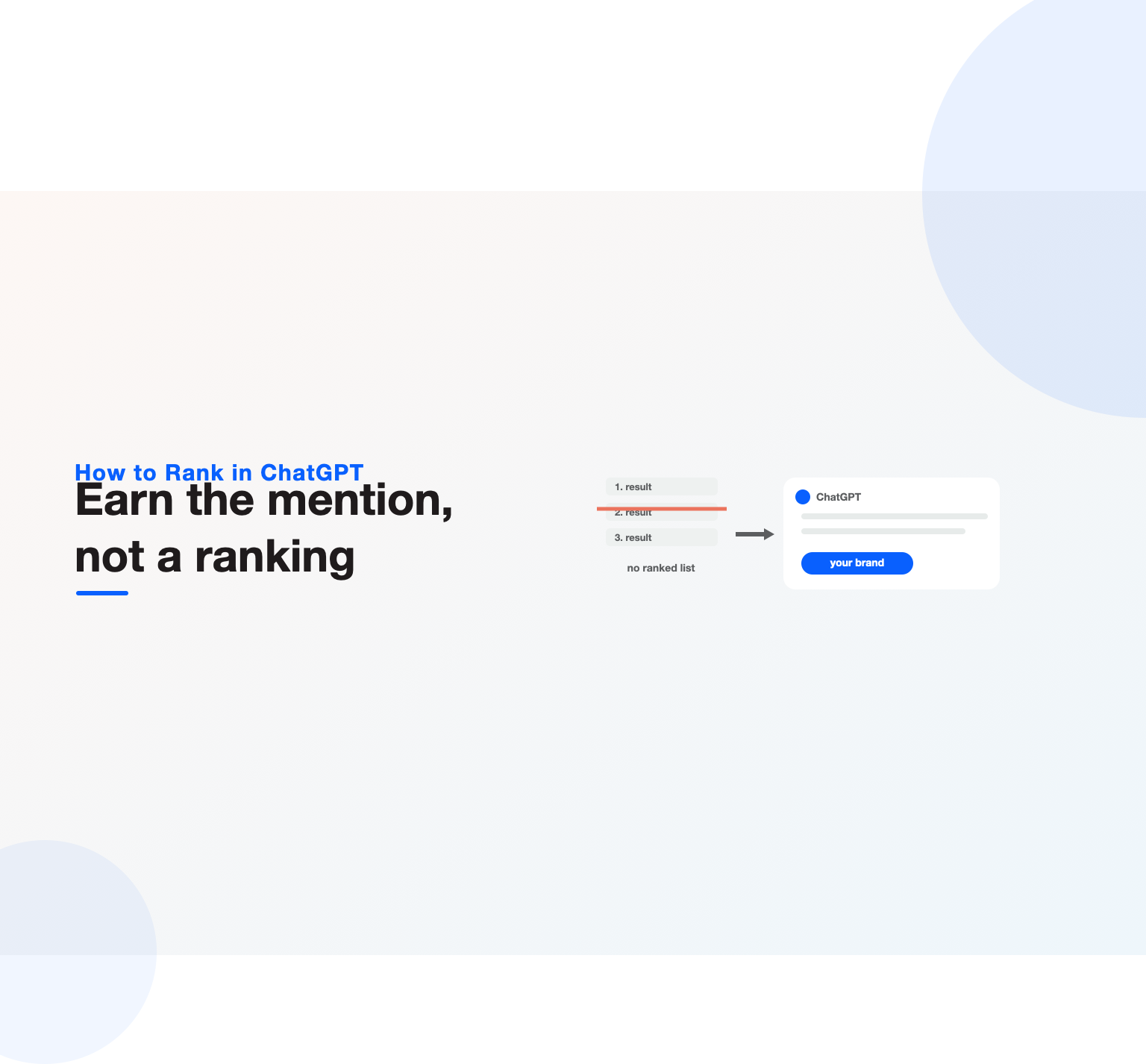
Learning how to rank in ChatGPT means understanding that there is no ranked list to climb; instead, you earn a place in the answer ChatGPT generates by being a source it knows, trusts, and can cite when someone asks about your category. It draws on its training data, on live web results when it browses, and on the broad consensus about brands across the internet, so you become visible by being genuinely authoritative, widely referenced, clearly written, and technically accessible. Rather than gaming a ranking algorithm, you win by deserving the mention: publish content that is the best answer to real questions, build a credible brand that many trustworthy sources reference, and make sure your pages are easy for ChatGPT’s systems to read.
Key Highlights
- There is no ranked list to climb; you win by being a source it recommends or cites in the answer it generates, which is a new kind of visibility.
- It draws on training data, live web browsing, and the wider consensus about brands, so both long-term authority and current, crawlable content matter.
- The brands ChatGPT names tend to be the ones many credible sources already reference, so third-party mentions and reputation carry real weight.
- Clear, accurate, answer-first content that a model can extract is far more citable than thin or promotional pages.
- You measure success by asking ChatGPT your audience’s real questions and tracking whether it surfaces you, then improving the gaps.
What it means to rank in ChatGPT
The first thing to get straight about how to rank in ChatGPT is that ranking is the wrong mental model. The assistant does not return a ranked list of links; it generates an answer, and within that answer it may name brands, recommend options, and, when it browses, cite sources. So visibility here means being part of the generated response, mentioned as a good option or cited as a source, rather than sitting at position one for a keyword. The goal quietly shifts from earning a ranking to earning a recommendation.
That reframing changes the whole approach. Since there is no ranked list, you cannot optimize a single page to a position; instead you influence a model that has absorbed a vast amount of information about your category and, when browsing, pulls live results. Becoming visible means being the kind of source that shows up strongly across that information: known in the training data, referenced by credible third parties, and present in crawlable, current content the model can retrieve. Understanding how to rank in ChatGPT therefore starts with accepting that you are earning a place in an answer, not climbing a list, which is the same shift our guide to broader AI visibility describes.
How ChatGPT surfaces brands and sources
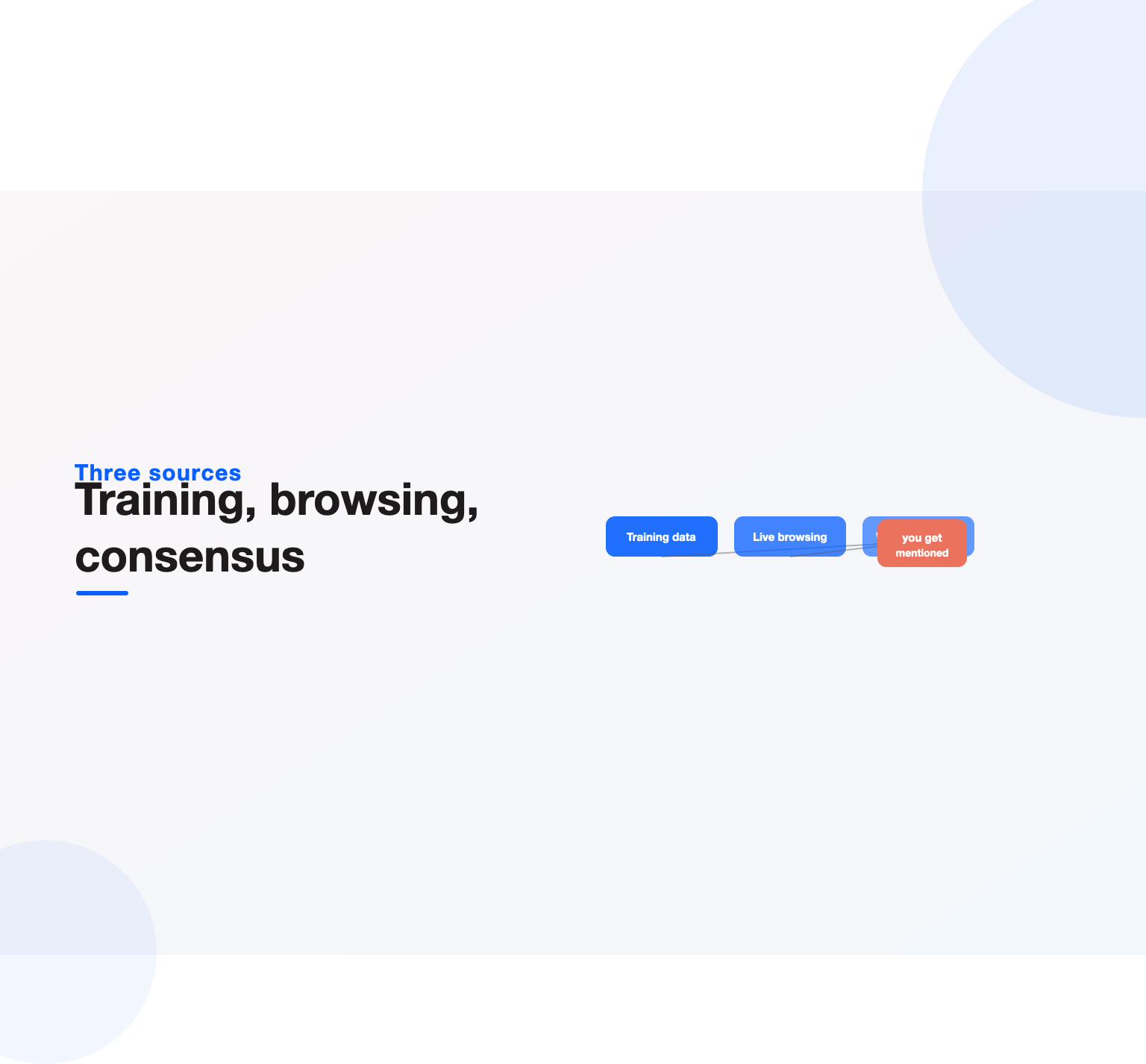
To work out how to rank in ChatGPT, it helps to know where its answers come from, which is broadly three places. The first is training data: the large body of text the model learned from, which shapes what it knows about brands, products, and topics, including which names come up when a category is discussed. The second is live web browsing: when ChatGPT, built by OpenAI, searches the web to answer a question, it can pull and cite current sources, so your crawlable content can directly enter an answer. The third is the aggregate consensus of the internet, since a model trained on vast text tends to reflect what many sources agree on.
Each source suggests a lever. You cannot edit training data, but you can build the sustained authority and third-party presence that make you part of what the model learned, and you can influence the live-browsing side directly by keeping crawlable, current, relevant content. The consensus effect means being widely and positively referenced across credible sources matters, because the model reflects that breadth. Anyone serious about how to rank in ChatGPT works all three: long-term authority, crawlable current content, and a broad, credible reputation, through the tools ChatGPT itself exposes and the wider web it reads, which is the core of a generative engine optimization program.
Being present where ChatGPT looks
A practical part of how to rank in ChatGPT is simply being present, and readable, wherever the model gathers information. On the live-browsing side, that means your content must be technically accessible: present in the served HTML rather than hidden behind client-side JavaScript, on fast, crawlable pages that the crawlers behind AI browsing can actually read. Content locked behind rendering can be invisible to these systems even when human visitors see it, which is the same issue covered in our work on JavaScript SEO.
On the training-and-consensus side, presence means being referenced across the credible sources a model is likely to have learned from: industry publications, respected communities, reference sites, and the broader web where your category is discussed. A brand that is widely and accurately represented across the internet is one the model is more likely to know and mention. So being present is both a technical matter, making your own pages readable, and a reputational one, being part of the wider conversation, and both feed how reliably ChatGPT can surface you when it matters.
Building the authority ChatGPT trusts
Authority sits at the center of how to rank in ChatGPT, because the model leans toward sources and brands that appear credible and are widely referenced. That authority is built the same way it is everywhere: by consistently publishing genuinely expert content, earning references and links from reputable places, and maintaining a coherent, trustworthy presence over time. The links and mentions a strong authority-building approach earns are part of the broader record that shapes what a model knows and trusts about you.
Crucially, this authority compounds and cannot be faked quickly, which is why it is defensible. A brand that steadily becomes a recognized, cited voice in its category builds a reputation the model increasingly reflects, while brands hoping for a shortcut find there is none. Since ChatGPT tends to mirror the consensus of credible sources, the work of becoming genuinely well-regarded, not just self-promotional, is exactly the work that makes you visible in its answers. The through-line of how to rank in ChatGPT is that earned authority, not clever tricks, is what the model rewards.
Do AI-generated answers recommend your competitors instead of you?
Our team reviews your current setup and shows you where the opportunities are. See how our GEO services work.
Creating content ChatGPT can use
Content is the raw material of how to rank in ChatGPT, and the content that gets used is clear, accurate, comprehensive, and easy for a model to extract. Leading with a direct answer to a question and then expanding on it gives the model a clean, quotable passage, while burying the point in a long, vague section makes it harder to lift and cite. Well-structured content with clear headings that map to real questions, and factual statements that stand on their own, is far more usable than promotional prose that says little.
Depth and accuracy matter as much as structure. Content that genuinely and thoroughly answers the questions your audience asks gives the model more reason to draw on you across many specific queries, and accuracy protects you, since a model built to be helpful is cautious about unreliable sources. This is the same answer-first, well-organized approach that wins featured snippets and AI Overviews, so it pays off across surfaces rather than only in ChatGPT, echoing how the same fundamentals win visibility in Claude and Gemini, and reflecting our guide to building an SEO content strategy. Making your genuine expertise easy to extract is a large part of how to rank in ChatGPT without any tricks.
Earning the third-party mentions that shape answers
One distinctive aspect of ChatGPT visibility is that your own content is not the whole story; what others say about you across the web matters a great deal, because the model reflects consensus. If credible publications, communities, and reference sources mention your brand as a leader in your category, the model is more likely to surface you when asked, even if the reference is not on your own site. This makes digital PR, genuine thought leadership, and being part of respected industry conversations directly relevant to AI visibility.
The practical implication is to pursue the kind of earned presence that builds a broad, positive footprint: original research and data that others cite, expert contributions to respected outlets, presence in the communities and lists where your category is discussed, and genuinely useful resources people reference. This is not about spraying mentions everywhere but about becoming a name that credibly recurs where your market pays attention. Because ChatGPT synthesizes what many sources say, the breadth and quality of your third-party reputation is one of the strongest levers in being surfaced by ChatGPT, and it doubles as ordinary brand-building.
Measuring your visibility in ChatGPT
You cannot manage showing up in ChatGPT without measuring it, and the most direct method is to ask ChatGPT the questions your audience asks and see how you fare. Build a list of the real questions buyers and researchers pose in your category, comparisons, recommendations, and how-to-choose questions, then put them to ChatGPT and record whether your brand is mentioned or cited, how it is described, and which competitors appear instead. Repeating this across a consistent set of questions over time turns it into a trackable audit.
That audit tells you exactly where to focus. The questions where you should be surfaced but are not become your content, authority, and PR priorities, and watching which competitors ChatGPT names shows you what is winning. Tracking your ChatGPT presence alongside your visibility in other assistants and traditional search gives a complete picture as behavior shifts, which is the same discipline described in our approach to measuring AI visibility across every surface. Treated as a metric rather than a guess, your standing in ChatGPT becomes something you can deliberately and steadily improve.
Ranking in ChatGPT for B2B and considered purchases
The value of showing up in ChatGPT is highest for B2B and considered purchases, where buyers research thoroughly before deciding and increasingly use assistants to build shortlists. When a buyer asks ChatGPT which providers or tools to consider in your category, being named puts you on the shortlist at the exact moment it forms, which can matter more than a click from a casual search. That aligns closely with how modern B2B SEO already works, targeting high-intent research rather than raw volume.
For these audiences, the priority is the specific questions a serious buyer would ask, the comparisons, the how-to-choose questions, the honest trade-offs, answered with genuine depth and balance. Thin marketing content fails both the buyer and the model, while credible, expert content earns the mention and the trust behind it. Since the model reflects consensus, being the provider that respected industry sources treat as a leader is what tips the answer your way, so B2B visibility in ChatGPT is as much about reputation as it is about your own pages.
ChatGPT memory, custom GPTs, and your brand
Beyond the main assistant, ChatGPT includes features that shape how your brand appears, and they are worth understanding. Custom GPTs and the broader ecosystem of assistants built on the same model can surface brands within specialized contexts, so being a recognized, well-documented source increases the chance you appear across these variants, not just the default chat. As these tailored assistants proliferate in workflows and products, the reach of being a trusted source in the underlying model compounds.
The practical takeaway is that you are optimizing for a model that appears in many places, not a single interface, which reinforces the same fundamentals. A brand that is genuinely authoritative and well-represented across the web tends to surface wherever that model is used, from the main app to embedded and custom assistants. Rather than chasing each surface separately, building real authority and clear, accessible content makes you visible across the whole ecosystem the model powers, which is the efficient way to think about it.
A step-by-step plan to earn ChatGPT visibility
A concrete plan turns this from theory into action. Start by auditing where you stand: ask ChatGPT the real questions your audience would pose and record whether it mentions you, establishing a baseline. Next, make sure your important content is technically accessible, present in server-rendered HTML, fast, and not blocked, so the crawlers behind browsing can read it. Then identify the questions where you should be surfaced but are not, and improve or create the clear, authoritative, answer-first content that would earn the mention.
From there, invest in the reputation the model reflects: pursue credible third-party coverage, original research others cite, and a consistent, expert brand presence, then keep your best content current and re-audit regularly to track progress. Since none of this fights your existing SEO, the effort compounds across search and every assistant at once, which is why coordinating it within a full AI search optimization program is more efficient than treating each engine as a separate project. Followed consistently, this plan is the reliable path to being the brand ChatGPT names.
How ranking in ChatGPT differs from traditional SEO
It is worth being clear on how earning a mention in ChatGPT differs from classic SEO, because the differences shape strategy. Traditional SEO targets a position in a list of links for a query, measured by rankings and clicks, while visibility in ChatGPT is about being part of a generated answer, measured by whether and how you are mentioned. You optimize a page for a keyword in classic SEO; for ChatGPT you influence a model shaped by your whole footprint across the web, which is broader and slower to move.
Yet the two rest on the same foundations, which is the reassuring part. The authoritative, clear, well-structured, technically accessible content that ranks in Google is largely what ChatGPT draws on too, so good SEO is most of the work. The differences are in emphasis, more weight on third-party consensus and brand reputation, and in measurement, checking answers rather than rankings. This is why the deeper discipline of ChatGPT SEO builds on classic SEO rather than replacing it, and why investing in fundamentals pays off across both surfaces at once.
Reputation, reviews, and where visibility forms
Since a model reflects what many sources say, the places your reputation forms matter as much as your own website. Reviews, community discussions, industry roundups, and reference sites all feed the broad picture a model builds of your category, so a brand spoken well of across these places is more likely to be surfaced than one that only talks about itself. This is why genuine word of mouth, honest reviews, and presence in the communities where your buyers gather translate into AI visibility, not just brand warmth.
The practical move is to earn a credible, consistent presence wherever your market pays attention, and to make sure the picture is accurate and current. That means encouraging authentic reviews, contributing genuine expertise to respected outlets, and being part of the conversations that define your category, rather than chasing mentions for their own sake. Built patiently, this reputation compounds into the consensus a model reflects, and it is far more durable than anything you could manufacture, which is a large part of why SEO is not dead but evolving toward reputation and genuine authority.
Keeping your content current for ChatGPT
For the questions where recency matters, comparisons, pricing, features, and best-of-the-moment queries, keeping content current improves the odds of being surfaced when the assistant browses, and it signals that your brand is active and reliable rather than dormant. Maintaining and updating your key content is therefore part of the work, especially in fast-moving categories where the right answer changes over time, and it pairs with tracking your presence the way any good SEO reporting tracks performance over time.
This does not mean churning out updates for their own sake, which adds nothing. It means keeping the content that answers time-sensitive questions accurate and revisiting cornerstone pieces so they stay comprehensive and correct, the same measure-and-refresh discipline that keeps any content library healthy over the long term and connected to a sound SEO foundation. A brand that keeps its best content current gives the assistant an accurate, up-to-date source to trust, which is exactly what it wants to surface.
Want to be the brand generative AI recommends?
Book a free 30-minute strategy call and leave with a clear next step for your business.
Common mistakes when trying to rank in ChatGPT
Several mistakes undermine efforts at this. The first is trying to manipulate rather than deserve the mention, publishing thin or keyword-stuffed content in hopes of being cited, which fails because the model surfaces genuinely useful, trustworthy sources. The second is focusing only on your own site while ignoring the third-party reputation the model reflects, so you build content nobody references. The third is neglecting technical accessibility, so the crawlers behind browsing cannot read your pages.
Two more errors are common. Many brands do not measure at all, so they have no idea whether ChatGPT mentions them or how that is changing, and cannot improve deliberately. And some treat ChatGPT as entirely separate from their SEO, missing that the same content quality, authority, and technical health drive both. Avoiding these traps is most of the battle: take the surface seriously, build on solid SEO and reputation rather than against them, and do the honest work of becoming a source worth citing, which is exactly what the model is designed to reward. That mindset, more than any trick, is ranking in ChatGPT.
Does this work for small businesses?
Small and niche businesses often assume assistants only name big brands, but the opposite is frequently true: because a model surfaces the most relevant, credible source for a specific question, a focused smaller business can be the one it cites for its specialty. When the query is specific, a genuinely expert niche brand with clear, authoritative content can outshine a large generalist competitor that covers the topic only shallowly. The rising bar rewards genuine expertise regardless of size.
For a smaller business, the winning move is depth in a well-defined niche rather than competing on breadth: cover your specialty comprehensively, earn credible mentions within your niche community, and keep your content accurate and accessible. That focus is exactly what makes a brand the obvious answer to a specific question, and it is far more attainable than trying to be everything to everyone. So visibility in ChatGPT is not reserved for the biggest players; it is available to any brand willing to be genuinely the best, clearest source for the questions it can credibly own.
Key Takeaways
- Ranking in ChatGPT is not climbing a list; it is earning a place in the answer it generates, as a mentioned or cited source.
- ChatGPT draws on training data, live browsing, and the wider consensus about brands, so long-term authority, crawlable content, and third-party reputation all matter.
- Create clear, accurate, answer-first content a model can extract, and make sure it is technically accessible in the served HTML.
- Earn credible third-party mentions, because the model reflects what many trustworthy sources say about you, not just your own pages.
- Measure by asking ChatGPT your audience’s real questions and tracking whether it surfaces you, then close the gaps with content, authority, and PR.
Frequently asked questions
How do you rank in ChatGPT?
You do not rank in the traditional sense, because ChatGPT generates an answer rather than a ranked list. You earn a place in that answer by being a source it knows and trusts: publish clear, accurate, authoritative content that answers real questions, build a credible brand that many reputable sources reference, and make sure your pages are technically accessible to the crawlers behind its browsing. In short, you win by genuinely deserving the mention rather than gaming an algorithm.
Does ChatGPT use live web data?
It can. ChatGPT has broad knowledge from its training data and can also browse the web to bring in current information and cite sources when a question benefits from being up to date. That is why visibility works on two horizons: building long-term authority that informs the model’s general knowledge, and keeping crawlable, current content that can be surfaced and cited in its live browsing. Both matter, so a complete approach addresses each.
Why does ChatGPT recommend some brands and not others?
Because it reflects the information and consensus it has absorbed, ChatGPT tends to name brands that are widely and credibly referenced across the web and that publish clear, authoritative content. If many trustworthy sources treat a brand as a leader in its category, the model is more likely to surface it. That is why third-party reputation and genuine authority matter so much: the model mirrors what the credible internet broadly says about you.
How is ranking in ChatGPT different from Google SEO?
Google SEO targets a position in a list of links for a query, measured by rankings and clicks, while visibility in ChatGPT means being part of a generated answer, measured by whether you are mentioned or cited. You optimize a specific page for Google, but for ChatGPT you influence a model shaped by your entire footprint across the web. The foundations overlap heavily, so good SEO is most of the work, with extra weight on reputation and consensus.
Can I pay to appear in ChatGPT answers?
Organic mentions in ChatGPT’s answers are earned, not bought, so you cannot simply pay for a recommendation in the way you buy an ad. Visibility comes from being a genuinely authoritative, widely referenced, well-documented source that the model draws on. That makes the work more durable than advertising, because it rests on real reputation and content quality rather than a budget, and it cannot be switched off by a competitor outbidding you.
How long does it take to become visible in ChatGPT?
It varies, because part of your visibility depends on long-term authority and reputation that build over months, while the live-browsing side can reflect fresh, crawlable content more quickly. Improving technical accessibility and publishing strong content can help sooner, but becoming a brand the model reliably names across many questions is a compounding, longer-term effort. Like the rest of SEO, it rewards sustained investment rather than delivering instant results.
Do I need a separate strategy for ChatGPT?
Not entirely, because the fundamentals overlap heavily with good SEO: authoritative, clear, well-structured, accessible content and a strong reputation serve both. What ChatGPT adds is emphasis on third-party consensus and brand reputation, and a different way of measuring success by checking answers rather than rankings. So you extend your existing strategy to cover this surface rather than building a wholly separate one, which keeps the effort efficient and mutually reinforcing.
How do I check if ChatGPT mentions my brand?
Ask it. Build a list of the real questions your audience would pose in your category and put them to ChatGPT, recording whether your brand is mentioned or cited, how it is characterized, and which competitors appear instead. Repeating this regularly across a consistent set of questions shows where you are present, where you are absent, and whether your visibility is improving, turning it into a metric you can act on rather than a matter of guesswork.
Ready to put this into practice?
Talk to the team that runs SEO, AI search and paid growth programs every day.
Book a Strategy Call →