 Skip to content

GEO for Law Firms: Get Your Firm Recommended by AI
GEO for law firms optimizes your content and reputation so AI assistants recommend and cite your firm when clients ask for legal help. Why trust is decisive, what content wins, and how to measure it.
Quick Answer
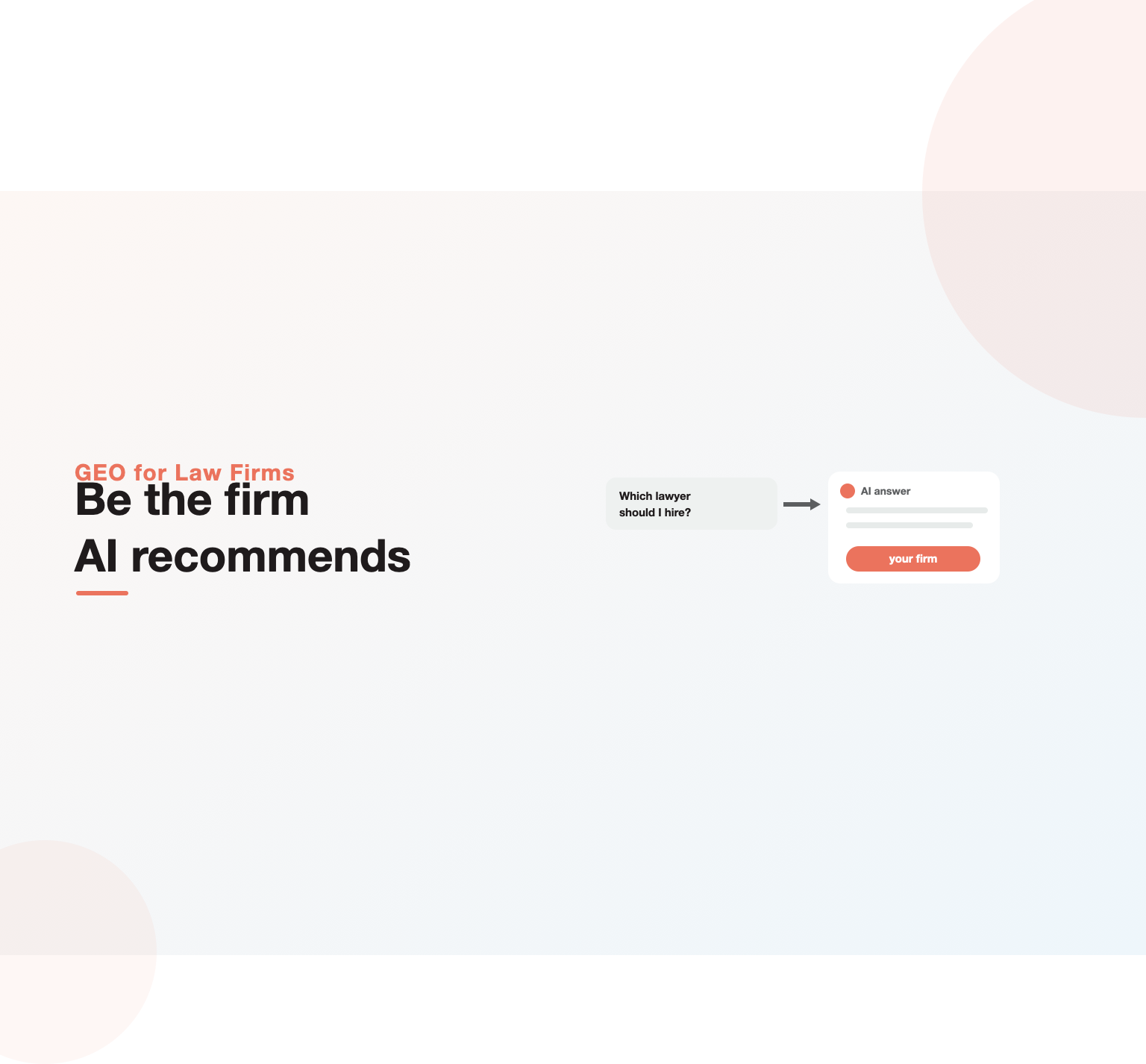
GEO for law firms is the practice of optimizing a firm’s content and reputation so that generative AI assistants like ChatGPT, Gemini, Perplexity, and Google’s AI answers recommend and cite the firm when people ask for legal help. It matters because prospective clients increasingly ask AI which lawyer or firm to consider for their situation, and the firms those assistants name gain trust at the exact moment someone is choosing representation. Because legal decisions are high-stakes, AI systems lean hard on signals of expertise, authority, and trustworthiness, so winning here means publishing genuinely authoritative practice-area content, earning a credible reputation, and making sure your pages are accessible to the systems that generate these answers.
Key Highlights
- GEO for law firms means being recommended and cited by AI assistants when prospective clients ask them for legal help, a new and high-trust visibility surface.
- Since legal choices are high-stakes, AI systems weight expertise, authority, and trust heavily, so credibility matters even more than in most industries.
- The content that wins is genuinely authoritative practice-area material that answers the real legal questions clients ask, written to be extractable and cited.
- Reputation signals, reviews, credentials, and credible third-party references, strongly influence which firms assistants name, because they reflect trust.
- The work must respect legal advertising and ethics rules, so accuracy and honesty are not just good practice but professional requirements.
What GEO for law firms is
At its core, GEO for law firms is the legal-industry application of generative engine optimization: making your firm the kind of source AI assistants draw on when answering questions about legal problems, lawyers, and representation. Where traditional legal SEO aimed at ranking a page in search results, this aims at being part of the answer an assistant generates, whether that is a recommendation of your firm, a citation of your content, or a mention as an authority on a legal topic. The goal is presence inside the AI answer, not a position on a results page.
That reframing matters because the legal buyer journey is changing. A prospective client used to search, scan a list of firms, and click; now they often describe their situation to an assistant and ask for guidance and options, getting a synthesized answer that names a few firms or explains what to look for. Being surfaced in that answer requires being known, trusted, and accessible to the model, which is what GEO for law firms sets out to achieve. It is a specific, high-stakes instance of the broader shift our guide to AI visibility describes, applied to an industry where trust is everything, and it sits within the broader generative engine optimization discipline.
Why law firms specifically need GEO
Legal services are a natural fit for AI-assisted research, which is exactly why GEO for law firms deserves focused attention. People with a legal problem often do not know the terminology, the type of lawyer they need, or what their options are, so they turn to an assistant that can interpret their plain-language situation and guide them. That conversational, advisory interaction is precisely what assistants do well, so a large share of early legal research is moving there, ahead of the traditional search-and-click.
The stakes make it even more important. Choosing a lawyer is a high-consequence decision, so prospective clients weight trust heavily and are receptive to a credible recommendation at the research stage. A firm named by an assistant as a strong option for a specific situation gains an advantage that is hard to buy through advertising, because it arrives as guidance rather than a pitch. For firms in competitive practice areas and markets, being the one the assistant surfaces, rather than a competitor, is a meaningful edge, which is why this work is worth building deliberately rather than leaving to chance.
How AI assistants choose which firms to surface
Understanding how assistants pick firms is the foundation of AI visibility for a firm, and while the mechanisms are proprietary, the patterns are clear and especially strict for legal. Assistants favor sources that demonstrate genuine expertise and authority, and because legal is a high-stakes, sensitive area, they are particularly cautious, leaning toward firms and content that clearly show credentials, experience, and trustworthiness. Thin, vague, or promotional legal content is unlikely to be surfaced, because an assistant answering a legal question wants to rely on a credible source.
Relevance and specificity drive the choice too: an assistant reaches for the source that best matches the precise legal situation and location, so a firm with deep, specific content on a practice area and jurisdiction is more likely to be named for those questions than a generalist. Established reputation, credentials, reviews, and credible references, makes an assistant more confident recommending a firm. The through-line for the practice is that assistants try to give trustworthy, helpful legal guidance, so they surface firms that genuinely appear expert and trustworthy, which means the work is about demonstrating real authority rather than gaming anything, the same merit-based logic behind winning visibility in how to rank in ChatGPT or getting cited by Claude.
Content that wins GEO for law firms
The content that earns a firm a place in AI answers is genuinely authoritative, practice-area-specific material that answers the real questions clients ask. Prospective clients ask assistants practical, situation-based questions, what to do after an accident, how a divorce process works, what a certain charge means, so content that clearly and accurately answers those questions positions your firm as the expert the assistant can cite. Deep, well-organized practice-area pages and genuinely helpful explainers beat thin service pages that only list what you do.
Structure and clarity make that expertise usable. Leading with a direct answer and then expanding, organizing content under headings that map to real client questions, and writing in clear, accurate language all make your content easy for an assistant to extract and cite. This mirrors the answer-first approach that wins across every AI surface, so strong legal content built this way serves search, assistants, and clients at once. Investing in comprehensive, trustworthy practice-area content is the single biggest content lever in AI visibility for a firm, and it is the same depth-over-thinness principle behind any effective content strategy.
Do AI-generated answers recommend your competitors instead of you?
Our team reviews your current setup and shows you where the opportunities are. See how our GEO services work.
Authority, reviews, and reputation for legal
Since assistants weight trust so heavily for legal questions, reputation is central to Being surfaced by assistants, arguably more than in any other industry. The signals that build legal trust, genuine client reviews, verifiable credentials and bar standing, recognition and awards, and references from credible legal and local sources, all feed the picture an assistant builds of your firm. A firm widely and credibly regarded as expert in its practice areas is one an assistant is more comfortable recommending, so building that reputation is direct GEO work, not just brand-building.
The practical implication is to cultivate the reputation signals that matter in law: encourage satisfied clients to leave authentic reviews, make your credentials and experience clear and verifiable, seek genuine recognition and citations within the legal community, and be present in the credible directories and sources where legal reputation forms. Since a model reflects the consensus of trustworthy sources, a firm spoken well of across these places is more likely to be surfaced. This reputation compounds and cannot be faked, which is exactly why it is defensible, and it doubles as the authority that lifts a firm across search and referrals too, reinforced by the same authority-building fundamentals that work everywhere.
Local and practice-area specificity
Law is intensely local and specialized, so specificity is a defining feature of GEO in legal. Clients need a lawyer for a particular practice area in a particular jurisdiction, and assistants surface firms that clearly match both, so a firm with deep, specific content on its practice areas and locations is far more likely to be named for the relevant questions than a vague generalist. Being explicit about where you practice and what you specialize in helps an assistant confidently match you to a client’s specific situation.
This means building content and a presence organized around your actual practice areas and markets: clear, authoritative pages for each service you offer and each jurisdiction you serve, answering the questions clients in those situations ask. The same local and specialization signals that help a firm in local search also help assistants place it correctly, so this work overlaps with strong local visibility, and it connects to both the discipline of local SEO that legal firms already depend on and a dedicated GEO service for law firms. Specificity is what turns a firm from a generic option into the obvious answer for a particular client in a particular place.
Technical accessibility for AI systems
None of the content and reputation work reaches assistants if they cannot access your pages, so technical accessibility is a quiet prerequisite for This work. The crawlers behind AI browsing generally work best with content present in the served HTML rather than content that only appears after client-side JavaScript runs, so a firm’s important practice-area content should be server-rendered and readable, not locked behind heavy scripts, which is the same concern covered in our work on JavaScript SEO.
Beyond rendering, the basics matter: fast, crawlable pages, sensible structure, and robots directives that allow the crawlers you want to reach your content. Many law firm websites are built for appearance rather than technical health, so they can quietly block or hide the very content that would earn AI visibility. Ensuring your practice-area pages, explainers, and credentials are technically accessible is unglamorous but decisive, because it is the difference between content an assistant can read and cite and content that, from the crawler’s point of view, does not exist.
Ethics, accuracy, and legal advertising rules
A firms AI visibility carries a professional dimension most industries do not face: legal advertising and ethics rules. Bar associations regulate how lawyers can market themselves, including rules against misleading claims, improper guarantees, and unverified superlatives, so the content that feeds AI visibility must be accurate, honest, and compliant. Fortunately this aligns with what assistants reward, since they favor accurate, trustworthy sources and are cautious about dubious claims, so ethical, precise content is both the compliant choice and the effective one.
The practical guidance is to let genuine expertise and evidence speak rather than making the exaggerated claims that both violate advertising rules and undermine credibility with cautious AI systems. Accurate descriptions of your experience, honest explanations of legal processes, and verifiable credentials build the trust assistants and clients both want, while misleading content risks professional consequences and poor AI performance alike. In legal, doing GEO ethically is not a constraint on effectiveness but a condition of it, because the same honesty the rules require is what earns the trust that wins the citation.
Measuring GEO visibility for your firm
Like any discipline, The practice needs measurement, and the most direct method is to ask the assistants the questions prospective clients would ask. Build a list of the real situations and questions clients in your practice areas and markets pose, then put them to ChatGPT, Gemini, Perplexity, and Google’s AI answers, recording whether your firm is mentioned or cited, how it is characterized, and which competitors appear. Repeating this across a consistent set of questions over time turns it into an audit of where you are visible and where you are absent.
That audit drives strategy directly. The client questions where your firm should be surfaced but is not become your content and reputation priorities, and seeing which competitors assistants name shows you what is winning. Tracking your firm’s AI visibility alongside its traditional search presence and reviews gives a full picture as client behavior shifts, which is the same measurement discipline described in our approach to AI visibility. Treated as a metric rather than a guess, your firm’s standing in AI answers becomes something you can deliberately and steadily improve.
GEO for law firms versus traditional legal SEO
It helps to see how AI visibility for a firm relates to the legal SEO firms already do, because they share foundations but differ in emphasis. Traditional legal SEO targets rankings in search results for terms like a practice area plus a city, measured by positions and clicks, while GEO aims at being surfaced within an assistant’s generated answer, measured by whether and how the firm is mentioned. You optimize a specific page for search; for GEO you influence a model shaped by your whole footprint of content and reputation.
Yet the two rest on the same base, which is reassuring for firms already investing in SEO. The authoritative practice-area content, strong reputation, local specificity, and technical health that help a firm rank are largely what assistants draw on too, so good legal SEO is most of the work. The differences are extra weight on trust and reputation and a different way of measuring success, and both are served by a coordinated generative engine optimization approach rather than treating AI as a separate silo. Investing in the fundamentals lifts a firm across search and AI at once.
GEO for law firms by practice area
How this plays out varies by practice area, and tailoring the effort helps. In personal injury, prospective clients ask assistants what to do after an accident and whether they have a case, so clear, reassuring, authoritative content on the process and rights positions a firm to be surfaced at a moment of urgency. In family law, questions about divorce, custody, and process are sensitive and detailed, so genuinely helpful, empathetic explainers earn trust. In criminal defense, people ask what a charge means and what happens next, where calm, accurate authority stands out.
For business, estate, and specialized practices, the questions are more technical, and depth signals genuine expertise to both clients and assistants. The common thread is that each practice area has its own set of real client questions, and the firm that answers them most clearly and credibly becomes the one an assistant cites for that area. Rather than generic legal content, a firm wins by owning the specific questions of its practice areas thoroughly, which is the same vertical-depth logic that strengthens specialized B2B and other niche SEO.
Building a GEO program for your firm
Turning this into results means running it as a program. Start by auditing where your firm stands: ask the assistants the real questions clients in your practice areas and markets would pose, and record whether you are mentioned. Next, make sure your important practice-area content is technically accessible, present in server-rendered HTML, fast, and not blocked, so the crawlers behind AI browsing can read it. Then identify the client questions where your firm should be surfaced but is not, and create or improve the authoritative, answer-first content that would earn the mention.
From there, invest in the reputation assistants reflect, encouraging authentic reviews, making credentials verifiable, and earning credible references, and keep everything accurate and compliant with advertising rules. Re-audit regularly to track progress, and coordinate the work with your existing legal SEO and local presence rather than running it separately. Since the fundamentals overlap, a coordinated AI search optimization program is more efficient than treating each surface alone, and it ensures your firm shows up consistently across search, maps, and AI answers as clients research their options.
GEO and the future of legal client acquisition
The direction of travel is clear: more of the legal client journey will begin with an AI conversation, and firms that are visible there will have a growing advantage in acquisition. As assistants become more capable and more embedded in how people research decisions, the firms established as trusted, cited authorities in their practice areas will be surfaced again and again, while late movers struggle to displace them. The reputational lead built now compounds, much as an early lead in search authority did a decade ago.
None of this replaces the fundamentals of good legal marketing; it extends them to a new and increasingly important surface. Firms that keep doing what has always mattered, demonstrating genuine expertise, earning real trust, and being genuinely helpful to prospective clients, are the ones assistants reward, so this is a continuation of good practice rather than a departure from it. That continuity is why the shift favors firms willing to invest in real authority, the same reason SEO is not dead but evolving, and why building AI visibility now is a durable investment in a firm’s future pipeline.
Want to be the brand generative AI recommends?
Book a free 30-minute strategy call and leave with a clear next step for your business.
Common mistakes in GEO for law firms
Several mistakes hold firms back. The first is thin, generic content, service pages that list practice areas without genuinely answering client questions, which gives assistants nothing authoritative to cite. The second is neglecting reputation, ignoring reviews and credible references that assistants weigh heavily for legal. The third is making exaggerated or non-compliant claims, which both violate advertising rules and read as untrustworthy to cautious AI systems. The fourth is technical: publishing important content in ways crawlers cannot read.
Two more errors are common. Many firms do not measure their AI visibility at all, so they have no idea whether assistants mention them or how that is changing, and cannot improve deliberately. And some treat GEO as entirely separate from their existing marketing, missing that the same authoritative content, reputation, and technical health drive search, referrals, and AI visibility together. Avoiding these traps comes down to doing legal marketing well and honestly, building genuine authority and trust, which is exactly what both the ethics rules and the AI systems reward, and what makes Being surfaced by assistants a durable advantage. Software companies face a different buying journey; see our guide to GEO for SaaS.
Key Takeaways
- GEO in legal is optimizing your content and reputation so AI assistants recommend and cite your firm when prospective clients ask them for legal help.
- Because legal is high-stakes, assistants weight expertise, authority, and trust heavily, so credibility is even more decisive than in most industries.
- Win with genuinely authoritative, practice-area-specific content that answers real client questions, structured to be extracted and cited.
- Cultivate the reputation signals that matter in law, authentic reviews, verifiable credentials, and credible references, and keep all content accurate and compliant with advertising rules.
- Make sure your content is technically accessible, measure your firm’s presence in AI answers, and treat GEO as an extension of strong legal SEO rather than a separate silo.
Frequently asked questions
What is GEO for law firms?
This work is the legal-industry application of generative engine optimization: optimizing a firm’s content and reputation so AI assistants like ChatGPT, Gemini, and Perplexity recommend and cite it when people ask them for legal help. Rather than aiming for a ranking in search results, it aims for a place inside the answer an assistant generates, which is where a growing share of prospective clients now begin their research into legal problems and lawyers.
Why do law firms need GEO?
Because prospective clients increasingly describe their legal situation to an AI assistant and ask for guidance and options before searching traditionally, and the firms an assistant names gain trust at the moment someone is choosing representation. Legal is a high-stakes decision where a credible recommendation carries weight, so being surfaced by an assistant is a meaningful advantage. Firms that build this visibility get considered; those absent from AI answers are never in the conversation.
How do AI assistants decide which law firms to recommend?
They favor firms that demonstrate genuine expertise, authority, and trustworthiness, and because legal is sensitive and high-stakes, they are especially cautious, leaning toward clear credentials, experience, and credible reputation. Relevance and specificity matter, so a firm with deep content on a specific practice area and jurisdiction is more likely to be named for those questions. Reviews, credentials, and credible references all feed the trust that makes an assistant comfortable recommending a firm.
What content helps a law firm win in AI answers?
Genuinely authoritative, practice-area-specific content that answers the real questions clients ask, such as what to do after an accident or how a legal process works, written clearly and accurately and structured answer-first so an assistant can extract and cite it. Deep, well-organized practice-area pages and helpful explainers beat thin service pages that only list offerings, because assistants surface the source that best and most credibly answers the client’s specific question.
Do reviews affect a law firm’s AI visibility?
Yes. Because assistants weight trust heavily for legal and reflect the consensus of credible sources, reputation signals like authentic client reviews, verifiable credentials, and references from respected legal and local sources strongly influence which firms get surfaced. A firm widely and credibly regarded as expert in its practice areas is more likely to be recommended, so cultivating genuine reviews and a strong reputation is direct GEO work for a law firm, not just brand-building.
Is GEO for law firms compliant with advertising rules?
It can and must be. Bar advertising and ethics rules prohibit misleading claims, improper guarantees, and unverified superlatives, so the content that feeds AI visibility must be accurate and honest. This aligns with what assistants reward, since they favor trustworthy sources and are cautious about dubious claims, so ethical, precise content is both compliant and effective. Doing GEO honestly is a condition of doing it well in legal, not a limitation on it.
How is GEO different from legal SEO?
Legal SEO targets rankings in search results for terms like a practice area and city, measured by positions and clicks, while GEO aims at being surfaced within an assistant’s generated answer, measured by whether the firm is mentioned or cited. You optimize a specific page for search, but for GEO you influence a model shaped by your whole footprint of content and reputation. The foundations overlap heavily, so strong legal SEO is most of the work, with added weight on trust.
How do I check if AI assistants recommend my firm?
Ask them. Build a list of the real questions and situations prospective clients in your practice areas and markets would pose, then put them to ChatGPT, Gemini, Perplexity, and Google’s AI answers, recording whether your firm is mentioned, how it is described, and which competitors appear. Repeating this regularly shows where you are visible, where you are absent, and whether your visibility is improving, turning it into a metric you can act on with content and reputation work.
How does GEO relate to local SEO for a law firm?
They are closely connected, because law is intensely local and the same signals that help a firm in local search, clear practice-area and location content, genuine reviews, and consistent, verifiable details, also help AI assistants place and trust the firm. A strong local SEO foundation for lawyers feeds directly into AI visibility, and the two are best run together. Assistants and local search both reward a firm that clearly signals where it practices and what it specializes in, so the work compounds across surfaces rather than being duplicated.
Does GEO work across all the AI assistants?
Yes. The fundamentals, authoritative content, trust signals, local and practice-area specificity, and technical accessibility, help a firm across ChatGPT, Gemini, Perplexity, and Google’s AI answers alike, because they all try to surface credible, relevant sources. Optimizing well for one generally lifts a firm across the others, so a coordinated approach that verifies presence on each is more efficient than treating them separately.
Ready to put this into practice?
Talk to the team that runs SEO, AI search and paid growth programs every day.
Book a Strategy Call →