 Skip to content

Claude SEO: How to Get Your Brand Cited by Claude
Claude SEO is optimizing your content and brand so Anthropic's Claude surfaces and cites you. How Claude finds information, how it chooses what to cite, and how to earn a place in its answers.
Quick Answer
It is the practice of optimizing your content and brand so that Claude, Anthropic’s AI assistant, surfaces, recommends, and cites you when people ask it questions related to what you do. It matters because a growing share of research and buying journeys now happen inside AI assistants rather than a search box, and Claude draws on both its training and, increasingly, live web results to answer, so being the clear, authoritative, well-structured source it trusts puts your brand in those answers. Optimizing for Claude is less about tricks than about deserving the citation: publish genuinely useful, accurate, clearly written content, make sure it is technically accessible to Claude’s crawler, and build the brand authority that makes an assistant confident to name you.
Key Highlights
- Claude SEO means earning mentions, recommendations, and citations inside Claude’s answers, a new visibility surface distinct from traditional search rankings.
- The assistant answers from a mix of its training data and live web results, so both long-term authority and crawlable, current content matter.
- It favors clear, accurate, well-structured, genuinely useful content from sources it can trust, which overlaps heavily with good SEO and GEO fundamentals.
- Technical accessibility matters: Claude’s web crawler needs to reach your content in the HTML, so server-rendered, unblocked pages are essential.
- You optimize for Claude by being the best, clearest answer and building real authority, then measuring how often Claude actually surfaces you.
What Claude SEO is
At its simplest, Claude SEO is the discipline of making your brand and content the kind of source Claude draws on when it answers questions, so you are mentioned, recommended, or cited in its responses. It is a specific application of the broader shift toward optimizing for AI assistants, focused on Anthropic’s Claude, which is widely used both directly through its apps and embedded in other products. Where classic SEO aims for a ranking on a results page, Claude SEO aims for a place inside the answer Claude generates, which is where a growing share of attention now lands.
It is worth being clear about what Claude SEO is not: it is not a way to trick or manipulate the assistant into naming you, which does not work and would not last. The assistant is built to be helpful and honest, so it surfaces sources it judges genuinely useful and trustworthy for the question at hand. That means Claude SEO is really about deserving the mention, producing content and building a brand that genuinely is a good answer, and making sure Claude can access and understand it. Understood this way, it is a natural extension of doing SEO and content well, pointed at a new and increasingly important surface.
How Claude accesses information
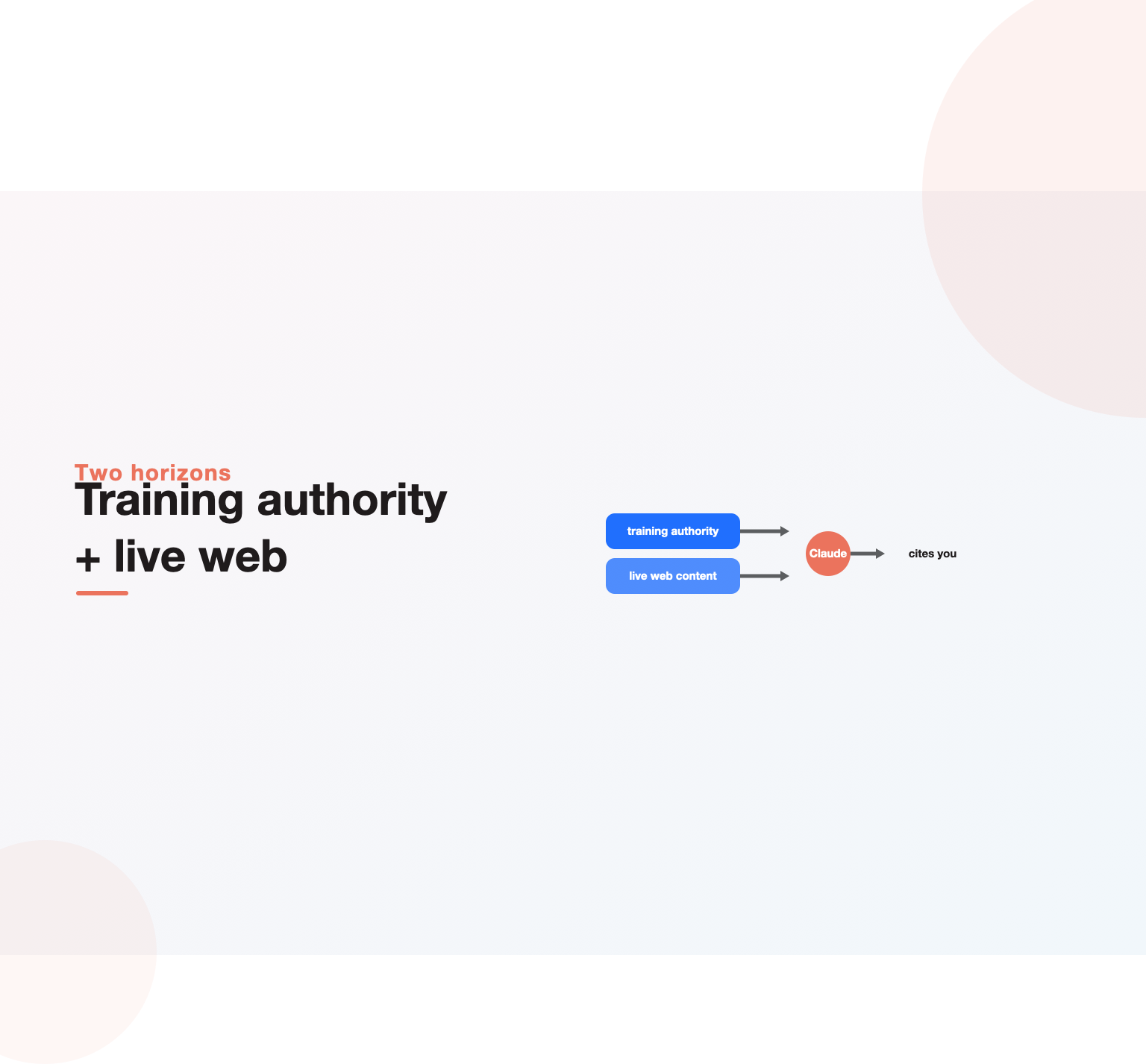
To optimize for Claude, it helps to understand how it gets its information, which comes from two broad sources. The first is its training data, the large body of text it learned from, which gives it broad knowledge up to a point in time and shapes what it knows about brands, topics, and categories. The second, increasingly important, is live web access: Claude can search the web and cite current sources when answering questions that benefit from up-to-date information, which means your live, crawlable content can directly influence its answers.
This dual nature shapes Claude SEO strategy. Being well represented in the kind of content that informs training, widely referenced, authoritative material about your brand and topic, helps Claude know and trust you over the long term, while being visible, current, and crawlable helps you show up in its live web results now. You cannot directly edit training data, but you can build the sustained authority and presence that make you part of the broader record, and you can absolutely optimize your live content for the web-search side. So the discipline works on both horizons at once: long-term authority and immediate crawlable relevance, through Anthropic’s Claude and the surfaces it powers.
Why optimize for Claude specifically
Optimizing for Claude specifically is worthwhile because it is one of the most widely used and trusted AI assistants, favored by professionals, businesses, and knowledge workers who make and influence decisions, and built by Anthropic. The people asking Claude about tools, providers, and approaches in your category are often exactly the audience you want, so being surfaced there reaches high-value users at a formative moment. As Claude is embedded into more products and workflows, that reach compounds, making presence in its answers a growing asset.
There is also a quality-of-audience argument. Claude’s user base skews toward considered, professional use, research, analysis, and work tasks, so a recommendation or citation from Claude often reaches someone doing serious evaluation rather than a casual browse. For B2B and considered-purchase brands especially, being named by Claude when a buyer researches their options can influence a real decision. This is why Claude SEO deserves attention as its own focus within a broader AI-visibility strategy, rather than being lumped in as an afterthought, even as the same fundamentals serve every assistant.
How Claude chooses what to surface and cite
While the exact mechanisms are proprietary, the patterns behind what Claude surfaces are consistent and sensible. Because it aims to be genuinely helpful, Claude favors content that clearly and accurately answers the question, drawn from sources that appear authoritative and trustworthy. When it uses web results, it tends to cite credible, relevant, well-structured pages that directly address what was asked, because those make for a reliable answer. Accuracy and clarity matter a great deal, since an assistant built to be honest is cautious about citing thin, dubious, or confusing sources.
Relevance and specificity also drive what gets surfaced: Claude reaches for the source that best matches the precise question, so genuinely comprehensive content that covers a topic well is more likely to be drawn on across the many specific questions within it. Established authority and a consistent, credible brand presence make Claude more confident naming you. The through-line for Claude SEO is that the assistant is trying to give the best, most trustworthy answer, so it rewards content and brands that genuinely are the best, most trustworthy answer, which means earning visibility is a matter of merit rather than manipulation, the same principle behind winning any AI visibility.
Do AI-generated answers recommend your competitors instead of you?
Our team reviews your current setup and shows you where the opportunities are. See how our GEO services work.
How to optimize your content for Claude
Optimizing content for Claude starts with being genuinely the best answer to the questions your audience asks. Create clear, comprehensive, accurate content that directly addresses real questions in your category, and write it so the key information is easy to find and extract, an answer-first approach with clear structure. Because Claude values accuracy and clarity, precise, factual, well-organized content is more citable than vague or promotional material, and depth that genuinely covers a topic gives Claude more reason to draw on you across many related questions.
Authority and trust are the other half. Build the brand signals that make Claude confident to name you: demonstrable expertise, a credible and consistent presence, and the kind of reputation that authoritative sources have. These are the same signals that help you rank and get cited everywhere, so Claude SEO is not a separate content operation but a lens on doing content and authority well. The practical recipe is familiar because it works across surfaces: answer real questions thoroughly and honestly, structure content clearly, demonstrate genuine expertise, and be the source a careful assistant would be comfortable citing.
Content structure that helps Claude cite you
Because Claude extracts and synthesizes information to build answers, how you structure content affects how usable it is. Leading with a direct, clear answer to a question and then expanding on it gives Claude a clean, quotable passage, while burying the answer in a long, meandering section makes it harder to extract and cite. Clear headings that map to real questions, factual statements that stand on their own, and logically organized sections all make content easier for an assistant to parse and attribute confidently.
This structure serves people as much as machines, which is the point, since Claude is trying to surface what genuinely helps its users. Write comprehensive content that reads well for a human and is organized cleanly enough for a machine to navigate: direct answers, well-labeled sections, and precise, factual detail. This is the same answer-first, clearly-structured approach that improves visibility across all AI assistants, so structuring for Claude also strengthens your presence in other engines, which is why it sits naturally within a broader generative engine optimization approach rather than standing alone.
Technical accessibility for Claude’s crawler
None of the content work matters if Claude cannot actually access your pages, so technical accessibility is a prerequisite for the web-search side of Claude SEO. Anthropic operates a web crawler, and like many AI crawlers it works best with content present in the HTML rather than content that only appears after client-side JavaScript executes. If important information is locked behind heavy client-side rendering, it can be invisible to the crawler even when human visitors see it perfectly, so server-side rendering or static delivery of key content matters, the same concern covered in our work on JavaScript SEO.
Beyond rendering, make sure your robots directives allow the crawlers you want to reach your content, keep pages fast and crawlable, and ensure the information you want surfaced actually exists in the served HTML. A site that is slow, blocked, or dependent on rendering for its core content will struggle to appear in Claude’s web-sourced answers regardless of how good that content is. This technical layer is unglamorous but decisive: it is the difference between content Claude can read and cite and content that, from the crawler’s point of view, effectively does not exist.
Measuring your visibility in Claude
Like any discipline, Claude SEO needs measurement, and the most direct way is to ask Claude the questions your audience would ask and see how you fare. Build a list of the real questions buyers and researchers pose in your category, comparisons, recommendations, how-to and which-provider questions, then put them to Claude and record whether your brand is mentioned or cited, how it is characterized, and which competitors appear instead. Repeating this across a consistent set of questions over time turns it into an audit that shows where you are present and where you are absent.
That measurement feeds strategy directly. The questions where you should be surfaced but are not become content and authority priorities, and watching which competitors Claude names shows you what kind of presence is winning. Tracking your visibility in Claude alongside your presence in other assistants and traditional search gives a complete picture as the landscape shifts, and it connects to the broader practice of measuring AI visibility across every surface. Treated as a tracked metric rather than a guess, your standing inside Claude becomes something you can deliberately improve.
Where Claude SEO fits in the bigger GEO picture
Since Claude is one assistant among several, Claude SEO is best understood as part of the broader discipline of optimizing for generative engines rather than an isolated tactic. The same foundations, clear and authoritative content, strong brand signals, and technical accessibility, are what earn visibility in ChatGPT, Gemini, Perplexity, and Google’s AI Overviews too, so work done for Claude largely transfers. Optimizing well for one credible assistant tends to lift your standing across all of them, because they are all trying to surface genuinely useful, trustworthy sources.
That said, being aware of each assistant, including Claude, helps you check your presence where your audience actually is rather than assuming. If your buyers lean on Claude for professional research, prioritizing it makes sense; if they spread across assistants, cover them all with the shared fundamentals and verify presence on each, including answer engines like Perplexity where citations are explicit. The effort compounds because the same excellent content rarely wins just one engine, so treating them as one program is more efficient than chasing each in isolation. This is exactly the coordinated approach a full generative engine optimization service takes, treating Claude, ChatGPT, Gemini, and the rest as surfaces of one strategy, and connecting to the wider AI search optimization program so every engine pulls in the same direction.
Why Claude SEO matters for B2B audiences
Claude’s user base skews professional, which makes it especially valuable for B2B and considered-purchase brands. The people using it to research vendors, compare approaches, and analyze options are often decision-makers or the researchers who brief them, so being surfaced by Claude reaches exactly the audience a B2B marketer wants at the exact moment a shortlist is forming. That aligns closely with how modern B2B SEO already works, targeting high-intent research rather than raw volume, which means B2B brands are often well positioned to win here if they invest.
The practical implication is to prioritize the questions a professional buyer would actually ask about your category, the comparisons, the how-to-choose questions, the honest trade-offs, and to answer them with the depth and credibility that audience demands. Thin marketing content fails this audience and this assistant alike, while genuinely expert, balanced content earns the citation and the trust behind it. For B2B especially, Claude SEO is less a novelty than a natural extension of the expertise-led content that already wins serious buyers, pointed at the surface where those buyers increasingly do their early research.
Building the authority Claude will trust
Because Claude leans toward sources it judges authoritative, building genuine authority is central to Claude SEO. That authority comes from the same things that build it anywhere: consistently publishing genuinely expert content, earning references and links from credible places, and maintaining a coherent, trustworthy brand presence over time. The links and mentions that a strong authority-building approach earns are part of the broader record that shapes how assistants understand and trust your brand, so off-site reputation and on-site quality reinforce each other.
Authority also compounds, which rewards starting now. A brand that steadily becomes a recognized, cited voice in its category builds a reputation that assistants increasingly rely on, while brands that wait start from behind as competitors become the default sources. This is the same logic behind a deliberate content strategy: cover your topic comprehensively and credibly over time, and you become the source both search engines and assistants reach for. There is no shortcut to the authority Claude trusts, only the sustained work of genuinely earning it, which is precisely why it is defensible once built.
Content freshness in Claude SEO
Because Claude can draw on live web results, keeping content current matters for the questions where recency counts. For fast-moving topics, comparisons, pricing, features, best-of-the-moment questions, fresh, accurate content is more likely to be surfaced than stale material, and it signals that your brand is an active, reliable source rather than a dormant one. Maintaining and updating your key content is therefore part of Claude SEO, not a separate chore, especially in categories where the right answer changes over time.
This does not mean churning out updates for their own sake, which adds no value. It means keeping the content that answers time-sensitive questions accurate and current, and revisiting your cornerstone pieces so they stay comprehensive and correct as your category evolves. Freshness paired with genuine depth is the combination that earns both classic rankings and assistant citations, and it connects to the same measure-and-refresh discipline that keeps any content library healthy. A brand that keeps its best content current gives Claude an accurate, up-to-date source to trust, which is exactly what a helpful assistant wants to cite.
Want to be the brand generative AI recommends?
Book a free 30-minute strategy call and leave with a clear next step for your business.
Getting started with Claude SEO
Starting is straightforward because the work builds on fundamentals you likely already have. Begin by auditing where you stand: ask Claude the real questions your audience would pose in your category and record whether it mentions you, so you have a baseline. Then make sure your most important content is technically accessible, present in server-rendered HTML, fast, and not blocked, so the crawler behind Claude’s web access can actually read it. These two steps, knowing your baseline and being crawlable, are the foundation everything else builds on.
From there, prioritize the questions where you should be surfaced but are not, and improve or create the clear, authoritative, answer-first content that would earn the mention, exactly the kind of work a sound SEO foundation already involves. Keep that content current, build genuine authority over time, and re-audit regularly to track progress. Because none of this fights your existing SEO and it echoes the reality that SEO is not dead but evolving, Claude SEO is low-risk and high-leverage: the same investment strengthens your visibility across Claude, other assistants, and traditional search at once, so you are never optimizing for a single surface at the expense of the rest.
Common Claude SEO mistakes
A few mistakes hold brands back with Claude. The first is ignoring it entirely, assuming traditional SEO covers everything while competitors quietly become the sources Claude names in your category. The second is trying to manipulate rather than deserve the mention, producing thin or promotional content in hopes of being cited, which fails because Claude is built to surface genuinely useful, trustworthy sources. The third is neglecting technical accessibility, publishing important content in ways the crawler cannot read, so good material never reaches Claude’s web results.
Another common error is not measuring, so a brand has no idea whether Claude mentions it or how that is changing, and therefore cannot improve deliberately. And some treat This work as wholly separate from their other work, missing that the same content quality, authority, and technical health drive visibility everywhere. Avoiding these traps comes down to taking Claude seriously as a real surface, building on solid SEO and GEO fundamentals rather than against them, and doing the honest work of being the best, clearest, most trustworthy answer, which is exactly what the assistant is designed to reward.
Key Takeaways
- The discipline is optimizing your content and brand so Claude surfaces, recommends, and cites you, a distinct and growing visibility surface built on SEO and GEO fundamentals.
- It draws on both its training and live web results, so long-term authority and crawlable, current content both matter.
- The assistant favors clear, accurate, well-structured, genuinely useful content from trusted brands, so you earn visibility by deserving it, not by tricks.
- Technical accessibility is a prerequisite: keep important content in server-rendered HTML the crawler can read, and do not block it.
- Measure how often Claude surfaces you by asking it your audience’s real questions, and treat Claude as one surface within a coordinated GEO strategy.
Frequently asked questions
What is Claude SEO?
Optimizing for Claude is the practice of optimizing your content and brand so that Claude, Anthropic’s AI assistant, mentions, recommends, or cites you when people ask it questions related to what you do. It is a specific application of optimizing for AI assistants, aimed at winning a place inside the answers Claude generates rather than a ranking on a search results page, and it rests on being a genuinely useful, authoritative, accessible source the assistant can trust.
How does Claude decide what to cite?
The assistant aims to be genuinely helpful and honest, so it favors content that clearly and accurately answers the question from sources that appear authoritative and trustworthy, and when it uses web results it tends to cite credible, relevant, well-structured pages. Relevance and specificity matter, so comprehensive content that covers a topic well is more likely to be surfaced, and established brand authority makes Claude more confident naming you. In short, it rewards genuinely being the best answer.
Can I optimize my content for Claude?
Yes. You optimize for Claude by creating clear, accurate, comprehensive content that directly answers your audience’s real questions, structured answer-first so it is easy to extract and cite, and by building the brand authority that makes the assistant confident to name you. You also need to ensure your content is technically accessible to Claude’s web crawler, which means keeping important information in server-rendered HTML rather than behind client-side JavaScript.
Does Claude use live web data or just training data?
Both. The model has broad knowledge from its training data, which shapes what it knows about brands and topics, and it can also access the web to bring in current information and cite sources when a question benefits from being up to date. That is why This practice works on two horizons: building long-term authority that informs its general knowledge, and optimizing crawlable, current content that can appear in its live web-sourced answers.
How is Claude SEO different from ChatGPT SEO?
The underlying fundamentals are the same, clear, accurate, authoritative, well-structured content and a crawlable site, so most of the work transfers across assistants. The differences are at the margins: each assistant has its own audience, its own way of accessing and citing sources, and its own tendencies, so it is worth checking your presence in each rather than assuming. Optimizing well for Claude generally strengthens your standing in ChatGPT, Gemini, and others too.
How do I know if Claude recommends my brand?
Ask it. Build a list of the real questions your audience would pose in your category and put them to Claude, recording whether your brand is mentioned or cited, how it is described, and which competitors appear instead. Repeating this across a consistent set of questions over time shows where you are present, where you are absent, and whether your visibility is improving, which turns Claude visibility from a guess into a metric you can act on.
Does Claude have a web crawler I need to allow?
Anthropic operates a web crawler that gathers content for Claude’s web-access features, and like most AI crawlers it works best with content present in the served HTML. To be eligible for Claude’s web-sourced answers, make sure your robots directives allow the crawlers you want, keep your pages fast and crawlable, and ensure important content is not locked behind client-side rendering. If the crawler cannot reach or read your content, it cannot surface it.
Is Claude SEO worth it for my business?
If your audience uses Claude to research decisions in your category, then yes, because being surfaced there reaches high-value users at a formative moment, and Claude’s professional-leaning user base is especially valuable for B2B and considered purchases. Even if you are unsure, the work overlaps almost entirely with good SEO and GEO, so investing in clear, authoritative, accessible content improves your visibility across Claude and every other engine at once, making it low-risk and high-leverage.
How is Claude SEO related to GEO?
It is one part of generative engine optimization, the broader discipline of earning visibility inside AI assistants and answer engines. The fundamentals are shared across every engine, so most of the work you do to be surfaced by Claude also helps you in ChatGPT, Gemini, Perplexity, and Google’s AI Overviews. Treating Claude as one surface within a coordinated GEO strategy, rather than a separate project, is what lets a single investment in clear, authoritative, accessible content pay off everywhere your audience turns to AI.
Ready to put this into practice?
Talk to the team that runs SEO, AI search and paid growth programs every day.
Book a Strategy Call →