 Skip to content

LLM SEO: How to Get Your Brand Recommended by AI Models
LLM SEO is how you get cited and recommended inside ChatGPT, Gemini and Perplexity. What it is, how models pick sources, the pillars, and how to measure it.
Quick Answer
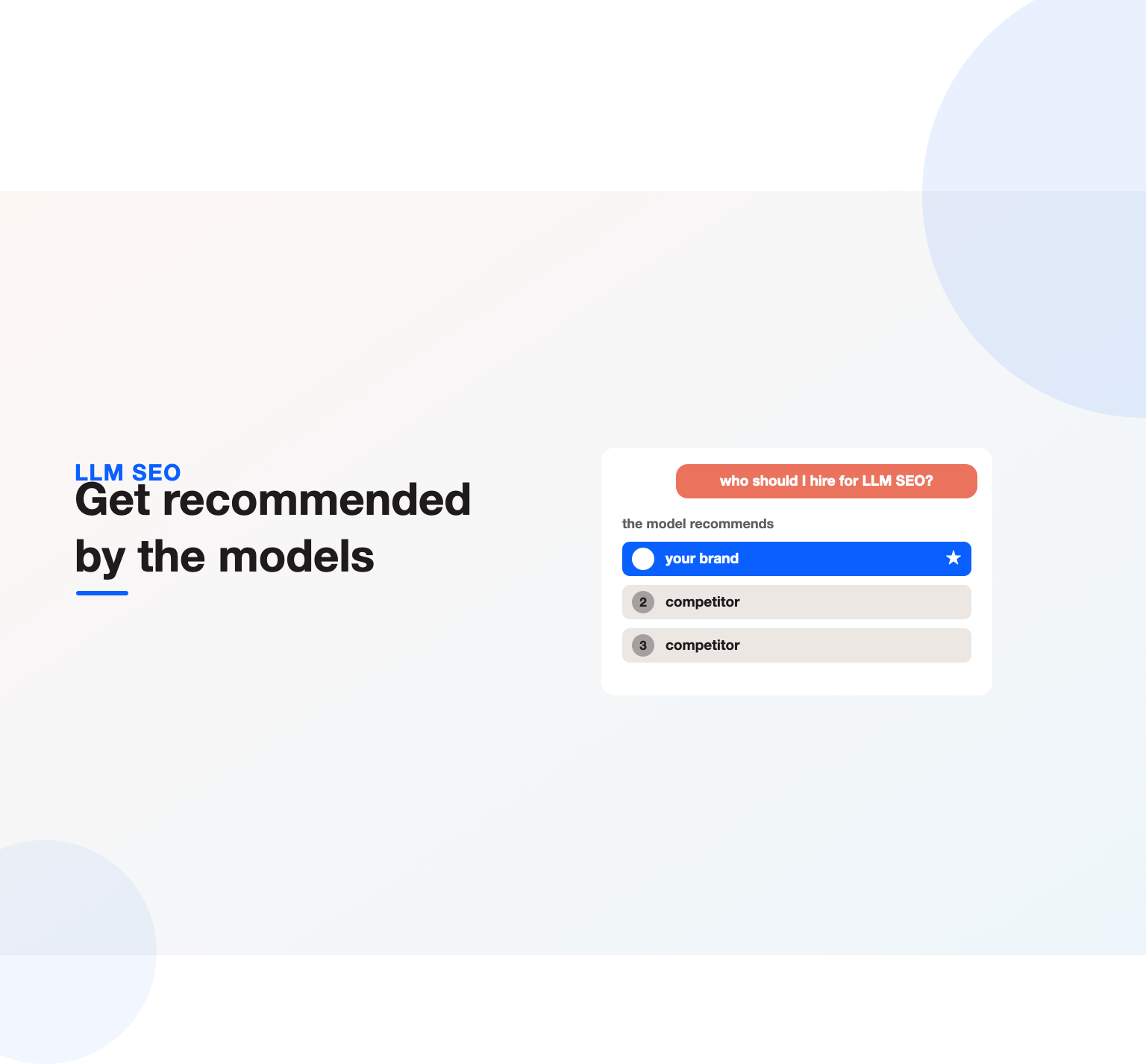
LLM SEO is the practice of optimizing your content and brand so that large language models cite, quote or recommend you when they answer questions. It differs from traditional SEO because the goal is not a ranked link but inclusion in a generated response, which depends on clear, factual, well-structured content, genuine topical authority, and a consistent presence across the web that models can verify. Where classic search rewards pages that rank, LLM SEO rewards sources that models trust enough to build an answer around, which makes credibility and clarity as important as any technical signal.
A growing share of your future customers will never see your website in a search result. They will ask ChatGPT, Gemini, Perplexity or Google’s AI Overviews a question, read the answer the model writes, and act on it, and the only brands that got any exposure are the ones the model chose to mention. LLM SEO is the discipline of earning that mention: making your brand and content the kind of source large language models retrieve, trust and surface when they generate an answer. This guide explains what it is, how it differs from classic search optimization, how the models actually decide who to feature, and the concrete steps that move a brand from invisible to recommended inside AI answers. It is written for marketers and founders who can already see the shift happening in their own searches and want a practical, durable way to respond rather than another list of short-lived tricks.
Key Highlights
- LLM SEO targets being cited or recommended inside AI answers, not ranked in a list of links, which is a distinct and fast-growing form of visibility.
- Large language models favor sources they can retrieve, extract cleanly, and trust, so structure, factual precision, and authority matter more than keyword repetition.
- The practice extends SEO rather than replacing it: the technical and content foundations still apply, but answer-first writing and demonstrable expertise become decisive.
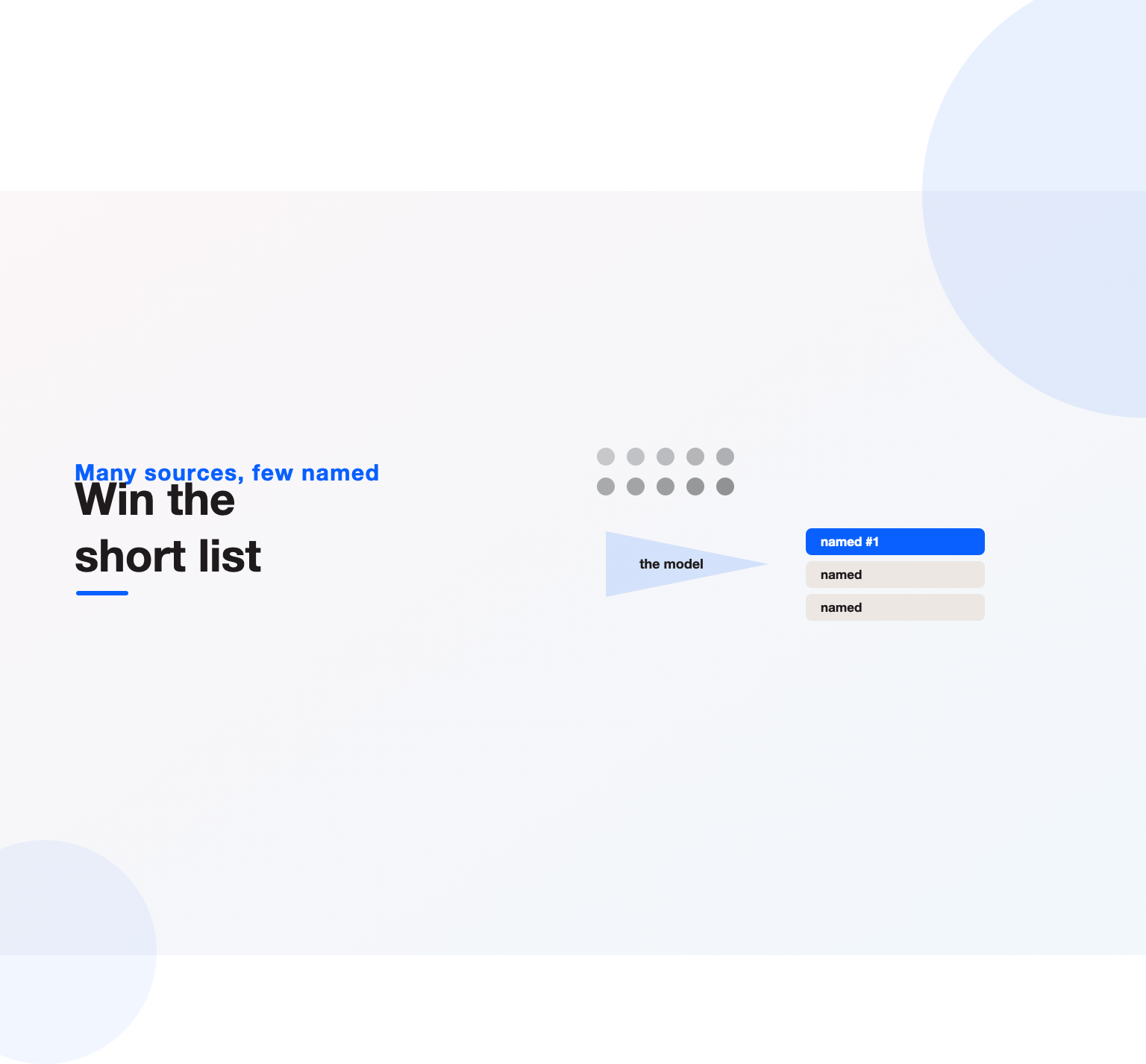
- Because a model usually names only a few sources, visibility is concentrated, so early and consistent effort earns an outsized share of mentions.
- Measurement shifts from rankings and clicks toward how often and how prominently your brand appears in the answers your buyers actually ask for.
What LLM SEO actually is
LLM SEO is the work of making a brand the kind of source a large language model reaches for when it composes a reply. That is a distinct objective from ranking a page. A traditional search engine returns a list of links and lets the person choose; a language model reads across many sources, synthesizes them, and produces a single answer that names only a handful. To be one of those named sources, your content has to be retrievable when the model gathers candidates, extractable so it can lift a clean fact or claim, and credible enough that the model is willing to attribute the point to you. Fail any of those and you are absent from the answer no matter how strong your classic rankings are.
This is why the discipline is best understood as an extension of search optimization rather than a break from it. The familiar foundations still matter: a model cannot cite a page it cannot access, and it cannot quote content that says nothing quotable. On top of those, the discipline adds priorities shaped by how language models work, including answering questions directly, proving genuine authority on a topic so the model treats you as reliable, and maintaining a consistent, verifiable footprint across the web so your claims can be corroborated. For the citation mechanics underneath all of this, our guide to answer engine optimization covers the fundamentals that LLM SEO builds on.
Why LLM SEO matters now
The shift is already underway and it is accelerating. A rapidly rising share of questions are answered directly by an AI system, and for informational queries in particular the person reads the generated summary and never clicks through to a source. In that world, the traffic and influence that used to come from a strong ranking now flow to whichever brands the model named, and everyone else is invisible. This work is urgent because it is the only way to be present in this new surface: if the model is writing the answer, your job is to be one of the sources it writes the answer from. A brand that ranks well but is never mentioned is winning a contest fewer and fewer people are entering.
There is a compounding advantage for brands that act early. Since a model typically names only a few sources, being one of them is worth far more than being the seventh link on a results page, and models tend to return to sources they have learned to trust. That dynamic rewards the brands that build the authority and citation-ready content behind LLM SEO before their competitors treat it as a serious channel. The window in which a mid-authority brand can establish itself as a default reference in its category is open now and will narrow as more organizations compete for the same few slots in the answer. Early, consistent investment is unusually valuable precisely because the surface is still forming.
How large language models choose who to cite
To optimize for it you have to understand the selection process, which runs in stages. It begins by pulling a set of candidate pages, from a live lookup or its index, so anything uncrawlable or off-topic never enters the running. Then it extracts the specific facts, definitions or passages it needs, which strongly favors content that states answers plainly and early rather than burying them. Finally it selects and attributes, deciding which sources to trust enough to name, weighing your track record, whether other sources agree, and how credible the brand making the claim appears. Our breakdown of how AI search engines choose which brands to cite goes deeper on each stage.
The practical lesson is that visibility is won or lost at all three stages, not one. A brand with strong authority but poorly structured content fails at extraction; a brand with clean structure but no authority fails at selection; a brand with both but a crawl problem fails at retrieval before it begins. This is what makes the discipline more demanding than chasing a single ranking factor. You need the crawl hygiene that gets you gathered, the plain-spoken answers that make you quotable, and the earned reputation that makes you trusted, all in the same breath, and the models keep getting better at telling apart sources that have all three from those that fake one.
The pillars of LLM SEO
Everything in the discipline reduces to a few durable pillars. The first is answer-first content: put the direct answer up front, in a sentence a model can quote as-is, and only then add the supporting detail. The second is structure: headings phrased as the questions people ask, tight definitional sentences, and lists or tables where they suit the material, so the model can pull a clean unit of meaning. The third is authority, meaning demonstrable expertise and a track record on the topic, because models increasingly weigh who is making a claim. The fourth is a steady, checkable footprint elsewhere on the web, so a model verifying your claims finds agreement instead of conflict.
These pillars reinforce one another, and LLM SEO works best when they are pursued together. Answer-first writing gives the model something to extract, but only authority persuades it to attribute the point to you; structure makes your content legible, but only a verifiable cross-web presence makes it trustworthy. A brand that invests in all four builds a compounding citability, where each clear, authoritative, corroborated page makes the next more likely to be featured, because the model has learned that this source tends to be right. That compounding is the real prize of LLM SEO, and it is why the discipline rewards consistency over one-off tactics. Our guide to building topical authority for AI citations lays out the slowest but most durable of these pillars.
Is your brand missing from ChatGPT, Gemini and Perplexity answers?
Our team reviews your current setup and shows you where the opportunities are. See how our AEO services work.
Writing content models want to quote
The single highest-leverage habit in LLM SEO is writing content that answers the question before it does anything else. Models extract best from passages that make a clean, self-contained claim: a direct definition, a specific number, a clear yes or no followed by the reason. That means leading a section with the answer and then elaborating, rather than building toward a conclusion the model has to infer, and writing sentences that stand on their own, because a passage lifted out of context still has to make sense as a citation. Our guide to writing answer-first content that AI engines extract turns this into a repeatable format you can apply to every page.
Just as important is what to avoid. Vague, hedging or padded writing gives a model nothing to quote, and content that only makes sense inside a long argument is hard to extract as a standalone claim. Overstatement is worse than vagueness, because models increasingly cross-check claims and a source caught exaggerating loses trust. Keyword stuffing, the old reflex, actively hurts LLM SEO, because repetition signals low quality to systems built to reward clarity. The discipline here is almost editorial: be direct, be specific, be accurate, and make every important claim quotable on its own. A page written this way tends to earn mentions across many related questions, because it gives the model clean, reliable material wherever the topic arises.
Building the authority models reward
Authority is the pillar brands most often underinvest in, and it is frequently the deciding factor in whether LLM SEO succeeds. Language models are built to avoid recommending unreliable sources, so they lean on signals of expertise and reputation: a track record on the topic, real authorship by identifiable experts, mentions and references from other credible sources, and consistency between what you claim and what the rest of the web says. Building this is slower than fixing structure, but it is also more durable, because authority is hard for competitors to copy quickly. Going deep on a well-defined topic, rather than spreading thin across many, is how a mid-sized brand earns the topical authority that makes models treat it as a default voice.
Authority also has an off-page dimension that the discipline cannot ignore. Because models cross-check claims and weigh reputation, your presence on other credible sites, in industry conversations, and across the platforms your buyers trust all feed the model’s judgment of whether to feature you. This is where the practice overlaps with digital PR and brand-building: a brand that is talked about, referenced and corroborated across the web gives a model every reason to name it, while a brand that exists only on its own domain gives the model nothing to verify against. The most-featured sources in AI answers tend to have both strong on-page content and a broad, credible footprint, a pattern our analysis of the most cited websites in AI answers makes clear.
Technical foundations for LLM SEO
None of the content and authority work matters if a model cannot retrieve your pages, so LLM optimization rests on solid technical foundations. Your content must be crawlable and renderable, because a model gathering candidates cannot include what it cannot access, and pages that hide their substance behind heavy client-side scripting are unreliable candidates. Clean, semantic markup helps the model understand structure, and structured data helps it identify entities and relationships. These are familiar concerns, but they carry renewed weight when the cost of a technical failure is not a lower ranking but complete absence from the answer. A single crawl or rendering problem can quietly remove you from consideration entirely.
Beyond crawlability, consistency of information is a technical and editorial discipline at once. Contradictory facts, out-of-date claims and inconsistent entity details all give a model reasons to distrust or skip a source, so keeping your key facts accurate and aligned everywhere they appear, from your site to your profiles to third-party references, is part of the hygiene of optimizing for LLMs. A brand that treats its information as a maintained asset rather than a set-and-forget publication gives models the reliability they are built to look for. Increasingly, teams also publish machine-readable summaries of who they are and what they cover, so models encounter a clear, authoritative account of the brand rather than assembling one from scraps.
How LLM SEO fits with AEO, GEO and search
The terminology in this field is still settling, and it helps to place AI answer visibility among the related disciplines. Traditional SEO optimizes for ranked links. Answer engine optimization focuses on earning citations inside answer engines. Generative engine optimization, or GEO, is often used for the same goal with an emphasis on generative surfaces like AI Overviews and chat assistants. LLM SEO is the slice of this that focuses specifically on large language models, the systems behind ChatGPT, Gemini, Claude and the AI features now woven through search. In practice these disciplines overlap heavily, because they reward the same things, and our broader guide to AI search optimization frames the umbrella that connects them.
What unites these disciplines matters more than what separates them. Every one rewards clear, authoritative, well-structured content from a trustworthy brand, and every one is moving in the same direction as search shifts from retrieval toward synthesis. A brand doing this work well is, almost by definition, doing SEO, AEO and GEO well, because the underlying signals are shared. The value of understanding the distinctions is that it stops teams from over-indexing on a single model or acronym and keeps them focused on the durable goal: being the source trustworthy AI systems reach for, wherever and however people search. For a closer comparison of the adjacent terms, our explainer on AEO versus GEO is a useful companion.
Measuring LLM SEO
The hardest practical challenge is measurement, because the metrics that defined classic SEO do not fully capture success here. Rankings still matter as a retrieval signal, but a top ranking that never gets mentioned produces little exposure in an answer-first world. The measures that matter for the practice are how often your brand appears in answers to the questions you care about, how prominently it is featured when it does, and the small but highly qualified referral traffic that AI systems send. The foundational habit is to check how the major models answer your priority questions and whether you appear, then watch how that presence changes as you invest.
This requires new routines and tooling. Tracking your presence across ChatGPT, Gemini, Perplexity and AI Overviews for a defined set of buyer questions, monitoring how it shifts, and watching which competitors are winning the mentions you want are all part of a mature LLM optimization program. The measurement is less precise than a rank tracker, but the direction it gives is clear enough to guide effort: find the high-value questions where you are absent from the answer, do the content and authority work to become featured for them, and confirm your presence improves. Our overview of how brands win AI search connects these measurement habits to the actions that move them.
Getting started with LLM SEO
For a brand beginning this work, the path is concrete. Start by identifying the handful of high-intent questions in your category where being featured would matter most, and check how the major models currently answer them and who they name. That reveals both the opportunity and the competitors to study. Then take your most important pages and rewrite them answer-first: lead with the direct answer, structure around real questions, and make every key claim clean and quotable. In parallel, begin the slower work of building genuine topical authority, because that is what converts good content into featured content over time. Avoiding the common errors matters too, and our guide to the common mistakes that kill your citation rate helps you sidestep the reasons models leave brands out.
From there, the discipline becomes a sustained program rather than a project: expand coverage to more priority questions, strengthen your cross-web presence so models can corroborate your claims, keep your information consistent and current, and measure your presence as you go. The brands that treat it this way, as an ongoing discipline with clear priorities, are the ones establishing themselves as default references while the surface is still forming and the competition is still light. If you want a partner to build and run that program, our answer engine optimization services team does exactly this work, and for the generative-answer surfaces specifically our generative engine optimization services extend the same approach. The move from links to answers is the largest change in search in two decades, and the brands that master the practice now will own the visibility the rest are only beginning to notice they have lost.
Want AI answer engines to cite your brand?
Book a free 30-minute strategy call and leave with a clear next step for your business.
Common LLM SEO mistakes to avoid
Most failures in this discipline trace to a few avoidable errors. The most common is importing old habits wholesale, above all keyword stuffing, on the assumption that repetition still signals relevance, when language models are specifically built to reward clarity and treat obvious padding as a quality problem. A second error is polishing structure while ignoring authority, producing tidy pages no model trusts enough to feature because the brand behind them has no demonstrable expertise. A third is inconsistency: stating a fact on your site that contradicts what the rest of the web says, which gives the model a reason to distrust and skip you. Each of these hands the model a reason to leave you out of the answer, and removing those reasons is often faster than any positive tactic.
A subtler mistake is fragmenting effort across every model and surface at once, building one plan for ChatGPT, another for Perplexity, another for AI Overviews, when the work that earns a mention is largely shared across them. The systems reward the same fundamentals, so the winning approach is to do the core work well and let it pay off everywhere rather than chasing model-specific tricks that mostly duplicate each other and age quickly as the models change. Brands that get featured are not the ones with the cleverest engine-specific hack; they are the ones that built genuinely clear, authoritative, corroborated content and let every system discover it. Treating the fundamentals as the strategy, and the surfaces as distribution, is what keeps an effort durable.
LLM SEO and the buyer journey
The reason this work is a commercial priority, not just a marketing exercise, is that buyers increasingly begin their research inside AI systems. A prospect asks a model to compare options, recommend providers, or explain a category, and the brands the model names enter the consideration set while the rest never surface. Being featured at that moment shapes the shortlist before a buyer has visited a single website, which makes presence in the answer a top-of-funnel advantage that compounds through the rest of the journey. A brand absent from those early answers has to work far harder later to be considered at all, because it never made the initial cut the model effectively curated.
This is why the payoff of consistent work extends well beyond vanity metrics. When a model repeatedly names your brand as a credible option in your category, it is doing at scale what a trusted advisor does for a single buyer: pointing people toward you at the exact moment they are forming a decision. Our analysis of how buyers use AI to choose vendors shows how directly this now influences purchasing, and it is the clearest argument for treating presence in AI answers as a demand-generation channel rather than a technical curiosity. The brands that understand this are investing now, while being featured is still winnable, rather than waiting until it becomes table stakes.
Related reading
- AI Search Optimization: The Definitive Guide
- How AI Search Engines Choose Which Brands to Cite
- How to Write Answer-First Content That AI Engines Extract
- How to Build Topical Authority for AI Citations
- The Most Cited Websites in AI Answers
Key Takeaways
- Rewrite your most important pages answer-first, with clean, quotable claims.
- Concentrate on one topic to build the authority that decides most citations.
- Earn a consistent, corroborated presence across the web, not just on your own domain.
- Track how the major models answer your buyer questions and close the gaps.
Frequently asked questions
What is LLM SEO?
LLM SEO is the practice of optimizing your content and brand so that large language models like ChatGPT, Gemini and Perplexity cite, quote or recommend you when they answer questions. Unlike traditional SEO, which aims for a ranked link, it aims for inclusion in the generated answer, which depends on answer-first content, genuine authority, and a verifiable presence across the web that models can cross-check.
How is LLM SEO different from traditional SEO?
Traditional SEO optimizes for a search engine’s ranking of links, while LLM optimization optimizes for a language model’s decision about which sources to feature in an answer. The foundations overlap, but the newer discipline adds priorities built for how models work: answering directly and early, proving authority so the model trusts your claims, and staying consistent across the web so it can verify them. Keyword stuffing that once helped now actively hurts.
Which models does LLM SEO target?
It targets the large language models behind ChatGPT, Gemini, Claude, Perplexity and the AI features now built into search, including Google’s AI Overviews. Since these systems reward the same underlying signals of clarity, structure and trust, a single well-executed program tends to improve your presence across all of them rather than requiring a separate effort for each.
Does keyword optimization still matter?
Understanding the questions and language your buyers use still matters, because it tells you what content to create and how to phrase answers. But repeating a keyword to signal relevance, the old tactic, does not help and can hurt, because language models reward clarity and trust rather than density. In optimizing for LLMs the goal is to answer the real question cleanly, not to hit a keyword count.
How do you measure LLM SEO success?
Measurement shifts from rankings and clicks toward how often your brand appears in answers to your priority questions, how prominently it is featured, and the qualified referral traffic AI systems send. The routine is to track how the major models answer a defined set of buyer questions, check whether you appear, and confirm your presence improves as you invest. It is less precise than rank tracking but clear enough to guide effort.
How long does LLM SEO take to work?
Structural and answer-first content improvements can change how models extract from your pages relatively quickly, while the authority work that drives selection is slower and compounds over months. Given that models name few sources and return to those they trust, early and consistent effort tends to pay off disproportionately, but AI answer visibility is a sustained program rather than a one-time fix.
How does LLM SEO relate to content marketing?
They are deeply complementary. Content marketing produces the depth, expertise and consistency that this work depends on, while the discipline ensures that content is structured, answer-first and credible enough for models to feature. In practice, a strong content program that also follows answer-first and authority principles will earn AI mentions almost as a byproduct, which is why teams that already invest in genuine content have a real head start rather than starting from zero.
Can a small brand win at LLM SEO?
Yes, often more easily than in classic search. Given that being featured depends heavily on topical authority and answer-first clarity rather than raw domain size, a focused brand that goes deep on a well-defined subject can become a default reference in its niche even against larger competitors. Concentration and consistency are how smaller brands win at this work while incumbents spread thin. A challenger that becomes the clearest, most trustworthy source on one specific topic can be featured ahead of a household name that treats that topic as a footnote, and that is an edge a focused team can build in months rather than years. The models care about who is most credible on the exact question, not who is biggest overall.
Ready to put this into practice?
Talk to the team that runs SEO, AI search and paid growth programs every day.
Book a Strategy Call →