 Skip to content

On-Page SEO: The Complete Guide for 2026
The complete on-page SEO guide for 2026: match search intent, cover entities not keyword density, structure content answer-first so it ranks and gets cited by AI, and link internally with discipline.
Quick Answer
On-page SEO is everything you control on the page itself, titles, headings, content, internal links, and structure, tuned so searchers, search engines, and now AI answer engines all understand and trust it. In 2026 the winning move is an answer-first structure that is extractable by default. Good on-page SEO starts with matching the page to the searcher.
On-page SEO is everything you control on the page itself, titles, headings, content, internal links, and structure, tuned so both searchers and search engines, and now AI answer engines, understand and trust it. In 2026 the winning move is not keyword density. It is matching search intent, covering the topic’s entities completely, and leading each section with a direct, quotable answer. Structure a page that way and the same content that ranks in Google also earns citations in AI Overviews and chatbots. This guide walks the full modern on-page checklist, from intent and titles to entities, answer-first structure, disciplined internal linking, and the experience and trust signals that actually move the needle, plus the outdated tactics that now backfire.
Key Highlights
- On-page SEO covers titles, headings, content, internal links, and structure, all the signals you directly control.
- Start with search intent before writing a word; matching intent beats matching a keyword.
- Write title tags and meta descriptions for humans and engines alike, clear, specific, and click-worthy.
- Use headings and structure engines can extract, and cover the topic and its entities, not just a single keyword.
- Answer-first structure, a direct answer near the top, makes a page AEO-ready by default.
What on-page SEO is, and what actually matters
In practice, on-page SEO covers the elements on the page you can directly optimise, as opposed to technical SEO (the site’s plumbing) and off-page SEO (signals like links from other sites). For years the advice was mechanical: put the keyword in the title, the H1, and the first hundred words, and hit a keyword density. That model is outdated. Google now ranks on how well a page satisfies intent, how completely it covers a topic’s entities, and how genuinely helpful and trustworthy it is. The single biggest on-page upgrade you can make in 2026 is to stop optimising for a keyword and start comprehensively answering a query, in a structure that both people and machines can extract. Everything below serves that goal.
Start with search intent, before you write
The most common on-page failure is not a missing keyword, it is a page that does not match what the searcher actually wants. If your page does not satisfy intent, it will not rank no matter how many backlinks or keywords it has. So classify the intent first. Is the query informational (they want to learn), commercial (they are comparing options), transactional (they are ready to act), or navigational (they want a specific site)? Then match the format to it. An informational query wants a thorough guide; a commercial query wants comparisons and evidence; a transactional query wants a clear path to act. Look at what currently ranks to confirm the intent Google is rewarding, then out-answer it rather than imitate it. This is where good on-page work starts, and it flows directly from proper keyword research.
In many cases, on-page SEO for title tags and meta descriptions
Your title tag is still one of the most influential on-page elements, because it tells engines what the page is about and heavily influences whether people click. Keep it to roughly 50 to 60 characters so it does not get truncated, lead with the primary term naturally, and write it to earn the click, not just to contain a keyword. Note that Google may rewrite titles it deems unhelpful, so make yours strong and genuinely descriptive of the page.
The meta description does not directly affect rankings, but it strongly affects click-through rate, which matters. Keep it around 150 to 160 characters, include the term and a clear reason to click, and make it read like a promise the page keeps. Every page should have a unique title and description, never a template repeated across the site.
Headings and structure engines can extract
Headings do double duty in 2026: they help humans scan, and they help engines and AI models extract your content. Use a single H1 that states the page topic clearly, then logical H2 and H3 subheadings that nest properly. The high-leverage move is to phrase many of your headings as the actual questions your audience asks, because that maps directly to how people search and how AI answers pull structured content. A heading that reads how much does on-page SEO cost is more extractable than one that reads pricing. Clean, logical heading hierarchy is also one of the strongest signals that a page is easy for an AI engine to parse and cite.
Content and entities: cover the topic, not the keyword
This is the shift most on-page advice still misses. Modern ranking is about topical completeness, covering the entities, subtopics, and questions that genuinely belong to a topic, not repeating a keyword a target number of times. Entities are the people, tools, concepts, and related ideas associated with your subject. A page about on-page SEO that never mentions intent, title tags, headings, internal links, or Core Web Vitals is incomplete in the eyes of an engine that understands the topic, regardless of keyword density.
So build content by asking what a reader genuinely needs to fully understand this topic, and cover it, including first-hand experience and specific detail that only someone who has actually done the work would know. That depth is what makes a page the best answer, which is what both search engines and AI models reward. Keyword density, by contrast, is a relic, and pushing it now reads as a spam signal rather than an optimisation.
Answer-first structure: on-page that is AEO by default
Here is the technique that makes a page rank and get cited at the same time, and it is UP’s home turf. Lead each section with a direct, self-contained answer of one or two sentences, then expand. Instead of building up to the point over three paragraphs, state it first, then support it. Do this and each section becomes a clean, quotable passage an AI engine can lift and attribute, while human readers get their answer immediately and stay to read more.
Picture the before and after. The old way buries the answer to how long does on-page SEO take at the end of a rambling section, so neither an impatient reader nor an AI model can extract it. The answer-first way opens with on-page changes can affect rankings within days to weeks once recrawled, though full impact builds over months, then explains why. The second version is what gets pulled into an AI Overview with your brand attached. This is the bridge between classic SEO and answer engine optimization, and we go deeper on the craft in our answer-first writing guide and build whole programs around it in our AEO services.
We audit and rebuild your key pages to match intent, cover the full topic, and lead with extractable answers, so the same content wins Google rankings and AI citations. Ask us for an on-page teardown.
Internal linking with discipline, not stuffing
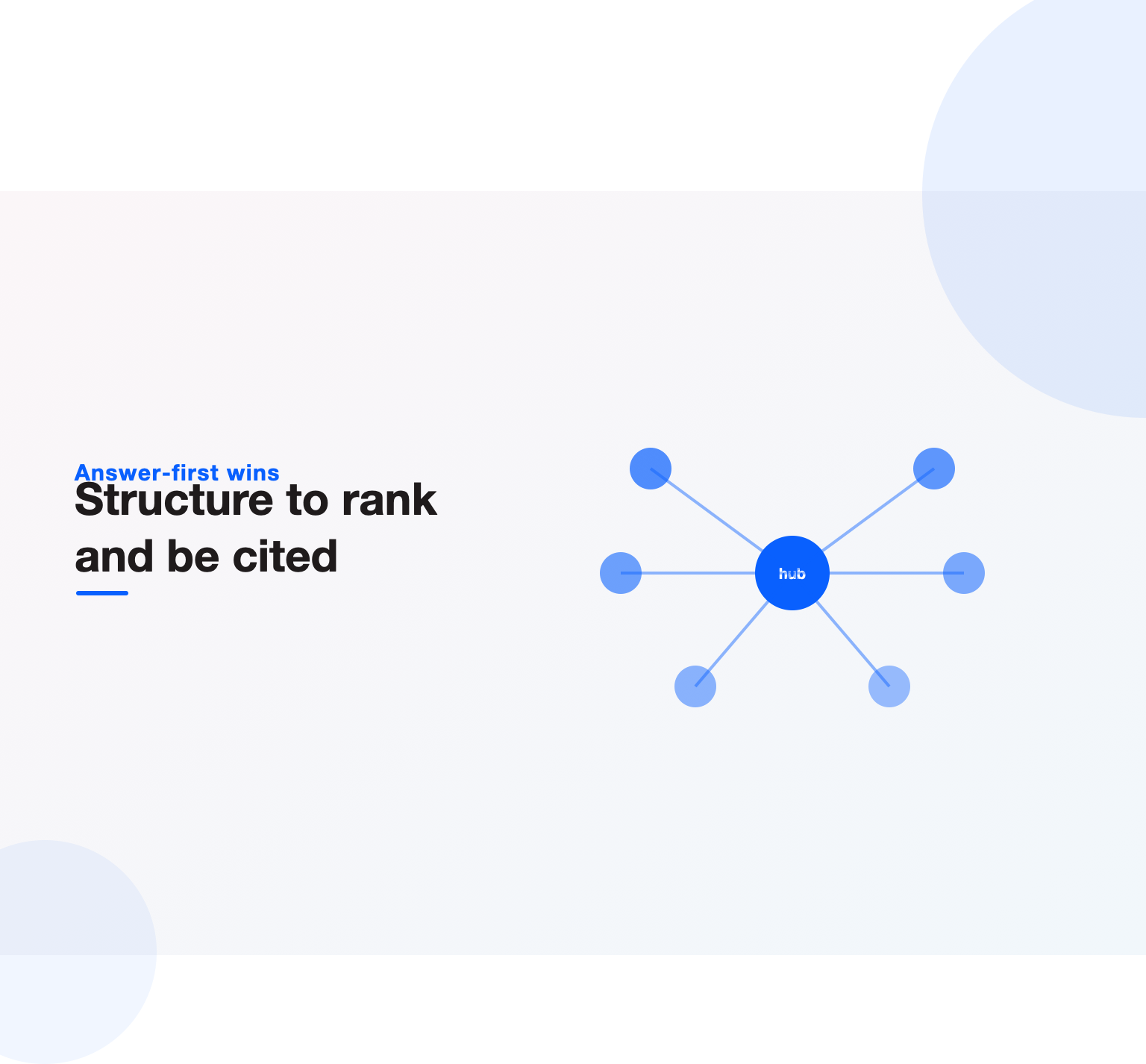
Internal links guide both readers and engines through your site and pass authority to the pages that matter, but the usual advice, use keyword-rich anchors, is shallow and can backfire. Do it with discipline. Link contextually from within relevant content, not just from templated blocks repeated site-wide. Vary your anchor text naturally rather than pointing the same exact-match phrase at a page dozens of times, which reads as manipulation. And build a hub-and-spoke structure where a strong pillar page links to related detail pages and they link back, concentrating topical authority where you want it.
The goal is a mesh that feels natural to a reader and clearly signals which pages are most important, not a page crammed with identical links to a target URL. Quality, relevance, and variety beat volume every time, and the same links that help rankings also help engines and readers discover your best content.
For most teams, on-page E-E-A-T you can actually implement
Experience, expertise, authoritativeness, and trust get talked about endlessly and operationalised rarely. On the page, they are concrete signals you can add. Attribute content to a real, named author with genuine credentials and, ideally, an established identity across the web, so the expertise is verifiable. Demonstrate first-hand experience with specifics, real examples, original data, screenshots, things only someone who did the work would include. Cite reputable sources for factual claims, the way this guide does. Show publish and updated dates and keep the facts current, because stale, unmaintained content erodes trust. These are not cosmetic bylines bolted on after the fact, which do nothing on their own; they are real signals that the content deserves to be believed, and they matter for both rankings and AI citation.
URLs, media, and where on-page meets technical
A few remaining elements round out strong on-page work. Keep URLs short, descriptive, and keyword-relevant, without dates or parameters, so they are readable and stable. Give images descriptive alt text that genuinely describes the image, which helps accessibility and image search, and compress and size them properly so they do not hurt loading. That last point is where on-page meets technical SEO: your content choices affect Core Web Vitals like LCP and CLS. The two disciplines overlap, which is why this guide pairs with our technical SEO checklist, and why FAQ markup, though it no longer earns a rich result, can still aid AI parsing when used honestly.
Optimising for click-through and featured snippets
Ranking is not the finish line; earning the click is, and on-page choices heavily influence it. Your title and meta description are effectively the ad copy for your listing, so write them to stand out and promise something specific rather than to read like every other result. Beyond that, the answer-first structure covered above is also how you win featured snippets and the position-zero style answers that still appear: a clear, concise answer placed directly under a question-shaped heading is exactly what engines lift into a snippet. In practice, use formats that are easy to extract, a short definition after a heading, a numbered list for a process, a compact table for a comparison, because these are what get pulled into both snippets and AI answers.
Content freshness is the other lever most pages ignore. Search and AI engines favour content that is current, so revisiting and genuinely updating your important pages, refreshing data, adding new developments, improving weak sections, and updating the date when you do, protects and often lifts their performance. This is not about changing the date cosmetically, which does nothing; it is about keeping the content genuinely accurate and complete so it stays the best answer over time. A practical habit is to review your most important pages on a schedule, quarterly for high-value pages and at least yearly for the rest, and ask whether each still answers the query more completely than whatever now ranks around it. Where it does not, improve it; where it does, leave it alone rather than changing it for the sake of activity. This steady maintenance often returns more than constantly publishing new pages, because defending the pages already earning traffic protects revenue you have and compounds the authority you have already built.
The on-page SEO mistakes that backfire in 2026
Two errors do active harm. The first is keyword stuffing, repeating a term unnaturally to try to signal relevance. It no longer works and is treated as a spam signal that can, at the extreme, trigger a manual action. Write naturally for people and cover the topic instead. The second is ignoring search intent, publishing a page in the wrong format for what the searcher wants, which is the most common reason genuinely well-written pages fail to rank. Beyond those, avoid thin content that does not fully answer the query, duplicate titles and descriptions across pages, and internal links stuffed with identical anchors. Fix intent and completeness first, because they decide whether the rest of your on-page work has any chance to matter.
Put all of this together, intent, complete entity coverage, answer-first structure, disciplined linking, and real trust signals, and you have on-page SEO built for how search and AI actually work in 2026. The thread running through all of it is the same: serve the searcher so completely and so clearly that both a person and a machine can get their answer from your page, and the rankings and citations follow. For the strategy that surrounds it, see our complete guide to SEO, and for proof of what it produces, our case studies.
We will optimise your key pages end to end, intent, structure, entities, links, and trust signals, so they rank, convert, and get cited in AI answers. Book an on-page audit with our team. On WordPress, the right plugin handles much of this; compare the best WordPress SEO plugins.
An on-page SEO checklist for every new page
Use this list before publishing any page. It takes a few minutes and catches most of the issues that hold pages back.
- The page targets one main keyword and its close variations, and no other page on the site targets the same term.
- The title tag includes the main keyword near the start, reads naturally and stays within roughly 60 characters.
- The meta description summarises the page and gives a reason to click.
- There is one H1 that matches the topic, and H2s describe each section clearly.
- The first paragraph answers the main question directly.
- The content covers the subtopics searchers expect, based on the results page and People Also Ask.
- Images have descriptive file names and alt text, and are compressed.
- The URL is short, readable and contains the main topic.
- The page links to related pages and receives links from at least two relevant existing pages.
- Claims are supported with sources, and the author is named with relevant credentials.
- Structured data is valid for the page type.
In short, on-page SEO for different page types
Product pages need unique descriptions rather than manufacturer copy, clear specifications in text, reviews and product structured data with price and availability. Category pages need a short introduction that explains the range and helps users choose, plus internal links to subcategories and top products.
Service pages need a clear statement of what the service includes, who it is for, how it works and how pricing is set, with proof such as case studies and testimonials. Location pages need genuinely local information, such as service areas, local examples and directions, rather than copies of a template with the city name changed.
Blog posts and guides need answer-first structure, depth on the subtopics searchers expect and links to the commercial pages they relate to. Our guide to keyword research explains how to choose the right term for each page type before optimizing it.
Optimizing existing pages that already rank
Improving pages that already have some visibility often produces faster results than publishing new ones. In Search Console, find pages ranking between positions 5 and 20 for valuable queries. These are close enough to move with targeted improvements.
For each page, review the queries it ranks for and check whether the content fully answers them. Add sections for important questions it misses, update outdated facts and strengthen internal links from related pages. Be careful with titles: if a page already earns impressions and clicks, change the title only when there is clear evidence the new one will perform better, because a poorly chosen change can cost existing traffic.
Track each improved page for six to eight weeks before making further changes, so you can see what effect the update had.
Equally, on-page SEO 2026: what has changed
Several shifts stand out. Answer-first structure now matters for AI features as well as for traditional snippets, so the opening of each page and section deserves more attention than ever. Entity clarity, meaning clear statements about who you are and what your products do, helps both search engines and AI assistants. Evidence of first-hand experience carries more weight, in line with Google’s emphasis on helpful, people-first content described in its helpful content guidance.
Some older habits have lost value. Exact keyword counts, keyword-stuffed headings and thin pages written for minor keyword variations are less effective and can be harmful. Comprehensive pages that serve a topic well, with natural language and clear structure, perform better across both search and AI answers.
In practice, on-page SEO across regions
If you serve several markets, on-page work must reflect local differences. Spelling, terminology, currency, units and examples should match the audience. A page for the United Kingdom should use British spelling and pounds; a page for Australia should reference local regulations and prices. Searchers in Asia-Pacific markets often use different terms for the same service, so keyword research needs to be done separately in each market rather than translated.
Use hreflang tags to connect versions of the same page across markets, as described in Google’s localization guidance, and make sure each version is genuinely adapted rather than duplicated.
Measuring on-page improvements
Track impressions, average position and click-through rate for the main queries of each optimized page in Search Console, comparing four to eight weeks before and after the change. Track engagement and conversions in analytics. For pages that answer common questions, check whether they are cited in AI answers.
In practice, keep a log of every change with its date. Over time, the log shows which types of on-page SEO changes produce results on your site, so future work can focus on what works. If you would like an expert review of your key pages, our SEO services team can audit and prioritise improvements.
Common questions about optimizing pages
How long should a page be? As long as it needs to be to answer the query completely and no longer. Check the results page: if top results are short answers, a long guide may not fit; if they are comprehensive guides, a short page is unlikely to compete.
How many times should the keyword appear? There is no fixed number. Use the main term in the title, H1, opening paragraph and naturally through the content, and use related terms and synonyms elsewhere. If a sentence sounds forced, rewrite it.
Do meta descriptions affect rankings? Not directly, but they influence whether people click, which matters just as much. Write them for humans, summarising the page and giving a reason to visit.
Should every page have an FAQ section? Only where readers genuinely have follow-up questions. A relevant FAQ helps readers and AI engines; a generic one adds clutter.
How often should pages be reviewed? Review important pages at least twice a year and after any significant change in rankings, competitors or the products they describe.
Working with developers and writers
Much of the work depends on people outside the SEO team. Writers need briefs that specify the main keyword, the questions to answer, the structure and the internal links. Developers need clear requests for template changes, such as fixing heading levels, adding structured data or improving image handling. Designers need to know that key content must appear in text rather than in images.
Make these requests easy to act on. Group related fixes into a single ticket, explain the expected benefit in plain terms and include examples. Teams that understand why a change matters are far more likely to keep applying it to future pages without being asked, which is how good optimization becomes standard practice across a whole site.
Document the standards in a short internal guide with examples from your own site, covering titles, headings, openings, internal links, images and structured data. Share it with everyone who publishes content, and update it whenever you learn something new from your results. A living guide like this keeps quality consistent as the team grows and makes onboarding new writers and developers much faster. It also gives you a clear reference when reviewing work from agencies or freelancers, so every page published on the site meets the same bar regardless of who created it.
Most importantly, keep the reader at the centre of every decision. Pages that answer real questions clearly, load quickly and guide visitors to the next useful step tend to perform well in search engines and AI answers alike, because both are ultimately trying to reward the same thing.
Review that principle whenever a new tactic is proposed: if it helps readers, it is usually worth doing; if it only exists to influence an algorithm, it rarely lasts and can even cause harm when systems change. For the next step after on-page work, see our technical SEO checklist.
Key Takeaways
- Match each page to one clear primary intent.
- Lead with the answer and structure around real questions.
- Optimise titles, headings, links and internal structure.
- In many cases, keep content accurate, useful and up to date.
Frequently asked questions
How long should a title tag be in 2026?
Aim for roughly 50 to 60 characters so the title does not get truncated in results. Lead with your primary term naturally and write it to earn the click, not just to contain a keyword. Remember that Google may rewrite titles it considers unhelpful, so make yours strong and genuinely descriptive.
How many times should I use my keyword on a page?
There is no target count, and chasing one is counterproductive in 2026. In many cases, use the term naturally where it makes sense, then focus on covering the topic’s entities and subtopics completely. Repeating a keyword to hit a density is now treated as a spam signal rather than an optimisation.
Does keyword density still matter?
No. Modern ranking is based on topical completeness and how well a page satisfies intent, not on how often a keyword appears. Cover the entities and questions that belong to your topic thoroughly and write naturally; keyword density is a relic that can now hurt you if pushed.
How many internal links should a page have, and what anchor text?
There is no fixed number; link to genuinely relevant pages where it helps the reader. For most teams, use varied, descriptive anchor text rather than the same exact-match phrase repeatedly, and place links contextually within content rather than in templated blocks. Natural, relevant linking beats volume and avoids the over-optimisation that identical anchors signal.
What are entities in SEO and how do I optimise for them?
Entities are the people, tools, concepts, and related ideas associated with your topic. Optimising for them means covering the full set a reader and an engine expect to see on the subject, rather than repeating a keyword. Comprehensive entity coverage is what signals genuine topical authority in 2026.
How do I structure content to get cited in AI Overviews?
Lead each section with a direct, self-contained answer of one or two sentences, then expand, and phrase headings as the questions people ask. This makes each passage easy for an AI engine to extract and attribute, and it is the same structure that helps human readers, so it improves both rankings and AI citation at once.
Do meta descriptions affect rankings?
Not directly, but they strongly affect click-through rate, which matters for how much traffic a ranking earns. Write a unique description of about 150 to 160 characters that includes the term and a clear reason to click, and treat it as ad copy for your listing rather than a ranking lever.
What is the difference between on-page and technical SEO?
In many cases, on-page SEO covers the content elements you optimise on the page itself, titles, headings, content, internal links, and structure. Technical SEO covers the site’s underlying health, crawlability, indexation, speed, and rendering. They overlap, since content choices affect Core Web Vitals, and both are needed for a page to rank and be cited.
Ready to put this into practice?
Talk to the team that runs SEO, AI search and paid growth programs every day.
Book a Strategy Call →