 Skip to content
AI Overview Optimization: Get Cited by Google
AI overview optimization explained: how to get cited in Google's AI Overviews with strong organic ranking, extractable content, topical authority and accuracy. How overviews pick sources, and measurement.
Quick Answer
AI overview optimization is the practice of shaping your content and authority so Google’s AI Overviews, the generated summary that now appears above the classic results for many searches, surface and cite your brand. Since that summary sits at the very top and answers the query directly, being one of the sources it draws from is prime visibility, and being absent means a searcher may never scroll to your listing. The work rests on ranking strongly in organic search, structuring content so it is easy to extract and quote, building genuine topical authority, and keeping information accurate and current. Done well, AI overview optimization turns the feature from a threat that buries your links into a channel that puts your brand in front of searchers first.
Key Highlights
- AI overview optimization aims to be cited in Google’s generated summary above the classic results.
- Overviews draw heavily on pages that already rank well, so strong organic performance is the foundation.
- Content that answers questions directly and is easy to extract is far more likely to be pulled in.
- Topical authority, accuracy and freshness strongly influence which sources an overview trusts.
- The feature can reduce clicks, so appearing in it is increasingly essential rather than optional.
What AI Overviews are and why they matter
Google’s AI Overviews are generated summaries that appear at the top of the results for a growing share of searches, answering the query directly by synthesizing information from multiple sources and citing several of them. For the user, this means an immediate answer without scrolling; for a business, it means the most valuable position on the page is now this generated box rather than the first blue link beneath it. Appearing as a cited source in that box is prime visibility, while being left out can mean a searcher gets their answer and never reaches your listing at all.
This shift matters because it changes the economics of search visibility. When an overview answers a question completely, fewer users click through to any result, so the traffic that once flowed to the top organic listings can shrink. That makes being inside the overview, rather than merely ranking beneath it, increasingly important, since the citation in the summary may be the main way your brand is seen for that query. A business that ignores this risks watching its hard-won rankings deliver less traffic as the overview intercepts the click, which is why AI overview optimization has moved from a curiosity to a priority.
It helps to see the feature as part of the broader move from ranked links to synthesized answers rather than an isolated change. The same forces reshaping search through assistants and answer engines are at work here, and the skills that win a citation in an overview overlap heavily with those that win visibility across AI answers generally. So while this guide focuses on Google’s overviews specifically, the work sits within the wider discipline of getting cited by AI, and it reinforces the rest of a modern search strategy rather than standing apart from it, a connection our overview of SEO services keeps in view.
How AI Overviews choose their sources
To optimize for the feature, it helps to understand how it selects what to cite, because the mechanism dictates the tactics. Google assembles an overview by drawing on content it judges relevant, authoritative and clearly understandable, and the strongest single predictor of being included is already ranking well organically for the query. The overview tends to pull from pages in the top results, so classic ranking strength is the foundation on which everything else is built; a page nowhere near the first results is unlikely to be cited no matter how well written.
Beyond ranking, the feature favors content it can easily extract and trust. Pages that answer the question directly and clearly, with the relevant information stated plainly rather than buried, are easier for the system to lift and cite, so structure and clarity matter a great deal. Topical authority reinforces this: a site that demonstrates genuine depth and expertise across a subject is a safer source for the overview to draw on than one with a single thin page, which is why comprehensive, credible coverage of your area improves your odds of being included.
Accuracy and freshness round out the selection signals. Since an overview is answering a user directly, the system prizes correct, current information and is cautious about sources that seem outdated or unreliable, so keeping your content accurate and up to date supports inclusion. Taken together, these signals, strong organic ranking, extractable and direct content, topical authority, and accuracy, describe exactly what AI overview optimization sets out to build, and they explain why the work is inseparable from broadly good search practice rather than a separate set of tricks.
The core levers of AI overview optimization
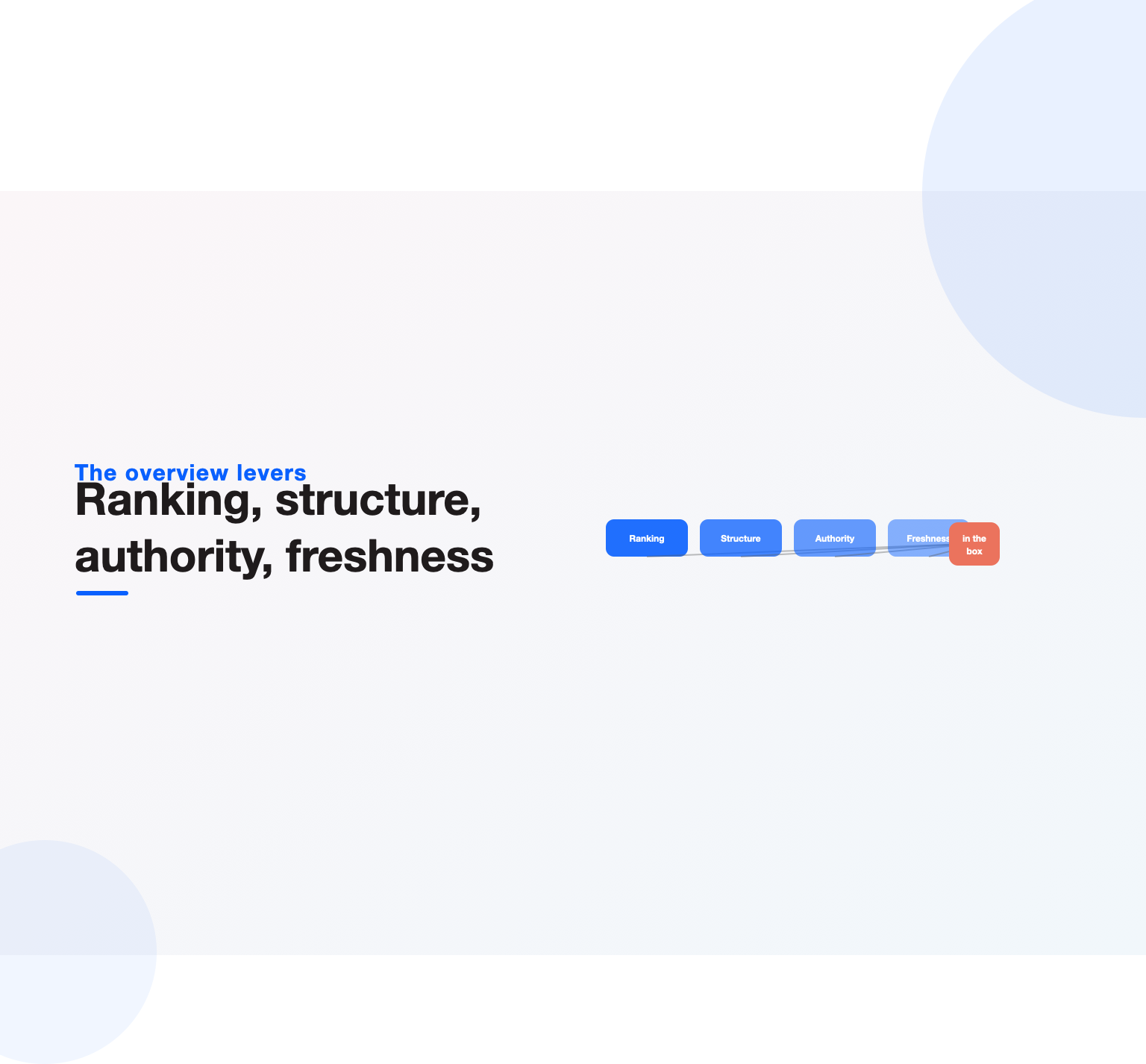
Effective work on this front pulls a few connected levers, and a serious effort attends to all of them. The first is organic ranking strength, since the overview draws so heavily on top-ranking pages. That means the foundational work of good optimization, relevant content, technical health, authority, still matters enormously, because it is the price of entry to being considered at all. There is no shortcut around ranking well; it is the base the rest is built upon.
The second lever is content structure and clarity. Pages should answer the questions users ask directly and near the top, in plain language, with clean formatting that makes each important passage easy to extract. Question-shaped headings, concise definitions, and dedicated question-and-answer sections all give the system clean material to lift and cite, so structuring content for extraction directly improves inclusion. This is often the fastest lever to improve, since it is entirely within your control and helps human readers at the same time.
The third lever is topical authority and trust, built through comprehensive coverage of your subject and the external credibility that signals expertise. A site that thoroughly and accurately covers its area, and that is well regarded across the web, is a source the overview can draw on with confidence, which is why depth and reputation matter as much as any single page. The fourth is freshness and accuracy, keeping information correct and current so the system continues to trust you as a source, since stale or wrong content invites it to look elsewhere. Planning that work against genuine demand, much as our guide on SEO cost advises, keeps it focused where it matters.
Do AI-generated answers recommend your competitors instead of you?
Our team reviews your current setup and shows you where the opportunities are. See how our GEO services work.
How this builds on classic SEO
One of the most useful things to understand is that AI overview optimization is not a replacement for search optimization but an extension of it. Every signal the overview relies on, strong organic ranking, clear extractable content, topical authority, accuracy, is something good optimization already pursues, so a business with a healthy, authoritative site is far along before it does anything overview-specific. The additional work is a matter of emphasis rather than a new playbook: sharpening how directly pages answer questions, deepening topical coverage, and making sure the most important answers are stated plainly enough to be lifted.
This continuity is reassuring because it means the effort compounds rather than competing for budget. Money spent improving rankings and content quality serves both the classic listings and the overview at once, and a page restructured to be more extractable tends to perform better for human readers and in featured snippets too. Rather than treating the overview as a separate project, the productive approach folds it into an existing search program as one more reason to do the fundamentals well, which is exactly how the broader SEO services that surround it are meant to work. The businesses that see the overview as an extension of good practice, not a departure from it, adapt to it most smoothly.
The distinction that does matter is one of goal. Classic optimization aims to rank a page in the list; overview optimization aims to be cited in the summary above it. Holding both goals at once changes how you judge success, adding citation presence to the rankings you already track, and it nudges content toward answering questions directly rather than only covering a topic. That shift in mindset, from ranking a page to being the answer, is the real substance of the discipline, and it aligns closely with the wider move our guide on generative engine optimization describes.
Common mistakes to avoid
Several avoidable errors keep businesses out of AI Overviews even when they invest effort. The most common is chasing overview inclusion while ignoring organic ranking, when strong ranking is the very foundation the overview draws on; a page that does not rank well is unlikely to be cited no matter how it is formatted. A second frequent error is burying the answer, writing content that eventually addresses the question after a long preamble instead of stating it plainly near the top, which gives the system nothing clean to lift.
Another mistake is neglecting topical authority, publishing a single thin page on a subject and expecting it to be treated as a trustworthy source, when the overview favors sites that cover their area comprehensively and credibly. Letting content go stale is a related error, since the feature prizes current, accurate information and quietly discounts sources that seem outdated. The subtlest mistake is panic: reacting to the traffic the overview absorbs by abandoning search altogether, rather than adapting to be cited within it and focusing on the queries where users still click. Avoiding these errors is less about clever tactics than about doing the fundamentals well and adjusting the emphasis, the same discipline our guide on SEO for business stresses for durable results.
How AI Overviews differ across query types
The feature does not affect every search equally, and understanding where it appears helps a business focus its effort. Overviews show up most for informational and question-based queries, where a synthesized answer serves the user well, and less consistently for navigational or highly transactional searches, where the user wants a specific site or is ready to act. This means the impact on your business depends heavily on the mix of queries you rely on, and mapping which of your priority terms trigger an overview is a sensible first step.
For informational queries where an overview dominates, the goal is clearly to be cited within it, since ranking beneath may deliver little traffic. For commercial and transactional queries where users still click through to compare and buy, classic ranking retains much of its value, and the overview, where it appears, becomes an additional visibility layer rather than a replacement. A balanced approach recognizes this split, prioritizing overview citation where the feature intercepts the answer and continuing to compete hard on the queries where clicks persist. This is also where the overview connects to local and commercial intent, since businesses serving nearby customers should ensure their strong local SEO foundations feed the answers users get, wherever those answers appear.
Where AI Overviews are heading
The trajectory of the feature points toward more prominence, not less, as generated answers become a normal part of how people search. As the system matures and expands to more queries, being cited within it will matter increasingly for visibility, and the brands that have built the ranking strength, extractable content and topical authority it rewards will be positioned to benefit while others watch their traffic erode. Treating overview optimization as a durable investment now, while its patterns are still settling, follows the same early-mover logic that rewards adaptation across emerging search surfaces.
The convergence with the wider world of AI answers is the most important part of this trajectory. Google’s overviews draw on the same generative approach that powers assistants and standalone answer engines, so the work of earning a citation in an overview and the work of being named by an AI assistant are increasingly one and the same. A business that builds authoritative, extractable, accurate content is preparing for every version of this future at once, which is why overview optimization is best understood as one expression of the broader disciplines of AI search optimization and the citation-focused work an answer engine optimization program handles. Seen that way, adapting to the overview is not a defensive scramble but a forward investment in how discovery is heading.
The impact on traffic and clicks
One of the most discussed effects of AI Overviews is their impact on click-through, and it is worth understanding honestly. When an overview answers a query completely, some users get what they need without clicking any result, which can reduce the traffic that flows to organic listings, especially for simple, informational questions. This is a real change, and businesses that depended on ranking for such queries may see fewer visits even as their rankings hold, because the overview now intercepts the answer.
The response to this is not to abandon search but to adapt to how visibility now works. Being cited in the overview keeps your brand in front of searchers even when they do not click, which builds awareness and can still drive qualified visits from users who want more depth than the summary provides. And for many commercial and complex queries, users still click through to research, compare and buy, so the value of ranking well remains substantial. The practical lesson is that appearing inside the overview, and focusing on the queries where users still click, matters more than lamenting the clicks the feature absorbs, a reframing our guide on SEO for business encourages.
Measuring AI overview optimization
Measuring performance in AI Overviews is less direct than tracking classic rankings, but a useful picture can be assembled from several signals. The most important is presence: whether your brand appears as a cited source in the overviews for your priority queries, checked by searching those queries and observing the result. Tracking how many of your target questions you are cited for, and how that changes over time, is the clearest read on whether the work is succeeding, even though it takes deliberate effort to observe.
Alongside presence, watching the relationship between rankings and traffic reveals the feature’s effect on your business. If rankings hold but clicks for informational queries soften, that signals overviews are intercepting answers, and the sensible response is to prioritize being cited and to focus on the queries where clicks persist. Pairing overview presence with your analytics, organic traffic, conversions, and the queries driving them, connects the feature to real outcomes. Since the surface is observable, you can see the overviews yourself, progress is verifiable, which makes the work accountable even without a dashboard that reports it directly.
Getting started with AI overview optimization
A business can begin without a large program by focusing on the highest-leverage fundamentals. The natural starting point is to identify the queries most important to your business, search them, and see whether an overview appears and whether you are cited in it. That quick check reveals both the opportunity and the gap, showing where being included would matter most and giving the work a concrete target rather than a vague ambition to be more visible.
From there the early work is clear and overlaps with sound optimization generally: strengthen your organic rankings for those queries, restructure the relevant pages so they answer the questions directly and are easy to extract, deepen your topical coverage to build authority, and keep the information accurate and current. Since these fundamentals also serve classic search and the wider set of AI answers, nothing is wasted, and they can be started in-house before any specialist help is engaged. As competition on your priority queries intensifies, a partner that works these surfaces accelerates progress, the same logic that applies across emerging search disciplines and that ties this work to broader AI search optimization and the citation-focused approach an answer engine optimization program brings. The businesses that build for the overview now, while its patterns are still settling, are positioning themselves for a results page that increasingly leads with a generated answer.
Want to be the brand generative AI recommends?
Book a free 30-minute strategy call and leave with a clear next step for your business.
A practical approach to earning overview citations
Turning the principles into action is easier with a clear sequence. Begin by mapping which of your priority queries actually trigger an overview, because that tells you where the feature is intercepting answers and where classic ranking still carries the traffic. With that map in hand, focus first on the queries where an overview appears and where you already rank on the first page but are not being cited, since those are the nearest wins, a strong page that simply needs sharper, more extractable answering to earn its place in the summary.
For those pages, the work is concrete: state the direct answer to the query plainly near the top, use question-shaped headings that mirror how people ask, add concise definitions and clean question-and-answer sections, and make sure the facts are current and correct. Then widen the effort to build topical depth around each priority subject, since the overview trusts sources that cover their area comprehensively rather than in isolation. This combination, extractable answers on pages that already rank, supported by genuine topical authority, is what most reliably converts a first-page ranking into an overview citation, and it improves the page for human readers at the same time.
The queries where you do not yet rank on the first page require the longer game of classic optimization first, since ranking is the price of entry to the overview. Here the sensible move is to invest in the content quality, authority and technical health that lift rankings generally, knowing that as those pages climb, they become eligible for overview inclusion too. Sequencing the work this way, quick extractability wins on strong pages, then authority building on the rest, makes the effort tractable rather than overwhelming, and it keeps the investment tied to genuine demand, much as our guide on SEO cost recommends. Approached as a staged program rather than a scramble to appear everywhere at once, earning overview citations becomes a natural extension of the search work a business is already doing, and pairing it with the wider AI search optimization effort ensures the same content earns visibility across every answer surface, not just Google’s.
It is worth keeping the bigger picture in view as you do this work. The overview is one of several places a generated answer now stands between a searcher and your site, alongside assistants and standalone answer engines, and the content that earns a citation in one tends to earn it in the others, since they draw on the same signals of authority, clarity and trust. A business that builds once, extractable answers on authoritative, accurate pages, is therefore optimizing for the whole answer landscape at once, which is why this work connects so naturally to the citation-focused approach an answer engine optimization program takes and the generative-answer work a GEO agency performs. Framed that way, adapting to Google’s overview is not a narrow fix but a step into a durable, forward-looking way of earning visibility wherever answers are generated. For most businesses the honest starting point is simply to check today which of their important queries return an overview and whether they are named in it, then treat any gap as the brief, a diagnostic that costs nothing and, as our guide on SEO for business notes, grounds the whole effort in real, observable opportunity rather than guesswork.
Key Takeaways
- AI overview optimization works to get your brand cited in Google’s generated summary above the classic results.
- Strong organic ranking is the foundation, since overviews draw heavily on pages that already rank well.
- Direct, extractable content, topical authority and accuracy strongly influence which sources are cited.
- The feature can reduce clicks, so being inside the overview matters more than lamenting the traffic it absorbs.
- Measure by whether you are cited for priority queries, and start now while the patterns are still settling.
Frequently asked questions
Direct answers to the questions businesses ask most about AI overview optimization.
What is AI overview optimization?
It is the practice of shaping your content and authority so Google’s AI Overviews, the generated summary above the classic results, surface and cite your brand. Because that summary answers the query directly at the top of the page, being a source it draws from is prime visibility. The work rests on ranking strongly in organic search, structuring content so it is easy to extract and quote, building genuine topical authority, and keeping information accurate and current so the system trusts you as a source.
How does Google choose sources for AI Overviews?
Google assembles an overview from content it judges relevant, authoritative and clearly understandable, and the strongest single predictor of inclusion is already ranking well organically for the query. Beyond ranking, it favors pages that answer the question directly and are easy to extract, sources with genuine topical authority, and information that is accurate and current. In short, it rewards exactly the qualities that AI overview optimization sets out to build, which is why the work overlaps so heavily with good search practice.
Do AI Overviews reduce my website traffic?
They can, especially for simple informational queries a summary answers completely, since some users get what they need without clicking. Rankings may hold while clicks soften for those queries. The response is to adapt: being cited in the overview keeps your brand visible even without a click, and for commercial or complex queries users still click through to research and buy. Focusing on being inside the overview and on queries where clicks persist matters more than lamenting the traffic it absorbs.
How do I get my content into an AI Overview?
Start by ranking well organically for the query, since overviews draw heavily on top-ranking pages, then structure the relevant content to answer the question directly and clearly near the top so it is easy to extract. Build genuine topical authority through comprehensive, accurate coverage of your subject, and keep information current. These levers together, ranking, extractable structure, authority and freshness, are what make the system confident enough to cite you rather than a competitor.
Is AI overview optimization different from SEO?
It builds directly on SEO but adds a specific focus. Strong organic ranking is the foundation, so classic optimization still matters enormously, but AI overview optimization adds attention to extractable structure, topical authority and accuracy aimed at being cited in the generated summary rather than only ranking beneath it. Think of it as an extension of good SEO for a results page that now leads with an answer, not a separate discipline that replaces the fundamentals your rankings depend on.
Can I measure whether I appear in AI Overviews?
Not through a simple ranking report, but you can assemble a clear picture. Search your priority queries and observe whether an overview appears and whether you are cited, tracking how many of your target questions include you over time. Pair that with your analytics to watch how rankings and clicks relate, since softening clicks on held rankings signal overviews intercepting answers. Because you can see the overviews yourself, progress is observable even without a dashboard that reports it.
Should small businesses worry about AI Overviews?
Yes, and they can also benefit. Because the overview draws on relevant, authoritative, well-structured content rather than only the biggest brands, a focused small business that ranks for its niche queries, answers them directly and builds genuine authority can earn citations, sometimes on questions larger rivals neglect. Much of the work overlaps with good general optimization, so it can begin in-house, with specialist help added as competition on priority queries grows.
How long does AI overview optimization take?
Because it builds on organic ranking and topical authority, it follows a similar timeline: structure and content improvements can help sooner, while the ranking and authority work compounds over months. There is no fixed schedule, since inclusion depends on competing for queries where the overview appears, but progress is observable throughout because you can check the overviews directly. Starting early, while the feature’s patterns are still settling, tends to pay off more than waiting for them to harden.
Ready to put this into practice?
Talk to the team that runs SEO, AI search and paid growth programs every day.
Book a Strategy Call →