 Skip to content

GEO for SaaS: Get Your Software Recommended by AI
GEO for SaaS optimizes your content and reputation so AI assistants recommend your software when buyers ask which tool to use. Why SaaS is exposed to AI research, what content wins, and how to measure it.
Quick Answer
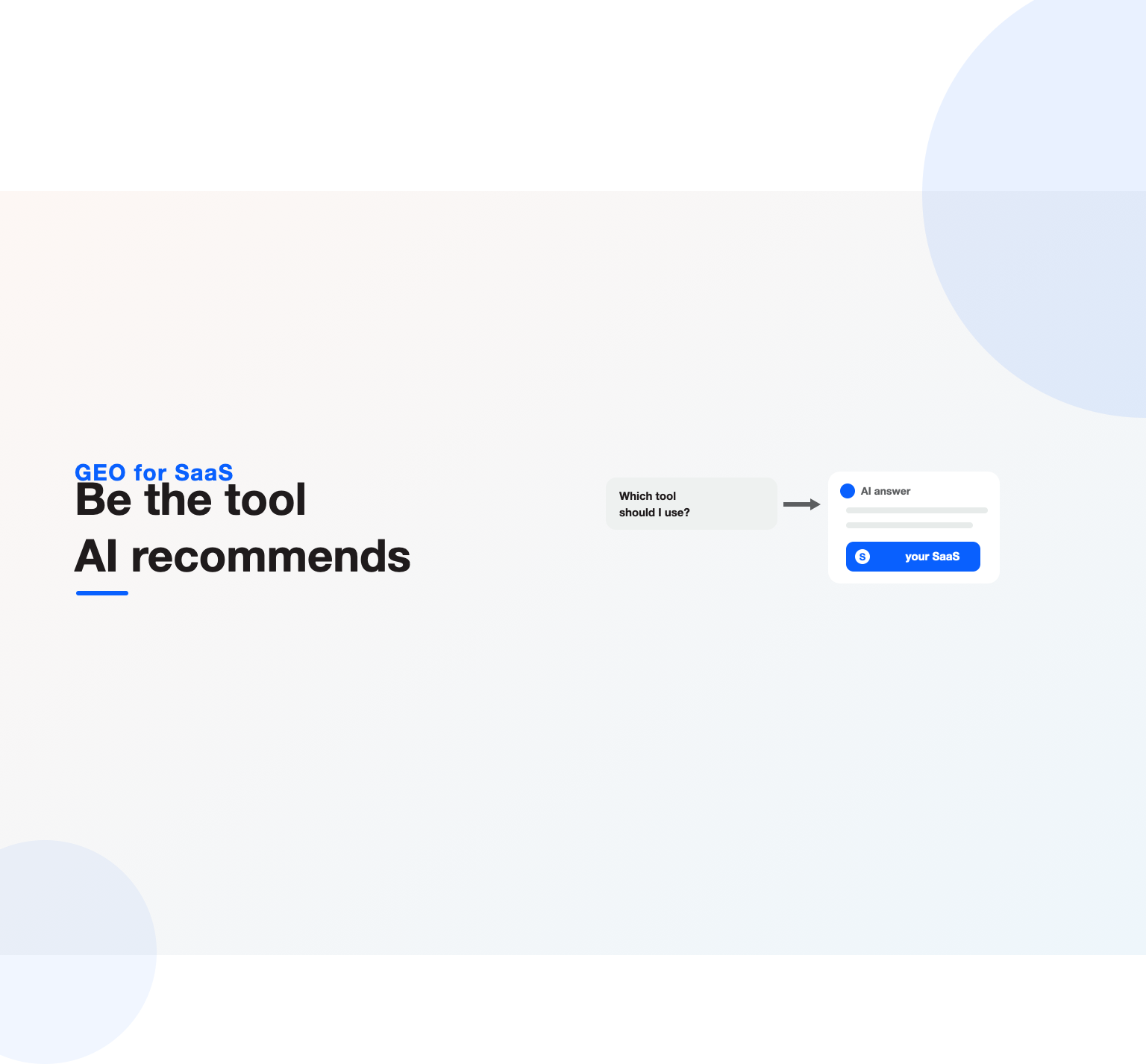
GEO for SaaS is the practice of optimizing a software company’s content and reputation so generative AI assistants like ChatGPT, Gemini, and Perplexity recommend and cite it when buyers ask which tool to use. It matters because software buyers increasingly ask assistants to shortlist options, compare tools, and explain categories before they ever visit a review site or run a search, so the products those assistants name enter the shortlist while the rest are never considered. Winning here means publishing genuinely useful, comparison-rich, well-structured content about your category and product, earning a strong reputation across the review sites and communities models trust, and making sure your pages and docs are technically accessible to the systems that generate these answers.
Key Highlights
- GEO for SaaS means being recommended and cited by AI assistants when buyers ask which software to use, a fast-growing part of the software buying journey.
- SaaS buyers lean heavily on assistants for category explanations, comparisons, and shortlists, so being named early shapes which tools get evaluated at all.
- The content that wins is honest comparison and category content, clear product information, and useful documentation that models can extract and cite.
- Reputation across review platforms and communities strongly influences which tools assistants surface, because models reflect that consensus.
- Technical accessibility of your site and docs is a prerequisite, since crawlers behind AI browsing must be able to read the content.
What GEO for SaaS is
At its core, GEO for SaaS applies generative engine optimization to software companies: making your product the kind of source and option that AI assistants draw on when answering questions about tools, categories, and use cases. Where classic SaaS SEO aimed at ranking pages for terms like a category plus the word software, this aims at being part of the answer an assistant generates, whether that is a direct recommendation of your product, a citation of your content, or a mention as a leader in your category. The target shifts from a ranking to a recommendation.
This matters because the software buyer journey is changing shape. A buyer used to search a category, read a listicle or review site, and click through to a few products; now they often ask an assistant to explain the category, compare the main options, and suggest what fits their situation, getting a synthesized answer that names specific tools. Being surfaced in that answer requires being known, well-reviewed, and accessible to the model, which is what GEO for SaaS sets out to achieve. It is a specific, high-value instance of the broader shift our guide to AI visibility describes, applied to a category where buyers research heavily, and it is delivered through a dedicated GEO service for SaaS.
Why SaaS is especially exposed to AI research
As a category, software is a natural fit for AI-assisted buying, which is exactly why GEO for SaaS deserves focused attention. Buyers often start without knowing the exact category name, the key features to weigh, or which tools exist, so they ask an assistant to educate them and narrow the field, precisely the advisory interaction assistants do well. A large share of early software research, the category explanation and initial shortlist, is therefore moving into assistants ahead of the traditional search-and-compare path.
The economics amplify it. These purchases are considered, recurring, and often high-value, and they run through evaluation and comparison stages where a credible recommendation carries weight. A tool named by an assistant as a strong fit for a specific need gains a shortlist spot that is hard to buy through advertising, because it arrives as guidance. For SaaS companies in crowded categories, being the product an assistant surfaces rather than a competitor is a meaningful edge, which is why GEO for SaaS is worth building deliberately rather than leaving to how the models happen to describe your space.
How assistants choose which software to recommend
Understanding how assistants pick tools is the foundation of GEO for SaaS, and the patterns are consistent. Assistants favor products that are well-documented and clearly described, backed by content that genuinely explains the category and how options compare, and supported by a strong reputation across the sources models trust. Since software recommendations carry real consequences for a buyer, models lean toward tools that appear credible, established, and well-reviewed rather than obscure or thinly documented.
Relevance and fit drive the specific recommendation: an assistant reaches for the tool that best matches the buyer’s stated needs, use case, size, budget, integrations, so a product with clear content about who it is for and what it does well is easier to match than one described vaguely. Consensus matters too, since models reflect what review sites, communities, and credible sources broadly say about a tool. The through-line for GEO for SaaS is that assistants try to give useful, trustworthy software guidance, so they surface tools that genuinely appear to be a good, well-regarded fit, which means the work is about being genuinely well-documented and well-reviewed, the same merit-based logic behind how to rank in ChatGPT and getting cited by Claude.
Content that wins GEO for SaaS
The content that earns a SaaS product a place in AI answers is honest, useful category and comparison content plus clear product information. Buyers ask assistants what the best tool is for a job, how two products compare, and what to look for in a category, so content that genuinely answers those questions, comparison pages, category explainers, use-case guides, positions your product as a knowledgeable option the assistant can cite. Clear pages about who your product is for, what it does, and how it fits common needs give a model the specifics it needs to recommend you accurately.
Documentation is an underrated asset here. Well-written docs and help content that explain how your product solves real problems are exactly the kind of clear, factual, useful material models draw on, so treating documentation as public, high-quality content rather than an afterthought pays off. Structure and clarity make all of it usable: answer-first sections, clear headings mapped to real buyer questions, and precise, factual descriptions. This mirrors the depth-and-clarity approach behind any effective content strategy, and it distinguishes GEO for SaaS from the thin feature-list pages that give a model nothing distinctive to cite.
Reviews, communities, and reputation in SaaS
Since models reflect consensus, reputation is central to GEO for SaaS, and software has especially influential reputation sources. Review platforms like G2, comparison sites, and communities where software buyers gather all feed the picture a model builds of your product, so a tool well-regarded across those places is more likely to be surfaced than one absent from them. Genuine, positive reviews and an active, credible presence in your category’s communities translate directly into AI visibility, not just social proof.
The practical move is to earn a strong, authentic reputation where software reputation forms: encourage satisfied customers to leave honest reviews on the platforms buyers consult, be genuinely present and helpful in the communities relevant to your category, and seek credible coverage and comparisons. Since a model reflects what many trustworthy sources say, breadth and quality of reputation is one of the strongest levers in This work, and it compounds over time into the kind of standing that is hard for competitors to displace. This reputation work doubles as ordinary SaaS marketing, so it pays off across channels, reinforced by the same authority-building fundamentals that work everywhere.
Positioning, category, and use-case clarity
Clear positioning is where software lives and dies, and that clarity is a direct lever in GEO for software. Assistants recommend the tool that best fits a stated need, so a product that clearly communicates its category, its ideal customer, its standout use cases, and its differentiators is far easier to match to the right buyer than one with vague, everything-to-everyone messaging. Being explicit about who you are for and what you do best helps a model confidently recommend you for the situations you actually fit.
This means building content and messaging organized around real categories and use cases: clear pages for the problems you solve and the segments you serve, honest about where you fit and where you do not. The same specificity that helps a buyer self-qualify helps an assistant place you correctly, so precise positioning serves both. Vague positioning, by contrast, leaves a model unsure when to recommend you, so it defaults to clearer competitors. Sharp, honest category and use-case clarity is therefore one of the highest-leverage and most controllable parts of The practice, and it aligns with how modern B2B SEO already targets specific buyer intent.
Technical accessibility for SaaS sites and docs
None of the content and reputation work reaches assistants if they cannot read your pages, so technical accessibility is a quiet prerequisite for AI visibility for software, and it is a common weak spot for software sites. Many SaaS marketing sites and documentation portals are built as JavaScript-heavy applications, and the crawlers behind AI browsing generally work best with content present in the served HTML, so content that only renders client-side can be invisible to them, which is the same issue our work on JavaScript SEO covers in depth.
The fix is to ensure your important marketing content and documentation are server-rendered or otherwise present in the HTML, on fast, crawlable pages, with robots directives that allow the crawlers you want. Since docs are such valuable citable content, making sure they are accessible rather than locked behind a rendering-heavy portal is especially important for SaaS. This technical layer is unglamorous but decisive, since it determines whether all the careful Optimizing a SaaS product for assistants work can actually reach the models it was meant for, rather than being hidden behind code they never execute.
Measuring GEO for SaaS
Like any discipline, This discipline needs measurement, and the most direct method is to ask the assistants the questions your buyers ask. Build a list of the real category, comparison, and recommendation questions software buyers pose in your space, then put them to ChatGPT, Gemini, and Perplexity, recording whether your product is mentioned or cited, how it is characterized, and which competitors appear. Repeating this across a consistent set of questions over time turns it into an audit of where you are surfaced and where you are absent.
That audit drives strategy directly. The buyer questions where your product should be recommended but is not become your content and reputation priorities, and seeing which competitors assistants name shows you what is winning. Tracking your product’s AI visibility alongside its traditional search presence and review standing gives a full picture as software buying shifts, which is the same measurement discipline described in our approach to AI visibility. Treated as a metric rather than a guess, your product’s standing in AI answers becomes something you can deliberately and steadily improve.
GEO for SaaS versus classic SaaS SEO
It helps to see how This work relates to the SaaS SEO teams already do, because they share foundations but differ in emphasis. Classic SaaS SEO targets rankings for category and comparison terms, measured by positions and clicks, while GEO aims at being recommended within an assistant’s answer, measured by whether and how the product is named. You optimize a page for a keyword in one; for the other you influence a model shaped by your whole footprint of content, docs, and reputation.
Yet the two are complementary, and much of the work serves both. The clear category and comparison content, strong documentation, sharp positioning, credible reviews, and technical health that help a SaaS product rank are largely what assistants draw on too, so good SaaS SEO is most of the work. The differences are extra weight on reputation and consensus and a different way of measuring success, and both are served by a coordinated generative engine optimization approach rather than treating AI as a separate silo. Investing in the fundamentals lifts a SaaS product across search and AI at once.
GEO for SaaS across the buyer journey
Software buyers move through stages, and assistants now touch each one, so a complete approach covers the whole journey. Early on, buyers ask an assistant to explain a category and what to look for, which rewards clear educational content that frames the space and positions you as knowledgeable. In the middle, they ask for comparisons and shortlists, where honest comparison content and a strong review reputation decide whether you make the list. Near a decision, they ask detailed fit questions, where precise product and use-case content and good documentation help an assistant confirm you are right for them.
Mapping your content to those stages ensures you are present wherever a buyer engages an assistant, not just at one point. A product visible only at the category-education stage but absent from comparisons loses the shortlist, while one strong at comparison but vague on fit loses the final check. Covering the journey with the right content at each stage is what turns AI visibility into pipeline, mirroring the funnel thinking that drives effective B2B SEO, and it is a core part of doing this well for software.
Comparison and alternatives content for SaaS
Comparison and alternatives content is especially powerful for software visibility, because so many buyer questions to assistants are comparative: which of these tools is better, what are the alternatives to a given product, what should I use instead. Honest, useful comparison pages, ones that fairly explain trade-offs rather than just claiming you win, give assistants exactly the kind of balanced, informative content they favor for these questions, and they position your product as a credible option within the consideration set.
The key is genuine helpfulness and honesty, since assistants and buyers alike distrust one-sided comparisons. Content that accurately describes where your product fits, who it suits, and even where another tool might be a better match reads as trustworthy and is more likely to be cited than transparent self-promotion. Building fair, informative comparison and alternatives content for the real questions buyers ask is one of the highest-return moves for a SaaS product in AI answers, and it doubles as strong classic SEO for the same high-intent comparison queries, connected to a broader content strategy.
A GEO plan for your SaaS
Turning this into results means running it as a program. Start by auditing where your product stands: ask the assistants the real category, comparison, and recommendation questions your buyers pose, and record whether you are named. Next, make sure your marketing site and documentation are technically accessible, present in server-rendered HTML, fast, and not blocked. Then identify the buyer questions where your product should be surfaced but is not, and create or improve the category, comparison, and use-case content that would earn the mention.
From there, invest in the reputation assistants reflect, encouraging genuine reviews and an active community presence, sharpen your positioning so a model knows exactly when to recommend you, and re-audit regularly to track progress. Coordinate the work with your existing SaaS SEO rather than running it separately, since the fundamentals overlap, and a coordinated AI search optimization program is more efficient than treating each surface alone. Followed consistently, this plan makes your product one an assistant reliably names when buyers ask what to use.
The future of SaaS discovery
The direction is clear: more of software discovery will run through AI assistants, and the products established as trusted, well-documented, well-reviewed options will be recommended repeatedly while others struggle to break in. As assistants get better at understanding needs and matching tools, the advantage compounds for products that have built genuine authority and reputation, much as an early lead in search once did. SaaS categories move fast, so the brands that start building AI visibility now accumulate a lead that late movers find hard to close.
None of this replaces good SaaS marketing; it extends it to a decisive new surface. The products that keep doing what has always mattered, explaining their category clearly, earning genuine reviews, documenting their product well, and being honestly useful, are the ones assistants reward, so this is continuity rather than reinvention. That is the same reason SEO is not dead but evolving, and it rests on the enduring fundamentals of how SEO works. For SaaS companies, treating AI visibility as a first-class channel now is a durable investment in tomorrow’s pipeline, not a reaction to a passing trend.
Common mistakes in GEO for SaaS
Several mistakes hold SaaS companies back. The first is thin, feature-focused content, product pages that list features without explaining categories, comparisons, or fit, which gives assistants nothing useful to cite. The second is neglecting reputation, ignoring the review platforms and communities models weigh heavily for software. The third is vague positioning that leaves a model unsure when to recommend you. The fourth is technical: building marketing sites and docs as rendering-heavy apps crawlers cannot read.
Two further errors are common. Many SaaS teams do not measure their AI visibility at all, so they have no idea whether assistants recommend them or how that is changing, and cannot improve deliberately. And some treat GEO as entirely separate from their existing marketing, missing that the same content, docs, reputation, and technical health drive search, review-site presence, and AI visibility together. Avoiding these traps comes down to doing SaaS marketing well, clear category content, strong docs, sharp positioning, and genuine reputation, which is exactly what both buyers and assistants reward, and what makes GEO for software a durable advantage.
Key Takeaways
- The practice is optimizing your content and reputation so AI assistants recommend and cite your product when buyers ask which software to use.
- Software buyers lean on assistants for category explanations, comparisons, and shortlists, so being named early decides which tools get evaluated at all.
- Win with honest comparison and category content, clear product information, and strong documentation, all structured to be extractable and cited.
- Cultivate reputation across review platforms and communities, sharpen your positioning and use-case clarity, and keep your site and docs technically accessible.
- Measure your product’s presence in AI answers, and treat GEO as an extension of strong SaaS SEO rather than a separate silo.
Frequently asked questions
What is GEO for SaaS?
AI visibility for software is the software-industry application of generative engine optimization: optimizing a product’s content and reputation so AI assistants like ChatGPT, Gemini, and Perplexity recommend and cite it when buyers ask which tool to use. Rather than aiming for a ranking, it aims for a place inside the answer an assistant generates, whether a direct recommendation, a citation, or a mention as a category leader, which is where a growing share of software buyers now begin their research.
Why do SaaS companies need GEO?
Because software buyers increasingly ask assistants to explain categories, compare tools, and suggest options before searching traditionally, and the products an assistant names gain a shortlist spot at the moment evaluation begins. Software is a considered, recurring purchase where a credible recommendation carries weight, so being surfaced by an assistant is a meaningful advantage. Tools that build this visibility get considered; those absent from AI answers are never in the running.
How do AI assistants decide which software to recommend?
They favor products that are well-documented and clearly described, backed by content that explains the category and comparisons, and supported by a strong reputation across review sites and communities the model trusts. Relevance and fit drive the specific pick, so a tool with clear content about who it is for and what it does well is easier to match to a buyer’s need. Because recommendations have consequences, models lean toward credible, established, well-reviewed tools.
What content helps a SaaS product win in AI answers?
Honest comparison and category content, clear product information about who you serve and what you do well, use-case guides, and strong public documentation, all written answer-first and structured so an assistant can extract and cite it. Thin feature-list pages give a model nothing distinctive, while genuinely useful content that explains the category and how options compare positions your product as a knowledgeable, citable option for the buyer’s specific question.
Do reviews affect a SaaS product’s AI visibility?
Yes, strongly. Because assistants reflect the consensus of trustworthy sources, reputation signals like genuine reviews on the platforms buyers consult, presence in relevant communities, and credible comparisons all influence which tools get surfaced. A product well-regarded across those places is more likely to be recommended, so cultivating authentic reviews and a strong community presence is direct GEO work for a SaaS company, not just social proof, and it compounds over time.
Does documentation matter for GEO?
Very much, and it is often underused. Well-written documentation and help content that clearly explain how your product solves real problems are exactly the kind of factual, useful material models draw on, so treating docs as high-quality public content, and making sure they are technically accessible rather than locked behind a rendering-heavy portal, gives assistants strong material to cite. For SaaS, good docs are both a support asset and a genuine GEO advantage.
How is GEO different from SaaS SEO?
SaaS SEO targets rankings for category and comparison terms, measured by positions and clicks, while GEO aims at being recommended within an assistant’s answer, measured by whether the product is named. You optimize a specific page for search, but for GEO you influence a model shaped by your whole footprint of content, docs, and reputation. The foundations overlap heavily, so strong SaaS SEO is most of the work, with added weight on reputation and consensus.
How do I check if assistants recommend my software?
Ask them. Build a list of the real category, comparison, and recommendation questions your buyers would pose, then put them to ChatGPT, Gemini, and Perplexity, recording whether your product is mentioned, how it is described, and which competitors appear. Repeating this regularly shows where you are surfaced, where you are absent, and whether your visibility is improving, turning it into a metric you can act on with content, positioning, and reputation work.
How does GEO relate to product-led growth?
They reinforce each other. A product-led SaaS already invests in clear documentation, transparent pricing, and self-serve content that explains the product, which is exactly the kind of accessible, useful material assistants draw on to recommend and describe tools. Making that content public, well-structured, and technically readable turns your product-led assets into GEO assets. So teams practicing product-led growth are often well positioned for AI visibility, provided they ensure the content is crawlable and organized around the real questions buyers ask.
Does GEO work across all the assistants for SaaS?
Yes. The fundamentals, clear category and comparison content, strong docs, sharp positioning, genuine reviews, and technical accessibility, help across ChatGPT, Gemini, Perplexity, and Google’s AI answers, because each tries to surface credible, well-fit tools. Optimizing well for one generally lifts a product across the others, so a coordinated approach that verifies presence on each is more efficient than treating them separately, and it fits within a wider AI visibility program.
Ready to put this into practice?
Talk to the team that runs SEO, AI search and paid growth programs every day.
Book a Strategy Call →