 Skip to content

B2B SEO: How to Drive Pipeline, Not Just Traffic
B2B SEO targets high-intent buyers over long sales cycles and is measured in pipeline, not traffic. Keyword strategy, content for the buying committee, measurement, and aligning SEO with sales.
Quick Answer
B2B SEO is search engine optimization built for businesses that sell to other businesses, where the buying process is long, the deals are high-value, and several people influence each purchase. It differs from consumer SEO less in its mechanics than in its economics: the keywords that matter often have low search volume but very high intent and value, so a term searched a few hundred times a month can drive more revenue than a consumer term searched by the million. Effective B2B SEO targets the specific, problem-aware and solution-aware queries a buying committee uses, produces content credible enough to earn the trust of professional evaluators, and is measured by pipeline and revenue rather than raw traffic.
Key Highlights
- B2B SEO optimizes for long sales cycles and high-value deals, so success is measured in pipeline and revenue rather than traffic volume.
- The most valuable B2B keywords usually have low search volume but high intent, so chasing big numbers misses the terms that actually convert.
- Purchases involve a buying committee of several people, so content has to serve different roles and stages, from early research to final vendor evaluation.
- Credibility is decisive: professional buyers trust depth, expertise, and evidence, so thin content that works in consumer niches fails in B2B.
- SEO works best aligned with sales and demand generation, feeding qualified pipeline rather than being judged on isolated traffic metrics.
What B2B SEO is, and how it differs from B2C
B2B SEO is the practice of optimizing to attract and convert business buyers through organic search. The technical foundations are shared with all SEO, crawlability, relevance, authority, and good user experience, but the strategy on top of them is shaped by how businesses buy. Where consumer SEO often targets broad, high-volume terms and a fast path to purchase, B2B SEO targets narrower, higher-intent terms and a long, considered journey involving research, comparison, and internal approval before anyone buys.
That difference changes almost every decision. The keywords worth pursuing are different, weighted toward intent and value rather than volume. The content is different, built to demonstrate expertise and answer the detailed questions of professional evaluators rather than to entertain or convert impulsively. The measurement is different, focused on the leads and pipeline the work generates rather than traffic totals. Recognizing that B2B SEO is a distinct application of shared fundamentals, a point that also holds for the SaaS SEO subset of it, rather than consumer SEO pointed at businesses, is the starting point for doing it well, and it is why generic SEO advice so often falls flat when applied to a business audience.
Why B2B SEO is different: the economics of the sale
The defining feature of B2B SEO is the nature of the sale it supports, and everything else follows from it. Deals are high-value, so a single conversion can be worth thousands or millions, which means a keyword with modest volume can justify serious investment if it reaches the right buyers. The cycle is long, often months from first research to signed contract, so content has to support a journey rather than a single decision, staying useful across repeated visits as the buyer educates themselves and builds a case internally.
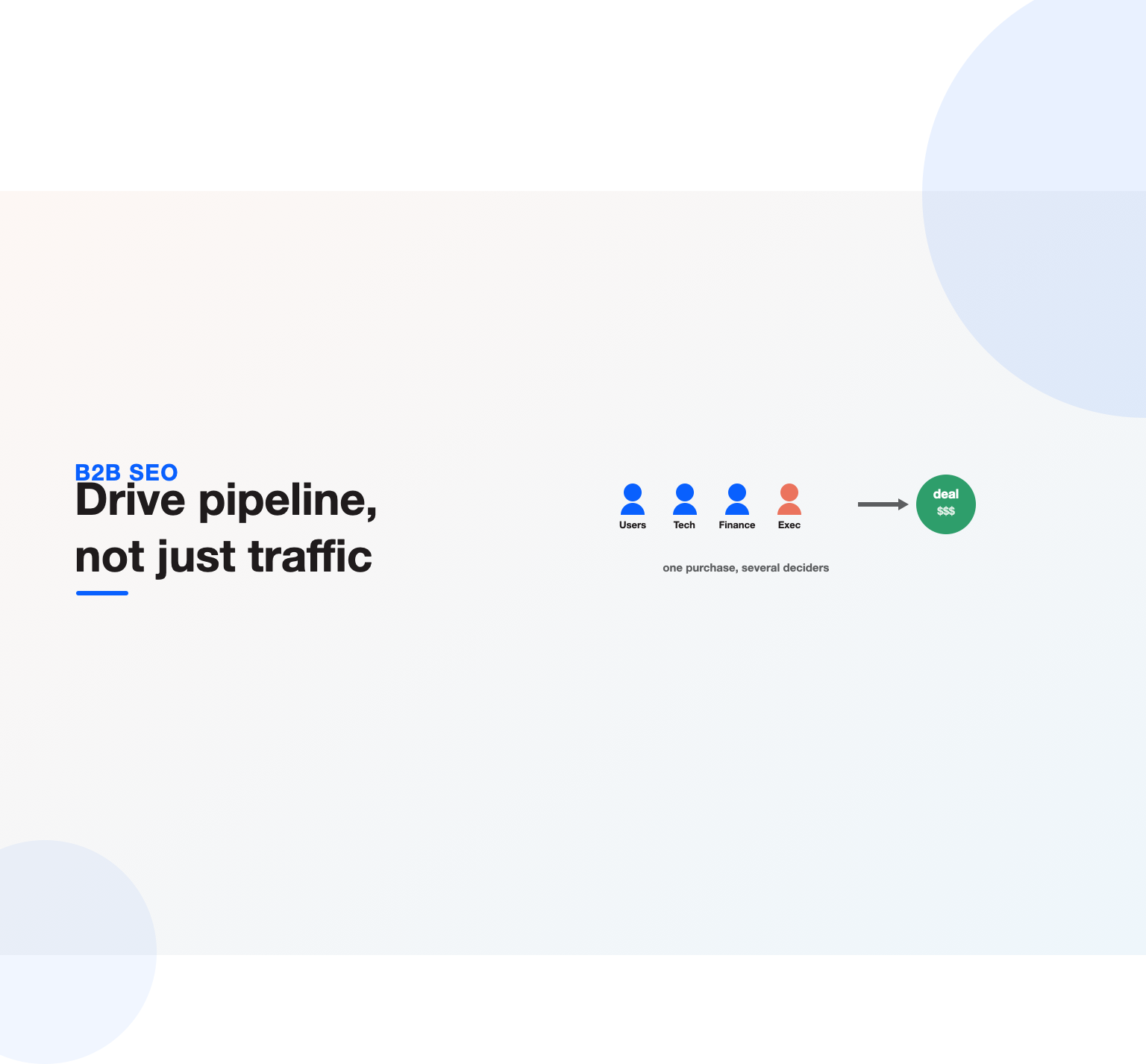
Purchases also involve multiple people, a buying committee that can include end users, managers, technical evaluators, finance, and executives, each with different questions and concerns. This means B2B SEO cannot target a single persona or a single query; it has to serve a range of roles and stages so the content reaches whoever is searching at each point. And because these buyers are professionals making consequential decisions, they are skeptical and thorough, rewarding genuine expertise and evidence while ignoring the thin, generic content that can still win in low-stakes consumer niches. These economic realities, high value, long cycle, many stakeholders, and demanding buyers, are what make B2B SEO its own discipline.
Keyword strategy for B2B SEO
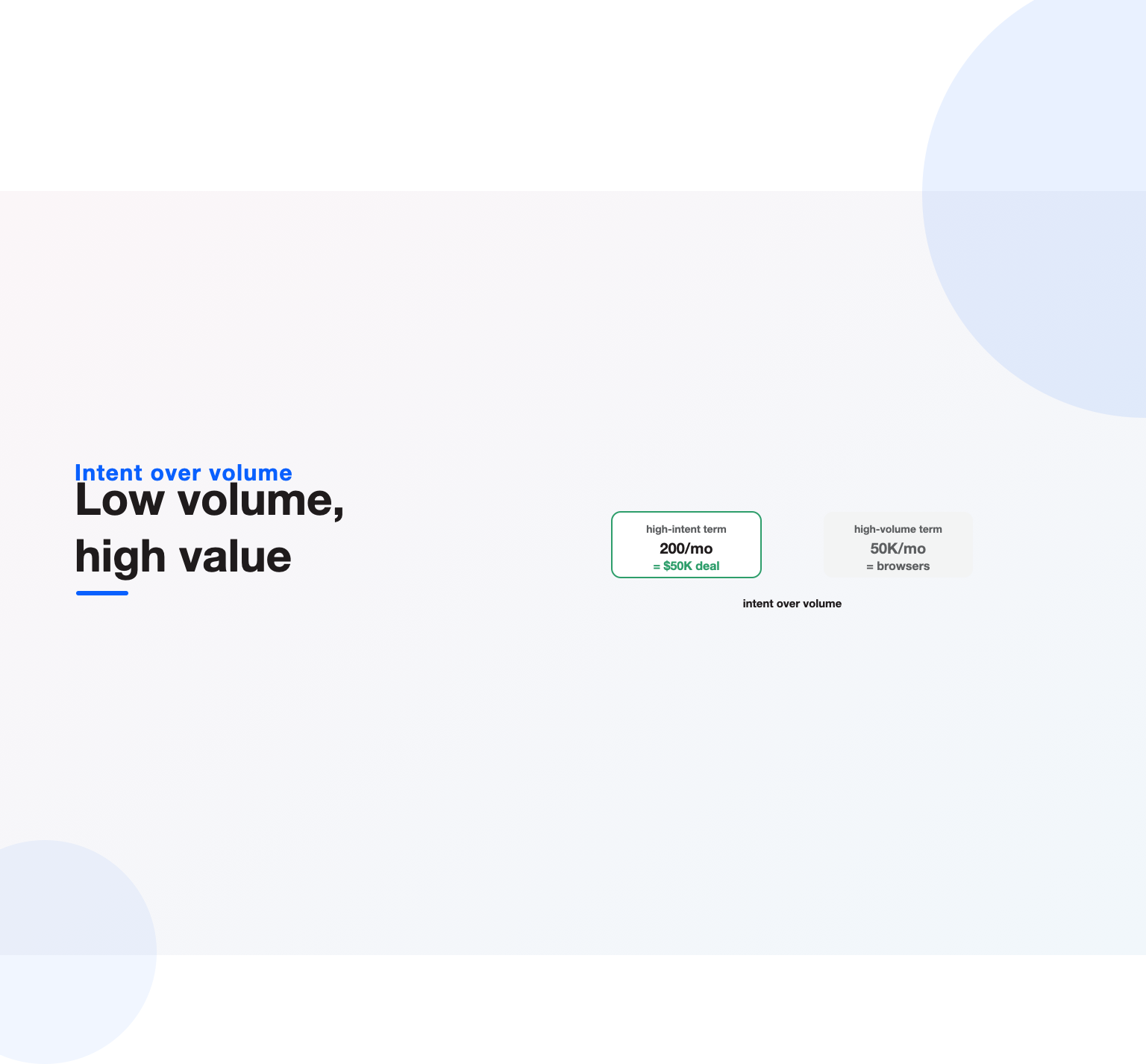
Keyword strategy is where B2B SEO most obviously departs from the consumer playbook, because the instinct to chase volume actively misleads you. The terms that drive B2B revenue are frequently low-volume, problem-aware and solution-aware queries, the specific phrases a professional uses when researching a real business challenge, and they convert at a rate that dwarfs high-volume informational terms. A query searched two hundred times a month by people with a budget and a problem is worth more than one searched fifty thousand times by a general audience with no intent to buy.
Building a B2B keyword strategy means mapping the language of your buyers across their journey and prioritizing by intent and value rather than volume alone. Target the problem-focused queries buyers use early, the solution and category terms they use as they evaluate, and the comparison and vendor-specific terms they use near a decision, including the review-site queries that platforms like G2 dominate, and do not dismiss a valuable term just because its volume looks small. This demand-mapping discipline is the same one behind all good keyword research, but in B2B search the weighting shifts decisively toward intent, because the whole point is to reach a small number of high-value buyers rather than a large audience of browsers.
Content that works for B2B buyers
Content is the engine of B2B organic search, and it has to meet a higher bar of credibility than most consumer content because the audience is expert and the stakes are high. Professional buyers reward the depth, specificity, and evidence that the helpful content guidance from Google also prizes, and they quickly dismiss generic articles that tell them nothing they did not already know. Content that demonstrates genuine expertise, thought leadership, detailed guides, research, frameworks, and honest comparisons, is what earns their trust and positions you as a credible option when they are ready to evaluate vendors.
The content also has to span the journey, since a buying committee needs different things at different stages. Educational and problem-focused content attracts and helps buyers early, solution and use-case content supports evaluation, and comparison, case-study, and product content serves the decision stage. Tying it all together into a coherent library that builds authority and guides buyers toward you is the work of a deliberate content strategy, applied with a B2B buyer in mind. The through-line is credibility and usefulness at a professional level, because in B2B search optimization the content is not just attracting traffic, it is auditioning for a place on the shortlist.
Not sure why your pages are not ranking or bringing enquiries?
Our team reviews your current setup and shows you where the opportunities are. See how our SEO services work.
Serving the buying committee and the journey
Because B2B purchases run through a committee over a long cycle, This discipline has to be planned around the buying journey rather than a single conversion. Map the stages your buyers move through, from recognizing a problem, to exploring approaches, to comparing vendors, to justifying a decision internally, and ensure you have content that meets the search intent at each one. A buyer early in research needs education, not a demo request, while a buyer comparing vendors needs the detail and evidence to make and defend a choice.
Serving the committee also means addressing different roles, because the person who first researches a solution is often not the one who signs off. Technical evaluators want depth and specifics, executives want outcomes and business cases, and finance wants cost justification, so a complete The approach program produces content that speaks to each without losing focus. Linking these pieces so a reader can move from an educational article toward a decision-stage page mirrors the internal journey the buyer is on, and it is what turns organic visibility into influence over a real purchase rather than a disconnected stream of visits.
Technical and on-page foundations
The technical and on-page fundamentals of Search for B2B are the same as any SEO, and neglecting them undermines even the best content and keyword strategy. The site has to be crawlable, fast, secure, and mobile-friendly, the pages have to be optimized so search engines understand what each targets, and the internal structure has to route authority to the pages that matter. None of this is unique to B2B, but it is the foundation every other effort depends on, and business sites, often built for brand rather than search, frequently have technical gaps that quietly cap performance.
Where A B2B program adds nuance is in applying these fundamentals to a considered-purchase context. Site structure should reflect the buyer journey and your solution categories so both users and search engines can navigate a complex offering, and internal linking should guide buyers from educational content toward decision-stage pages. Handling these foundations well is simply competent SEO, covered in our broader guide to how SEO works, but skipping them is a common reason B2B sites with good content still fail to rank, because the best content in the world cannot compensate for a site search engines struggle to crawl and understand.
Building authority and links in B2B
Authority matters in B2B search as it does everywhere, but the way you earn it fits the professional context. Business audiences and the publications that serve them respond to genuinely valuable, citable assets, original research, data, expert frameworks, and thought leadership, which earn links and mentions from industry sites, professional communities, and the press. Rather than chasing links for their own sake, the durable B2B approach is to create the kind of authoritative content that professionals reference and that naturally attracts citations.
Relationships and reputation play a larger role in B2B than in most consumer niches. Industry partnerships, expert contributions, speaking and podcast appearances, and a visible presence in professional communities like LinkedIn all build the authority that supports rankings while also building the brand credibility that influences buyers directly. Since the audience is narrow and reputation-driven, the same activities that earn links also build trust with the exact people who make purchasing decisions, so authority-building in B2B organic search doubles as demand generation, and the strongest programs pursue both together rather than treating links as a separate technical exercise.
Measuring B2B SEO by pipeline, not traffic
Measurement is where B2B search optimization most needs to break from consumer habits, because judging it on traffic volume misses the point entirely. A B2B program can succeed with modest traffic if that traffic is the right buyers converting into qualified leads and pipeline, and it can fail with impressive traffic that never turns into revenue. The metrics that matter are leads, qualified opportunities, pipeline, and closed revenue attributable to organic search, tracked through to the business outcomes the work is meant to drive.
This requires connecting SEO to the sales process rather than reporting it in isolation. Track how organic search contributes to lead generation and how those leads progress through the pipeline, and report on the qualified opportunities and revenue influenced rather than sessions and rankings alone, the same outcome-focused approach our guide to SEO reporting lays out. Because attribution in long, multi-touch B2B cycles is genuinely hard, honest measurement acknowledges organic search’s assisting role across the journey rather than claiming only last-click conversions. Measured this way, This discipline earns its budget by proving it feeds pipeline, which is the language the business actually funds.
Aligning SEO with sales and demand generation
The approach delivers the most when it is integrated with the wider go-to-market motion rather than run as a standalone channel. Sales teams know the real questions, objections, and language of buyers, which is invaluable intelligence for keyword and content strategy, and content built from that knowledge both ranks and equips sales conversations. Aligning SEO with demand generation means the organic content supports and amplifies the same campaigns and messages the business is running everywhere else, so the channels reinforce rather than duplicate each other.
This alignment turns SEO from a marketing silo into a pipeline contributor. When organic content is designed to attract and nurture the same buyers the sales and demand-gen teams pursue, and when the leads it generates flow cleanly into the sales process, SEO becomes part of an integrated engine rather than a source of traffic disconnected from revenue. Connecting it to demand generation in this way is what lets Search for B2B be judged and valued on its contribution to the pipeline, and it is the difference between a program that competes for budget on vanity metrics and one that defends its budget on business results.
Account-based and niche targeting in B2B SEO
B2B markets are often narrow and defined by industry, company size, or role, which lets search work in tandem with an account-based approach rather than casting a wide net. Instead of chasing the largest possible audience, you can build content that speaks precisely to a vertical or a segment, the specific challenges of manufacturers, or healthcare providers, or mid-market finance teams, so the buyers you most want to reach find content that feels made for them. This niche focus turns modest search volume into high relevance, and it aligns organic content with the same accounts and segments the sales team is pursuing.
The tactic is to identify your highest-value segments and create dedicated content and pages that address their particular language, problems, and objections, rather than generic material that speaks to no one in particular. Vertical-specific guides, use cases, and comparisons rank for the exact terms a segment searches and convert far better because they demonstrate that you understand that buyer’s world. Done consistently, this segmented approach compounds, since each vertical you cover deeply becomes a cluster that builds authority with exactly the accounts worth winning, and where segments share a structure it can even be scaled with programmatic pages, which is a more efficient use of B2B search than competing for broad terms against everyone.
B2B SEO versus paid channels
Most B2B companies run paid search and social alongside organic, and understanding how they differ clarifies why B2B search is worth the patience it demands. Paid channels buy immediate visibility and can be turned on instantly, which suits launches and time-sensitive campaigns, but the traffic stops the moment the budget does, and B2B click costs on competitive terms are among the highest anywhere. Organic search is slower to build but compounds, producing an asset that keeps generating qualified pipeline without paying for every click, which our comparison of SEO versus PPC examines in detail.
The strongest B2B programs use both deliberately rather than treating them as rivals. Paid can test which messages and keywords convert, informing the organic content roadmap, while organic builds the durable, trusted presence that lowers overall acquisition cost over time and supports the long research phase where buyers are not yet clicking ads. Since the ceiling on organic is content quality and authority rather than budget, B2B search is often the more defensible long-term investment, particularly for the high-value, considered purchases where buyers research thoroughly before they ever talk to sales, and where being the trusted answer matters more than being the paid one.
B2B SEO and AI search
AI search is reshaping how business buyers research, and it plays directly to the strengths of a strong A B2B program program. Buyers increasingly use AI assistants to shortlist vendors, summarize options, and answer detailed questions, and the brands cited in those answers gain influence at exactly the research stage where shortlists form. The same authoritative, in-depth, well-structured content that earns rankings and trust with professional buyers is what AI systems draw on to generate and cite answers, so investing in genuine expertise positions you for AI-driven discovery as well.
The practical move is to build content that is genuinely the best answer to buyers’ questions and to structure it clearly so both professionals and AI systems can extract and cite it, while tracking presence in AI answers as a new indicator of B2B visibility. Because business buyers making high-stakes decisions still verify and dig deeper, being cited by an AI tool often earns a click and a serious evaluation rather than a zero-click dead end. When we build B2B programs through our SEO services, they are designed to win visibility across traditional and AI search together, because that is where the modern buying committee actually does its research.
Want a team to run this SEO work for you?
Book a free 30-minute strategy call and leave with a clear next step for your business.
How to start a B2B SEO program
Starting well matters more than starting big, so a first B2B search program should be focused rather than sprawling. Begin by getting the technical and on-page foundations sound, using a technical SEO checklist so content has a healthy site to rank on, then pick one high-value segment or problem area to own rather than trying to cover everything at once. Research the real language and questions of buyers in that area, ideally with input from sales, and build a focused cluster of genuinely expert content around it before expanding to the next.
Set expectations and measurement up front so the program is judged fairly. Agree that success means qualified pipeline over months, not traffic next week, connect analytics to the sales process so you can show that contribution, and report on the outcomes that matter to the business. Because the value of a single B2B deal is high, even a modest flow of qualified organic leads can deliver a strong return, which is a large part of why SEO is worth the investment for business sellers. Start focused, prove pipeline in one area, and expand from a base that already works rather than spreading thin across a market you have not yet earned authority in.
Common B2B SEO mistakes
A few recurring mistakes hold B2B programs back. Chasing high-volume keywords instead of high-intent ones brings traffic that never converts, because the terms with the biggest numbers are rarely the ones buyers use near a decision. Producing thin or generic content fails an expert audience that expects depth and evidence. Measuring on traffic and rankings instead of pipeline hides whether the work is actually driving revenue and invites the wrong optimizations. And treating SEO as a silo, disconnected from sales and demand generation, wastes the buyer intelligence and integration that make it effective.
The deeper error behind these is importing a consumer mindset into a B2B context, optimizing for scale and speed when the game is intent, credibility, and a long considered purchase. Doing B2B search well means accepting that success looks different: fewer, higher-value conversions from lower-volume terms, content that proves expertise rather than chasing clicks, and measurement tied to pipeline. Avoiding these traps is mostly about aligning the strategy to how businesses actually buy, because a program optimized for the wrong outcomes will produce activity and traffic while quietly failing at the only thing that matters, which is qualified revenue.
Key Takeaways
- B2B organic search is a distinct application of shared fundamentals, shaped by high-value deals, long sales cycles, buying committees, and skeptical professional buyers.
- Prioritize low-volume, high-intent keywords over high-volume terms, because reaching the few hundred real buyers is worth more than a large low-intent audience.
- Create credible, in-depth content that spans the buyer journey and serves the different roles on the buying committee, because thin content fails an expert audience.
- Measure by leads, pipeline, and revenue rather than traffic, and align SEO with sales and demand generation so it feeds and is judged on qualified pipeline.
- The same expertise-led content that wins professional trust also earns citations in AI search, where business buyers increasingly build their shortlists.
Frequently asked questions
What is B2B SEO?
B2B search optimization is search engine optimization for businesses that sell to other businesses, built around long sales cycles, high-value deals, and purchases made by a committee. It shares the technical foundations of all SEO but differs in strategy: it targets lower-volume, higher-intent keywords, produces credible in-depth content for professional evaluators across a long buying journey, and is measured by the pipeline and revenue it generates rather than by traffic volume.
How is B2B SEO different from B2C SEO?
The mechanics are shared, but the economics differ. B2C often chases high-volume terms and a fast path to purchase, while This discipline pursues narrower, high-intent terms that reach a small number of high-value buyers over a long, considered cycle involving several decision-makers. That changes the keywords you target, the depth and credibility the content needs, and the way you measure success, which shifts from traffic to leads, pipeline, and revenue.
Which keywords matter most for B2B SEO?
The keywords that matter most are usually low-volume, high-intent, problem-aware and solution-aware terms, the specific phrases professionals use when researching a real business challenge or evaluating vendors. These convert at rates that dwarf high-volume informational terms, so a query searched a few hundred times a month by buyers with budget and intent can be worth far more than one searched tens of thousands of times by a general audience. Prioritize intent and value over volume.
How do you measure B2B SEO success?
Measure it by business outcomes rather than traffic: leads generated, qualified opportunities, pipeline created, and revenue influenced by organic search. Connect SEO to the sales process so you can track how organic leads progress, and report on pipeline contribution rather than sessions and rankings alone. Because B2B cycles are long and multi-touch, honest measurement recognizes organic search’s assisting role across the journey rather than crediting only last-click conversions.
What kind of content works best for B2B SEO?
Content that demonstrates genuine expertise and evidence works best, because professional buyers reward depth and dismiss generic articles. That means detailed guides, original research and data, frameworks, honest comparisons, and case studies, spanning the buyer journey from early education through vendor evaluation. The content has to serve different roles on the buying committee and build the credibility that earns a place on the shortlist, rather than chasing clicks with thin, high-volume pieces.
How long does B2B SEO take to work?
The approach generally takes several months to build momentum, as content is created, indexed, and ranked and as authority accumulates, and the long B2B sales cycle means the pipeline impact can take even longer to show in revenue. It is a compounding, long-term investment rather than a quick win, on the same patient curve as SEO generally, but the pipeline it builds is durable, and the high value of B2B deals means even a modest volume of qualified organic leads can deliver a strong return over time.
Should B2B SEO focus on traffic or leads?
Leads and pipeline, not traffic. In B2B, a smaller volume of the right visitors converting into qualified opportunities is worth far more than large traffic that never turns into revenue, so optimizing for traffic can actively mislead. Focus on the high-intent terms and credible content that attract real buyers, and measure the leads, pipeline, and revenue that result, because that is what proves the program is driving the business rather than just generating visits.
Does AI search change B2B SEO?
Yes, because business buyers increasingly use AI assistants to research and shortlist vendors, so being cited in AI answers influences decisions at the research stage. The same authoritative, in-depth content that earns rankings and professional trust is what AI systems draw on to cite, so a strong Search for B2B program is well positioned for AI search. Track presence in AI answers as a new visibility indicator, since a citation there often earns a serious evaluation rather than a zero-click loss.
Ready to put this into practice?
Talk to the team that runs SEO, AI search and paid growth programs every day.
Book a Strategy Call →