 Skip to content
Local Pack SEO: How to Win the Map Pack and Near-Me Search
Local pack SEO gets your business into Google's map pack and near-me results: Business Profile, citations, reviews, and how to build a program that wins.
Quick Answer
Local SEO is the practice of optimizing a business to appear in the search results people see when they look for products or services “near me” or in a specific place, both in Google’s map pack and in the regular results. It works differently from national SEO because ranking depends heavily on your Google Business Profile, local citations, reviews, and proximity to the searcher, not just links and content. For any business that serves customers in a physical area, local SEO is usually the highest-return channel there is, because it reaches people with immediate, high-intent, ready-to-buy demand.
Key Highlights
- The channel targets “near me” and place-based searches, appearing in both the Google map pack and the organic results below it.
- Its biggest ranking levers are unique: a complete Google Business Profile, consistent citations, genuine reviews, and proximity, alongside normal on-page signals.
- The intent is exceptionally high, most local searches are from people ready to visit, call, or buy soon, which is why it converts so well.
- For multi-location businesses, local SEO becomes a scalable system of location pages and profiles rather than a single effort.
- AI and “near me” answers are reshaping local discovery, so being the trusted, consistent local source now matters across maps, search, and AI.
What local SEO actually is
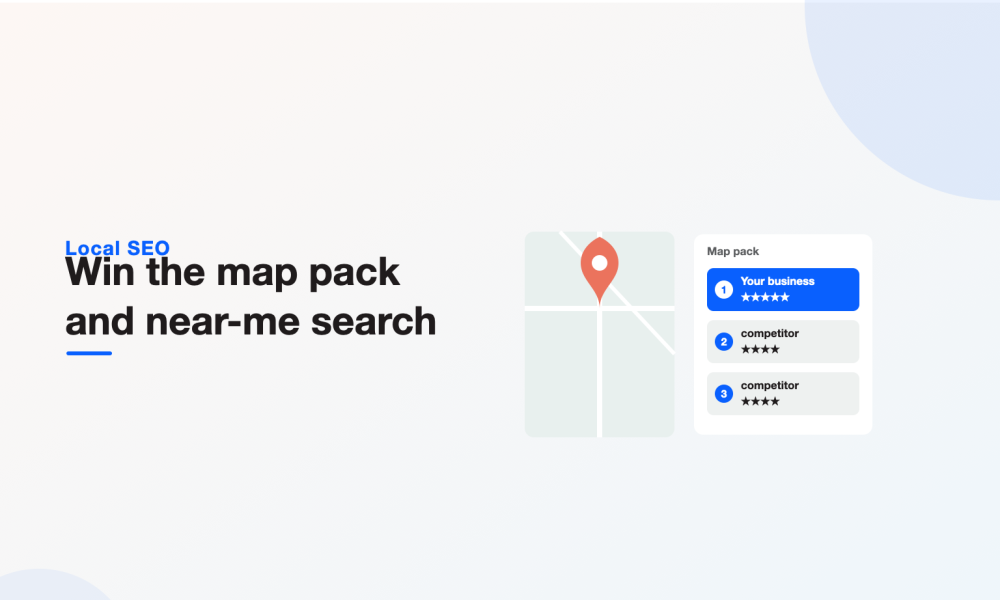
At its core it is the discipline of making a business visible to searchers in its service area, in the specific surfaces Google uses for local intent. Those surfaces are distinct from ordinary results: the map pack (the boxed set of map listings with reviews and distance), the Google Business Profile that powers each listing, and the localized organic results Google tailors to the searcher’s location. Ranking well in these places depends on a partly different set of signals than national SEO, which is why it is treated as its own discipline even though it shares the same foundations of relevance, authority and trust.
The defining feature of the channel is that physical proximity and place-specific trust signals matter enormously. Google is trying to answer “which nearby business best fits this need,” so it weighs how close you are to the searcher, how complete and active your Business Profile is, how consistently your details appear across the web, and what your reviews say, alongside the usual content and link signals. A business can have a modest website and still dominate local results by nailing these local-specific factors, which is what makes local SEO such an accessible, high-return channel for small and location-based businesses.
Why local SEO matters so much
The reason local SEO is so valuable is intent. A large share of local searches come from people who are ready to act soon, and many “near me” searches lead to a visit, call or purchase within a day. That is demand at the very bottom of the funnel: the searcher is not researching idly, they are choosing where to go now. Capturing that moment through local SEO puts your business in front of buyers precisely when they are deciding, which is why local visibility so often outperforms broader marketing on cost per acquired customer.
There is also a structural advantage: local SEO is winnable. National head terms can be dominated by huge brands with enormous authority, but local results are scoped to a place, so you are competing against other businesses in your area rather than the whole internet. A well-run local SEO effort can put a small business above much larger national competitors for the searches that actually bring it customers. For service-area and storefront businesses, that combination, extreme intent plus achievable competition, is what makes local SEO the channel to get right before almost anything else.
Google Business Profile: the foundation
No element of local search matters more than your Google Business Profile, the free listing that powers your presence in Maps and the local pack. A complete, accurate, actively managed profile is the single biggest lever you have: the correct categories, business name, address and phone number, hours, services, photos, and regular posts all feed how, and whether, Google surfaces you. Many businesses leave this profile half-finished, which is precisely why fully optimizing it is often the fastest local search optimization win available. Claiming, verifying and thoroughly completing the profile should be step one for anyone starting the discipline.
Beyond the basics, the profile rewards ongoing activity. Responding to reviews, answering questions, posting updates, keeping hours current, and adding photos all signal to Google that the business is active and legitimate, which supports local visibility rankings and builds trust with the people who see the listing. Since the Business Profile is both a ranking factor and the storefront searchers actually interact with, treating it as a living asset rather than a one-time setup is central to this work. A strong profile can drive calls, direction requests and visits directly from the search results, often before a user ever reaches your website.
Citations and NAP consistency
Citations, mentions of your business name, address and phone number (NAP) across the web, are a core local search signal because they help Google confirm your business is real, established, and located where you claim. Consistency is everything: your NAP should be identical across your website, your Business Profile, major directories, and industry-specific listings. Inconsistent or contradictory details, an old address here, a different phone format there, confuse Google and weaken local search optimization, because the search engine cannot confidently verify which information is correct.
Building citations is therefore a matter of getting listed accurately on the directories that matter for your area and industry, and then keeping every listing consistent as your details change. The major data aggregators and popular directories carry the most weight, but relevance matters too: an industry-specific or locally prominent listing can be especially valuable. This work is unglamorous but foundational to local visibility, because clean, consistent citations across the web give Google the confidence to rank and display your business, while messy citations quietly cap how well you can perform no matter how good the rest of your effort is.
Losing local customers to competitors on Google Maps?
Our team reviews your current setup and shows you where the opportunities are. See how our local SEO services work.
Reviews and reputation
Reviews are one of the most powerful local search signals and, at the same time, the most influential thing prospective customers look at. Google weighs the quantity, quality, recency and, to a degree, the keywords of your reviews when deciding local rankings, and searchers use them to choose between the businesses in the map pack. This dual role, ranking factor and conversion driver, makes actively earning genuine reviews one of the highest-leverage activities in local search optimization. A business with more and better reviews than its neighbors often wins both the ranking and the click.
The right approach to reviews in the discipline is to make earning them a consistent habit: ask satisfied customers at the right moment, make leaving a review easy, and respond thoughtfully to every review, positive or negative. Responding matters because it signals engagement to Google and shows prospective customers that the business cares, and handling criticism gracefully can turn a negative into a trust-builder. Never buy or fake reviews, which violates policy and destroys trust if discovered; genuine reputation, earned steadily, is what durably lifts local visibility and turns local visibility into booked customers.
On-page and content for local
While the Business Profile, citations and reviews carry special weight, on-page optimization still matters in this work, especially for the localized organic results beneath the map pack. Your website should make your location and service areas unmistakable, with clear NAP details, locally relevant content, and, for multi-location businesses, a dedicated, genuinely useful page for each location. Location pages that simply swap the city name are thin and ineffective; the ones that win in local search offer real, specific information about serving that area. Solid on-page SEO fundamentals apply here as they do everywhere.
Content about the community also helps establish relevance and authority for the area you serve. Content about local issues, events, guides and questions relevant to your community signals to Google that you are genuinely part of that place, and it earns local links and engagement that reinforce your local search optimization. The underlying technical foundation matters too, a fast, crawlable, mobile-friendly site, because most local searches happen on phones; our technical SEO checklist covers those basics. Together, location-clear on-page signals and genuinely local content give the organic half of local visibility the support it needs to rank.
Multiple locations
For businesses with several locations, local search becomes a scalable system rather than a single project. Each location needs its own optimized Google Business Profile, its own consistent citations, and its own dedicated, substantive page on the website, so that every location can rank in its own area. The challenge is doing this at quality and scale without producing thin, duplicated location pages, which is a real risk when the same template is stamped across dozens of cities. The businesses that win multi-location local search optimization invest in genuinely differentiated location pages and properly managed profiles for each.
Managing the discipline across many locations also demands process and consistency: a system for keeping NAP details accurate everywhere as they change, for gathering and responding to reviews per location, and for monitoring rankings and performance location by location. This starts to resemble the systematic, process-driven work of larger SEO programs, where governance and quality control at scale matter as much as any single tactic. Done well, multi-location local visibility turns each storefront into its own local-search engine; done carelessly, it produces a sprawl of weak pages and neglected profiles that underperform their potential.
Local search, “near me,” and AI
Local discovery is shifting as “near me” behavior grows and AI enters the picture, and this work is adapting with it. Voice assistants and AI answer engines increasingly field local questions, “where’s the best-rated dentist near me,” “which hardware store is open now nearby”, and they draw on the same underlying signals: an accurate, well-reviewed Business Profile, consistent citations, and clear local relevance. A business strong in traditional local search is well-positioned to be the one an AI recommends, because it has given these systems a consistent, trustworthy picture to draw on. Our look at how AI answers “near me” queries goes deeper on this shift.
The practical implication is that the fundamentals of local search optimization are becoming more important, not less, as discovery fragments across maps, search and AI. Keeping your Business Profile accurate and active, your citations consistent, and your reviews genuine and plentiful pays off across every one of these surfaces at once. Rather than treating AI local search as a separate discipline, the right move is to do local visibility so well that any system, Google Maps, organic search, or an AI assistant, has every reason to surface you as the trusted local choice. That consistency across surfaces is the durable advantage local search now provides.
Measuring local SEO
Measuring local search optimization means tracking the outcomes that reflect real local demand, not just abstract rankings. The metrics that matter are your visibility in the map pack for your priority terms, the actions people take from your Business Profile, calls, direction requests, website clicks, and ultimately the calls, bookings and visits attributable to local search. Because local rankings vary by the searcher’s exact location, local rank tracking has to account for geography, checking how you appear from different points in your service area rather than assuming one universal position.
Tying the discipline to business outcomes is what proves its value and guides investment. The Business Profile’s own insights show how many people found you, where they came from, and what they did, which connects local visibility directly to real actions. Layering in call tracking and conversion measurement lets you see the customers and revenue local search produces. Measured this way, across map-pack visibility, profile actions, and booked business, local visibility becomes an accountable channel with a clear return, which makes it easy to justify continued investment in the profile, citations, reviews and content that drive it.
Doing it yourself or with a partner
Much of this work is accessible to a motivated business owner: claiming and optimizing the Business Profile, fixing citations, and earning reviews are all doable in-house, and doing them yourself builds valuable understanding of how local search works. For a single-location business with time to invest, a self-directed local search effort can go a long way, especially once the profile is fully optimized and a review habit is established. The fundamentals are learnable, and the early wins are often the easiest.
A specialist partner earns its place when local search optimization gets complex or competitive, multiple locations, tough markets, or simply no internal time to run it consistently, because local visibility rewards ongoing, disciplined effort that busy owners struggle to sustain. An experienced partner brings the tools, citation networks, review systems and know-how to move faster and avoid costly mistakes. For businesses that want that support, our local SEO services handle the profile, citations, reviews, content and measurement as a managed program. Whether in-house or with a partner, the key is consistency, because local search rewards the businesses that keep at it over those that treat it as a one-time setup.
Getting started with local SEO
For a business starting local search optimization, the sequence is clear and the early wins are quick. First, claim, verify and thoroughly complete your Google Business Profile, since it is the biggest lever and often the fastest improvement. Next, audit and fix your citations so your NAP is consistent everywhere it appears. Then build a steady habit of earning and responding to genuine reviews. With those foundations in place, strengthen your website’s local relevance and, if you have multiple locations, build a substantive page for each. This order front-loads the highest-impact the discipline work.
From there, local visibility becomes an ongoing practice: keep the profile active, citations consistent, and reviews flowing, publish locally relevant content, and measure map-pack visibility and profile actions so you can see what is working. Since it targets such high-intent demand and is winnable at the local level, a disciplined this work program is one of the most reliable ways for a location-based business to grow. If you would like specialist help building and running it, our local SEO services team does exactly this, and the broader SEO services practice supports every part of search. Get local search right and your business shows up exactly when nearby customers are ready to buy. Few marketing investments match that combination of high intent, achievable competition, and durable compounding returns, which is why for any business serving a physical area this is the channel to build first and maintain relentlessly.
Common mistakes to avoid
A few avoidable mistakes hold local businesses back. The most common is leaving the Google Business Profile half-finished, wrong categories, missing hours, no photos, no posts, which caps visibility no matter what else you do. A second is inconsistent NAP details scattered across old directory listings, quietly undermining Google’s trust in your location. A third is neglecting reviews, either not asking for them or ignoring the ones you get, when reviews drive both rankings and customer choice. Each of these is entirely fixable, and fixing them is usually faster and cheaper than any other marketing you could run.
A subtler mistake is impatience and inconsistency, treating local search as a one-time setup rather than an ongoing habit, so profiles go stale and review flow dries up. The honest expectation, as with all search, is that consistent effort compounds; our realistic takes on how long SEO takes and whether SEO is worth it apply here too, though local results often come faster than national ones. Avoid these traps, keep the profile active, citations clean and reviews flowing, and local visibility tends to build steadily.
Want your business to show up first in local search?
Book a free 30-minute strategy call and leave with a clear next step for your business.
The local ranking factors, in order
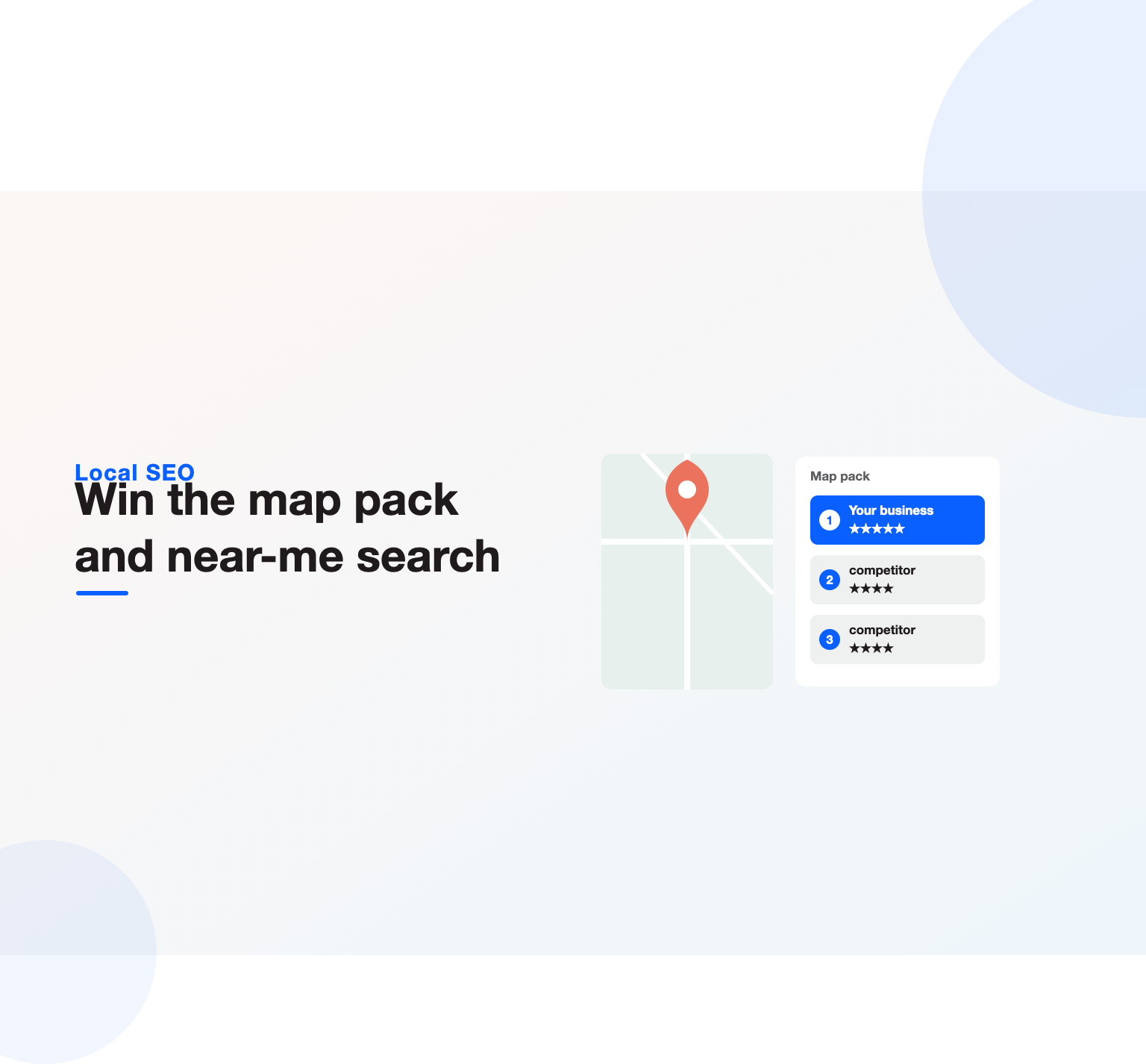
It helps to hold a rough priority order in mind. Proximity to the searcher you cannot control, but everything else you can: a complete, active Google Business Profile carries the most controllable weight, followed by review quantity and quality, then citation consistency, then on-page and website signals, then local links and content. Getting the top of that list right, profile, reviews, citations, delivers most of the gains, which is why a focused effort beats a scattered one. Tools can help you track it; our roundup of the best local SEO tools covers what to use.
The practical lesson is to work the factors in order of controllable impact rather than trying to do everything at once. A business that perfects its profile, builds a steady review habit, and cleans up its citations will out-rank a competitor with a fancier website but a neglected profile nearly every time. This prioritisation is what makes local search approachable even for a busy owner: a handful of high-leverage actions, done consistently, move the needle more than an exhaustive checklist done once. Focus beats breadth in local search.
Across business types
The emphasis shifts with the kind of business. A single storefront, a restaurant, salon or clinic, wins mostly on a strong profile, reviews and proximity, and can often succeed with a modest website. A multi-location brand needs the scalable system described above, a managed profile and substantive page per location. A service-area business that travels to customers, a plumber or mobile service, relies on well-defined service-area settings and location-relevant content rather than a single storefront address. Knowing your type tells you where to concentrate.
Across all of them, the economics of local search are compelling compared with paid alternatives, an argument our comparison of SEO versus PPC lays out, and the investment is modest relative to the high-intent customers it brings, as our look at what SEO costs frames. Whether you run it yourself or with a partner, the through-line is the same: a complete, active profile, consistent citations, genuine reviews, and clear local relevance win local customers. For businesses weighing help, our guide to choosing an SEO partner and the complete guide to SEO put local work in the wider context. Many local searches are now spoken, so pair this with our guide to voice search optimization.
Key Takeaways
- Start with your Google Business Profile, claim, verify and fully complete it, because it is the single biggest local ranking lever.
- Fix and maintain consistent NAP citations across the web so Google can confidently verify and rank your business.
- Earn genuine reviews steadily and respond to all of them, since reviews drive both rankings and customer choice.
- Make your website’s location and service areas unmistakable, with substantive pages for each location if you have several.
- Measure map-pack visibility and profile actions (calls, directions, clicks), and keep the effort consistent over time.
Frequently asked questions
What is local SEO?
Local SEO is the practice of optimizing a business to appear in searches for products or services “near me” or in a specific place, in both Google’s map pack and the organic results. It relies on partly different signals than national SEO, above all the Google Business Profile, consistent citations, reviews, and proximity to the searcher, which makes it the highest-return channel for most businesses serving a physical area.
How is local SEO different from regular SEO?
Regular SEO competes for rankings across the whole web, while local search optimization competes for visibility within a place, so proximity and local trust signals matter far more. Local SEO leans heavily on your Google Business Profile, citations and reviews, and targets the map pack and localized results, whereas national SEO is dominated by content and links. The intent is also higher, most local searches are close to a purchase.
What is the most important local SEO ranking factor?
The Google Business Profile is the single biggest lever: a complete, accurate, actively managed profile with the right categories, details, photos and posts strongly influences whether you appear in the map pack. Reviews, consistent citations, and proximity to the searcher come close behind. Since many businesses under-optimize their profile, fully completing it is usually the fastest local visibility win available.
How important are reviews for local SEO?
Very. Google weighs the quantity, quality and recency of reviews in local rankings, and searchers rely on them to choose between businesses in the map pack, so reviews affect both whether you rank and whether you get the click. Earning genuine reviews steadily and responding to all of them is one of the highest-leverage local search activities. Never buy or fake reviews, which breaks policy and trust.
How do I rank in the Google map pack?
The map pack rewards proximity, a complete and active Google Business Profile, strong and recent reviews, and consistent citations, more than website links. To improve your odds, fully optimise the profile with correct categories and rich detail, earn genuine reviews steadily, keep your NAP consistent everywhere, and add locally relevant content and service-area pages. Track how you appear from different points in your area, and use the right local tools to monitor it. Consistency on these fundamentals is what moves you into the three-pack.
What are citations and why do they matter?
Citations are mentions of your business name, address and phone number across the web, on your site, your Business Profile, and directories. They help Google verify your business is real and located where you claim, so consistency is essential: contradictory details confuse the search engine and weaken local search optimization. Getting accurately listed on the directories that matter, and keeping every listing consistent, is foundational local-search work.
Does local SEO work for multiple locations?
Yes, but it becomes a scalable system: each location needs its own optimized Business Profile, consistent citations, and a substantive, differentiated page on your website, plus per-location review and ranking management. The risk is thin, duplicated location pages, so quality at scale is the challenge. Done well, multi-location the discipline turns every storefront into its own local-search presence in its area.
How much does local SEO cost?
It ranges widely, from doing the essentials yourself for the cost of your time, to a managed monthly program for competitive markets or multiple locations. Because it targets such high-intent, ready-to-buy demand, the return is usually strong relative to the spend, and it should be judged on calls, bookings and visits rather than a flat fee. Our transparent look at what SEO costs frames the ranges and the value question for local work too.
Can I do local SEO myself?
Yes, much of it. Claiming and fully optimising your Google Business Profile, fixing citations, and building a review habit are all doable in-house and build useful understanding. A partner earns its place when you have multiple locations, a competitive market, or no time to run it consistently. Either way, consistency is what wins, and our local SEO services can run the whole program if you would rather focus on the business.
How does AI search affect local SEO?
AI assistants and “near me” answers increasingly field local queries, and they draw on the same signals as traditional local visibility, an accurate, well-reviewed Business Profile, consistent citations, and clear local relevance. A business strong in this work is well-positioned to be the one an AI recommends, so the fundamentals matter more, not less. Doing local search well pays off across maps, organic search and AI at once.
Ready to put this into practice?
Talk to the team that runs SEO, AI search and paid growth programs every day.
Book a Strategy Call →