 Skip to content


Local SEO: How to Win Nearby Customers
Local SEO explained: how to win the map pack and near-me searches with your Google Business Profile, consistent citations, reviews and location content. Costs and how to choose help.
Quick Answer
Local SEO is the practice of making a business visible to nearby customers who search for what it offers, so it appears in the map pack, in the local results, and increasingly in the AI answers people now rely on. It combines a well-optimized Google Business Profile, consistent business information across the web, genuine customer reviews, and location-relevant content on your own site. Done well, it turns a searcher a few miles away who types a service and a city, or simply says near me, into a phone call, a booking or a visit. For any company that serves a physical area, this is the channel that most directly converts intent into customers.
Key Highlights
- Local SEO wins nearby, high-intent searches: the map pack, local results, and near-me and AI answers.
- The Google Business Profile is the single most important asset, and optimizing it thoroughly moves rankings fast.
- Consistent name, address and phone details across the web, plus real reviews, are the trust signals that decide the map pack.
- Location pages and locally relevant content on your own site anchor the organic side of local visibility.
- Measurement is concrete: calls, direction requests, form fills and map-pack presence for your priority terms.
What local search visibility actually means
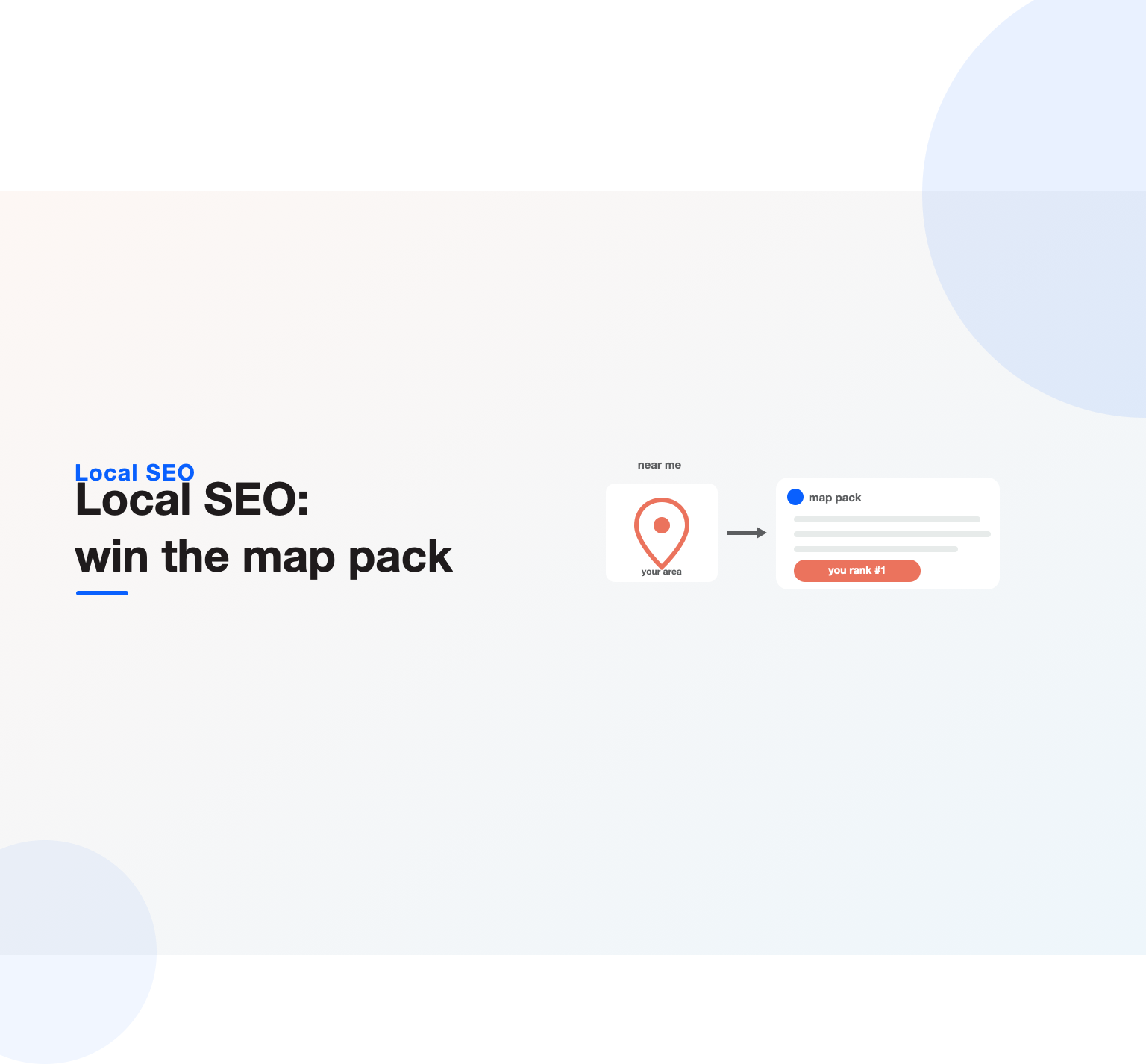
When someone searches for a service with local intent, a plumber, a dentist, a law firm, a coffee shop, the engine shows a different kind of result than it does for a general query. Above the standard links sits a map with a short list of nearby businesses, the block most people call the map pack, and that placement drives the majority of clicks and calls for local terms. Local SEO is the work of earning a place there and in the local organic results beneath it, so that the customers physically able to buy from you actually find you. It is a distinct discipline because the ranking signals are different: proximity, prominence and relevance to the searcher location matter in ways they simply do not for a national query.
The behavior driving all of this is the near-me search, where a person looks for a solution close to them and expects an immediate, trustworthy shortlist. That intent is unusually valuable because it is late in the buying journey; the searcher is not browsing, they are choosing. A business that shows up prominently at that moment captures a customer who is ready to act, while a business that is absent loses that customer to whoever did appear. This is why local search tends to produce a faster, more measurable return than broad national campaigns for companies that serve a defined area.
It is also worth separating this channel from general search optimization, because the two overlap but are not the same. Classic SEO services aim to rank pages for queries regardless of the searcher location, while local work adds the geographic layer: the profile, the citations, the reviews and the location signals that tell an engine you are the right nearby answer. The strongest programs run both together, since a healthy website supports local rankings and local prominence feeds organic authority, but the local levers deserve dedicated attention rather than being treated as an afterthought.
Why local SEO matters more than ever
The value of appearing in local results has grown as search has moved onto phones and, more recently, into AI answers. A large share of local searches lead to a call, a visit or a purchase within a day, which makes this one of the highest-converting channels a local business can invest in. When a searcher on a phone asks for a service nearby, the map pack is often the entire decision surface; they tap a listing, read a few reviews, and call. Owning that surface is not a vanity metric, it is a direct line to revenue.
Artificial intelligence has raised the stakes rather than lowering them. Assistants and AI answer features increasingly field local questions, and they assemble their recommendations from the same underlying signals that power the map pack: a complete and consistent business presence, credible reviews, and clear information about what you do and where. A business with strong local foundations is therefore well positioned to be named when someone asks an assistant for a recommendation, while one with a thin or inconsistent presence risks being left out of both the map and the answer. Investing in local visibility now pays off across every surface where nearby customers look.
There is a competitive dimension too. In most local markets, only a handful of businesses have done this work properly, which means the field is more winnable than the crowded national terms where large sites dominate. A focused local business can outrank bigger, less attentive competitors in its own area by getting the fundamentals right, and that advantage compounds as reviews accumulate and the profile matures. For a company deciding where to put a limited marketing budget, local SEO often delivers the clearest path from spend to customers, an argument our guide on SEO for business develops in more depth.
The Google Business Profile: your most important asset
No single thing influences local visibility more than the Google Business Profile, the free listing that populates the map pack and the knowledge panel. Optimizing it thoroughly is the highest-leverage move in local SEO, and it is where any serious effort should begin. That starts with claiming and verifying the profile, then completing every field accurately: the correct business name, the primary and secondary categories that match what you do, precise hours, a service area or address, and a clear description written for humans rather than stuffed with keywords.
Beyond the basics, the profile rewards ongoing attention. Photos of your premises, team and work make a listing more compelling and are associated with more clicks and calls. The products and services sections let you spell out exactly what you offer, giving the engine more relevance signals to match against searches. Posts keep the listing active with offers, news and updates, and the questions and answers section is worth seeding with the real questions customers ask, answered clearly. A profile treated as a living asset, updated regularly, consistently outperforms one that was filled in once and forgotten.
Categories deserve particular care because they strongly shape which searches you appear for. Choosing the most accurate primary category, and adding relevant secondary ones, tells the engine precisely what you are, and a mismatch here quietly caps your visibility no matter how much else you do. It is worth researching the categories that top-ranking competitors in your area use and choosing the tightest fit for your core service, since this one setting often explains why a well-run business is or is not showing up for its most important terms.
Citations and consistent business information
After the profile, the next pillar of local SEO is the consistency of your business information across the web, what practitioners call citations. Every place your business name, address and phone number appear, on directories, review sites, social profiles and industry listings, is a data point the engines use to confirm that you are a real, established business at a specific location. When those details are identical everywhere, they reinforce trust; when they conflict, an old address here, a different phone number there, they create doubt that can hold back your rankings.
Building and cleaning citations is therefore foundational work. The priorities are the major data aggregators and the well-known general directories, alongside the directories and associations specific to your industry, since a niche listing often carries more relevance than a generic one. The goal is not sheer volume but accuracy and coverage on the sources that matter, with every listing carrying the exact same core details. A single authoritative, consistent set of business information across the web does more for local trust than dozens of sloppy, contradictory entries.
Consistency has to be maintained, not just established. Businesses move, change phone numbers and adjust hours, and each change needs to be propagated everywhere the old information lives, or the inconsistencies creep back. This ongoing hygiene is unglamorous but genuinely affects rankings, and it is one of the clearest reasons businesses bring in a dedicated local SEO partner rather than trying to police dozens of listings by hand. Getting this base right also makes every other effort more effective, since the engine can attribute your reviews, content and links to a clearly defined entity.
Reviews: the trust signal that decides the map pack
Among all the local ranking factors, customer reviews carry outsized weight, because they signal both relevance and trust to the engines and to the humans reading them. A business with many recent, positive, detailed reviews tends to rank higher in the map pack and, just as importantly, converts far better once it appears, since a searcher comparing two listings almost always favors the one with stronger social proof. Reviews are simultaneously a ranking lever and a conversion lever, which is why a deliberate review strategy is central to any local program.
Earning reviews consistently requires a simple, repeatable process: asking every satisfied customer at the right moment, making it effortless with a direct link, and doing so steadily rather than in occasional bursts. A steady flow of fresh reviews signals an active, trusted business, while a listing that gathered a burst of reviews years ago and nothing since looks stale by comparison. The aim is a natural, ongoing accumulation that keeps the profile current and reflects the real experience of your customers.
Responding to reviews matters as much as collecting them. Thoughtful replies to positive reviews reinforce goodwill, and calm, constructive responses to negative ones show prospective customers that you take service seriously, often turning a critical review into a trust signal rather than a liability. Engaging with every review also demonstrates an active presence that engines and readers both reward. Handled well, reviews become a compounding asset that lifts rankings, improves conversion and strengthens reputation all at once, which is why they sit at the heart of local SEO.
Location content and on-site signals
While the profile and citations power the map pack, your own website anchors the organic side of local visibility, and it needs its own local signals. For a single-location business, that means a clear, well-optimized page describing what you do and where, with your address, service area and contact details presented cleanly and marked up so engines can read them. For a multi-location business, it means a dedicated, genuinely useful page for each location rather than thin, near-duplicate templates, since each page is your bid to rank in that specific area.
Locally relevant content extends the same idea. Pages and articles that speak to the needs, questions and context of your area help the engine connect you to local searches and give you something substantive to rank. This is not about repeating a city name mechanically; it is about genuinely useful material, guides, answers and service explanations, framed for the community you serve. Content that reads as if it were written for the people in your area, rather than assembled from a template, performs far better and is less likely to be treated as thin.
On-page technical signals round this out. Fast, mobile-friendly pages are essential given how much local search happens on phones, and structured data that describes your business, location and reviews helps engines understand and display you correctly. Internal links that connect your location and service pages sensibly spread authority to the pages that need to rank locally. None of this is exotic, but neglecting it leaves easy visibility on the table, and attending to it makes every other local effort more effective. Understanding what this scope of work costs, which our guide on SEO cost breaks down, helps set a realistic budget for it.
Local links and authority
Links from other websites still matter locally, but the emphasis differs from a national campaign. What counts most is relevance and locality: a link from a respected local organization, a community sponsorship, a regional publication, a local business association, tells the engine you are a genuine part of the area you claim to serve. These local links are often easier to earn than competitive national backlinks and carry real weight for map-pack and local-organic rankings, making them a high-value focus for a local program.
Earning them tends to flow from real community involvement rather than purely digital tactics. Sponsoring a local event, partnering with nearby complementary businesses, joining a chamber of commerce, or contributing genuinely useful expertise to a regional outlet all create natural reasons for local sites to link to you. The work overlaps with reputation building generally, and it strengthens the same entity that your profile, citations and reviews describe. A handful of authentic local links, tied to real relationships, usually does more for local visibility than a larger pile of generic, low-quality ones.
Measuring local SEO
Local SEO is unusually measurable, which is one of its strengths, and a serious effort tracks outcomes rather than vanity numbers. The metrics that matter map directly to business value: calls generated from the profile, direction requests, clicks through to the website, form submissions and bookings, and the actual map-pack and local-organic positions for your priority terms across your service area. Watching these over time shows whether the work is turning visibility into customers, which is the only test that counts.
The profile itself reports a great deal of this, showing how people found you, what they did, and which searches surfaced your listing, and pairing that with website analytics and call tracking gives a complete picture. It is important to measure rankings from the searcher perspective, since local results vary by the exact location of the person searching, so a business should track its visibility across the neighborhoods and towns it actually serves rather than from a single point, the same discipline that broader AI search optimization reporting applies to answer engines. This grounded, outcome-focused measurement keeps a local program honest and makes it clear where to invest next.
Because the signals are observable, progress in local SEO is easier to attribute than in many channels. When calls and direction requests climb as the profile strengthens, reviews accumulate and citations get cleaned up, the causal link is clear, and that clarity makes it straightforward to justify continued investment. It also makes it easy to spot what is not working and adjust, so the program keeps compounding rather than stalling.
Common local SEO mistakes to avoid
Most struggling local businesses are not missing some exotic tactic; they are undermined by a handful of avoidable errors. The most common is an unclaimed or half-finished Google Business Profile: a missing category, no photos, no service list, or a description written years ago. A second is inconsistent business information scattered across old listings, an outdated address or a former phone number that quietly erodes the trust the engines place in you. A third is a passive approach to reviews, gathering a few early on and then never asking again, which leaves the listing looking stale beside more active competitors. Fixing these three alone lifts many businesses out of obscurity, and none of them requires specialist tools, only discipline. A partner offering full SEO services will usually audit for exactly these gaps first.
Two subtler mistakes hold back businesses that have the basics in place. One is thin, templated location pages that repeat a city name without saying anything genuinely useful, which engines increasingly treat as low value; each location deserves real, specific content. The other is ignoring measurement, running local efforts on instinct rather than tracking calls, direction requests and map-pack presence, so there is no way to tell what is working. Because local results are so observable, flying blind is a needless handicap, and correcting it turns guesswork into a program that compounds. The same clean foundations also feed visibility in AI search, so avoiding these errors pays off across more surfaces than the map pack alone.
Local SEO for multi-location and service-area businesses
Businesses that serve several areas face a harder version of the same problem, and the way they handle it separates the winners from the also-rans. A company with multiple storefronts needs a distinct, genuinely useful page for each location and, where eligible, a separate verified profile for each, so every branch can rank in its own area rather than cannibalizing the others. Cutting corners with near-identical templated pages is the classic failure here; each location page should carry specifics that a local customer would actually value, from the services offered there to the neighborhoods served.
Service-area businesses that travel to customers rather than operating a storefront, trades, cleaners, mobile services, have their own considerations. They define a service area on the profile instead of a public address, and they lean even harder on reviews, locally relevant content and community links to establish prominence across the towns they cover, since they lack a single fixed location to anchor to. Measuring visibility across each part of the service area, rather than from one point, becomes especially important. In both cases the underlying levers are unchanged, but the coordination required grows, which is one reason multi-location and service-area companies most often bring in a dedicated local SEO partner to run the program consistently across every area they serve. Setting an honest budget for that scope, which our SEO cost guide helps with, keeps expectations realistic.
Doing it yourself versus hiring help
A capable owner can absolutely start local SEO alone: claiming and completing the profile, gathering the first reviews, and cleaning up the most important citations are all within reach and deliver real early gains. For a single-location business in a modest market, disciplined attention to these fundamentals may be enough to compete well, and beginning this way builds a useful understanding of how the channel works before any money is spent on help.
The case for a partner grows with competition, with the number of locations, and with the ongoing nature of the work. Maintaining consistent citations across dozens of sources, running a steady review process, producing genuinely useful location content, earning local links and measuring it all is a continuous job, and in a competitive market the difference between an average and an expert effort is the difference between being in the map pack or beneath it. A specialist also brings pattern knowledge from many local campaigns, which shortens the path to results. Weighing that ongoing cost against the value of the nearby customers it wins, a question our business SEO guide frames in detail, is the right way to make the call.
Whichever route you choose, the priorities are the same, and that is the reassuring part of local SEO. Get the profile right, keep your information consistent everywhere, earn reviews steadily, publish honest location content and involve yourself in your community, and the visibility follows. A partner accelerates and sustains that work, but the fundamentals are knowable and durable, which is exactly why this channel rewards businesses that commit to it. For companies that want a done-for-you approach, a dedicated local SEO service handles the whole cycle so the owner can focus on serving the customers it brings in.
Fitting nearby search into a wider strategy
Winning nearby customers works best as one layer of a connected search program rather than a silo. The same clean site and trusted brand that power the map pack also lift your organic rankings, and the reviews and consistent information that build local trust increasingly shape whether an assistant recommends you. Businesses that treat the discipline alongside broader business SEO, emerging answer engine optimization and the citation-focused work a GEO agency does tend to compound their gains, because the underlying signals reinforce one another. A local SEO partner that understands those connections keeps the whole picture aligned rather than optimizing one surface in isolation.
Key Takeaways
- Local SEO earns visibility in the map pack, local results and AI answers for nearby, high-intent searchers.
- The Google Business Profile is the highest-leverage asset; complete it fully and treat it as a living listing.
- Consistent business information across the web and a steady flow of genuine reviews are the decisive trust signals.
- Your own site needs real location pages, locally relevant content and clean technical signals to anchor organic local visibility.
- Measure outcomes, calls, directions, bookings and map-pack presence, and invest in help as competition and locations grow.

Frequently asked questions
Direct answers to the questions businesses ask most about local SEO.
What is the difference between local SEO and regular SEO?
Regular SEO aims to rank pages for searches regardless of where the searcher is, while local SEO adds a geographic layer to win nearby customers. It focuses on the Google Business Profile, consistent business information, reviews and location signals that decide the map pack and local results. The two share foundations and work best together, but local SEO targets the proximity-driven searches that turn nearby intent into calls and visits.
How long does local SEO take to show results?
Some gains come quickly: fully optimizing a neglected Google Business Profile can lift map-pack visibility within weeks. The compounding results, from accumulating reviews, cleaning citations and building local content and links, typically build over a few months. Competitive markets take longer than quiet ones, but because the signals are observable, you can usually see steady, attributable progress well before the full effect arrives.
Is the Google Business Profile really that important?
Yes. It is the single most influential asset in local SEO because it directly populates the map pack, the block that captures most clicks and calls for local searches. Claiming, verifying and fully completing it, then keeping it active with photos, posts and accurate details, is the highest-leverage work you can do. A thin or unclaimed profile is the most common reason a capable local business fails to show up.
How do I get more reviews without breaking the rules?
Ask every satisfied customer at a natural moment, make it effortless with a direct link, and do it consistently rather than in bursts. Never buy reviews or offer incentives for positive ones, since that violates the guidelines and risks penalties. A simple, steady process of genuinely requesting feedback from real customers produces the fresh, authentic reviews that both rank and convert, and responding to each one strengthens the effect.
Do citations still matter for local SEO?
Yes, though accuracy matters more than quantity. Consistent name, address and phone details across the major directories, data aggregators and industry-specific listings confirm to engines that you are a real, established business at a specific location. Conflicting information holds rankings back, so the priority is a clean, identical core set of details everywhere that matters, maintained over time as the business changes.
Can local SEO help me appear in AI answers?
It can, because AI assistants draw local recommendations from the same signals that power the map pack: a complete, consistent business presence, credible reviews and clear information about what you do and where. A business with strong local foundations is well positioned to be named when someone asks an assistant for a nearby recommendation, so investing in local SEO increasingly pays off across both traditional results and AI answers.
How much does local SEO cost?
It varies with your market, the number of locations and how much of the work you outsource. A single-location business in a modest market can start with mostly its own time plus small tool costs, while a competitive or multi-location effort handled by a specialist is a larger monthly investment. The right way to judge it is against the value of the nearby customers it wins, since local searches convert at a high rate.
Can I do local SEO myself?
Yes, at least to start. Claiming and completing your profile, gathering the first reviews and fixing the most important citations are all achievable alone and deliver real early gains. The case for help grows with competition, additional locations and the ongoing nature of maintaining citations, reviews, content and links. Many businesses begin themselves and bring in a partner once the fundamentals are in place and they want to scale.
Ready to put this into practice?
Talk to the team that runs SEO, AI search and paid growth programs every day.
Book a Strategy Call →