 Skip to content
Voice Search Optimization: Win Spoken Answers
Voice search optimization explained: how to win the spoken, conversational queries people ask phones and assistants with question-based content, featured snippets, local signals and structured data.
Quick Answer
Voice search optimization is the practice of shaping your content so it wins the spoken queries people ask their phones, smart speakers and assistants. Spoken searches are longer, more conversational and more often phrased as full questions than typed ones, and they frequently return a single spoken answer rather than a page of links. Optimizing for them means writing in natural, question-and-answer language, earning the concise featured-snippet style responses assistants read aloud, strengthening local signals since many voice queries are location-based, and keeping your site fast and well-structured. As assistants and AI answers converge, the same work increasingly decides whether your brand is the one spoken back to a searcher.
Key Highlights
- People phrase spoken searches as longer, conversational, complete questions.
- They often return one spoken answer, so winning the concise featured response is the goal.
- Many voice queries are local and immediate, making local signals especially important.
- Natural question-and-answer content, structured data and fast pages are the core levers.
- Optimizing for voice and AI answers increasingly overlaps, so the work pays off across both.
What voice search optimization means
When someone speaks a query instead of typing it, the search behaves differently in ways that change how you should optimize. People talk to their devices the way they talk to a person, so a typed query like best pizza downtown becomes a spoken where can I get the best pizza near me right now. These queries are longer, more natural and far more likely to be full questions, and the device often responds with a single spoken answer rather than a list the user can scan. The discipline is the work of making your content the source that answer comes from.
This is a meaningful shift because a spoken result is winner-take-most in a way a page of links is not. When a screen shows ten results, several can earn a click; when an assistant reads one answer aloud, only one source is heard. That raises the stakes of being the chosen response and rewards content designed to be the clear, concise, authoritative answer to a specific question. The discipline is less about ranking a page among many and more about being the definitive answer to the exact thing a person asked out loud.
It is also closely tied to the broader move toward answer-based search. The same qualities that win a spoken answer, a direct response to a natural question, backed by authority and clean structure, are the qualities that win featured snippets and, increasingly, citations in AI answers. So voice search optimization is not an isolated niche but part of a wider transition from ranking links to providing answers, which is why the effort compounds with the rest of a modern search strategy rather than sitting apart from it, a connection our overview of SEO services keeps in view.
Why voice search matters
The case for taking this seriously rests on how people now use their devices. Assistants on phones, in cars, on smart speakers and built into everyday software have made speaking a query a normal, frequent behavior, especially for quick questions, local needs and hands-busy moments. A large share of these searches carry strong intent, someone asking aloud for a nearby service, an immediate answer or a quick fact is often ready to act, which makes winning the spoken response a direct route to customers rather than a novelty.
Local intent runs especially strong through voice. A great many spoken searches are about finding something nearby, a place to eat, a service to call, directions, hours, and they frequently include the near me pattern or an implied location. For any business that serves a local area, that makes voice a meaningful channel to nearby customers at the moment they are choosing, and it ties voice search optimization tightly to strong local fundamentals. The two reinforce each other, since the profile, reviews and consistent information that win the map pack also feed the answers assistants give, which is why a solid local SEO foundation is so valuable here.
The behavior is also still maturing, which is precisely why acting now is worthwhile. As assistants grow more capable and more embedded in daily life, the share of searches spoken rather than typed keeps rising, and the brands that have built answer-ready content are positioned to capture that growth. Treating voice as a forward-looking investment, rather than waiting until it is universal, follows the same logic that rewards early movers across emerging search surfaces, a theme our guide on SEO for business develops.
How voice queries differ from typed ones
Understanding the specific ways spoken queries differ is the key to optimizing for them. The first difference is length and phrasing: spoken queries are longer and conversational, using natural language and full questions rather than clipped keywords. Where a typed search might be weather Chicago, a spoken one is what is the weather going to be like in Chicago today, so content that matches natural, question-shaped phrasing has an advantage that keyword-stuffed pages do not.
The second difference is the question format itself. These searches lean heavily on the classic question words, who, what, where, when, why and how, because people naturally ask rather than type fragments. This makes explicitly answering real questions, in the words people actually use, central to voice search optimization, and it is why question-and-answer content performs so well. The third difference is immediacy and context: many voice searches are local, on the move, or tied to a specific moment, so the intent is often to act now, which rewards content that gives a direct, usable answer rather than a page the user must work through.
Taken together, these differences point to a clear approach. Content should anticipate the natural questions people ask about your topic or business and answer each one directly and concisely, in conversational language, with the authority and structure that make an assistant confident to read it aloud. That is a different craft from optimizing for a clipped keyword, and getting it right is what separates content that wins spoken answers from content that merely ranks on a screen.
How to optimize for voice search
The practical work of the discipline rests on a handful of connected tactics. The foundation is conversational, question-based content: identifying the real questions your customers ask and answering them directly, in natural language, ideally leading each answer with a concise, self-contained response before adding supporting depth. Dedicated question-and-answer sections map neatly to how people speak and give assistants clean, quotable answers to draw from, which is why they are so effective for voice.
Winning the concise featured response is the next lever. Assistants frequently read aloud the answer that search engines feature at the top, the position often called position zero, so structuring content to earn that spot, a clear, direct answer to a specific question, well-formatted and authoritative, directly improves your chances of being the spoken result. Supporting this, structured data helps engines understand your content, your business, your location, your answers, so they can use it confidently in a spoken response, and it is an underused advantage for voice.
Local optimization and technical health round out the essentials. Because so many voice searches are local, a complete and consistent business presence, an optimized profile, accurate information, genuine reviews, makes you far more likely to be the answer to a nearby query, tying voice directly to local fundamentals. And because assistants favor fast, reliable sources, a quick, mobile-friendly, well-structured site underpins everything, since a slow or messy page is a poor candidate to be read aloud. None of these levers is exotic, but together they make your content the kind an assistant reaches for, and planning that work against real demand, much as our guide on SEO cost advises, keeps it grounded.
Not sure how visible you are in AI search?
Our team reviews your current setup and shows you where the opportunities are. See how our AI search optimization work.
Voice search and the rise of AI answers
The discipline has grown more important as assistants and AI answer engines have converged on the same model of behavior: a person asks a natural-language question and receives a single, synthesized answer. The skills that win spoken results, direct answers to real questions, backed by authority and clean structure, are essentially the skills that win citations in AI answers, so the two disciplines increasingly reinforce each other. A business that has made its content answer-ready for voice is well along the path to being cited by AI systems, and vice versa.
This convergence means voice work should be understood as part of a broader answer optimization strategy rather than a standalone tactic. The entity clarity, extractable content and trust that help an AI engine choose your brand are the same foundations that help an assistant speak your answer, which is why the strongest approach treats voice, AI answers and classic search as one connected effort. Investing in answer-ready content therefore pays off across the emerging disciplines of AI search optimization and the citation-focused work an answer engine optimization program handles, so the return extends well beyond spoken queries alone.
Featured answers and position zero in depth
Since assistants so often read aloud the single answer engines feature at the top of the results, understanding that featured position is central to winning spoken queries. The featured answer, sometimes called position zero, is the concise response an engine lifts from a page and displays above the ordinary links, and it is frequently the exact text an assistant speaks. Earning it therefore does double duty: it captures a prominent spot on screen and makes you the likely voice answer at the same time, which is why it sits at the heart of any serious effort here.
Winning that spot is less about tricks than about giving engines the cleanest possible answer to lift. That means stating a direct, self-contained response to a specific question near the top of a section, in plain language, before expanding into detail, so an engine can extract a clean passage without ambiguity. Clear formatting helps, a concise paragraph, a short list, or a tidy table where the question calls for it, as does genuine authority on the topic, since engines prefer to feature sources they trust. Content that buries its answer in a long preamble, by contrast, gives an engine nothing easy to quote and forfeits the spot to a competitor who answered plainly.
The reassuring part is that optimizing for featured answers improves your search performance broadly, not just for voice, since the same clarity and structure that earn the spoken response also serve readers on screen and help you rank, so the effort is never wasted even for queries that are rarely spoken. This is why featured-answer optimization is one of the highest-leverage activities in the whole discipline, and why it connects so directly to the broader SEO services that surround it, rather than being a voice-only tactic bolted on the side.
Voice search for local businesses
For businesses that serve a physical area, the local dimension of spoken search deserves its own attention, since it is where much of the opportunity concentrates. A great many voice queries are people looking for something nearby at the moment they intend to act, asking for the closest option, current hours, directions or a place to call, and the assistant answers from the same signals that power local results. That makes a complete, consistent and well-reviewed local presence the single biggest factor in whether you are the business an assistant recommends aloud to a nearby searcher.
The practical implication is that voice and local work are largely the same investment. Claiming and fully completing your business profile, keeping your name, address and phone details consistent everywhere, earning genuine reviews and answering common questions all feed directly into the answers assistants give, so effort spent on local fundamentals pays off in spoken results automatically. A business that has done this well is often already the voice answer for nearby queries without any voice-specific work, which is why pairing voice optimization with a strong local SEO program is the most efficient path for any company with a location or service area. Planning that combined effort against real local demand, much as our guide on SEO cost frames the wider budget question, keeps it grounded in what actually drives nearby customers.
Common mistakes in voice search optimization
Several avoidable errors keep businesses from winning spoken results. The most common is writing for clipped keywords rather than natural questions, so the content never matches how people actually speak; the fix is to answer real questions in real language. A second is burying the answer, forcing an engine to wade through preamble instead of finding a clean, quotable response up front, which forfeits the featured spot that so often becomes the spoken one. A third is neglecting the local and technical foundations, a slow site or an incomplete business presence, that quietly disqualify a page from being the answer an assistant trusts to read aloud.
A subtler mistake is treating voice as a separate project rather than part of a connected answer strategy, since the skills that win spoken results are the same as those that win featured snippets and AI citations, siloing voice work wastes the overlap and duplicates effort. The businesses that do best fold voice into a single, coherent effort spanning classic search, local visibility and AI answers, so every piece of answer-ready content works across all of them. Avoiding these mistakes is less about clever tactics than about the discipline of answering genuinely, plainly and in a well-built site, the same qualities our guide on SEO for business stresses for durable results.
Where voice and conversational search are heading
The trajectory of spoken and conversational search points firmly toward more of it, and toward tighter integration with AI answers. As assistants grow more capable and more embedded in phones, cars, homes and software, more searches will be spoken and more will be answered conversationally, which steadily raises the value of content built to be the answer rather than merely to rank. Businesses that invest early in answer-ready content are positioning for that shift rather than reacting to it once competitors have already claimed the spoken results that matter.
The convergence with AI answers is the most important part of this trajectory. Assistants increasingly draw on the same generative systems that power AI Overviews and standalone answer engines, which means the work of winning a spoken answer and the work of earning an AI citation are becoming one and the same. A business that builds a clear entity, answers real questions plainly and earns genuine authority is preparing for every version of this future at once, which is why voice optimization is best understood as an on-ramp to the broader disciplines of AI search optimization and the citation-focused work an answer engine optimization program handles. Seen that way, investing in spoken search is not a narrow bet on one device but a durable investment in how discovery is heading.
Measuring voice search optimization
Spoken results are harder to measure directly than typed rankings, since assistants rarely report which source they read aloud, but useful proxies exist. Tracking your featured-snippet presence for the questions that matter is one of the best indicators, because the featured answer is so often the spoken one, so watching how many of your target questions you own the featured response for tells you a great deal about your voice readiness. Growth in traffic and conversions from question-shaped, conversational queries is another signal that your answer-ready content is working.
For businesses with a local dimension, the local metrics matter too, since so much voice intent is local. Calls, direction requests and profile visibility for nearby queries reflect the same underlying strength that wins spoken local answers, so improvement there is a good sign that your voice and local work is paying off together. Because the surface is indirect, the sensible approach is to watch this basket of proxies over time, featured answers owned, conversational query performance, and local outcomes, and judge progress by the trend rather than by any single hard-to-observe metric.
Getting started
A business can begin voice search optimization without a large program by focusing on the highest-value fundamentals first. The natural starting point is to list the real questions your customers ask about your product, service or business, then make sure your site answers each one directly and concisely in natural language, ideally in a dedicated question-and-answer format. That single step, genuinely answering the questions people ask aloud, does more for voice readiness than any amount of technical tweaking, and it improves your featured-snippet chances at the same time.
From there, the supporting work follows naturally: add structured data so engines understand your content and business, shore up your local presence if you serve an area, and ensure your site is fast and mobile-friendly. These overlap heavily with good general and local optimization, so nothing is wasted, and they can be started in-house before any specialist help is engaged. As the effort matures, or as voice and AI answers become a bigger share of how your customers search, bringing in a partner that works these surfaces accelerates progress, the same logic that applies to any emerging search discipline. The businesses that build answer-ready content now are positioning themselves for a search landscape that keeps moving from typed links toward spoken and AI-generated answers.
Want a plan to grow your AI search visibility?
Book a free 30-minute strategy call and leave with a clear next step for your business.
Building voice search optimization into your strategy
The most productive way to think about voice search optimization is as one thread woven through a wider search program rather than a separate campaign with its own budget and team. The answer-ready content it depends on serves classic rankings, featured snippets, local visibility and AI answers all at once, so folding voice search optimization into your existing effort multiplies the return on work you are already doing. A business that adds a voice lens to its content planning, asking of each important topic what question a person would speak and whether the page answers it plainly, improves across every one of those surfaces without a parallel workstream.
Sequencing that integration is straightforward because the priorities overlap with sound fundamentals. Begin with the questions your customers actually ask and make sure each is answered directly and concisely, then layer in structured data, a strong local presence and a fast, mobile-friendly site. As these mature, voice search optimization becomes less a task to schedule and more a habit built into how content is created and reviewed, which is the point at which it starts compounding quietly in the background. Planning that content against genuine demand, much as our guide on SEO cost recommends for any search investment, keeps the effort focused on the questions that matter to your buyers rather than spread thin.
For most businesses the decision about outside help mirrors the rest of search. Beginning in-house on the fundamentals builds understanding and delivers early gains, and it makes any later partnership more productive because you know what good answer-ready content looks like. As competition on your priority questions grows, or as voice and AI answers become a larger share of how customers find you, a partner that works these surfaces accelerates progress and brings pattern knowledge from many campaigns, the same steady judgment our guide on SEO for business recommends for any growth investment. Either way, the businesses treating spoken and conversational search as a durable part of their strategy now are the ones best placed as discovery keeps shifting toward answers. In practice that means treating voice as an on-ramp to the wider AI search optimization effort and the citation-focused answer engine optimization work that increasingly shares its foundations, so a single body of answer-ready content earns visibility across spoken, typed and AI-generated results alike.
Key Takeaways
- Voice search optimization wins the spoken, conversational, question-based queries people ask their devices.
- Spoken results are winner-take-most, so being the concise featured answer to a specific question is the goal.
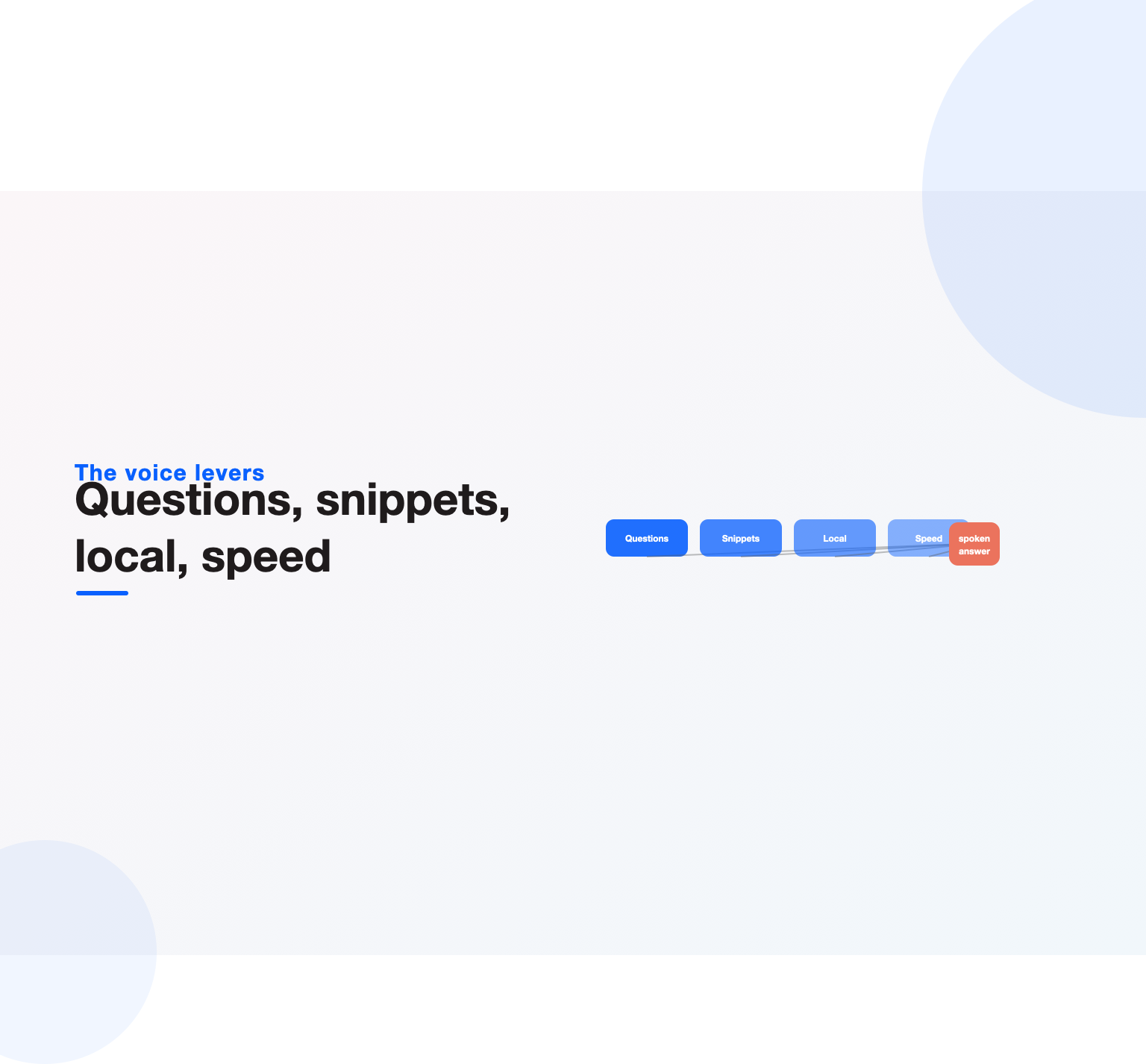
- Natural question-and-answer content, structured data, local signals and fast pages are the core levers.
- Voice and AI answer optimization converge, so answer-ready content pays off across both surfaces.
- Measure by featured-snippet presence, conversational query performance and local outcomes over time.
Frequently asked questions
Direct answers to the questions businesses ask most about voice search optimization.
What is voice search optimization?
It is the practice of shaping your content so it wins the spoken queries people ask their phones, smart speakers and assistants. Because voice searches are longer, conversational and usually phrased as full questions, and often return a single spoken answer, the work means writing natural question-and-answer content, earning the concise featured response assistants read aloud, strengthening local signals, and keeping your site fast and structured. The goal is to be the definitive answer to the exact question someone asks out loud.
How is voice search different from typed search?
Voice queries are longer, more conversational and far more likely to be complete questions, using natural language and question words like how, what and where rather than clipped keywords. They are also more often local and immediate, tied to acting now. And they usually return one spoken answer instead of a page of links, making the result winner-take-most. These differences mean content should answer real questions directly in natural language rather than target fragmented keywords.
Why does voice search matter for my business?
Speaking queries has become normal on phones, in cars and on smart speakers, especially for quick, local and hands-busy searches that carry strong intent. Many voice searches are about finding something nearby at the moment of choosing, so winning the spoken answer is a direct route to customers. The behavior keeps growing as assistants become more capable, so building answer-ready content now positions you to capture that rising share rather than catching up later.
How do I optimize my content for voice search?
Start by identifying the real questions your customers ask and answering each directly and concisely in natural, conversational language, ideally in a question-and-answer format. Structure content to win the featured response engines read aloud, add structured data so engines understand your content and business, strengthen your local presence if you serve an area, and keep your site fast and mobile-friendly. These levers together make your content the kind an assistant confidently speaks back.
Is voice search optimization the same as local SEO?
They overlap heavily but are not identical. Many voice queries are local, so the profile, reviews and consistent information that power local visibility also feed the answers assistants give, making strong local fundamentals central to voice for any business serving an area. But voice optimization also covers non-local questions through conversational content and featured answers. Think of local SEO as a major pillar of voice readiness rather than a full substitute for it.
How does voice search relate to AI answers?
They are converging on the same behavior: a natural-language question answered with a single synthesized response. The skills that win spoken results, direct answers to real questions backed by authority and clean structure, are essentially those that win citations in AI answers, so the two reinforce each other. Content made answer-ready for voice is well along the path to being cited by AI systems, which is why the strongest approach treats voice, AI answers and classic search as one connected effort.
Can I measure voice search performance?
Not directly, since assistants rarely report which source they read aloud, but useful proxies exist. Tracking featured-snippet presence for your target questions is one of the best indicators, since the featured answer is often the spoken one. Growth in traffic from conversational, question-shaped queries and, for local businesses, calls and direction requests from nearby searches are also strong signals. Watch this basket of proxies over time and judge progress by the trend.
Do I need special tools for voice search optimization?
Not really. The core work, answering real questions in natural language, earning featured responses, adding structured data, strengthening local signals and keeping the site fast, uses the same tools and skills as good general and local optimization. What changes is the emphasis: conversational, question-based content and concise direct answers. Because it overlaps so much with sound search fundamentals, most businesses can begin voice optimization with the capabilities they already have.
Ready to put this into practice?
Talk to the team that runs SEO, AI search and paid growth programs every day.
Book a Strategy Call →