 Skip to content

SaaS SEO: How to Turn Search Into Signups and Revenue
SaaS SEO drives signups and revenue, not vanity traffic. The full-funnel playbook: bottom-funnel comparison and alternative pages, technical SaaS fixes, programmatic pages, and measuring by trials.
Quick Answer
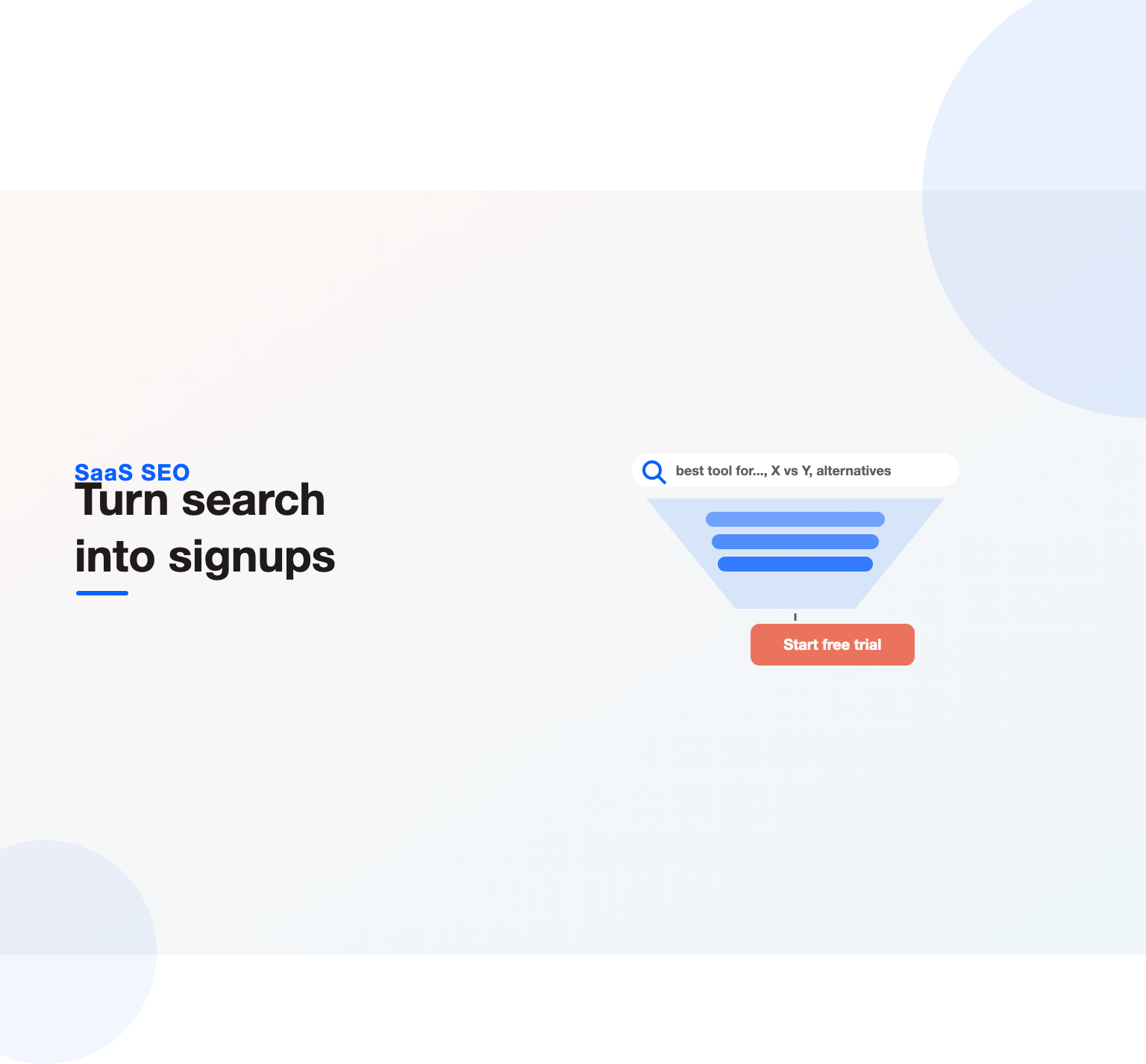
SaaS SEO is the practice of using search to drive product signups and revenue, not just traffic, by targeting the high-intent queries buyers use across the whole funnel and connecting those rankings to activation. It differs from generic SEO because the goal is qualified signups, so the strategy leans heavily on bottom-of-funnel content, comparison and alternative pages, integration and use-case pages, and product-led content that turns a search into a trial. Done well, SaaS SEO becomes a compounding, low-marginal-cost acquisition channel that lowers blended CAC as it grows.
Key Highlights
- SaaS SEO optimises for signups and revenue, not vanity traffic, so success is measured in trials and pipeline rather than sessions.
- The highest-value work is bottom-of-funnel: comparison, alternative, integration and use-case pages that capture buyers close to a decision.
- It spans the full funnel, from problem-aware content down to product-led pages, each mapped to a real stage of intent.
- Technical care matters because SaaS sites often split a marketing site from a JavaScript-heavy app, and only the crawlable parts can rank.
- AI search is reshaping how buyers discover software, so being cited in AI answers is now part of SaaS SEO.
What makes it different
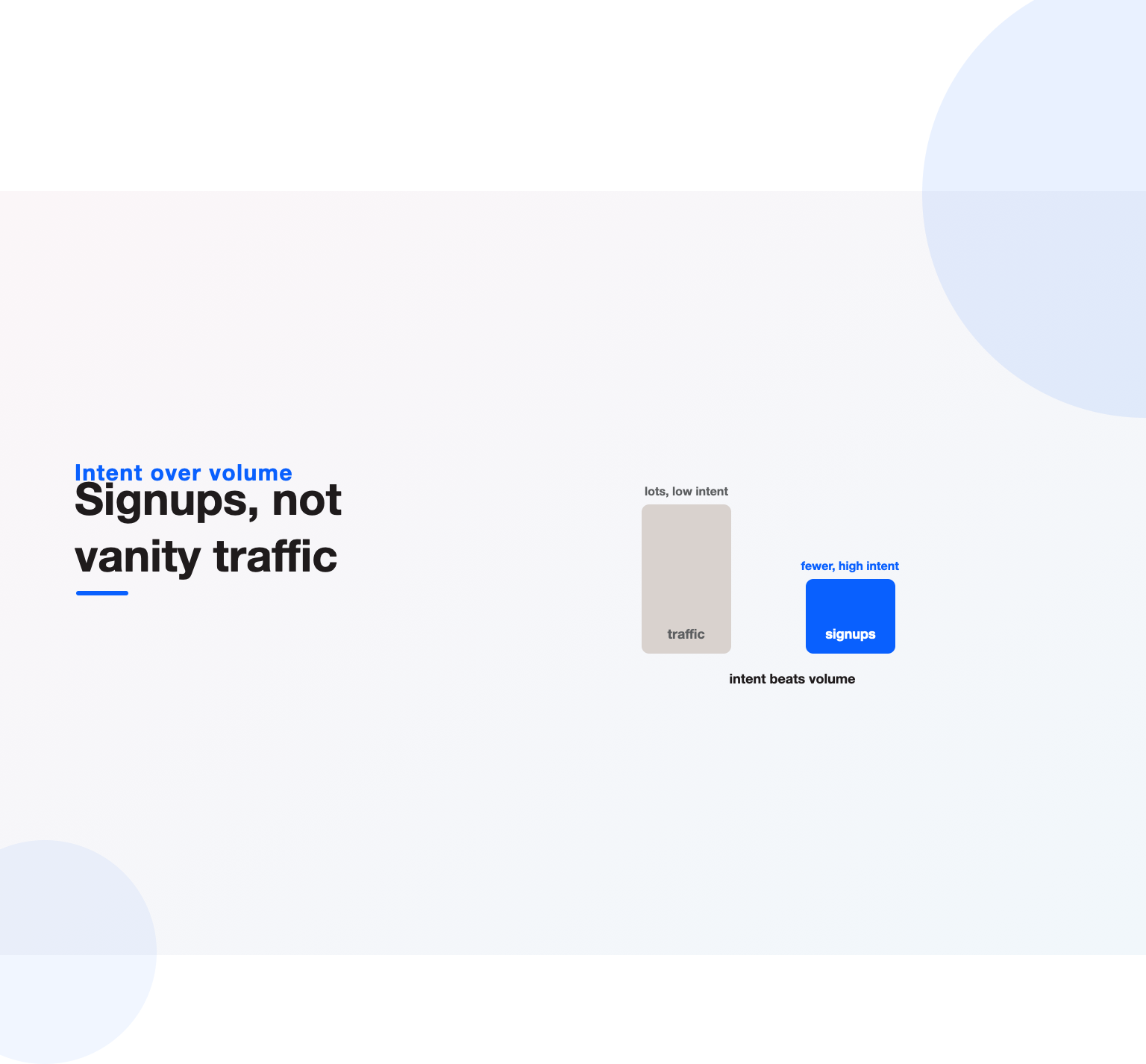
At its core it is search optimisation aimed squarely at product growth, and that goal changes everything about how it is practised. A media site wins by maximising traffic and ad impressions; a SaaS business wins only when a search turns into a signup that becomes a paying customer. That means the metric that matters is not raw traffic but qualified trials and the revenue behind them, and a page that brings a thousand irrelevant visitors is worth less than one that brings fifty buyers ready to evaluate your product. This intent-first orientation is its defining feature.
The other difference is where the value concentrates. In many content strategies the top of the funnel gets most of the attention, but in SaaS SEO the bottom of the funnel, where buyers are comparing tools and ready to act, is disproportionately valuable even though its search volumes are smaller. A comparison page or an alternative page might get a fraction of the traffic of a broad how-to article, yet convert at many times the rate because the searcher is deciding what to buy. Understanding that intent, not volume, drives SaaS revenue is what separates SaaS SEO that grows the business from content that merely grows a traffic chart.
Keyword strategy for SaaS
Keyword strategy in SaaS SEO starts from the jobs your product does and the problems it solves, then maps queries to funnel stages. At the bottom sit the highest-intent terms: your category term, competitor and alternative searches, and integration or feature queries where the searcher wants a tool right now. In the middle sit problem-aware and solution-aware queries, where buyers know their pain and are exploring approaches. At the top sit broad educational topics that build awareness and authority. A complete SaaS SEO plan covers all three, but it prioritises the bottom, because that is where searches convert into trials.
This is why proper keyword research matters so much for SaaS SEO: you are not just finding high-volume terms, you are identifying the specific, often low-volume queries that signal a buyer close to a decision. Niche integration searches, use-case queries and comparison terms may each have modest volume, but collectively they represent your most valuable demand. The discipline is to resist the pull of vanity keywords with big numbers and weak intent, and instead build deliberately around the queries that map to your product’s value. Get that mapping right and the rest of SaaS SEO becomes far more effective, because every page is aimed at demand that can actually convert.
Bottom-of-funnel content that converts
The engine room of SaaS SEO is bottom-of-funnel content, and a few page types do the heavy lifting. Comparison pages, where your product is weighed against a competitor, capture buyers actively choosing between options. Alternative pages, targeting searches for alternatives to a well-known tool, capture demand created by competitors. Integration pages, covering how your product works with the other tools in a buyer’s stack, capture highly specific, high-intent searches. Use-case and jobs-to-be-done pages show a buyer exactly how your product solves their particular problem. Each of these turns a search into a trial far more reliably than a generic blog post.
The key to these pages in SaaS search is that they must be genuinely useful and honest, not thin sales copy. A comparison page that fairly represents both tools earns trust and gets cited; an alternative page that actually helps a frustrated user find the right fit converts. Because these pages sit close to the buying decision, quality and credibility matter enormously, and the best SaaS companies treat them as core product-marketing assets rather than afterthoughts. Building a comprehensive set of these bottom-of-funnel pages, one for each meaningful competitor, integration and use case, is often the single highest-return project in a SaaS SEO programme.
Full-funnel content and topical authority
While the bottom of the funnel converts, search for SaaS still needs full-funnel coverage to build the topical authority that makes those money pages rank and to capture demand earlier in the journey. Problem-aware and educational content establishes your brand as an authority on the category, earns links, and brings buyers into your world before they are ready to choose. The trick is to connect that top-of-funnel content to the product through clear internal linking and genuine relevance, so awareness content feeds the bottom-funnel pages rather than sitting in isolation. A strong SEO foundation underpins all of this.
Topical authority is especially important in SaaS search because it lifts the whole domain’s ability to rank, including the high-value commercial pages. By covering a category comprehensively, from foundational concepts to advanced tactics, a SaaS company signals to search engines that it is a genuine authority, which helps its comparison and use-case pages compete. This is where software SEO connects to a broader on-page and content strategy: the educational content and the commercial content work as a system, with authority built at the top flowing down to support conversions at the bottom. Neglect either layer and the programme underperforms.
Technical SEO for SaaS products
The field carries a technical wrinkle most content sites do not face: the split between a marketing site and a web application. The marketing site, blog, comparison pages, landing pages, needs to be fast, crawlable and well-structured so it can rank. The application itself is often a JavaScript-heavy single-page app that search engines struggle to render, which means content locked inside the app may be invisible to search. Deciding what belongs on the crawlable marketing site versus the app, and ensuring anything meant to rank is server-rendered and accessible, is a core technical task in search for software.
Beyond the app-versus-site question, SaaS search depends on the same technical foundations as any serious programme: clean site architecture, fast performance, sensible internal linking, and structured data that helps engines understand your product and content. Our technical SEO checklist covers these fundamentals. For SaaS specifically, watch for common traps like important content trapped behind logins or heavy scripts, thin programmatically generated pages, and marketing sites bolted onto app frameworks in ways that hurt crawlability. Getting the technical foundation right ensures the content and authority work in your search for SaaS programme can actually pay off in rankings.
Programmatic pages at scale
Many SaaS products have natural opportunities for programmatic SEO, generating large sets of pages from structured data, and used well this is a powerful part of SaaS search. Integration directories, template galleries, location or industry landing pages, and comparison matrices can each produce hundreds of targeted, high-intent pages that capture long-tail demand no team could write by hand. When each generated page genuinely serves a distinct query with useful, differentiated information, programmatic the discipline scales coverage of exactly the specific, buying-intent searches that convert.
The danger, and the reason programmatic work in search for SaaS must be handled carefully, is thin duplication. The same technique that creates hundreds of useful integration pages can, applied carelessly, spawn thousands of near-identical doorway pages that engines penalise and that waste crawl budget. The rule is that every programmatic page must earn its place by being genuinely helpful for its specific query, backed by real data and differentiated content, not just a template with a swapped noun. Handled with that discipline, programmatic pages let the practice cover a vast surface of high-intent long-tail demand efficiently; handled carelessly, they become a liability.
Link building and authority for SaaS
Authority still decides a great deal of what ranks, so link building is part of any serious software SEO programme, and SaaS companies have some natural advantages. Original data from your product, useful free tools, integration partnerships, and genuinely valuable content all earn links without manual outreach. Our guide to link building strategies covers the approaches; for SaaS the most durable is usually creating link-worthy assets, proprietary research, calculators, and definitive guides, that other sites reference because they are useful. This earns the authority that helps your commercial pages compete.
The strategic point for this work is that authority-building and product-marketing overlap. The same original research that earns backlinks also fuels demand generation and gets cited by AI engines; the same free tool that attracts links also captures leads. Treating link-worthy asset creation as a shared investment across SEO, content and product marketing makes it far more efficient than chasing links as an isolated activity. For SaaS companies that want specialist help turning this into a system, our SaaS SEO services build and run exactly this kind of authority-and-conversion programme.
Measuring SaaS SEO
Because the goal is product growth, measuring SaaS search means tying search back to signups and revenue, not stopping at traffic. The metrics that matter are organic-driven trials and demos, the conversion rate of organic traffic by page and segment, and ultimately the pipeline and revenue attributable to organic search. This requires connecting your analytics to product events, so you can see not just that a page brought visitors but that it brought visitors who signed up and converted. A search for SaaS programme judged on traffic alone will optimise for the wrong things; judged on signups and revenue, it optimises for the business.
Segment-level measurement is especially useful in SaaS search. Grouping pages by type, comparison, alternative, integration, educational, and watching how each converts reveals where to invest: often the bottom-funnel pages convert many times better than educational content, which justifies building more of them. Tracking these outcomes over time also makes the case for continued investment, because SEO’s compounding returns are only visible when you measure the trials and revenue it produces quarter over quarter. Measured this way, the discipline becomes an accountable growth channel with a clear, improving return rather than an act of faith.
SaaS SEO and AI search
Buyers increasingly research software through AI assistants and AI Overviews, asking which tool is best for a job or how options compare, which makes AI visibility a growing part of search for SaaS. The same assets that power traditional the practice, clear comparison content, honest alternative pages, well-structured product information and genuine authority, are what make a product likely to be cited when an AI answers a software question. A SaaS company that is well-represented and consistently described across the web gives these engines every reason to recommend it. Our overview of AI search optimization covers how that visibility is earned.
The practical implication is that software SEO and AI-search readiness are converging rather than competing. Investing in the clear, credible, well-structured content that ranks also positions your product to be recommended inside AI answers, and as more buyers start their software search with an assistant, that dual payoff grows. The adaptation for this work is mainly in measurement and emphasis: track whether AI engines recommend you for your key buying queries, and keep your product information and comparison content accurate and consistent so those engines represent you correctly. Handled well, AI search becomes another high-intent discovery channel feeding the same signups SaaS search has always chased.
Getting started with SaaS SEO
For a SaaS company beginning to take search seriously, the highest-return starting point is almost always the bottom of the funnel. Map your most important buying-intent queries, your category term, key competitors and alternatives, core integrations and use cases, and build a genuinely useful page for each, because these convert fastest and prove the value of SEO to the business quickly. In parallel, fix the technical foundations, especially the marketing-site-versus-app crawlability question, so nothing you build is invisible to search. Early, conversion-focused wins build the internal case for sustained investment.
From there, search for SaaS becomes an ongoing programme: expand full-funnel coverage to build topical authority, invest in link-worthy assets that double as demand-gen, extend into programmatic pages where your data supports it, and measure everything against signups and revenue. Since the returns compound, a disciplined SaaS search programme steadily becomes one of the most efficient acquisition channels a software business has, lowering blended CAC as organic grows. If you want specialist help building and running it, our SaaS SEO services team does exactly this, and the broader SEO services practice supports every part of the work. Done right, the discipline turns search into a compounding signup engine rather than a traffic vanity metric.
Common mistakes to avoid
A handful of predictable mistakes hold these programmes back. The most common is chasing traffic instead of intent, publishing high-volume top-funnel content that ranks and gets visits but never produces trials, while neglecting the smaller-volume bottom-funnel pages that actually convert. A second is treating comparison and alternative pages as thin sales copy rather than genuinely useful, honest resources, which kills both trust and rankings. A third is ignoring the marketing-site-versus-app crawlability problem, so pages meant to rank are locked inside a JavaScript app and stay invisible. Each of these wastes effort on motion that does not move signups.
A subtler mistake is judging the practice on the wrong timeline and the wrong metric, expecting instant results and measuring traffic rather than pipeline, then abandoning the channel before its compounding returns appear. Our honest looks at how long SEO takes to work and whether SEO is worth it set realistic expectations. The fix across all these mistakes is the same discipline: aim at buying intent, keep quality high, ensure everything rankable is crawlable, and measure against signups and revenue over a realistic horizon. Avoid these traps and software SEO compounds; fall into them and it looks like a cost with no return.
How it fits your growth mix
SaaS SEO works best understood alongside your other acquisition channels rather than in isolation. Compared with paid acquisition, its economics are compelling: our comparison of SEO versus PPC lays out how paid buys immediate but rented visibility while SEO builds an owned asset that keeps producing trials after the spend stops, steadily lowering blended acquisition cost as it grows. For a SaaS business burning to hit efficient growth, that shift from rented to owned demand is strategically significant, and it is why mature software companies invest in search even when paid is working.
The economics also shape how you resource this work. Whether you build an in-house team, partner with a specialist, or blend both depends on your stage and internal capacity, and our guide to in-house versus agency and choosing an SEO partner weigh the trade-offs. Whatever the model, the key is to connect SaaS search to revenue so leadership funds it as the efficient growth channel it is, and our transparent view of what SEO costs frames that investment against its return.
Across company stages
What SaaS search should prioritise shifts with company stage. Early-stage SaaS companies win fastest by owning their niche bottom-funnel terms, category, competitors, integrations, before larger rivals crowd in, and by publishing the founder-led, genuinely expert content that earns early authority. Given that their domains are young, they should be realistic that broad head terms will take time, and concentrate on the specific, high-intent queries they can win now. This focused approach lets a small SaaS company compete with much larger ones on the searches that actually drive its trials.
Growth-stage and larger SaaS companies, by contrast, can pursue search for software at scale, expanding programmatic pages, building comprehensive topical authority across the category, and running the kind of systematic programme that starts to resemble enterprise SEO as the site and team grow. At that point the discipline becomes as much about process, prioritisation and cross-team execution as about individual pages. For SaaS companies at any stage that want specialist support matched to where they are, our AI SEO services for SaaS and dedicated SaaS SEO services meet the programme to the moment, from a startup owning its first commercial terms to a scale-up systematising search across a large site. To extend these strategies into AI answers, read our guide to GEO for SaaS.
Key Takeaways
- Optimise for signups and revenue, not traffic, and measure organic by trials, conversion and pipeline, not sessions.
- Start at the bottom of the funnel: build honest comparison, alternative, integration and use-case pages that convert.
- Build full-funnel topical authority so the domain, and its commercial pages, can rank.
- Fix the marketing-site-versus-app crawlability problem so anything meant to rank is server-rendered and accessible.
- Use programmatic pages only with strict quality control, and extend the same assets into AI-search visibility.
Frequently asked questions
Is SaaS SEO worth it versus paid ads?
For most software companies, yes, as a complement rather than a replacement. Paid ads buy immediate, controllable visibility but stop producing the moment you stop paying, while SaaS search builds an owned asset that keeps generating trials at almost no marginal cost once it ranks, steadily lowering blended acquisition cost. The trade-off is time: paid works instantly, search compounds over months. The strongest SaaS growth engines run both, using paid for speed and testing and search for durable, efficient demand, and feed keyword and conversion data between the two.
What is SaaS SEO?
SaaS SEO is the practice of using search to drive product signups and revenue rather than just traffic, by targeting the high-intent queries buyers use across the funnel and connecting rankings to activation. It leans heavily on bottom-of-funnel content, comparison, alternative, integration and use-case pages, because those turn searches into trials, and it measures success in signups and pipeline, not sessions.
How is SaaS SEO different from regular SEO?
The principles are the same, but the goal, qualified signups, changes the emphasis. SaaS SEO prioritises high-intent bottom-of-funnel queries over high-volume vanity terms, treats comparison and alternative pages as core assets, and measures against revenue rather than traffic. It also has a technical wrinkle: separating the crawlable marketing site from a JavaScript-heavy app so that content meant to rank is actually accessible to search engines.
What content works best for SaaS SEO?
Bottom-of-funnel pages convert best: comparison pages against competitors, alternative pages for rival tools, integration pages for the buyer’s stack, and use-case pages showing how your product solves a specific job. These capture buyers close to a decision. They should be paired with full-funnel educational content that builds topical authority and feeds the commercial pages through internal linking.
Why is bottom-of-funnel content so important for SaaS?
Because intent, not volume, drives SaaS revenue. A comparison or alternative page may get less traffic than a broad how-to article, but it converts at many times the rate because the searcher is actively choosing what to buy. Prioritising these pages means your search for SaaS effort targets the demand most likely to become trials and paying customers, which is what grows the business.
Does programmatic SEO work for SaaS?
Yes, when your product has structured data that supports it, integrations, templates, use cases, so you can generate many targeted, high-intent pages that capture long-tail demand. The critical rule is quality control: every generated page must genuinely serve its specific query with useful, differentiated content, or it becomes thin, duplicative bloat that engines penalise. Done with discipline, programmatic pages scale the practice efficiently.
How do you measure SaaS SEO success?
Tie search to product outcomes: organic-driven trials and demos, the conversion rate of organic traffic by page type, and the pipeline and revenue attributable to organic. Connect analytics to product events so you can see which pages bring visitors who actually sign up, and measure by segment so you can invest in the page types that convert best. Traffic alone is a misleading metric for software SEO.
How long does SaaS SEO take to show results?
Bottom-of-funnel pages targeting specific, low-competition buying terms can start producing trials within a few months, which is why they are the right place to start. Broader authority and head terms take longer, often six to twelve months or more, because they depend on the domain earning trust over time. The compounding nature of the channel means results accelerate rather than plateau, so the honest expectation is early wins on high-intent pages followed by growing returns as authority builds, provided the investment is consistent rather than stop-start.
What is product-led SEO?
Product-led SEO is a strand of SaaS search where the product itself, or data and templates derived from it, becomes the rankable content: think integration directories, template galleries, or free tools that both rank and demonstrate value. It works because these pages capture specific, high-intent demand and route searchers straight into product experiences that drive signups. Used with quality control, it is one of the most durable and defensible forms of SaaS search, because competitors cannot easily replicate assets built on your own product and data.
Should early-stage startups invest in SaaS SEO?
Yes, but with focus. Early-stage companies should not chase broad head terms their young domains cannot yet win; they should own their niche bottom-funnel terms, category, competitors, integrations, and publish genuinely expert, founder-led content that earns early authority. Since the returns compound and the marginal cost of each ranking page is low, starting early builds an owned acquisition asset that pays off exactly when the company needs efficient growth, rather than waiting until paid channels become too expensive.
What are the most common SaaS SEO page types?
The workhorses are comparison pages (“your product vs a competitor”), alternative pages (“alternatives to a well-known tool”), integration pages (“your product with X”), and use-case or jobs-to-be-done pages that show how you solve a specific problem. These bottom-of-funnel types capture buyers close to a decision and convert far better than generic articles. They are supported by educational, problem-aware content higher in the funnel that builds the authority those commercial pages need, and increasingly by product-led pages such as free tools and template galleries.
How does AI search affect SaaS SEO?
Buyers increasingly ask AI assistants which software to use, so being cited in AI answers is now part of this work. The same comparison content, honest alternative pages, structured product information and authority that drive rankings also make a product likely to be recommended by AI engines. Keep your product and comparison information accurate and consistent, and track whether AI engines recommend you for your key buying queries.
Ready to put this into practice?
Talk to the team that runs SEO, AI search and paid growth programs every day.
Book a Strategy Call →