 Skip to content

SEO Reporting: How to Build Reports That Prove ROI
SEO reporting turns data into proof of value. The KPIs that matter, the vanity metrics to cut, how to structure a report, tie SEO to revenue, and report on AI search visibility.

Quick Answer
SEO reporting is the practice of measuring and communicating how your SEO program is performing, translating raw data into a clear story about traffic, rankings, and the business results the work is driving. Good SEO reporting is not a data dump of every metric a tool can export; it is a focused view of the KPIs that matter, organic traffic and its quality, rankings for priority topics, conversions and revenue from search, and technical health, framed so the reader understands what is working, what is not, and what happens next. Done well, it turns SEO from a channel people distrust because they cannot see its value into one they fund confidently because the reporting makes the return obvious.
Key Highlights
- SEO reporting exists to communicate value and guide decisions, not to list every metric, so it centers on a few KPIs tied to business outcomes.
- The metrics that matter are organic traffic and its quality, rankings for priority topics, conversions and revenue from organic, visibility, and technical health, not vanity numbers.
- A strong report leads with an executive summary and results, then insight and recommended actions, so the reader gets the story before the spreadsheet.
- Tying SEO to revenue and pipeline, through proper conversion tracking, is what turns reporting from a defense of activity into proof of return.
- Cadence and audience matter: executives need outcomes and trends, practitioners need the detail, and the same data should be framed differently for each.
What SEO reporting is and what it is for
SEO reporting is the process of collecting performance data, interpreting it, and communicating it to the people who need it, whether that is a client, an executive team, or your own colleagues, and it is the feedback layer that keeps the wider SEO program honest. Its purpose is twofold: to demonstrate the value the SEO program is creating, and to inform decisions about what to do next. A report that does neither, that simply shows numbers went up or down without explaining why or what it means, has failed at its actual job even if every figure in it is accurate.
The mindset shift that improves most SEO reporting is treating the report as communication rather than documentation. The goal is not to prove you tracked everything but to help the reader understand performance and make good decisions, which means selecting, interpreting, and framing rather than exporting. That is why the strongest reports are often the simplest: a few well-chosen KPIs, a clear narrative about what happened and why, and a specific set of next steps. Everything in this guide follows from that principle, because a report that communicates value and guides action is worth more than one that is comprehensive but unread.
Why most SEO reports fail
Most SEO reporting fails in one of two opposite ways. The first is the vanity-metric report, which celebrates numbers that look impressive but do not connect to the business, total impressions, keywords ranked, or raw traffic with no view of whether any of it drives revenue. An executive reading it cannot tell whether the investment is paying off, so the report inspires no confidence even when the work is good. The second failure is the data dump, a sprawl of every metric available with no narrative, which forces the reader to do the interpretation the report should have done.
Both failures share a root cause: the report was built around what is easy to measure rather than what the audience needs to know. Fixing SEO reporting starts with a different question, not “what can I show” but “what does this reader need to decide,” and letting that drive which metrics appear and how they are framed. A report that answers whether the program is working, why, and what to do next will always beat one that is longer, prettier, or more comprehensive, because it does the job reporting exists to do.
The SEO KPIs that actually matter
Effective SEO reporting centers on a focused set of KPIs that connect to business value. Organic traffic is the starting point, but it matters most when segmented by landing-page type and intent, so you can see whether the pages that drive the business are growing rather than just a total going up. Rankings still matter, but reported for priority topics and tracked as movement over time rather than a vanity list, because a page climbing from position twelve to four on a valuable term is the signal, not the raw count of keywords.
The KPIs that carry the most weight are the ones closest to money. Conversions and revenue from organic search, leads, signups, or sales attributable to the channel, are what prove the program’s worth and belong at the top of any report. Around them sit supporting indicators: organic visibility or share of voice on your target topics, and technical-health metrics like indexation coverage and crawl status, the kind a technical SEO checklist surfaces, that act as early warnings. Good SEO reporting weaves these into a hierarchy, business outcomes first, then the traffic and rankings that lead to them, then the technical foundations, so the reader sees both the result and the reasons behind it. Overlaying these against the cost of the work is also what frames the return, the same value question our look at how much SEO costs puts at the center.
Vanity metrics to leave out
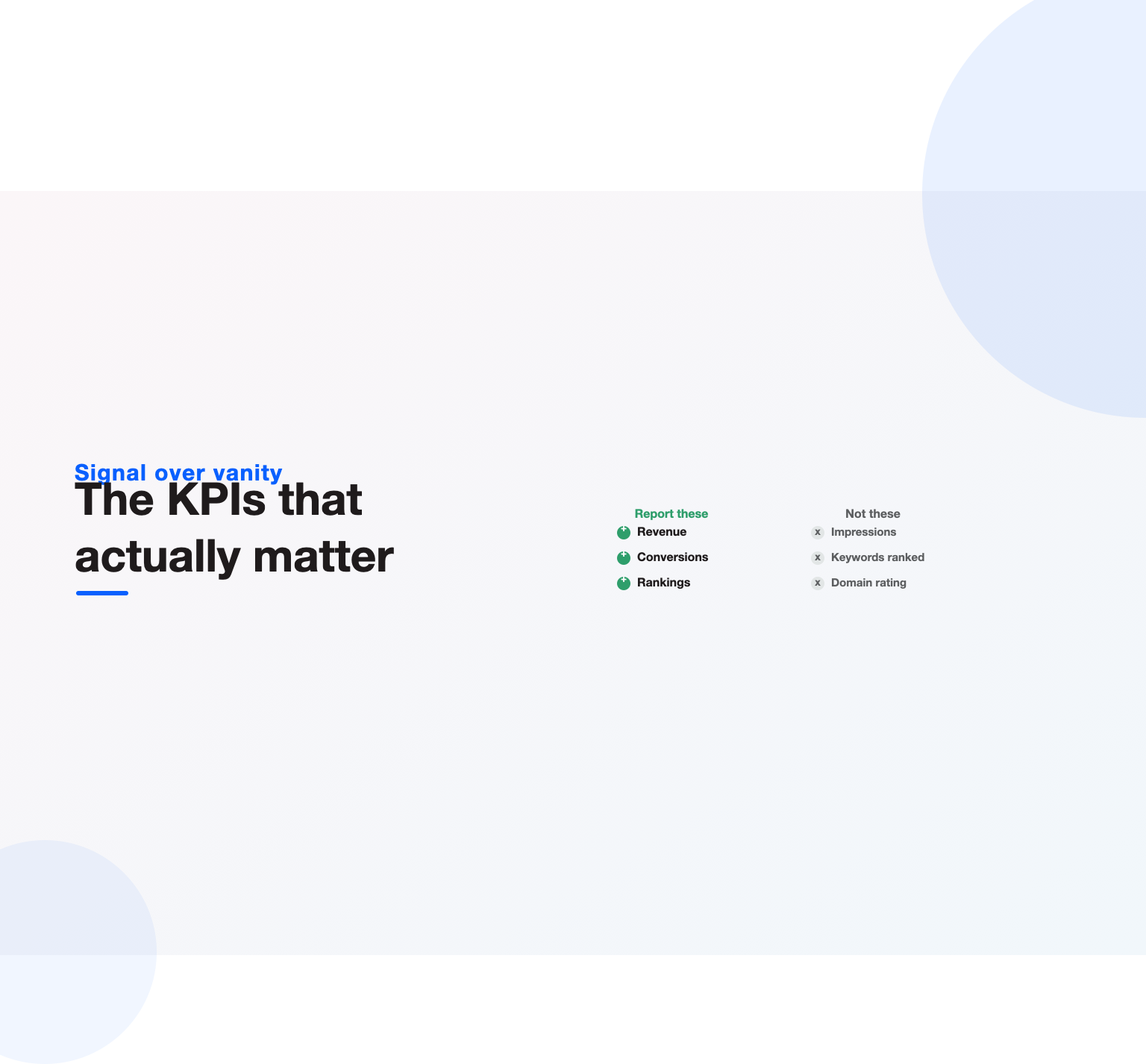
Just as important as what to include is what to cut, because vanity metrics actively undermine SEO reporting by crowding out signal with noise. Total keywords ranked sounds impressive but says nothing about whether those are valuable terms or whether you rank in positions anyone sees. Raw impressions can balloon without a single extra click or conversion. Bounce rate and time on page, absent context, mislead as often as they inform. Domain rating and similar third-party scores are useful diagnostics but are not business outcomes and do not belong at the center of a report.
None of these are useless numbers, but they are diagnostics for the practitioner, not headline results for a stakeholder, and presenting them as achievements erodes trust the moment someone asks what they are worth. The discipline is to demote them: keep what you need to diagnose in a working view, and reserve the report itself for metrics that connect to the business. A leaner report built on meaningful KPIs is more persuasive than a crowded one, because every number in it can survive the question every executive eventually asks, which is what this actually did for revenue.
How to structure an SEO report
Structure is what turns the right metrics into a report people actually read and act on. Lead with an executive summary: the handful of sentences that say how the program performed against its goals, the most important wins and issues, and what you recommend next. Most readers, especially senior ones, may read only this, so it has to stand alone and deliver the story without requiring the rest. Everything after it exists to support and evidence that summary.
Below the summary, move from outcomes to detail in a logical order: headline results and KPIs against targets and prior periods, then the traffic, ranking, and visibility trends that explain them, then technical health, and finally the insights and specific recommended actions that turn the data into a plan. Comparison is what gives numbers meaning, so show performance against the previous period, the same period last year, or the goal, never a bare figure with no reference point. This top-down structure respects the reader’s time and makes strong SEO reporting feel less like a spreadsheet and more like a briefing that ends with a decision.
Tying SEO to revenue and business outcomes
The single biggest upgrade you can make to SEO reporting is connecting it to revenue, because that is the language decision-makers fund. This means setting up conversion tracking so organic search is credited with the leads, signups, or sales it drives, and reporting those outcomes prominently rather than leaving the reader to guess whether traffic turned into anything. When a report shows that organic search generated a specific number of qualified leads or a quantum of revenue, the conversation shifts from whether SEO works to how much more to invest.
Attribution is imperfect, and honest SEO reporting acknowledges that rather than overclaiming. Organic often assists conversions that close through other channels, so reporting assisted conversions and the channel’s role in the journey gives a fairer picture than last-click alone. Tie results to the business model, pipeline and deal value for B2B, revenue and average order value for ecommerce, so the numbers map to how the company actually makes money. Framing performance this way is what elevates reporting from a defense of activity to evidence of return, and it is the core of demonstrating that SEO is worth the investment. When a stakeholder can see organic search producing pipeline month after month, the reporting stops being a justification and becomes the reason the budget grows.
Cadence and audience: who reads the report
The same data needs different framing for different readers, and good SEO reporting adapts to its audience. Executives and clients want outcomes and trends: is the program hitting its goals, is it driving revenue, what is the trajectory, and what should we do. They need the executive summary, the business KPIs, and clear recommendations, not the granular detail. Practitioners and SEO teams need the opposite: the page-level rankings, the technical issues, the query data that guides day-to-day work.
Cadence should match the audience and the reality that SEO moves over months, not days. Monthly reporting suits most stakeholders, giving enough time for meaningful change while keeping people informed, with quarterly reviews for strategic direction and lighter weekly views for the working team. Going too frequent invites overreaction to noise, since a week rarely shows a real trend, while going too rare leaves stakeholders in the dark. Matching both the depth and the frequency to who is reading is what makes SEO reporting land, because a report that overwhelms an executive or underserves a practitioner fails regardless of how good the underlying data is.
Tools for SEO reporting
A practical SEO reporting stack combines a few sources rather than relying on any single tool. Google Search Console is the primary source for how you perform in Google, clicks, impressions, average position, and the queries and pages behind them, straight from the source. Google Analytics supplies the traffic and, crucially, the conversion and revenue data that ties SEO to business outcomes. A rank tracker adds reliable position tracking for your priority terms over time, and a crawler or site-audit tool covers technical health.
The reporting layer itself is where these come together. A dashboard tool such as Looker Studio can pull from Search Console, Analytics, and other sources into a single live report, which reduces manual work and keeps stakeholders looking at current data. The goal is not the most tools but a clean pipeline from a few trustworthy sources into a clear, consistent report. Whatever the stack, the tools serve the story: they exist to surface the KPIs and trends that matter, not to generate more charts than anyone will read, and a simple report built on solid data beats an elaborate one built on noise.
Automating SEO reports
Manual reporting eats hours that are better spent on the work itself, so automating the data collection and assembly is a high-return move once your metrics and structure are settled. A live dashboard that pulls from your sources means the numbers are always current and the monthly report becomes a matter of writing the narrative rather than rebuilding charts. Automation also enforces consistency, since the same metrics are presented the same way each period, which makes trends easier to read and comparisons trustworthy.
The part that should never be automated is the interpretation. A dashboard can show what happened, but the value of SEO reporting is in explaining why it happened and what to do about it, which requires a human who understands the program and the business. The right balance is to automate the plumbing, the data pull, the standard charts, the recurring KPIs, and to spend the saved time on the analysis and recommendations that make a report worth reading. A useful test is whether someone could hand the raw dashboard to a stakeholder and have it mean anything on its own: if the answer is no, the interpretation you add is precisely where the reporting earns its value, and no amount of automation replaces it. Automating the assembly while keeping the thinking human is what lets reporting scale without becoming a hollow, unread ritual.
Reporting on AI search visibility
As AI Overviews and answer engines take a growing share of search, SEO reporting has to expand to cover visibility that traditional metrics miss. When an AI answer satisfies a query without a click, a page can be influential and cited yet show flat or falling clicks in classic reporting, so reports that track only clicks will increasingly understate the value being created. Forward-looking SEO reporting adds new indicators: presence and citations in AI answers, visibility in AI Overviews for target queries, and referral traffic from AI tools where it can be identified.
This does not replace the established KPIs so much as supplement them, and the honest framing is that measurement here is still maturing. Report AI-search visibility alongside traditional rankings and conversions, note where clicks may be shifting to zero-click answers, and treat presence in AI answers as a leading indicator of brand authority even when its direct traffic is hard to attribute. Building this into reporting now keeps stakeholders informed about a real shift rather than blindsided by it, and it connects the SEO program to the broader visibility work handled in our SEO services, where being cited by AI systems is tracked as a first-class outcome.
Segmenting your SEO reporting
Aggregate numbers hide as much as they reveal, so strong SEO reporting segments performance rather than presenting one blended total. Splitting organic traffic and conversions by landing-page type, category pages, product pages, blog content, shows which parts of the site are actually growing and which are dragging, which a single sitewide line never exposes. Segmenting by topic cluster reveals whether the areas you invested in through interlinked clusters are gaining authority, and separating brand from non-brand queries is essential, because rising brand traffic can mask flat non-brand performance and flatter a report that is really standing still.
The point of segmentation is to make the report diagnostic, not just descriptive. When a number moves, segmentation tells you where and why, which is what turns reporting into a guide for the next month’s work rather than a scorecard. It also ties reporting directly to your content strategy, since seeing which clusters convert tells you where to invest and where to prune. A segmented view is more work to build once, but it is what separates reporting that drives decisions from reporting that merely records them.
Reporting for clients versus in-house teams
Who you report to shapes what the report must do. Agency and consultant reporting carries an extra burden of proof, because the client is paying an external party and needs to see clearly that the money is working, which puts revenue outcomes, transparency about what was done, and honest context front and center. Vague reports that hide behind jargon are how agencies lose accounts that were actually performing, so clarity about results and their business meaning is not optional when a retainer is on the line.
In-house reporting serves a different dynamic: the audience knows the business intimately but needs SEO framed in terms leadership already cares about, competing for budget against every other channel, a dynamic that also shapes the in-house versus agency decision itself. Here the job is to translate organic performance into the company’s own language of pipeline, revenue, and growth, and to connect it to cost so the investment case is explicit, the same value question our breakdown of SEO cost and our SEO versus PPC comparison both address. Leadership rarely doubts that organic matters; what it wants is a number it can compare against the alternatives. Either way, the principle holds: report to the reader’s stake in the outcome, because a client and an executive both fund what they can clearly see is working.
From report to action
A report that describes performance but changes nothing has missed its second purpose. The most valuable section of any SEO reporting is often the shortest: the specific, prioritized recommendations that say what to do next based on what the data showed. A page slipping in rankings, a cluster outperforming expectations, a technical issue emerging, each implies an action, and naming those actions is what turns a report from a rear-view mirror into a steering wheel. Report and strategy form a loop, with each report feeding the next period’s plan.
Prioritizing those actions matters as much as identifying them, because a list of twenty possible improvements paralyzes rather than guides. Rank them by likely impact and effort, surface the few that matter most, and tie them back to the goals the report is measured against. Because SEO compounds over time, the recommendations should also set realistic expectations about when results will show, in line with how long SEO takes to work, so stakeholders judge progress on the right timeline. A report that ends with a clear, prioritized plan is the difference between reporting that informs and reporting that actually moves the program forward.
Common SEO reporting mistakes
A handful of mistakes recur across otherwise capable teams. Leading with vanity metrics instead of business outcomes tops the list, because it trains stakeholders to distrust the report. Presenting numbers without comparison, no prior period, no target, no context, leaves the reader unable to judge whether a figure is good or bad. Drowning the story in data, with no executive summary or narrative, forces busy readers to give up. And reporting only activity, the tasks completed, rather than results, invites the question of what any of it achieved.
The subtler errors are about honesty and consistency. Cherry-picking the metrics that happen to look good this month destroys credibility the moment someone notices, so consistent KPIs reported every period, good news and bad, build far more trust. Overclaiming attribution, crediting SEO with conversions it only assisted, backfires when scrutinized. And changing the format or metrics each time makes trends impossible to follow. Avoiding these traps is mostly a matter of discipline: pick meaningful KPIs, report them consistently and honestly with context and a narrative, and always end with what the data means and what happens next.
Key Takeaways
- SEO reporting is communication, not documentation: its job is to demonstrate value and guide decisions, so build it around a few KPIs the audience actually needs.
- Center the report on business outcomes, conversions and revenue from organic, supported by segmented traffic, priority-topic rankings, and technical health, and cut vanity metrics.
- Lead with an executive summary and always show comparison against a prior period, target, or year, so numbers carry meaning.
- Tie SEO to revenue through proper conversion tracking, report assisted conversions honestly, and map results to how the business makes money.
- Match depth and cadence to the audience, automate the data assembly but keep the interpretation human, and start reporting AI-search visibility alongside traditional KPIs.
Frequently asked questions
What is SEO reporting?
SEO reporting is the practice of measuring how an SEO program is performing and communicating that clearly to clients, executives, or teams. It translates raw data into a focused story about organic traffic, rankings for priority topics, and the conversions and revenue the work drives, framed so the reader understands what is working, what is not, and what to do next. Its purpose is to demonstrate value and guide decisions, not to list every available metric.
What are the most important SEO KPIs?
The KPIs that matter most are the ones closest to business value: conversions and revenue from organic search first, then organic traffic segmented by page type and intent, rankings for priority topics tracked over time, organic visibility or share of voice, and technical-health indicators like indexation coverage. Vanity metrics such as total keywords ranked or raw impressions belong in a working view for diagnosis, not at the center of a stakeholder report.
How do I show the ROI of SEO?
Set up conversion tracking so organic search is credited with the leads, signups, or sales it generates, then report those outcomes prominently and tie them to the business model, pipeline value for B2B or revenue for ecommerce. Report assisted conversions honestly, since organic often supports conversions that close elsewhere, and compare the return against the cost of the work. Framing performance in revenue terms is what turns reporting into proof of return.
How often should I send SEO reports?
Monthly reporting suits most stakeholders, because SEO moves over months and a shorter window rarely shows a real trend, with quarterly reviews for strategy and lighter weekly views for the working team. Reporting too frequently invites overreaction to noise, while reporting too rarely leaves stakeholders in the dark. Match the cadence, and the level of detail, to who is reading and what decisions they need to make.
What should an SEO report include?
Start with an executive summary of performance against goals, key wins and issues, and recommendations, since many readers will read only that. Follow with headline KPIs against targets and prior periods, then traffic, ranking, and visibility trends, then technical health, and end with insights and specific next actions. Always include comparison to give numbers meaning, and keep the focus on outcomes rather than a list of completed tasks.
Which tools are best for SEO reporting?
A practical stack combines Google Search Console for search performance direct from Google, Google Analytics for traffic and conversion data, a rank tracker for reliable position tracking, and a crawler for technical health, brought together in a dashboard tool like Looker Studio for a live, consistent report. The goal is a clean pipeline from a few trustworthy sources into a clear report, not the largest possible number of tools or charts.
What are vanity metrics in SEO?
Vanity metrics are numbers that look impressive but do not connect to business value, such as total keywords ranked, raw impressions, domain rating, or bounce rate presented without context. They can be useful diagnostics for practitioners, but presenting them as headline results erodes trust because they cannot answer what the work did for revenue. Strong SEO reporting demotes them to a working view and reserves the report for meaningful KPIs.
How should I report on AI search and AI Overviews?
Add indicators that traditional metrics miss: presence and citations in AI answers, visibility in AI Overviews for your target queries, and any identifiable referral traffic from AI tools, reported alongside your established rankings and conversion KPIs. Note where clicks may be shifting to zero-click AI answers so flat click numbers are not misread as decline, and treat AI citations as a leading indicator of authority even while direct attribution is still maturing.
Ready to put this into practice?
Talk to the team that runs SEO, AI search and paid growth programs every day.
Book a Strategy Call →