 Skip to content

White Label SEO: How the Reseller Model Works
White label SEO explained: how an agency sells search under its own brand while a specialist partner does the work. How it works, pricing and margins, risks, and how to choose a partner.
Quick Answer
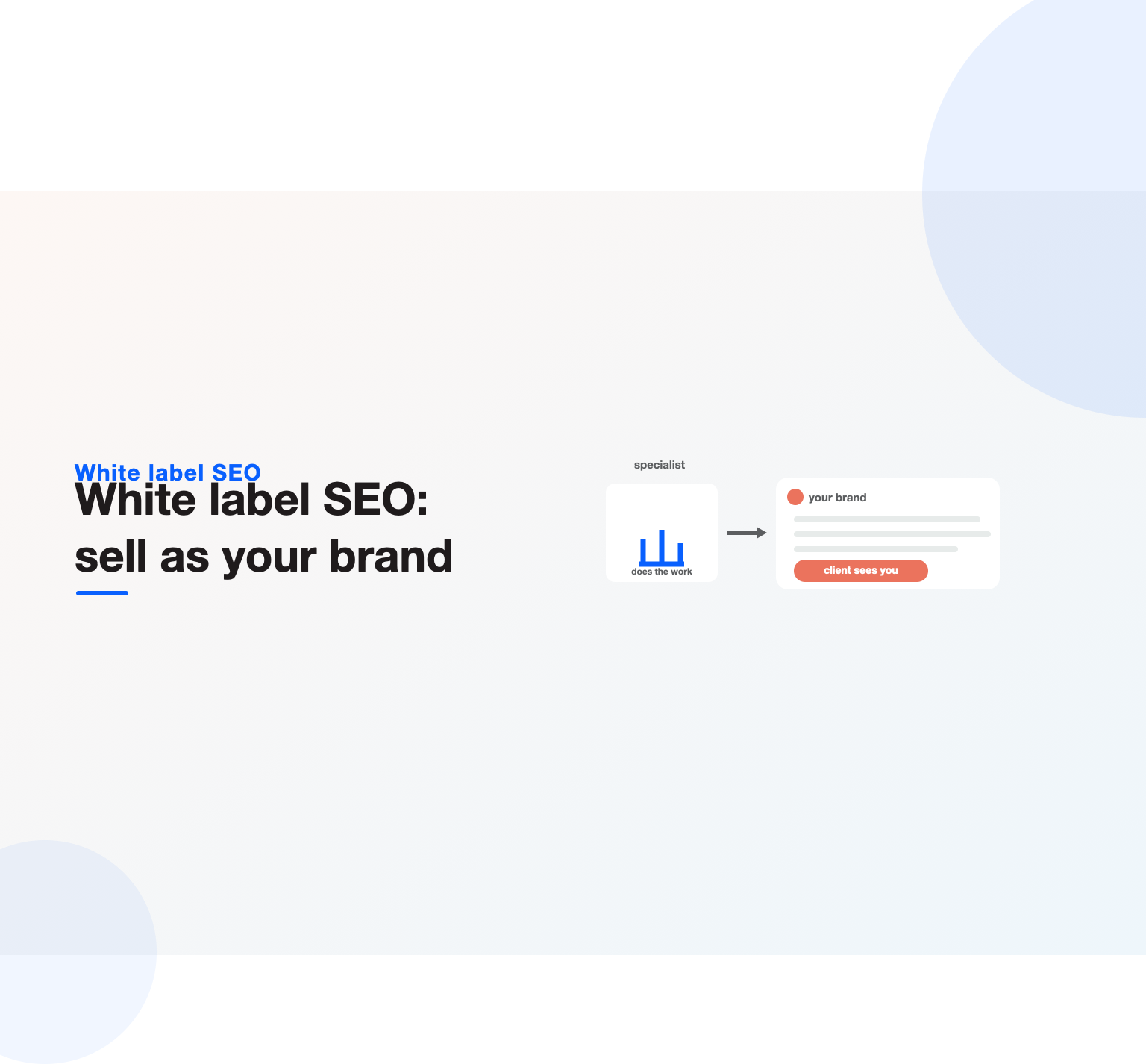
White label SEO is search optimization that one company performs on behalf of another, which then delivers it to clients under its own brand. An agency, a web designer, a marketing consultant or a digital shop sells SEO to its clients, but a specialist partner does the actual work behind the scenes, and every report, deliverable and dashboard carries the reseller brand rather than the provider. It lets a business offer expert search services without hiring and managing an in-house team, turning a capability it lacks into a revenue line it owns. Done well, the client never knows a partner is involved, and the reseller keeps the relationship, the margin and the credit.
Key Highlights
- White label SEO lets an agency sell search services under its own brand while a specialist partner does the work.
- It removes the cost and risk of hiring, training and retaining an in-house SEO team.
- Everything is unbranded or reseller-branded: reports, audits, dashboards and deliverables carry your name.
- The model works because SEO is specialized and ongoing, and few agencies can staff it well alone.
- Choosing the right partner, on quality, communication and transparency, is the entire game.
What white label SEO actually means
The idea is simple even though the arrangement can sound opaque at first. A business that has client relationships but not deep search expertise partners with a provider that has the expertise but wants to work through other companies rather than sell directly. The reseller signs the client, sets the price and owns the relationship, while the provider executes the strategy, the audits, the content, the technical fixes and the reporting, all delivered so the reseller can pass it on as its own. The client sees one brand, their agency, and experiences a seamless service, unaware that a second company is doing the specialized work.
This differs from simply subcontracting in an important way: the whole point is invisibility. A subcontractor might be disclosed and might interact with the client directly, whereas a white label partner is built to stay behind the curtain, producing unbranded deliverables and often communicating only through the reseller. That distinction matters because it lets the reseller protect its brand and its client relationships completely, presenting a unified front while quietly drawing on outside capability. For the client, the experience is identical to hiring an agency with a large in-house team.
It is worth being clear about who each party is. The reseller is the agency, freelancer or firm that faces the client and owns the account. The provider, sometimes called the white label or fulfillment partner, is the specialist that performs the work. The client is the end business paying for search results. Understanding these three roles makes the rest of the model easy to follow, because every decision, about pricing, communication and quality, flows from keeping the reseller in control of the relationship while the provider supplies the expertise. This is the same core service described in our overview of SEO services, simply delivered through a partner rather than directly.
How white label SEO works in practice
A typical arrangement follows a predictable rhythm once it is set up. The reseller brings on a client and gathers the basics, the website, the goals, the target market and any existing performance data, then hands that brief to the provider. The provider audits the site, researches the market and builds a strategy, returning it as a branded or unbranded document the reseller can present as its own. From there the work proceeds, on-page optimization, content, technical fixes, link building and ongoing refinement, with the provider executing and the reseller managing the client relationship and approvals.
Reporting is where the model becomes visible to the client, and it is handled with care. The provider produces reports and dashboards carrying the reseller brand, so the client receives regular, professional updates that appear to come straight from their agency. Many providers also offer a white label dashboard the reseller can give clients for live access to rankings and metrics, again under the reseller name. This steady stream of branded reporting is what makes the client feel served by a capable, dedicated team, which in a sense they are, just not the one they imagine.
Communication is deliberately structured to keep the reseller in the middle. In most arrangements the provider talks to the reseller, not the client, and the reseller relays strategy, results and recommendations in its own voice. Some providers offer white label calls, joining client meetings introduced as part of the agency team when deeper technical discussion is needed, but the default keeps the provider invisible. This structure protects the relationship and ensures the client always experiences a single, coherent brand, which is the foundation the whole model rests on.
Why agencies use white label SEO
The core reason is economic: building an in-house search team is expensive, slow and risky, while partnering is fast and flexible. Hiring skilled specialists, technical, content, link building, analytics, means salaries, training, tools and management overhead, and it takes months before a new team is productive. For an agency that wants to offer SEO without that commitment, a white label partner turns a large fixed investment into a variable cost that scales with client demand, letting it start earning immediately rather than after a long, costly build.
Flexibility is the second driver. Client demand for search services rises and falls, and staffing an in-house team for peak demand means paying for idle capacity in quieter periods, while staffing for average demand means turning work away when it spikes. A white label arrangement absorbs that variability, scaling up when several clients need work and down when they do not, without the reseller carrying the payroll risk. This elasticity is especially valuable for smaller agencies and freelancers, for whom a single large client can otherwise overwhelm capacity.
The third reason is focus. Many agencies are excellent at what they already do, design, advertising, web development, client strategy, and adding a deep, fast-moving discipline like search would dilute that focus and stretch their expertise thin. Partnering lets them stay excellent at their core offering while still providing expert search results, expanding what they sell without becoming mediocre at everything. It also lets them present a fuller, more competitive service, keeping clients who might otherwise take their search budget elsewhere, and capturing revenue that would have walked out the door.
There is a retention angle too that agencies often underestimate. A client that buys several services from one agency is far stickier than one that buys a single service, so adding search deepens the relationship and raises the cost of leaving. By offering optimization through a partner, an agency turns a gap in its lineup into a reason clients stay longer and spend more, which over time can matter as much as the direct margin on the service itself.
What is included in a white label SEO service
A full-service partner covers the same scope a strong in-house team would, delivered so the reseller can present it as its own. That begins with strategy and audits: a technical review of the site, a competitive analysis, keyword and market research, and a roadmap that sets priorities. These foundational deliverables are what the reseller presents early in a client engagement to demonstrate expertise and set expectations, and their quality shapes the client first impression of the whole service.
Execution spans the familiar pillars of search work. On-page optimization aligns pages with the terms and intent that matter, content creation produces the articles and pages that earn rankings and answer buyer questions, and technical work fixes the crawlability, speed and structure issues that hold a site back. Off-site work, earning quality links and building authority, rounds it out, since visibility depends on both a strong site and credible external signals. A capable provider handles all of these coherently rather than offering a disconnected menu.
Increasingly, a modern white label service also covers visibility in AI answers, not just classic rankings. As buyers shift toward assistants and AI Overviews, resellers whose clients want to stay visible there need a partner that understands entity strength, extractable content and citations, the levers behind being named in an AI answer. A provider that has extended into this territory, the same ground a GEO agency works, lets a reseller offer forward-looking services rather than only the traditional playbook, which is becoming a genuine differentiator when pitching clients.
White label versus reselling versus subcontracting
These terms overlap in everyday use but carry useful distinctions. White label, strictly, means the provider produces unbranded or reseller-branded deliverables so the reseller can present the work as entirely its own, staying invisible to the client. Reselling is a broader term for selling another company service, which may or may not be fully branded to the reseller. Subcontracting usually implies a more disclosed arrangement where the outside party may interact with the client and is understood to be a separate contractor rather than part of the agency team.
For most agencies, true white label is the preferred model precisely because it protects the brand and the client relationship most completely. The client experiences one seamless service, the reseller keeps full control of pricing, positioning and communication, and there is no risk of the client bypassing the agency to work with the provider directly. When evaluating partners, it is worth confirming that they genuinely operate white label, unbranded reports, reseller-branded dashboards, provider staying behind the curtain, rather than a lighter arrangement that leaves the reseller exposed. The difference determines how much control the reseller actually retains over its own clients.
Pricing and margins
The commercial appeal of white label SEO lies in the margin between what the provider charges the reseller and what the reseller charges the client. Providers typically price their work at wholesale rates designed to leave the reseller healthy room to mark up, and the reseller sets the retail price based on its market, its positioning and the value it adds through account management and strategy. A well-run reseller often earns a substantial margin while still offering the client a competitive price, because the wholesale cost is lower than building the capability in-house would be.
Setting the retail price is a strategic decision rather than a simple markup. The reseller has to account for its own costs, the account management, the client communication, the sales effort, and price for the value it delivers, not just the provider fee. Underpricing leaves money on the table and can signal low quality, while overpricing without matching value strains the relationship. The healthiest arrangements treat the provider fee as the cost of goods and build a sustainable margin on top that funds excellent client service, so the reseller profits while the client feels well served. Our guide on SEO cost helps frame what clients expect to pay and why.
Transparency about pricing structure matters when choosing a partner. Some providers charge per project, others on monthly retainers, and others per deliverable, and the right structure depends on how the reseller sells to its own clients. A partner whose pricing aligns with the reseller model, predictable, scalable and easy to build a margin on, makes the whole arrangement smoother, while opaque or unpredictable pricing makes it hard to quote clients confidently. Clarity here protects the reseller margin and its ability to plan.
How to choose a white label SEO partner
Because the provider work becomes the reseller reputation, choosing well is the single most important decision in the model. Quality comes first: the reseller should examine real examples of the provider work, results it has produced, the depth of its audits, the standard of its content, and ideally speak to other agencies that resell for it. Since the client will judge the reseller by these deliverables, anything less than genuinely strong work puts the reseller brand at risk, so this scrutiny is not optional.
Communication and reliability come a close second. A great partner communicates clearly and promptly, meets deadlines consistently, and makes the reseller look organized and expert in front of clients, while a poor one creates delays and confusion the reseller has to absorb and explain. Because the reseller sits between the provider and the client, any friction in that middle layer becomes the reseller problem, so dependable, responsive communication is as important as the quality of the work itself. It is worth testing responsiveness during the evaluation, since it rarely improves after signing.
Transparency and honesty round out the criteria. A trustworthy partner is candid about what SEO can and cannot achieve, avoids guarantees of specific rankings that no one can promise, and reports results honestly even when progress is slow. That integrity protects the reseller from making promises to clients that cannot be kept, which is one of the fastest ways to lose an account. A provider that sets realistic expectations and delivers steadily, the same discipline our guide on SEO for business stresses, is worth more than one that overpromises to win the deal and underdelivers afterward, and it should extend to how it handles emerging answer engine optimization for clients who ask about it.
Getting started with white label SEO
For an agency new to the model, the path in is gradual rather than all-at-once. The sensible first move is to identify a single client whose search needs you cannot currently meet well, and use that one account to test a prospective partner. Brief the provider fully, present its strategy and early deliverables to the client under your brand, and watch how the whole loop performs, quality, timeliness, communication, before you commit further clients. Starting with one account keeps the risk small while giving you a real, rather than theoretical, sense of whether the partnership works, and it lets you learn the workflow with low stakes.
As confidence grows, you can package the service into your own offering and sell it deliberately rather than reactively. That means pricing it into your menu, training your account managers to speak to search results credibly, and building the client-facing narrative that positions the work as your own expertise. Many agencies find that offering search alongside their existing core services makes them noticeably more competitive, since clients prefer a single provider that covers more ground. Pairing the offering with related capabilities, from local SEO for clients with physical locations to emerging AI search optimization for those worried about visibility in AI answers, lets you present a rounded, modern service that few smaller competitors can match.
The final step is operational discipline. Set clear internal processes for how briefs flow to the provider, how deliverables are reviewed before they reach clients, and how results are reported, so the arrangement runs smoothly as it scales. A little structure here prevents the friction that otherwise creeps in as client numbers grow, and it keeps your brand experience consistent. Understanding what clients should reasonably pay, which our guide on SEO cost lays out, helps you price the service confidently and defend your margin when clients push back.
Common misconceptions about white label SEO
Several myths keep agencies from adopting a model that would serve them well. The first is that using a partner is somehow dishonest, that clients are being deceived. In reality it is a standard, widely used business arrangement no different from a firm using specialist suppliers in any industry; the client buys a result from a brand they trust, and that brand ensures the result is delivered well. What matters ethically is that the work is genuinely good and the promises are honest, not whether every supplier is named, and honest expectation-setting, the kind our guide on SEO for business stresses, is what protects the client.
A second misconception is that white label work is lower quality by nature, when the opposite is often true. A specialist provider that does search all day, across many clients, frequently brings deeper expertise than an overstretched generalist would, which is precisely why the arrangement produces good results. The quality depends entirely on the partner chosen, not on the model itself, so due diligence, not avoidance, is the right response to the quality concern. A third myth is that the reseller loses control; in a true white label setup the reseller keeps full control of pricing, communication and the client relationship, with the provider working entirely through it. Recognizing these misconceptions for what they are lets an agency evaluate the model on its actual merits, which for many is a fast, low-risk route to a valuable new revenue line, including the forward-looking work a GEO agency handles.
Risks and how to manage them
The model is not without risk, and understanding the pitfalls helps a reseller avoid them. The main risk is quality: because the reseller stakes its brand on work it does not directly perform, a weak provider can damage client relationships the reseller spent years building. This is managed by choosing carefully, starting with a small engagement to test the partnership, and maintaining enough oversight to catch problems early rather than discovering them when a client complains. A trial period before committing several clients is a sensible safeguard.
A second risk is over-dependence on a single partner, which can leave a reseller exposed if the provider raises prices, drops in quality or becomes unresponsive. Prudent resellers understand their partner enough to maintain leverage, keep their client relationships firmly their own, and avoid arrangements that let the provider reach clients directly. A third, subtler risk is misaligned expectations passed to clients: if the reseller promises more than the provider can deliver, the gap becomes the reseller problem. Clear internal alignment on what is realistic, and honest client communication, prevents most of these issues before they arise.
Measuring success
A reseller should hold a white label arrangement to the same standard it would any service, judging it by client results and client satisfaction. The primary measures are the outcomes clients care about, improved rankings for their priority terms, more organic traffic, and ultimately more leads and revenue, tracked consistently and reported clearly. A partnership that reliably moves these numbers for the reseller clients is working, regardless of how the work is divided behind the scenes.
The reseller should also measure the health of the partnership itself, since that determines whether the results are sustainable. Reliable delivery, responsive communication, accurate and timely reporting, and honest handling of setbacks all indicate a partner worth keeping, while chronic delays or opacity signal trouble ahead even if current results look acceptable. Watching both the client outcomes and the partnership quality gives the reseller a complete picture and the confidence to scale the arrangement, adding more clients, or to change partners before problems reach the client. This dual view keeps the model accountable and the reseller in control.
Is white label SEO right for your agency?
The model suits agencies that have client relationships and trust but lack deep, current search expertise, and that would rather grow revenue than build a costly team. If clients are asking for search results you cannot confidently deliver, or leaving to buy them elsewhere, a good partner closes that gap quickly. It fits especially well when your strength lies in strategy and client service and you want to add capability without dilution, whether that means classic optimization, local search, the AI-answer work an AI search program covers, or the citation-focused approach a GEO agency brings. Judged against the cost of the customers it helps you keep, which our business SEO guide frames, the model earns its place for many agencies.
Key Takeaways
- White label SEO lets an agency sell expert search services under its own brand while a specialist partner does the work.
- It converts the cost and risk of an in-house team into a flexible, scalable expense that grows with demand.
- The model works through unbranded deliverables, reseller-branded reporting and the provider staying behind the curtain.
- Choosing the partner on quality, communication and transparency is the decision that determines success.
- Manage the risks with a trial, careful oversight and honest client expectations, and judge it by client results and partnership health.
Frequently asked questions
Direct answers to the questions agencies ask most about white label SEO.
What is white label SEO?
It is search optimization that a specialist provider performs on behalf of another company, which delivers it to clients under its own brand. The reseller signs the client, sets the price and owns the relationship, while the provider does the audits, content, technical work and reporting, all unbranded or reseller-branded. The client experiences one seamless service and never knows a partner is involved, letting the reseller offer expert SEO without building an in-house team.
How is white label SEO different from subcontracting?
The key difference is visibility. A white label partner is built to stay invisible, producing unbranded deliverables and usually communicating only through the reseller, so the client sees a single brand. Subcontracting is often more disclosed, with the outside party understood to be a separate contractor who may interact with the client directly. White label protects the reseller brand and client relationship more completely, which is why most agencies prefer it over looser subcontracting arrangements.
Why would an agency use white label SEO instead of hiring?
Building an in-house team is expensive, slow and risky, requiring salaries, tools, training and management before it becomes productive. A white label partner turns that large fixed investment into a variable cost that scales with client demand, so the agency earns immediately and absorbs demand swings without carrying payroll risk. It also lets the agency stay focused on its core strengths while still offering expert search results, deepening client relationships and capturing revenue that might otherwise go elsewhere.
Will my clients know I use a white label provider?
Not if the arrangement is run properly. A true white label provider produces unbranded or reseller-branded reports and dashboards, communicates through you rather than the client, and stays behind the curtain, so the client experiences your brand throughout. Some providers offer white label calls, joining meetings introduced as part of your team, but the default keeps them invisible. Confirming a partner genuinely operates this way protects your brand and relationship completely.
How do the economics of white label SEO work?
The provider charges the reseller a wholesale rate designed to leave room for markup, and the reseller sets a retail price based on its market and the value it adds through account management and strategy. A well-run reseller earns a healthy margin while still offering a competitive price, because the wholesale cost is lower than building the capability in-house. Treating the provider fee as a cost of goods and building a sustainable margin on top funds excellent client service while keeping the reseller profitable.
How do I choose a good white label SEO partner?
Judge quality first, examining real results, the depth of audits and the standard of content, since the client will judge you by these deliverables. Test communication and reliability, because friction in that middle layer becomes your problem in front of clients. Insist on transparency and honesty, a partner that avoids guaranteed-ranking promises and reports results candidly. Starting with a small engagement to test the partnership before committing several clients is a sensible way to confirm the fit.
What are the risks of white label SEO?
The main risk is quality, since you stake your brand on work you do not directly perform, so a weak provider can damage relationships you built. Over-dependence on a single partner and misaligned expectations passed to clients are the other main pitfalls. Manage them by choosing carefully, starting small to test the partnership, keeping oversight, retaining full ownership of your client relationships, and communicating honest expectations so the gap between promise and delivery never lands on you.
Can white label SEO include AI search optimization?
Increasingly yes, and it is becoming a differentiator. As buyers shift toward assistants and AI Overviews, clients want to stay visible in AI answers, which requires entity strength, extractable content and citations rather than only classic rankings. A partner that has extended into this territory lets you offer forward-looking services alongside traditional search, so you can pitch clients on where discovery is heading rather than only the established playbook, capturing demand that less current competitors miss.
Ready to put this into practice?
Talk to the team that runs SEO, AI search and paid growth programs every day.
Book a Strategy Call →