 Skip to content

Meta Andromeda: What It Is, How It Changes Ads, and What 156 Live Ads Show (2026)
Meta Andromeda explained: how Meta's ad retrieval engine works, what the update means for targeting and creative, plus our analysis of 156 live ads from Gymshark, Bombas and more.
Quick Answer
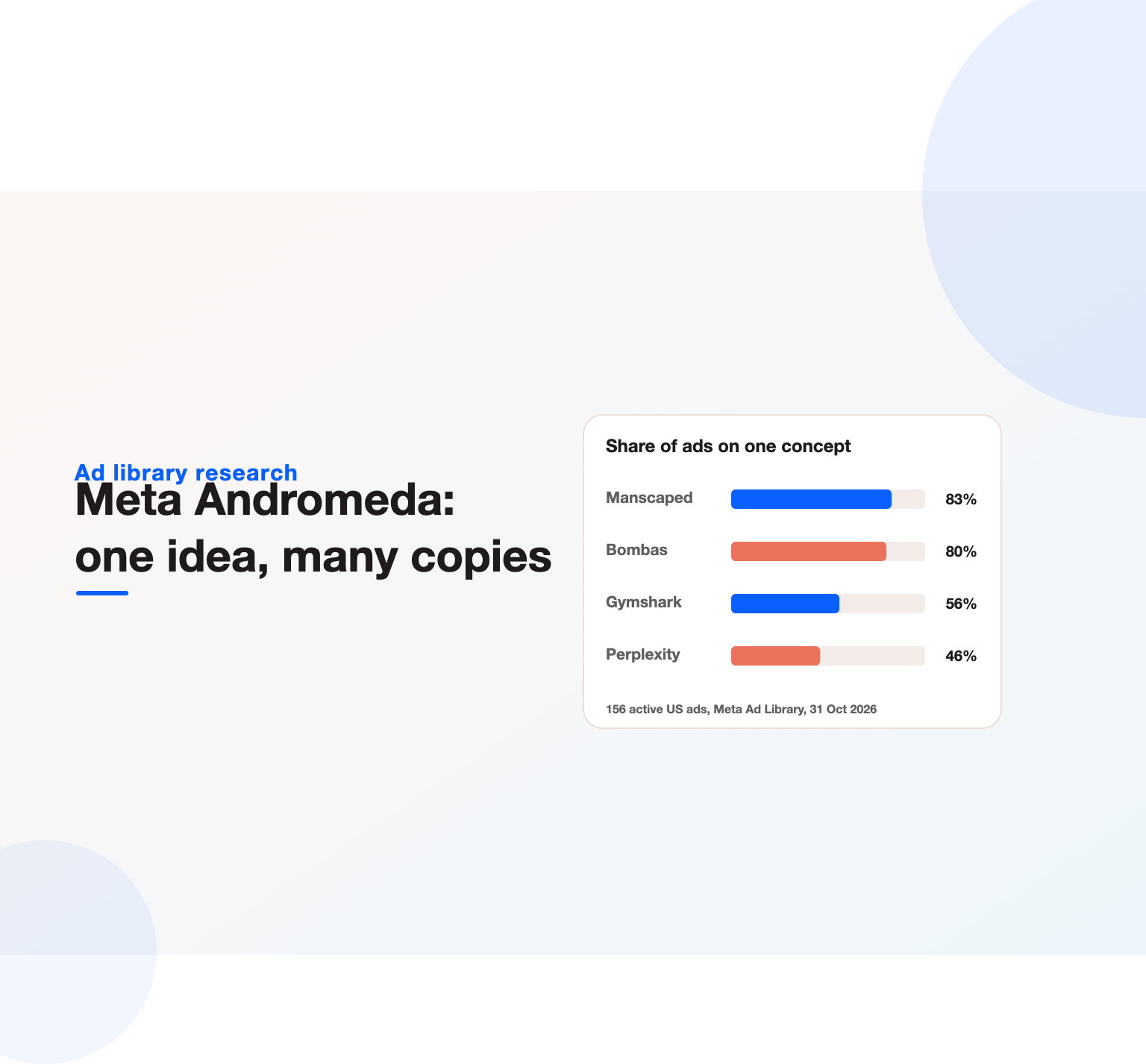
Meta Andromeda is the machine learning system Meta uses to choose which ads are even considered for each person on Facebook and Instagram. Announced in December 2024, it replaced the older ad retrieval stage with a far larger deep neural network running on NVIDIA Grace Hopper and Meta’s own MTIA chips. According to Meta, it improved retrieval recall by 6 percent and ad quality by 8 percent on selected segments. For advertisers, the practical effect of the Meta Andromeda update is that creative now does much of the targeting: varied concepts reach more distinct audiences, while dozens of near-identical variants compete with each other. In our review of 156 live ads from four large advertisers, the most-used concept accounted for between 46 and 83 percent of each brand’s newest ads.
Key Highlights
- Meta Andromeda is the retrieval stage of Meta’s ad system: it narrows millions of eligible ads to the few thousand that are ranked for a person.
- The system, Meta says, increased model capacity 10,000-fold, improved recall by 6 percent and ad quality by 8 percent on selected segments.
- It powers Advantage+ automation, so broad targeting and creative variety matter more than detailed audience settings.
- In our sample of 156 active ads from Gymshark, Bombas, Manscaped and Perplexity, brands ran only three to six distinct concepts each.
- Manscaped launched 20 ads in 99 seconds; Gymshark launched 27 in under 15 minutes, almost all on two headlines.
- The lesson: fewer, more different concepts beat many small variations of the same idea.
What is Meta Andromeda?
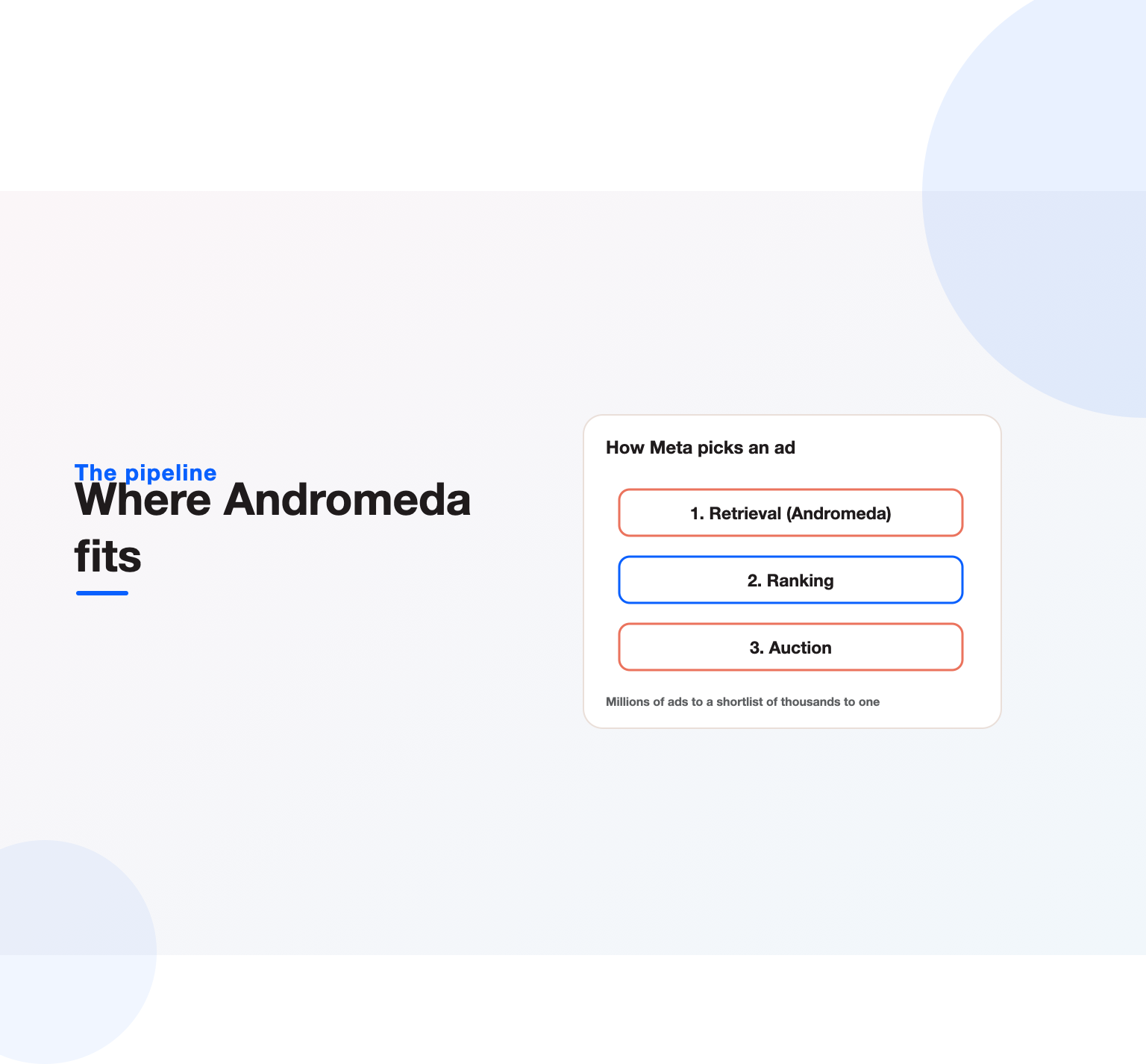
Every time someone opens Facebook or Instagram, Meta has to decide which of millions of active ads to show. It does this in stages. First, a retrieval stage pulls a shortlist of ads that might be relevant. Then ranking models score that shortlist in detail, and an auction picks the winner. Meta Andromeda is the new retrieval stage.
Meta’s engineering team described it in a December 2024 post titled Meta Andromeda: Supercharging Advantage+ automation. According to that post, Andromeda is a personalised ads retrieval engine built around a custom deep neural network co-designed with NVIDIA Grace Hopper Superchips and Meta’s Training and Inference Accelerator (MTIA). The headline numbers Meta published:
- A 10,000-fold increase in model capacity for personalisation, with sublinear inference cost.
- A 6 percent improvement in retrieval recall across Facebook and Instagram.
- An 8 percent improvement in ads quality on selected segments.
- Over 100 times faster feature extraction than the previous CPU-based approach, and more than three times the queries per second.
In plain terms: the stage that used to throw away most ads with relatively simple rules now uses a much smarter model, so the shortlist each person sees is more personal. Searches for “what is meta andromeda” and “andromeda meta ads” have grown accordingly, with around 1,300 monthly searches for the main term in the US and roughly 9,000 worldwide.
Retrieval, ranking and auction: where Andromeda sits
To understand why creative matters so much now, it helps to see the whole pipeline. When a person scrolls, the ad system works in three steps.
- Retrieval. From every active ad eligible for that person’s location and demographics, the system pulls a shortlist of a few thousand candidates. This is the step Meta Andromeda handles. It has to be extremely fast, because it runs for billions of feed and story loads every day.
- Ranking. Heavier models estimate, for each candidate, how likely the person is to click, watch, buy or sign up, and how good the experience will be.
- Auction. Each advertiser’s bid is combined with those estimates into a total value, and the highest-value ad wins the slot.
Older retrieval systems used comparatively simple models, so they leaned heavily on the targeting advertisers supplied to narrow the field. Because retrieval happens first, an ad that never makes the shortlist never gets ranked, however good it is. Andromeda’s much larger model is better at spotting which ads suit which people, which means the content of each ad, its visual style, message and format, now shapes whether it reaches the shortlist for a given person. That is the mechanical reason creative diversity matters: each distinct concept is a separate chance to be retrieved for a different kind of person.
How Meta Andromeda changes ad delivery
Before Andromeda, advertisers did much of the matching themselves through detailed targeting: interests, lookalikes and layered audiences told Meta who to consider. The retrieval stage then worked inside those boundaries. Andromeda flips the emphasis. With a model that can learn far more about the relationship between a person and an ad, Meta increasingly relies on the ad itself to find its audience.
Three practical shifts follow:
- Broad targeting works better. Narrow audiences restrict the pool the model can search. Meta’s own guidance pushes advertisers toward broad and Advantage+ audiences.
- Creative becomes the targeting signal. An ad about running shoes for marathoners and an ad about running shoes for commuters will be retrieved for different people, even inside the same broad audience.
- Similar ads cannibalise each other. If 20 ads say the same thing in the same way, the system has little reason to show them to different people. They end up competing for the same slots.
The company made the creative point explicitly in its business post on creative diversification with Meta Andromeda, which encourages advertisers to supply a range of distinct creative so the system has more options to match to different people.
The Meta Andromeda update and Advantage+
Andromeda is the engine underneath Advantage+, Meta’s suite of automated campaign tools. When you run Advantage+ sales campaigns, Advantage+ audience or Advantage+ creative, you are handing decisions to models that depend on retrieval quality. In the same engineering post, Meta noted that advertisers who switched on Advantage+ creative features saw higher return on ad spend, and that businesses using generative image tools saw more conversions.
The Meta ads Andromeda update therefore rewards a specific way of working: simple account structures, broad audiences, enough budget per campaign for the model to learn, and a steady supply of genuinely different creative. Our guide to Meta Advantage+ covers the campaign setup side in detail.
Our research: how big advertisers actually use creative
Advice about Andromeda is everywhere. We wanted to see what large advertisers actually do, so on 31 October 2026 we pulled the newest active US ads for well-known consumer and software brands from the Meta Ad Library and grouped each ad by its headline concept.
| Brand | Active US ads | Ads reviewed | Distinct concepts | Top concept share |
|---|---|---|---|---|
| Gymshark | 842 | 27 | 3 | 56% |
| Bombas | 65 | 50 | 6 | 80% |
| Manscaped | 29 | 29 | 5 | 83% |
| Perplexity AI | 466 | 50 | 5 | 46% |
What we found
- Few concepts, many copies. Across 156 ads, the four brands ran just 19 distinct concepts, about eight ads per concept.
- One idea dominates. The most-used concept made up 46 to 83 percent of each brand’s newest ads. For Bombas, 40 of 50 ads led with the same first-order discount, written four slightly different ways. For Manscaped, 24 of 29 active ads promoted one product launch.
- Ads launch in bursts. Manscaped created 20 ads within 99 seconds. Gymshark’s newest 27 ads were all created within about 14 minutes and used only two main headlines.
- Software brands vary more. Perplexity spread its newest 50 ads across five distinct messages, from a product launch to cost savings to an industry use case, the closest of the four to what Meta’s Andromeda guidance describes.
Bursts of near-identical ads are often the output of dynamic creative, Advantage+ creative or bulk uploads of size and copy variants, so they are not necessarily a mistake. They do show that even sophisticated advertisers still think in variants of one idea. Under Meta Andromeda, the variety that matters is the variety of ideas: different angles, audiences, formats and stories, not 20 crops of the same video.
Facebook and Instagram ads not paying back?
Our team reviews your current setup and shows you where the opportunities are. See how our Meta ads services work.
What counts as a different concept
Practitioners describe the shift as moving from “variations” to “concepts”. A useful test: would a different kind of person stop scrolling for this ad? If the answer is no, it is a variation.
| Variation (low diversity) | Concept (high diversity) |
|---|---|
| Same video in 1:1, 4:5 and 9:16 | A founder story vs a customer review vs a product demo |
| Three headlines for the same discount | Discount for new buyers vs bundle for gift buyers vs premium line for enthusiasts |
| Same image with different background colours | Problem-led static vs UGC video vs comparison carousel |
| Same script with a different first line | Different persona, pain point and setting |
Variations still have a job: they fit placements and help Meta’s own creative tools. But they should sit inside a concept, not stand in for one.
How to adapt your account to Meta Andromeda
1. Simplify campaign structure
Consolidate small ad sets into fewer, larger ones. Both retrieval and ranking models need volume to learn; dozens of tiny ad sets each with a few conversions a week starve them. Many advertisers now run one prospecting campaign with broad or Advantage+ audience and a separate retargeting or existing-customer setup only where needed.
2. Go broad on audiences
Let creative do the targeting. Use location, age and exclusions where they genuinely matter, and test Advantage+ audience against your historical interest stacks. Our guide to lookalike audiences explains where seed audiences still help as suggestions rather than limits.
3. Build a concept pipeline
Plan creative around personas and problems. For each product, list the three to five types of buyer and the main reason each one buys. Brief one concept per pair. Aim for a meaningful number of genuinely different concepts live in each campaign rather than a large number of near-duplicates.
4. Mix formats
Short vertical video, static images, carousels and user-generated content each reach different people. Our guides to Facebook video ads, carousel ads and ad creative cover format-specific best practice.
5. Refresh on a schedule
Fatigue sets in faster when each concept is shown to its natural audience efficiently. Add new concepts every two to four weeks, retire those whose cost per result rises steadily, and keep winners running.
6. Feed the model clean conversion data
Better retrieval needs better signals. Make sure the Meta pixel and the Conversions API send deduplicated, high-quality purchase or lead events, with value where possible.
7. Read results by concept
Report performance per concept, not just per ad. Name ads with a concept code so you can roll results up and see which ideas earn their budget. Our guide to Facebook ads reporting shows how to set this up.
How to brief a new concept
Creative teams often ask what a concept brief should contain in the Andromeda era. Keep it to one page:
- Persona: who this ad is for, in one sentence, with their situation.
- Problem or desire: the single reason this person would care right now.
- Angle: how we frame the product: proof, story, comparison, demonstration, offer.
- Format: video, static, carousel or UGC, and why it suits this persona.
- Hook: the first three seconds or first line, written out.
- Proof: the review, statistic, demo or guarantee that makes the claim believable.
- Variations: the placement crops and two alternative hooks, kept within the concept.
Briefs like this force real differences between concepts. If two briefs share a persona, problem and angle, merge them. A team that writes four such briefs a month gives Meta’s system far more to work with than a team uploading forty resized versions of last month’s winner.
Generative AI tools, including Meta’s own Advantage+ creative features, can produce variations quickly. Use them for the variation layer, not the concept layer. The concept should come from customer research: reviews, sales calls, support tickets and search queries tell you which personas and problems exist.
Meta Andromeda playbooks by business type
Ecommerce brands
Build concepts around use cases and buyer types, not just products. A sock brand might run separate concepts for athletes, nurses on long shifts, gift buyers and people with cold feet in winter. Keep a catalogue or Advantage+ shopping campaign for dynamic product ads, and feed it with distinct lifestyle concepts on top. Our Facebook ads for ecommerce guide covers catalogue setup.
Mobile apps and subscriptions
Map concepts to jobs users hire the app for. A fitness app might show concepts for beginners, strength athletes and busy parents, each with a different first screen and promise. Track trial starts and paid conversions back to Meta so retrieval learns which concepts produce paying users rather than installs alone.
Local and service businesses
Smaller budgets mean fewer concepts can get enough delivery, so pick three strong angles: price or offer, trust (reviews and credentials) and outcome (before and after). Keep location targeting tight, keep everything else broad, and refresh monthly.
B2B software
Treat each buying-committee role as a persona and each major pain point as a concept, and send qualified-lead and opportunity events back so the system learns which leads become pipeline.
Andromeda compared with earlier Meta changes
Meta’s ad system has changed several times in recent years, and each change pushed advertisers in the same direction.
| Change | What happened | What advertisers had to do |
|---|---|---|
| Apple App Tracking Transparency (2021) | Less tracking data from iOS users | Adopt the Conversions API, rely more on modelled conversions |
| Advantage+ campaigns (2022 to 2024) | Automated audiences, placements and creative | Simplify structure, trust automation with guardrails |
| Meta Andromeda (December 2024) | Far larger retrieval model | Supply diverse concepts, broaden targeting, improve signals |
The common thread is that Meta keeps moving decisions from the advertiser’s settings into its models. The inputs advertisers still control, creative, budget, conversion signals and offers, matter more each time. Meta’s own Advantage+ overview frames automation the same way.
A creative testing framework for Andromeda
Traditional A/B testing isolated one variable at a time. Under Andromeda, the more useful question is which ideas the system can find audiences for. A simple framework:
- Launch a batch of distinct concepts in one broad campaign, each with two or three placement-ready variations.
- Give the batch enough budget to reach meaningful conversion volume over one to two weeks.
- Look at spend distribution. Budget will flow toward concepts it can match. Concepts that receive almost no spend are telling you something.
- Judge winners on cost per result and incremental reach, not click-through rate alone.
- Iterate on winning concepts with new hooks and formats, and replace losers with new ideas, not tweaks.
Use Meta’s own A/B testing tools when you need a clean answer to one specific question, such as broad versus interest targeting.
What the Meta Andromeda update means for budgets
Consolidation and broad targeting usually mean fewer, larger campaigns. That makes budget pacing simpler, but it also means poor creative wastes more money faster. Plan creative production as a fixed line in the budget. For many advertisers, creative is now the main lever on cost per acquisition, so a team that can ship several new concepts a month will often beat a team with a bigger media budget and stale ads. Our guide to Facebook ads budgets covers how to split spend between testing and scaling.
Costs themselves are not set by Andromeda alone: auctions, seasonality and competition still matter. If cost per result rose for you after early 2025, check creative fatigue and account structure before blaming the algorithm. Our breakdown of Facebook ads cost shows typical ranges.
Meta Andromeda for B2B and lead generation
B2B advertisers often assume Andromeda is a consumer story. It is not. The retrieval stage works the same way for lead ads. The difference is that B2B audiences are smaller and buying committees have several roles, so concepts should map to roles: the finance lead, the end user, the IT owner. Perplexity’s mix of product launch, cost and industry use-case messages in our sample is a good template. Pair concept diversity with strong lead quality signals, such as sending qualified-lead events back through the Conversions API, so the system optimises for pipeline rather than cheap form fills. Our guide to Facebook ads for lead generation goes deeper.
Want Meta ads that produce customers, not just reach?
Book a free 30-minute strategy call and leave with a clear next step for your business.
How to measure the impact in your own account
Advertisers often ask whether Andromeda helped or hurt them. You cannot switch it off to compare, but you can watch the indicators that reflect how well your creative is being retrieved.
- Spend concentration. If one ad takes 80 percent or more of an ad set’s spend for weeks, the system has found little use for the others. That usually means they are too similar to the winner, or too weak.
- Reach and frequency. Rising frequency with flat reach suggests your concepts are being shown to the same people. New concepts aimed at new personas should lift reach.
- Cost per result by concept. Roll results up by concept tag. Concepts that cost far more than the account average after a fair test are candidates for replacement.
- New versus returning customers. Diverse prospecting concepts should bring a healthy share of new customers. If most conversions come from people who already know you, prospecting creative may be too narrow.
- Learning phase status. Ad sets stuck in learning are usually under-funded or over-fragmented, which limits what any model can do.
Review these monthly alongside creative output. A team that tracks concepts launched, concepts that earned spend and the cost per result of each can tell within a quarter whether its creative process is keeping up with the platform.
Myths about the Andromeda update
- “Targeting no longer matters.” Location, age limits, exclusions and existing-customer definitions still matter. What changed is that narrow interest stacks are rarely needed to find buyers.
- “More ads always means better results.” More distinct concepts help. More copies of one concept mostly split delivery among similar ads.
- “Small advertisers cannot benefit.” Smaller accounts benefit from simpler structures and broad targeting just as much. They simply need to be more selective about how many concepts their budget can support at once.
- “Andromeda is a penalty.” It is a retrieval model, not a quality filter aimed at advertisers. Weak results usually trace back to creative, offer, signals or structure.
- “AI-generated creative is enough.” Generative tools multiply variations quickly, but new concepts still come from understanding customers.
Common mistakes after the Andromeda update
- Uploading dozens of near-identical variants and calling it diversification.
- Keeping fragmented account structures with many small ad sets that never exit learning.
- Over-restricting audiences, which limits what retrieval can find.
- Judging concepts too early, before Meta has had time to find their audience.
- Ignoring signal quality, so the model optimises toward low-value conversions.
- Copying competitors’ exact ads from the ad library instead of finding unclaimed angles. Our Meta Ads Library guide shows how to research without imitating.
How to check your creative diversity
You can run the same analysis we did on your own account in about 30 minutes:
- Export all active ads with their headlines, primary text and creative names.
- Tag each ad with a concept: the persona, problem and angle it represents.
- Count ads per concept and the share of spend per concept over the last 30 days.
- If one concept takes most of the spend and most of your ads, you have a diversity problem.
- Brief new concepts for the personas and problems you are not covering.
Then run the same check on two competitors using the public ad library. It is the fastest way to see whether your market is crowded with one message.
A Meta Andromeda readiness checklist
Use this list to audit an account in under an hour:
- Prospecting runs in a small number of campaigns with broad or Advantage+ audiences.
- Each prospecting ad set has enough budget to exit the learning phase within a week or two.
- At least four genuinely different concepts are live, each tied to a named persona and problem.
- Every concept includes at least two formats, such as a short vertical video and a static image.
- Ad names carry a concept code so results can be grouped by idea.
- The pixel and Conversions API send deduplicated events with purchase value or lead quality.
- New concepts are added at least monthly, and fatigued ones are retired on a rule, not a hunch.
- Competitor creative is reviewed in the ad library each month to spot crowded angles.
- Reporting shows reach, frequency, new-customer share and cost per result by concept.
- The creative team works from one-page concept briefs grounded in customer research.
Accounts that tick eight or more of these boxes are usually set up to benefit from Meta Andromeda. Accounts that tick fewer than five tend to see the volatility advertisers complain about, which is less about the algorithm and more about giving it too little to work with.
Is Meta Andromeda the same as the Andromeda AI model or galaxy?
No. The name causes confusion. Searches for “andromeda” alone mostly concern the galaxy, and other companies use the name for unrelated AI products. In advertising, “Andromeda” refers to Meta’s ads retrieval engine described above. If you see “Andromeda meta” in industry news, it is the same system, sometimes called the Andromeda algorithm or the Andromeda update.
Methodology
On 31 October 2026 we queried the Meta Ad Library for active ads shown in the United States from the official Pages of Gymshark, Bombas, Manscaped, Perplexity AI and Allbirds, identified by Page ID. For four brands we reviewed the newest 27 to 50 active ads (156 in total) and grouped them by headline concept, treating rewordings of the same offer or product message as one concept. Active ad counts are the library’s estimated totals for each Page and country on that date. Creation times come from the library’s ad creation timestamps. Allbirds had 24 active US ads; we reviewed eight and excluded it from the concept totals because the sample was small. Headlines do not capture every difference between ads, such as visuals, so concept counts may understate visual variety. The sample is small and illustrative, not representative of all advertisers.
Need more concepts without more shoots? See our guide to AI video ads, including 12 tools priced from 9 dollars a month.
Key Takeaways
- Meta Andromeda is the retrieval engine that decides which ads are considered for each person; Meta reports a 10,000-fold increase in model capacity, 6 percent better recall and 8 percent better ad quality on selected segments.
- Under Andromeda, creative does much of the targeting, so concept diversity matters more than detailed audiences.
- In our sample of 156 ads, big advertisers ran only three to six concepts each, with one idea taking 46 to 83 percent of ads.
- Simplify structure, go broad, ship genuinely different concepts every few weeks and send clean conversion signals.
- Measure performance by concept, not just by ad.
Want a creative diversity audit of your Meta account? Our Meta ads team runs this analysis as part of every new engagement, or get in touch.
Frequently asked questions
What is Meta Andromeda?
It is Meta’s machine learning ads retrieval engine, announced in December 2024. It selects which ads from millions are considered for each person on Facebook and Instagram before ranking and the auction pick the final ad.
When did the Meta Andromeda update roll out?
Andromeda was announced in December 2024, and Meta described it as deployed across Facebook and Instagram. Advertisers widely reported its effects during 2025 as Advantage+ automation expanded.
Does Meta Andromeda mean I should stop using detailed targeting?
Not entirely, but broad and Advantage+ audiences usually give the system more room to find buyers. Keep restrictions that genuinely matter, such as location, and test broad against your old audiences.
How many creatives do I need for Andromeda?
There is no fixed number. What matters is the number of genuinely different concepts, each aimed at a different persona, problem or angle, with a few placement variations each. Refresh with new concepts every few weeks.
Is Andromeda the same as Advantage+?
No. Advantage+ is the set of automated campaign tools advertisers use. Andromeda is one of the underlying systems that powers ad retrieval for those tools and for Meta ads generally.
Does Meta Andromeda affect B2B lead ads?
Yes. Retrieval works the same way for lead campaigns. Map concepts to the roles in the buying committee and send qualified-lead events back to Meta so the system optimises for quality.
Ready to put this into practice?
Talk to the team that runs SEO, AI search and paid growth programs every day.
Book a Strategy Call →