 Skip to content

Facebook Ads for Ecommerce: What Actually Drives Sales
Facebook ads for ecommerce depend on a clean catalog, accurate tracking and strong creative. Learn Advantage Plus shopping, dynamic product ads, retargeting, scaling and measuring by ROAS.
Quick Answer
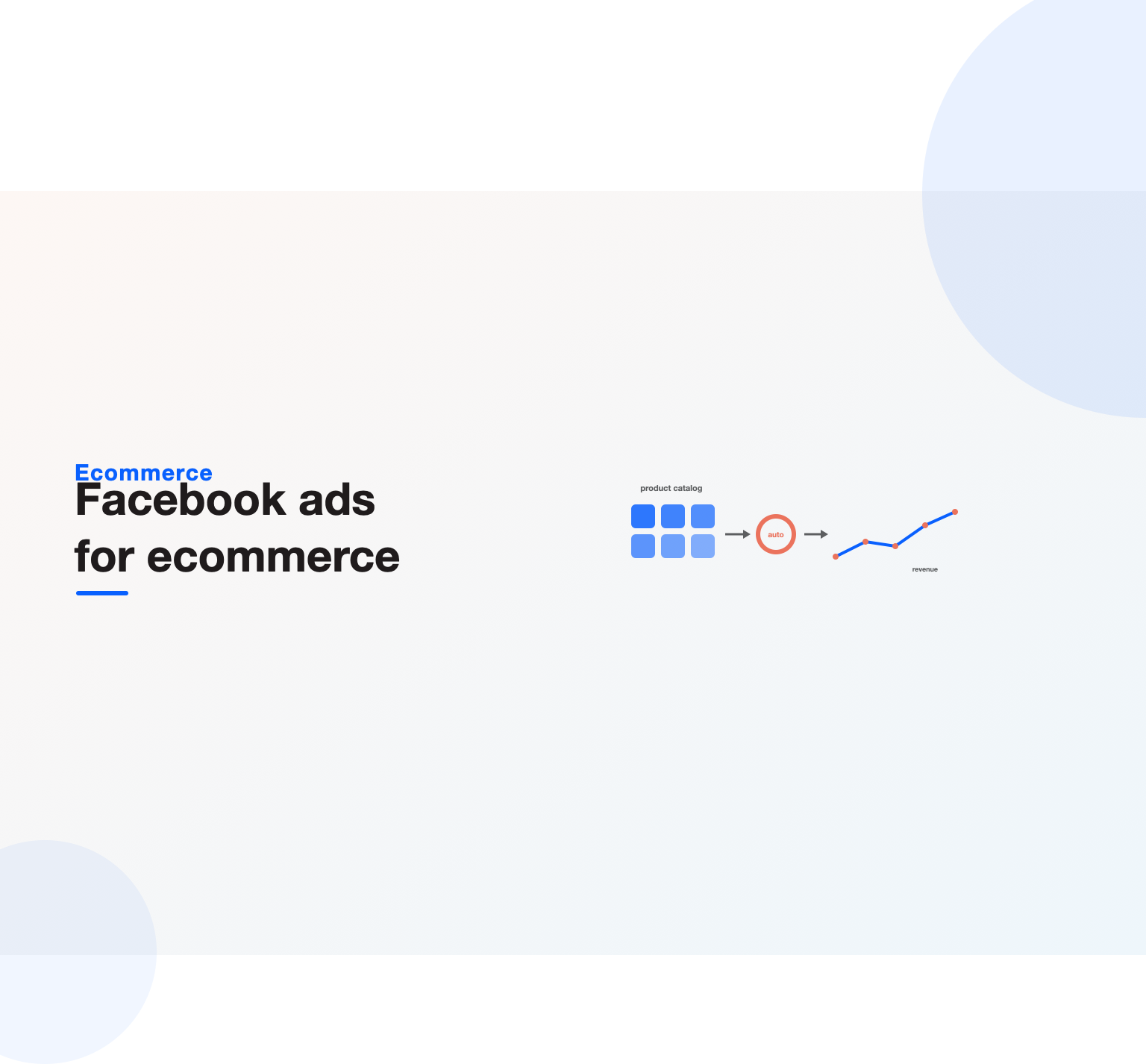
Facebook ads for ecommerce is the practice of using Meta’s advertising system to sell physical products profitably at scale, and on today’s platform it rests on three things far more than on clever audience targeting: a healthy product catalog, accurate purchase tracking, and a steady supply of strong creative. Because Meta’s automation now handles most of the targeting and bidding, an ecommerce brand wins by feeding the system a well-structured catalog, reliable signals from the pixel and the Conversions API, and ads that make people want the product, then judging everything by return on ad spend rather than cheap clicks. Advantage Plus shopping campaigns have become the default engine for most stores, pairing broad reach with dynamic product ads that show each shopper the items they are most likely to buy. Run well, facebook ads for ecommerce becomes a predictable acquisition channel where you know roughly what a new customer costs and how much they are worth; run badly, it quietly burns budget on traffic that never converts. This guide covers what actually drives profitable results now, from catalog and tracking through creative, scaling, and the numbers that decide whether the channel is working.
Key Highlights
- Profitable facebook ads for ecommerce depends on a clean product catalog, accurate purchase tracking, and strong creative, not on hand-built audiences.
- Advantage Plus shopping and dynamic product ads are the default engine for most stores, showing each shopper the products they are most likely to buy.
- The pixel plus the Conversions API keep purchase signals accurate after privacy changes, which is what the automation optimizes toward.
- Return on ad spend and contribution margin, not cost per click, decide whether the channel is actually making money.
- Scaling works by raising budgets steadily and widening creative, not by narrowing audiences or chasing tiny cost swings.
- Most ecommerce accounts fail on weak creative and broken tracking long before targeting is the problem.
Why ecommerce is different from other advertising
Selling products online through Meta has a distinct shape that separates it from lead generation or brand campaigns, because the goal is an immediate, measurable purchase and the whole account can be judged against revenue. That clarity is a gift: an ecommerce brand can tie ad spend directly to orders and see, with reasonable confidence, whether a campaign makes money. It is also unforgiving, since there is nowhere to hide a channel that spends without selling. Facebook ads for ecommerce therefore lives or dies on unit economics, and the advertiser who knows their margins and customer value has a decisive edge over one who only watches cost per click.
The product catalog is what makes ecommerce advertising on Meta genuinely different from every other objective. A properly connected catalog turns the platform into a shopping engine that can assemble ads automatically, retarget browsers with the exact items they viewed, and let the automation match products to people at a scale no manual campaign could reach. This is why so much of the work in facebook ads for ecommerce is really catalog and data work rather than campaign tinkering, and why a store with a clean feed and reliable tracking outperforms one with clever targeting and a messy catalog. If you would rather have the whole system built and run for you, our Meta ads for ecommerce brands team handles catalog, tracking, and creative as one engine.
Build a healthy product catalog first
The catalog is the foundation of facebook ads for ecommerce, so getting it right comes before any campaign work. A catalog is the structured feed of your products, with titles, images, prices, availability, and identifiers, that Meta reads to build dynamic ads and power shopping campaigns. When the feed is clean and complete, the system can show the right product to the right shopper and keep prices and stock accurate; when it is broken, ads promote sold-out items, mismatch images, or fail to build at all. Most stores connect the catalog through their ecommerce platform, and keeping that connection synced is ongoing maintenance rather than a one-time setup.
Feed quality quietly determines how much the automation can do for you. Rich, accurate product data, with good titles, high-quality images, correct categories, and complete availability, gives the system more to work with and lifts the performance of every dynamic ad. Product set organization matters too, since grouping catalog items into logical sets lets you tailor campaigns to best sellers, new arrivals, or seasonal ranges. Treating the catalog as a living asset that deserves regular attention, rather than a box ticked once, is one of the clearest dividing lines between stores that scale on Meta and stores that stall, and it pays off across every campaign type built on top of it.
Get purchase tracking right
Accurate purchase tracking is the second foundation, because the automation optimizes single-mindedly toward the conversions you report, and in ecommerce that conversion is a sale with a value attached. The Meta pixel captures on-site actions, but privacy changes and browser restrictions have weakened what it can see, which is why the server-side Conversions API has become essential for keeping purchase signals complete and reliable. Sending purchase events with accurate values through both the pixel and the Conversions API gives the system the data it needs to find buyers and optimize toward revenue rather than raw order counts.
Value is the detail that separates ecommerce tracking from simpler setups. Passing the actual order value with each purchase event lets the automation optimize toward high-value customers and lets you bid for return on ad spend, so a store that only counts purchases without values leaves its most important lever unused. Deduplicating events between the pixel and the Conversions API, matching customer information securely, and verifying that values flow correctly are the unglamorous tasks that decide whether facebook ads for ecommerce can actually optimize toward profit. Fixing measurement before touching targeting is almost always the highest-return work in an underperforming account, because everything the system does downstream depends on the signals you feed it.
Use Advantage Plus shopping campaigns
Advantage Plus shopping campaigns have become the default way to run facebook ads for ecommerce, and for most stores they are the right starting point rather than an experiment. These campaigns hand targeting, placement, and much of the budgeting to Meta’s automation, combining broad reach with dynamic product ads so the system finds buyers across a wide pool and shows each one relevant products. Because the automation now outperforms most hand-built audience structures for direct sales, fighting it with granular manual campaigns usually costs performance rather than protecting it.
Working with Advantage Plus shopping means shifting effort from audience construction to the inputs the automation relies on: a strong catalog, clean tracking, good creative, and sensible budget. You still guide the system through existing-customer settings, budget levels, and the creative and products you supply, but you stop trying to out-target it. Pairing this broad-plus-dynamic approach with a healthy feed is what lets stores scale, and it mirrors the wider shift that also powers Advantage Plus across objectives. For brands selling directly to consumers, the same engine underpins effective Meta ads for D2C brands, where catalog and creative do the heavy lifting.
Make creative that sells the product
Creative is the biggest controllable lever in facebook ads for ecommerce, because the automation can only sell with the ads you give it, and shoppers decide in a second whether a product is for them. Strong ecommerce creative shows the product clearly, communicates why it is worth buying, and does so in formats built for a fast, mobile feed. Video that demonstrates the product in use, images that show it in context, and user-generated content that feels authentic tend to outperform polished studio shots that look like advertising, because people trust what looks real. The store with a steady stream of fresh, varied creative gives the automation room to find winners; the store with two tired ads caps its own performance no matter how good its catalog.
Volume and variety matter as much as any single brilliant ad. Running a continuous creative engine, testing genuinely different angles, hooks, and formats, keeping winners and cutting losers, and refreshing before ads fatigue, is what sustains performance over time. Since creative is the main driver, the brands that win are usually the ones that produce and test the most, which is why building a repeatable creative process pays off more than perfecting any one asset. Grounding that process in what already works, of the kind that drives strong facebook ad creative, turns creative from a bottleneck into the engine that feeds everything else.
Offers and landing pages close the sale
The ad gets the click, but the offer and the landing page decide whether it becomes an order, and many stores pour money into ads while neglecting what happens after the tap. A compelling offer, whether a genuine discount, free shipping threshold, bundle, or first-order incentive, often lifts conversion more than any targeting change, because it changes the shopper’s math rather than just their attention. The product page the ad points to has to load fast on mobile, show the product clearly, answer the obvious questions, and make checkout effortless, since friction there wastes the demand the ad worked to create.
Matching the ad to the page is the detail that quietly costs stores money when it is missed. When an ad promises a specific product or offer, the page should deliver exactly that without making the shopper hunt, because a mismatch breaks the momentum that got them there. Testing offers and improving the post-click experience sit alongside creative and catalog as real levers on profit, not afterthoughts, and they compound with everything upstream. A store that treats the whole path, from feed to ad to page to checkout, as one connected system consistently converts more of the traffic it pays for, and it keeps a realistic facebook ads cost from being wasted at the final step. That end-to-end view is exactly how strong Meta ads for D2C brands are run.
Retarget browsers and past buyers
Retargeting is where the catalog earns its keep in facebook ads for ecommerce, because dynamic product ads can show shoppers the exact items they viewed but did not buy. A large share of ecommerce revenue comes from people who were already interested, browsed a product, and needed a reminder or a small nudge to complete the purchase, and dynamic retargeting reaches them efficiently at a cost far below cold prospecting. Setting up catalog-based retargeting for site visitors and cart abandoners is one of the highest-return activities available to any store running Meta ads.
Past customers are the other audience worth deliberate attention. Existing buyers are usually the most profitable people to advertise to, whether for repeat purchases, complementary products, or replenishment, so building campaigns aimed at them, and using them as the seed for lookalikes, compounds the value of every customer acquired. The discipline here is to separate the economics: prospecting to find new buyers carries a higher cost, while retargeting and retention convert cheaply, and reading them as one blended number hides where the money is actually made. Building a strong retargeting layer on top of the catalog, and treating existing customers as an asset, is a core part of profitable ecommerce advertising, and it connects naturally to the broader discipline of facebook retargeting.
Scale budgets without breaking performance
Scaling facebook ads for ecommerce is where many stores stumble, because the instinct to move fast collides with an automated system that needs stability to perform. The reliable way to grow is to raise budgets steadily, in measured increases the automation can absorb, rather than doubling spend overnight and knocking campaigns back into learning. A store that increases budget gradually while watching return on ad spend usually holds efficiency as it grows; a store that spikes spend chasing a good day often sees performance collapse as the system scrambles to spend the new budget.
Widening creative is the other half of sustainable scaling, since more spend needs more ads and more products to stay efficient. As budget grows, the account needs a broader supply of fresh creative and a fuller catalog working, so the automation can keep finding new buyers without exhausting a narrow set of winners. Expecting some efficiency to soften as you scale is realistic, because reaching more people naturally costs more per result, and the goal is profitable growth rather than holding a small-budget cost forever. Pairing patient budget increases with a widening creative and product base is how stores grow spend while staying profitable, the same discipline that keeps facebook ads cost predictable as volume rises.
Measure by return on ad spend and margin
The numbers that matter in facebook ads for ecommerce are return on ad spend and, beneath it, contribution margin, not the surface metrics that are easy to move but rarely decide profit. Return on ad spend tells you how much revenue each advertising dollar produces, and reading it against your margins reveals whether a campaign actually makes money after the cost of goods, shipping, and fees. A headline return that looks strong can still lose money on a thin-margin product, while a lower return can be healthy on a high-margin one, which is why margin has to sit alongside return in every judgment.
Attribution honesty is the harder discipline. Meta’s reported conversions can overlap with demand you would have captured anyway, so a store that treats platform-reported return as gospel often overspends on retargeting that takes credit for sales it did not cause. Watching blended metrics, total revenue against total ad spend, and testing incrementality where you can keeps the picture grounded in what advertising truly adds. Anchoring every decision to profitable return on ad spend, informed by real margins and a skeptical read of attribution, is what turns facebook ads for ecommerce from a spend that looks busy into a channel that reliably grows the business, whatever the category or price point.
Structure the account so the automation can learn
Account structure in ecommerce should be simple enough to give the automation the data it needs, because splitting budget across many tiny campaigns starves each of the conversions required to learn. A consolidated structure, with a broad prospecting engine, a catalog-driven retargeting layer, and a retention effort for existing buyers, gives the system volume to optimize while keeping the economics of each stage readable. The temptation to build a sprawling account with a campaign for every audience and product usually backfires, since fragmentation slows learning and hides where the money is made. Fewer, better-funded campaigns almost always beat many thin ones on modern Meta.
Naming and organization pay off as the account grows and more people touch it. Keeping product sets logical, campaigns clearly separated by funnel stage, and reporting tied to those stages makes it possible to see which part of the machine needs attention. This is where disciplined operators earn their keep, and it is a large part of what professional Meta Ads management provides beyond the day-to-day: a structure that stays legible at scale. A store that keeps its account simple, funded, and well organized gives the automation the clearest possible path to finding profitable buyers, and it makes every later optimization easier to reason about.
Prospecting to find new customers
Prospecting is the part of the account that finds people who have never heard of your store, and it carries a higher cost than retargeting because it is doing the harder work of creating demand rather than harvesting it. On modern Meta the effective way to prospect is broad: give the automation a wide pool and strong creative, and let it find likely buyers, rather than hand-building narrow interest audiences that box the system in. Broad targeting paired with a steady creative supply consistently outperforms tight segmentation for finding new customers, because the system has more room to learn where demand actually sits.
Lookalike audiences remain a useful seed for prospecting, since a value-based lookalike built from your best customers points the automation toward people who resemble them. The quality of that audience depends entirely on the source, so seeding from high-value buyers rather than all site visitors sharpens who the system pursues, a principle covered in depth in our guide to facebook lookalike audiences. Whether you lean on broad targeting or lookalikes, the goal is the same: keep the top of the funnel fed with new buyers at a cost your margins can sustain, so retargeting and retention always have fresh demand to convert.
Test and read the data honestly
Testing is how an ecommerce account improves, and the discipline is to test genuinely different things one at a time so you can read what actually moved performance. New creative angles, new product sets, and new offers are worth structured tests, while reflexive daily changes to budget or settings mostly reset learning and teach you nothing. A store that runs deliberate tests and reads them over sensible windows compounds small wins into a real edge; a store that reacts to every fluctuation stays busy and stuck. Reading performance patiently, rather than reacting to noise, is a habit that quietly separates accounts that grow from accounts that churn, and it sits at the heart of steady facebook ads optimization.
Creative testing deserves the most structured attention, because creative is the main driver of results, and video in particular tends to earn its place in ecommerce by showing the product in use. Building a habit of testing new formats and hooks, keeping winners, and cutting what fails is what keeps the account fresh as ads fatigue, and the same rigor that powers effective facebook video ads applies to every asset you run. Pairing honest measurement with a real testing engine turns the account into something that learns, so decisions rest on evidence rather than instinct, and the store gets steadily sharper at turning spend into profitable orders.
Avoid the common ecommerce ad mistakes
Most failures in facebook ads for ecommerce come from a short list of avoidable problems, and recognizing them saves months of wasted budget. Broken or incomplete tracking tops the list, because an account optimizing on bad purchase data will confidently spend toward the wrong outcome. A neglected catalog comes next, since sold-out items, poor images, and missing data quietly cap what dynamic ads can achieve. Weak or stale creative is the third, and it is the most common ceiling on performance in otherwise well-built accounts.
Structural and economic mistakes round out the list. Over-segmenting into many tiny audiences starves the automation of data, fighting it with granular manual campaigns usually underperforms the broad automated approach, and scaling too aggressively destabilizes campaigns that were working. The economic errors are just as costly: ignoring margins, reading prospecting and retargeting as one blended number, and judging the account by cost per click instead of profit. Fixing tracking and catalog first, feeding the automation strong creative, scaling patiently, and measuring by return and margin addresses nearly every one of these, which is why the fundamentals matter far more than any tactic. Getting them right is exactly what disciplined Meta Ads management is built to do, and it applies whether you sell one hero product or a catalog of thousands. Paid traffic only pays off when the store converts it, so pair this with our playbook on ecommerce conversion rate optimization. To recover the purchase signals that browsers block, set up the Facebook Conversions API.
Key Takeaways
- Treat the product catalog and purchase tracking as the foundation of facebook ads for ecommerce, and fix them before touching targeting.
- Use Advantage Plus shopping with dynamic product ads as the default engine, and feed it a clean catalog rather than fighting it with manual audiences.
- Invest most creative effort in a continuous testing engine, since creative is the biggest controllable lever on performance.
- Build a strong retargeting and retention layer on the catalog, and separate its cheap economics from higher-cost prospecting.
- Scale by raising budgets steadily and widening creative, not by narrowing audiences or reacting to daily swings.
- Judge the channel by return on ad spend and contribution margin, with a skeptical read of platform attribution.
Frequently asked questions
How much should an ecommerce store budget for Facebook ads?
There is no fixed figure, because the right budget depends on your margins, average order value, and how much a customer is worth, but the principle is to spend what still returns a profitable return on ad spend. Start with a budget large enough for the automation to gather meaningful purchase data, usually enough to generate a steady flow of sales rather than a trickle, then scale up gradually as long as the return stays profitable against your margins. Judge the budget by whether each additional dollar still makes money, not by a benchmark someone else uses. A practical way to start is to set a daily budget you can sustain for several weeks, give the automation time to exit learning, and only then decide whether to scale, since a budget changed constantly never stabilizes enough to reveal its true efficiency. As the account proves out, raising spend in measured steps while watching return keeps growth profitable, which is the same patient approach that underpins sound facebook ads optimization.
What is a good return on ad spend for ecommerce?
A good return on ad spend is one that leaves a profit after your cost of goods, shipping, fees, and overhead, which means the answer depends entirely on your margins. A high-margin product can be profitable at a lower return, while a thin-margin product needs a higher one to make money, so a single benchmark across all stores is misleading. Calculate the break-even return for your own economics, then treat anything comfortably above it as good, and always read platform-reported return with some skepticism about attribution.
Do I need the Conversions API for ecommerce ads?
For any serious ecommerce account, yes, because privacy changes and browser restrictions have weakened what the browser pixel alone can capture, and incomplete purchase data limits how well the automation can optimize. The Conversions API sends events server-side, restoring signal that the pixel misses, and running both together with proper deduplication gives Meta the most complete purchase data. Passing accurate order values through this setup is what lets the system optimize toward revenue and high-value customers rather than just order counts. Meta documents the event and value requirements in its own Conversions API guidance, and following it closely is what keeps the signal clean.
Are Advantage Plus shopping campaigns better than manual campaigns?
For most stores selling directly to consumers, Advantage Plus shopping campaigns now outperform hand-built manual campaigns for direct sales, because the automation targets and bids across a broad pool more effectively than manual audience structures. They are the sensible default rather than a guaranteed win, and their performance still depends on the catalog, tracking, and creative you feed them. Manual campaigns retain a role for specific control or testing, but trying to out-target the automation with granular manual setups usually costs performance rather than protecting it. The most reliable pattern for most stores is to run Advantage Plus shopping as the core engine, keep a lean manual campaign or two for deliberate experiments, and put the bulk of the effort into the catalog, tracking, and creative that determine how well the automated campaigns actually perform.
Why are my Facebook ecommerce ads not converting?
The most common causes, in order, are broken or incomplete purchase tracking, a neglected catalog with poor data or out-of-stock items, and weak or stale creative that fails to sell the product. Targeting is rarely the real problem on modern Meta, so before adjusting audiences, verify that purchases and their values are tracking accurately through the pixel and Conversions API, check that the catalog is clean and in stock, and refresh the creative with genuinely different angles. Structural issues like over-segmentation and scaling too fast are the next things to check, and a disciplined facebook retargeting layer often recovers sales that cold prospecting alone would lose. Work through tracking, catalog, and creative in that order, and most conversion problems resolve before targeting ever enters the picture. It also helps to check the post-click experience, since a slow or confusing product page can sink conversions that the ads earned fairly, and to confirm the offer is strong enough to move a first-time buyer. When those fundamentals are sound, the automation behind Meta ads for ecommerce brands has what it needs to turn clicks into orders.
Ready to put this into practice?
Talk to the team that runs SEO, AI search and paid growth programs every day.
Book a Strategy Call →