 Skip to content

Facebook Ads Cost: What Drives It and How to Lower It
Facebook ads cost is set by an auction, not a fixed price. Learn what drives it, why benchmarks mislead, and how to lower your cost per result through relevance and testing.
Quick Answer
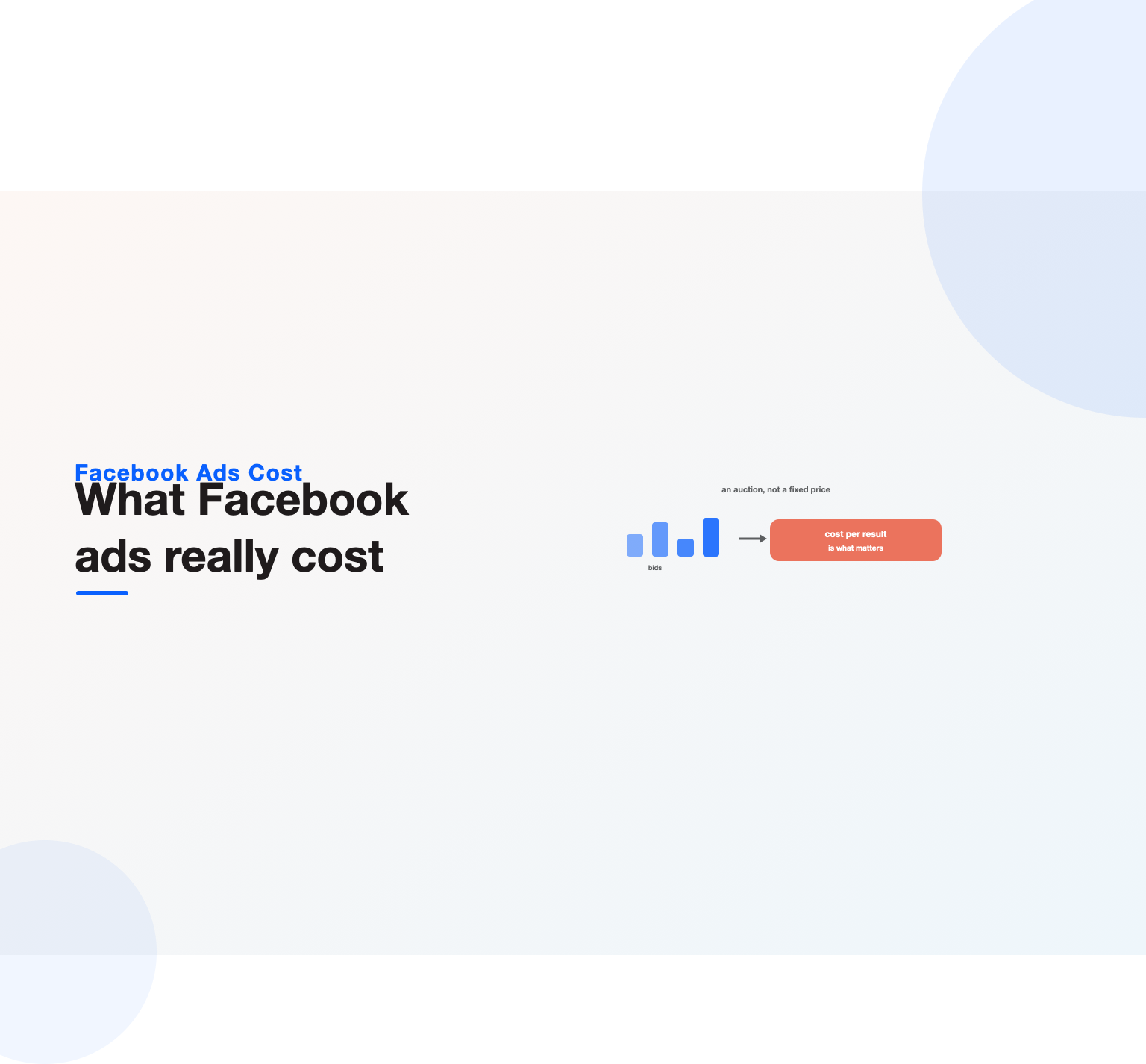
Facebook ads cost is not a fixed price but a result of an auction, so what you pay depends on your audience, your industry, your objective, the quality of your ads, and how much competition there is for the people you want to reach. Advertisers usually think about cost in a few ways: cost per click, cost per thousand impressions, and, most importantly, cost per result, the cost of the actual outcome you want, a lead, a purchase, an install, something that actually moves your business. Average benchmarks float around online, a few cents to a couple of dollars per click, a handful of dollars per thousand impressions, but these are almost meaningless for any specific business, because your cost is driven by your particular audience, offer and creative, not an industry average. What actually matters is not the headline cost per click but the cost per result and the return it produces, since cheap clicks that never convert are expensive and pricier clicks that convert well are a bargain. This guide explains what drives facebook ads cost, the metrics that matter, and how to lower your cost per result rather than just your cost per click.
Key Highlights
- Facebook ads cost is set by an auction, so it depends on your audience, industry, objective, ad quality and competition, not a fixed rate.
- The metrics that matter are cost per click, cost per thousand impressions and, above all, cost per result, the cost of your actual goal.
- Online benchmark averages are nearly useless for a specific business, since your cost is driven by your own audience, offer and creative.
- Ad relevance and quality lower cost, because the auction rewards ads people engage with by charging less to show them.
- Audience size and targeting, competition and seasonality, and your objective all push cost up or down.
- The goal is a low cost per result and strong return, not the lowest cost per click, since cheap clicks that never convert are expensive.
How the ad auction sets your cost
The foundation of understanding facebook ads cost is that you never pay a set price; you compete in an auction every time your ad could show, and the auction decides both whether you win the placement and what you pay. When you set up a campaign, you are effectively bidding to reach your chosen audience, and you compete against every other advertiser trying to reach the same people, so the more advertisers want that audience, the more it costs. This is why the same campaign can cost very different amounts depending on who you target and when, and why a cost that looks alarming in isolation may be perfectly normal for that audience in that moment.
Crucially, the auction does not simply award placements to the highest bidder; it weighs your bid alongside how likely your ad is to get the result and how much people are expected to engage with it, so a more relevant, engaging ad can win against a higher bid and pay less. This means the price is not just about how much you are willing to spend but about how good your ads are, which is why two advertisers targeting the same audience can pay very different prices. Understanding that the auction rewards relevance is the key to controlling cost, and it is a principle at the heart of effective Meta Ads management.
The metrics that actually matter
Talking about facebook ads cost sensibly means being clear about which metric you mean, because the common ones measure very different things. Cost per click tells you what you pay for a click, cost per thousand impressions tells you what you pay to be seen, and cost per result, the most important, tells you what you pay for the actual outcome you care about, whether that is a lead, a sale or an install. Focusing only on cost per click or impressions misses the point, because those cheap intermediate metrics mean nothing if they do not turn into results.
The metric to optimize is cost per result, and ideally the return that result produces. A campaign with a low cost per click but a high cost per result is expensive where it counts, while one with pricier clicks that convert efficiently is a bargain, so judging a campaign by clicks alone routinely misleads. Tying cost to the value each result produces is what turns cost from an abstract number into a business decision, and it depends on measuring outcomes properly through the pixel and conversion tracking, the same measurement discipline that sound marketing attribution and a well-run Meta ads for SaaS program both depend on.
Why benchmark averages mislead
Search for facebook ads cost and you will find averages, so many cents per click, so many dollars per thousand impressions, and it is tempting to treat these as a target, but they are almost useless for any specific business. Those averages blend together wildly different industries, audiences, objectives and countries, so the figure has no bearing on what your particular campaign, reaching your particular audience with your particular offer, will actually cost. A benchmark that averages a cheap awareness campaign in one market with an expensive lead campaign in another tells you nothing about your own numbers.
The more useful benchmark is your own historical performance and, above all, whether the cost produces a profitable result. Rather than asking whether your cost per click matches some published average, ask whether your cost per result leaves room for profit given what a customer is worth to you, because that is the only comparison that matters. Building your own baseline from your own campaigns, and judging your numbers against your economics rather than an internet average, is what keeps decisions grounded, and it connects directly to planning spend the way our approach to Meta ads for ecommerce brands and other verticals does.
Ad quality and relevance lower cost
Because the auction rewards ads people engage with, the single most controllable lever over what you pay is the quality and relevance of your ads. When your ad is relevant to the audience and earns strong engagement, clicks, reactions, shares, the system judges it likely to perform and effectively charges you less to show it, whereas a dull or poorly targeted ad that people ignore costs more to deliver because the auction expects it to underperform. This is why creative quality is not just a branding concern but a direct cost lever, arguably the most powerful one an advertiser controls.
Improving relevance means matching the ad to the audience and giving people a reason to engage: creative that speaks to the specific people you are targeting, a clear and compelling message, and formats that suit the placement. Strong, relevant creative lowers cost while also improving results, a double benefit that makes creative work one of the highest-return uses of effort in a Meta campaign. Advertisers who treat creative as central, testing and refreshing it constantly, consistently pay less and get more than those who set it once and let it stale, which is why disciplined creative testing is core to strong Meta ads for D2C brands and every other vertical.
How audience and targeting affect cost
Who you target has a large effect on facebook ads cost, because different audiences cost different amounts to reach depending on how many advertisers want them and how large the audience is. Highly sought-after audiences, valuable demographics many advertisers compete for, cost more, while narrow audiences can cost more per person simply because there are fewer of them to show ads to. Broad audiences give the system room to find the cheapest willing eyeballs, which is part of why modern Meta advertising often favors broader targeting paired with strong creative, an approach that has reshaped how advertisers across sectors, including Meta ads for home services, think about who to reach and at what cost.
The interaction between audience and creative is what matters most. A broad audience lets the auction optimize delivery toward the people most likely to respond, and when paired with creative relevant enough to engage them, it often produces a lower cost per result than tight manual targeting, which can box the system in. Matching your targeting approach to your objective and letting strong creative do the qualifying is a key way to manage facebook ads cost, and it is an approach that pays off across audiences from local services to national brands, including specialized ones like Meta ads for SaaS.
Objective, competition and seasonality
Your campaign objective shapes cost because different objectives ask the system for different, and differently priced, outcomes. An awareness objective optimizing for cheap impressions naturally shows a low cost per thousand impressions, while a conversion objective optimizing for purchases costs more per action but delivers the results that matter, so comparing the raw cost of campaigns with different objectives is meaningless. Choosing the objective that matches your actual goal, and judging cost by the result you wanted rather than the cheapest number the campaign happens to show, is what keeps the comparison fair.
Competition and timing move facebook ads cost too. When more advertisers compete for your audience, costs rise, which is why costs climb during peak retail seasons and around major events when everyone is bidding harder, and fall in quieter periods. Planning around these swings, spending into high-value seasons knowing costs will be higher, and not being alarmed when a busy period raises your numbers, keeps expectations realistic and stops you from cutting spend exactly when demand is highest, as our approach to Meta ads for restaurants and other seasonal sectors makes clear. Understanding that objective, competition and seasonality all move the price helps you read your facebook ads cost in context rather than reacting to every fluctuation, a perspective experienced management brings to campaigns in every sector, including Meta ads for real estate.
Lowering cost per result
The right goal is not to lower your cost per click but to lower your cost per result while maintaining or growing volume, and the levers for that are mostly about relevance and efficiency. Better creative that engages the right people lowers cost through the auction; sharper targeting or broader targeting matched with strong creative reaches the willing at lower cost; and a better post-click experience, a fast, relevant landing page or a smooth in-app flow, converts more of the traffic you paid for, which lowers cost per result even if cost per click is unchanged. Each of these attacks the metric that matters rather than a vanity number.
Testing is how you find these gains. Systematically testing creative, audiences and the post-click experience reveals what actually lowers your cost per result for your specific business, which often surprises intuition, so disciplined testing beats guessing or copying benchmarks. Because small improvements compound across all your spend, this optimization is among the highest-return work in a Meta account, steadily driving facebook ads cost down where it counts. Treating cost reduction as a continuous testing discipline rather than a one-time setting is what separates efficient advertisers from those who accept whatever the account gives them, and it applies to every vertical, including Meta ads for home services.
How much should you spend?
A question that follows naturally from cost is how much to spend, and the answer, like budget everywhere in advertising, comes from your economics rather than a round figure. Start from what a customer is worth and what you can afford to pay for a result while staying profitable, then spend enough to gather the data the system needs to optimize, since a budget so small that a campaign gathers only a handful of results never gives the automation enough signal to lower cost. Starving a campaign of budget is a common way to end up with a high cost per result.
Beyond the minimum needed to learn, scale spend as results prove profitable, increasing budget in measured steps so you do not disrupt the campaign’s performance. The relationship between spend and facebook ads cost is not fixed, spending more can raise cost per result as you exhaust the cheapest audience, or lower it as the system learns, so watching cost per result as you scale tells you when you are reaching the limit of profitable spend. Sizing the budget from unit economics and scaling by results, rather than picking an arbitrary number, is the disciplined approach that keeps a Meta account profitable as it grows, whatever the vertical, from a local service to a national D2C brand scaling hard.
The pixel and measurement behind cost
You cannot manage cost per result if you cannot measure results, so accurate measurement through the Meta pixel and conversions setup is the foundation beneath every cost decision. The pixel records what people do after they click, so it tells the system which ads, audiences and creatives produce actual outcomes, which both lets you judge cost per result honestly and lets the automation optimize delivery toward the people most likely to convert. An account with broken or missing measurement is flying blind, unable to tell a cheap result from an expensive one and unable to let the system lower cost by learning what works.
Privacy changes have made this harder and more important at once, as browser and platform restrictions erode the signals that measurement once relied on, which is why the server-side conversions setup has become essential for many advertisers to recover the data that keeps costs readable and optimization effective. Getting measurement right is not a technical afterthought but the thing that makes every cost figure trustworthy, and it is the same discipline that underpins strong results across verticals, from Meta ads for lawyers to ecommerce, where a wrong cost reading leads straight to a wrong scaling decision.
Cost across the funnel
It also helps to remember that not all costs are meant to be judged the same way, because campaigns at different stages of the funnel produce different, and differently priced, outcomes. An awareness campaign at the top of the funnel buys cheap reach and attention that will not convert immediately, while a conversion campaign at the bottom buys more expensive but directly valuable actions, so holding the awareness campaign to the bottom-funnel cost per result, or the reverse, misreads both. Each stage has its own fair measure of cost, tied to the job it is doing.
Reading cost this way keeps a full-funnel strategy honest. The cheaper upper-funnel spend feeds the demand that the bottom-funnel and retargeting campaigns then convert, so its value shows up partly in the performance of other campaigns rather than in its own direct results, which is exactly why judging every campaign by the same raw cost misleads. Understanding how cost behaves at each stage, and measuring each against the job it is meant to do, is what lets an advertiser build a coherent funnel rather than cutting the cheap awareness that quietly feeds the whole machine, a perspective that guides considered accounts like Meta ads for coaches and course creators.
Common mistakes in judging cost
Several recurring errors lead advertisers to misjudge facebook ads cost and make poor decisions. The most common is optimizing for cheap clicks or impressions instead of cost per result, chasing a low cost per click that never turns into profitable outcomes, which mistakes a vanity metric for genuine business success and leads to scaling exactly the wrong campaigns. Close behind is comparing your cost to published benchmark averages that blend unrelated industries and objectives, and concluding your numbers are wrong when they simply reflect your own audience and offer. Judging campaigns with different objectives by the same raw cost is another frequent confusion.
Other mistakes include blaming cost when the real problem is weak creative that the auction is penalizing, starving campaigns of the budget they need to learn and then wondering why cost per result is high, and reacting to normal seasonal or competitive swings as though something had broken. The thread through these errors is focusing on the wrong number and ignoring the levers, creative, relevance, the post-click experience, that actually move cost. Advertisers who focus on cost per result and return, judge against their own economics, and work the relevance levers control their facebook ads cost far better than those fixated on cheap clicks, a difference a careful account review reliably reveals.
Reading cost trends over time
A single day’s cost tells you very little, so the advertisers who manage cost well read it as a trend rather than reacting to daily noise. Costs naturally fluctuate day to day as the auction, competition and delivery shift, and a campaign that looks expensive on Monday may look fine across the week, so judging performance over a sensible window rather than a single day prevents the panicked changes that reset learning and make things worse. The useful question is whether cost per result is trending up or down over weeks, and why.
A steady rise in cost per result usually signals that creative is fatiguing, that you have exhausted the cheapest part of your audience, or that competition has intensified, each of which points to a different fix, refreshing creative, widening the audience, or accepting a higher cost in a hot season. A steady fall usually means the system is learning or your improvements are working, which tells you where to invest more. Reading the trend and its causes, rather than the daily number, is what turns cost data into decisions, and it is the same patient, evidence-led approach that governs strong Meta ads for gyms and fitness studios and every other account that scales profitably rather than lurching from one reaction to the next.
When to get help managing cost
A capable marketer can manage facebook ads cost by understanding the auction, focusing on cost per result, and working the creative and targeting levers that lower it, and for a smaller account, doing this yourself builds valuable understanding of what actually drives your numbers. The core ideas, optimize for results not clicks, judge against your economics, improve relevance, are more about clear thinking than technical difficulty, and a diligent advertiser can meaningfully lower their cost per result this way.
Expert help earns its keep as spend grows and the stakes rise, when creative testing, audience strategy and measurement become substantial work, when scaling profitably requires careful reading of how cost moves with spend, or when the account spans many campaigns and objectives. An experienced practitioner improves relevance, structures testing, and manages cost per result as a matter of routine, so folding cost management into ongoing Meta Ads services, whether for real estate or professional services, often lowers cost by more than the cost of the help. Whichever route you take, the principles of managing facebook ads cost stay the same: compete on relevance, optimize for cost per result, judge against your own economics, and keep testing.
Key Takeaways
- Facebook ads cost is set by an auction that weighs your bid against ad relevance, so better ads pay less to reach the same people.
- Optimize for cost per result and return, not cost per click or impressions, since cheap clicks that never convert are expensive.
- Ignore internet benchmark averages and judge cost against your own historical performance and unit economics.
- Improve creative and relevance to lower cost, because the auction rewards ads people engage with by charging less.
- Audience, objective, competition and seasonality all move cost, so read your numbers in context rather than reacting to every swing.
- Size the budget from economics and scale by results, applying the same discipline strong Meta ads for ecommerce brands use.
Frequently asked questions
How much do Facebook ads cost?
There is no fixed price, because Facebook ads cost is set by an auction and depends on your audience, industry, objective, ad quality and the competition for the people you want to reach. Advertisers measure cost as cost per click, cost per thousand impressions, or, most importantly, cost per result, the cost of the actual outcome you want. Published averages, a few cents to a couple of dollars per click, are nearly meaningless for any specific business, since your cost is driven by your own audience, offer and creative. What matters is not the headline cost per click but your cost per result and the return it produces, judged against what a customer is worth to you.
What is a good cost per result on Facebook ads?
A good cost per result is one that leaves room for profit given what a customer is worth to you, not a figure from a benchmark. Because businesses have wildly different margins, customer values and conversion rates, the same cost per lead or per purchase can be excellent for one advertiser and ruinous for another. Rather than comparing to an internet average, work out what you can afford to pay for a result while staying profitable, and judge your campaigns against that. Build a baseline from your own historical performance, then work to lower cost per result over time through better creative, targeting and post-click experience, which is what genuinely improves the account.
Why are my Facebook ads so expensive?
Usually because of one or more of a few factors. Weak or irrelevant creative is the most common and controllable cause, since the auction charges more to show ads people do not engage with. Targeting a highly competitive or very narrow audience raises cost, as does competing during a peak season when many advertisers are bidding harder. Optimizing for the wrong objective, or judging a conversion campaign by the cost of a cheaper action, can also make costs look worse than they are. Often the fix is better, more relevant creative and a focus on cost per result rather than cost per click, along with giving the campaign enough budget to learn.
Do better ads cost less on Facebook?
Yes, and this is one of the most important things to understand. The auction does not simply reward the highest bidder; it weighs your bid alongside how relevant your ad is and how much people are expected to engage with it, so a more relevant, engaging ad can win placements against higher bids and cost less to show. This means two advertisers targeting the same audience can pay very different prices depending on the quality of their ads. Because relevance directly lowers cost, improving creative is one of the highest-return levers available, delivering both cheaper delivery and better results at the same time, which is why creative testing is central to efficient Facebook advertising.
Should I focus on cost per click or cost per result?
Cost per result, almost always. Cost per click and cost per thousand impressions measure intermediate steps that mean nothing if they do not turn into the outcome you actually want, so a low cost per click that never becomes profitable results is expensive where it counts, while pricier clicks that convert efficiently are a bargain. Optimizing for cheap clicks routinely misleads advertisers into scaling campaigns that do not produce business results. Focus instead on cost per result, and ideally the return each result produces, since that ties your spending to actual value. Judging campaigns by cost per result, not clicks, is one of the clearest markers of a disciplined advertiser.
How much should I budget for Facebook ads?
Start from your economics rather than a round number. Work out what a customer is worth and what you can afford to pay for a result while staying profitable, then set a budget large enough that the campaign gathers enough results for the system to optimize, since a starved campaign never gives the automation the data it needs to lower cost. Beyond that minimum, scale spend in measured steps as results prove profitable, watching cost per result as you grow to see when you reach the limit of profitable spend. Sizing the budget from unit economics and scaling by results, not guessing an arbitrary figure, is what keeps a Facebook advertising account profitable as it grows.
Ready to put this into practice?
Talk to the team that runs SEO, AI search and paid growth programs every day.
Book a Strategy Call →