 Skip to content

Facebook Carousel Ads: When and How to Use Them
Facebook carousel ads show swipeable cards in one ad. Learn when to use them over single images, dynamic catalog carousels, card order, and the mistakes that flatten results.
Quick Answer
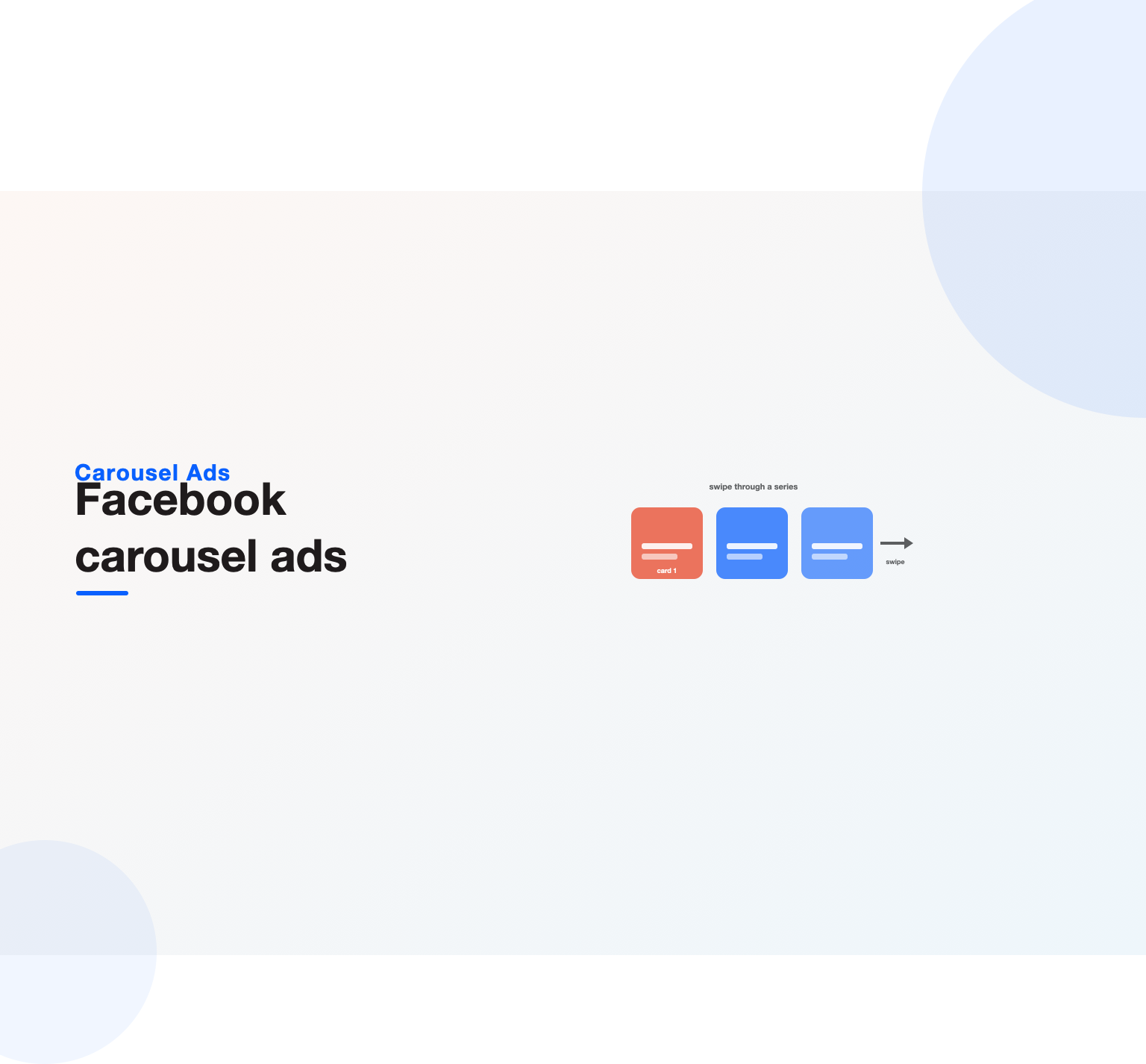
Facebook carousel ads are a format that shows two to ten images or videos in a single ad, each with its own link, that people swipe through in the feed. They work because the format is interactive and space-efficient: instead of one static message, a carousel lets you tell a sequence, show multiple products, or walk through steps, which invites engagement and gives Meta more creative to optimize. Facebook carousel ads shine for ecommerce, where each card can feature a different product pulled dynamically from a catalog, and for storytelling, where the cards build a narrative or explain a process one swipe at a time. On modern Meta, where creative is the main performance lever, the carousel is valuable because it multiplies what a single ad placement can say and lets the system show each person the card most likely to resonate. Used well, facebook carousel ads lift engagement and give the automation more to work with; used lazily, as a random pile of images, they waste the format’s potential. This guide explains what carousel ads are, when to use them over other formats, how to build them well, and the mistakes that flatten their results.
Key Highlights
- Facebook carousel ads show two to ten swipeable cards, each with its own image or video and link, in one ad.
- The format suits ecommerce catalogs, multi-product showcases, storytelling sequences, and step-by-step explanations.
- Dynamic carousels pull products from a catalog automatically, making them powerful for retargeting and shopping.
- Card order matters, since the first card must earn the swipe and Meta can also optimize the sequence.
- Each card should be strong on its own while contributing to a coherent whole, not a random pile of images.
- The format gives the automation more creative to optimize, which fits Meta’s creative-led performance model.
What a carousel ad actually is
A carousel is a single ad made of multiple cards, and understanding what facebook carousel ads offer starts with seeing them as a sequence rather than one image. Each card holds its own image or video, headline, and link, and the viewer swipes horizontally through them in the feed, so one ad can carry several messages, products, or steps. This makes the format fundamentally more flexible than a single-image ad, because it turns a fixed placement into a small, interactive space you can fill with a series rather than a single shot.
That interactivity is part of why the format performs, since swiping is a small act of engagement that pulls people deeper into the ad. Where a static ad gets a glance, a carousel invites a person to move through it, and each swipe is a moment of attention the format earned. Facebook carousel ads therefore do more than show more; they change how people interact with the ad, which is why they often lift engagement over single images. Grasping that the carousel is an interactive sequence, not just extra image slots, is the foundation for using it well, and it connects to the broader craft of strong facebook ad creative.
When to use a carousel over other formats
The carousel is not always the right format, so choosing facebook carousel ads should follow from what you are trying to show rather than novelty. They excel when you have multiple things to present, several products, a range of features, a set of benefits, or a sequence that unfolds, because the format is built to carry a series. A single hero product with one clear message may do better as a single image or video, while a catalog of products or a multi-step story is exactly what a carousel is for.
Matching the format to the message is the whole decision. Use a carousel when the content is genuinely a series that benefits from being swiped through, an ecommerce range, a before-and-after, a how-it-works sequence, and reach for a single image or video when one message lands hardest alone. Forcing a single idea into a carousel dilutes it, while cramming a true series into one image loses most of it, so the format should follow the content. Choosing facebook carousel ads because the message is genuinely multi-part, not because the format looks interesting, is what makes them work, and it is the kind of deliberate creative choice that separates strong campaigns from generic ones, whatever the objective, including facebook ads for ecommerce.
Dynamic carousels and the product catalog
One of the most powerful uses of facebook carousel ads is the dynamic carousel, where cards are populated automatically from a product catalog rather than built by hand. When connected to a catalog, the system can assemble a carousel showing the products each person is most likely to want, pulling images, prices, and links directly from the feed, which turns the format into a personalized shopping ad at scale. This is what powers catalog retargeting, showing someone the exact products they viewed alongside related items, without an advertiser building each ad.
Dynamic carousels are where the format and Meta’s automation combine most effectively for ecommerce. Because the cards are drawn from the catalog and matched to the viewer, a single dynamic carousel campaign can show endlessly personalized product combinations, which no manual approach could match. The quality of the catalog directly shapes how well these ads perform, since clean product data, good images, and accurate availability feed better cards. Using dynamic facebook carousel ads to turn a catalog into personalized, automatically assembled shopping ads is one of the highest-leverage plays for any store on Meta, and it sits at the heart of catalog-driven facebook retargeting.
Order your cards deliberately
Card order shapes how facebook carousel ads perform, because the first card determines whether anyone swipes at all and the sequence shapes the story that follows. The opening card is the hook, and if it does not earn attention, the rest of the carousel is never seen, so it deserves the same care as any ad’s first impression. From there, the order can build a narrative, move from problem to solution, or lead with your strongest items, depending on what the carousel is meant to do.
Meta can also optimize card order automatically for some carousels, showing the best-performing cards first, which is often worth allowing when you do not need a fixed narrative sequence. When the carousel tells a deliberate story that only makes sense in order, you keep the sequence fixed; when it is a showcase of independent items, letting the system optimize the order can lift results. Deciding whether the carousel needs a fixed narrative or benefits from automated ordering, and making the first card strong either way, is a small choice that meaningfully affects performance, and it reflects the same attention to sequence that thoughtful Meta Ads management brings to every format.
Make every card pull its weight
The strength of facebook carousel ads depends on each card being worth swiping to, since a carousel is only as engaging as its weakest cards, and a strong opener followed by filler loses people fast. Every card should offer something, a distinct product, a new point, a next step in the story, rather than padding the format to fill slots. When each card earns its place, the whole carousel rewards the swipe; when cards repeat or add nothing, people stop swiping and the format’s advantage evaporates.
Coherence matters as much as individual card quality, because the cards are experienced as one ad, not a random gallery. The best carousels feel like a designed sequence where the cards share a look and build toward a point, so the viewer senses a whole rather than a pile of images. Balancing strong individual cards with a coherent overall message is the craft of the format, and it is what turns facebook carousel ads from a novelty into a genuinely persuasive unit. Treating each card as both a standalone piece and part of a whole is how the format delivers, and it draws on the same discipline as writing effective facebook ad copy across the cards.
How carousels fit Meta’s creative-led model
On modern Meta, where the automation handles targeting and creative is the main lever, facebook carousel ads fit the model by giving the system more creative to work with in a single placement. A carousel is effectively several creatives bundled together, so it hands the automation a richer set of material to test and match to viewers than a single image does, which aligns with how performance is now won, through creative volume and variety rather than audience micromanagement. The format multiplies what one ad can say, and the system exploits that.
This makes carousels a natural fit for a creative-led strategy, since they let you supply more variety without building many separate ads. Feeding the automation a carousel of strong, varied cards gives it more to optimize with, which can lift performance the way fresh creative generally does on Meta. The format is not a gimmick but a way to pack more useful creative into a placement the system can then optimize, which is why it earns a place in a modern account. Using facebook carousel ads as part of a broader creative engine, rather than a one-off experiment, is how they contribute to sustained performance, and it complements the wider work of facebook ads optimization.
Design and technical basics that matter
Getting the fundamentals right keeps facebook carousel ads from being undercut by avoidable problems, and the basics are straightforward. Images and videos should meet Meta’s recommended dimensions so cards display cleanly, since a poorly sized card looks unprofessional and can be cropped badly. Consistent visual treatment across cards, similar framing, color, and style, makes the carousel feel like one designed unit rather than a mismatched set, which supports the coherence that makes the format work.
The functional details matter too, because each card can carry its own link and headline. Pointing each card to the most relevant destination, a specific product page for a product card, rather than sending every card to the same generic page, respects the intent behind a swipe and improves the post-click experience. Getting dimensions, visual consistency, and per-card links right is unglamorous but real work that determines whether the format performs to its potential. Handling these basics well, so the carousel looks polished and every card leads somewhere sensible, is part of running the format seriously, and Meta’s own carousel ad guidance covers the current specifications.
Carousels for storytelling and education
Beyond product showcases, carousels are a natural fit for storytelling and teaching, because a sequence of cards can walk a viewer through something one step at a time. A how-it-works explanation, a customer journey, a set of tips, or a before-and-after transformation all suit the format, since each card advances the point and the swipe keeps the person moving through it. This makes the carousel useful well beyond ecommerce, for any brand that has a process, a story, or an idea that unfolds better in sequence than in a single frame.
The strength here is that a carousel can hold attention longer than a static ad by rewarding curiosity, since each swipe promises the next piece. A brand explaining a complex product, breaking down a process, or building a case across several cards can communicate far more than a single image allows, without asking the viewer to read a wall of text. Using the format to teach or tell a story, letting each card carry one clear idea toward a conclusion, is one of the most underused ways to use the format, and it depends on the same clarity that makes any facebook ad copy land.
Carousels beyond ecommerce and retail
While the format is famous for shopping, carousels serve service businesses and lead generation just as well when used thoughtfully. A service provider can use cards to present different services, showcase a portfolio, walk through a process, or answer common questions, each card doing one job in a coherent set. For lead generation, a carousel can build the case across cards before the final one drives to a form or offer, warming the viewer through the sequence rather than asking for the action cold.
The principle is identical whatever the business: use the cards to carry a genuine series that benefits from being swiped through. A local business might show a range of offerings, a software company might present key features, and a coach might walk through a transformation, all using the format’s ability to say more in one placement. Recognizing that carousels are not only for product catalogs, and applying the same craft of strong, coherent cards to services and lead generation, extends the format’s value across account types, including accounts focused on lead generation.
Using video cards in carousels
Cards are not limited to still images, and mixing in short video can lift the format when the motion earns its place. A video card can demonstrate a product in use, show a quick before-and-after, or add movement that catches the eye as someone swipes, giving a card more impact than a static frame. Because video tends to communicate certain things faster than an image, a well-placed video card can carry a step of the story more vividly than a still.
The caution is to use video where it genuinely helps rather than everywhere by default, since a carousel of heavy videos can feel slow and a poorly made clip undercuts the polish of the set. Short, purposeful video cards that advance the sequence, kept consistent in style with the still cards around them, blend the strengths of both formats. Deciding card by card whether motion or a still serves the message better is the craft, and combining them well is where carousels meet the wider power of facebook video ads in one unit.
Testing and iterating on carousels
Like any creative, carousels improve through testing, and the format offers plenty to test: the first card, the order, the mix of products or messages, and the overall theme. Because the opening card determines whether anyone swipes, testing different hooks for card one is often the highest-leverage experiment, and swapping the lead card can change a carousel’s results substantially. Testing genuinely different approaches, rather than trivial tweaks, is what reveals what resonates with a given audience.
Reading those tests honestly feeds a growing understanding of what works, which makes each new carousel stronger. Noticing which opening cards earn swipes, which sequences hold attention, and which products or messages convert builds a playbook you can reuse and refine, turning the format from guesswork into a repeatable creative asset. Treating carousels as something to test and iterate on, not build once and forget, is what compounds their performance over time, and it fits the broader discipline of continuous facebook ads optimization.
Measuring how a carousel performs
Judging carousels well means looking past surface engagement to whether the format drives the outcome you care about. Swipes and interactions show that the carousel is engaging, but the real measure is whether it produces sales, leads, or whatever the campaign targets, so the same outcome-first discipline that governs any ad applies here. A carousel that gets swipes but no conversions is entertaining, not effective, and reading it by engagement alone hides that gap.
The format also offers card-level signals worth reading, since seeing which cards get attention and clicks reveals what resonates and informs the next iteration. Watching which products or messages pull people in, and which cards get skipped, turns a carousel into a source of learning as well as a placement. Measuring carousels by real outcomes while using card-level data to improve them is how the format earns its place in an account, and it depends on the honest measurement that sound facebook ads reporting provides.
Common carousel ad mistakes
Most weak facebook carousel ads fail for a few recurring reasons, and knowing them makes the format easy to use well. Choosing a carousel when the message is really a single idea tops the list, since forcing one point across multiple cards dilutes it, and a strong single image would have served better. Weak or filler cards are close behind, because a carousel padded to fill slots loses people the moment they hit a card that adds nothing. A weak first card is fatal, since if it does not earn the swipe, the rest is never seen.
The remaining mistakes are about coherence and follow-through. Cards that do not share a look or build toward a point feel like a random gallery rather than one ad, sending every card to the same generic page wastes the format’s per-card linking, and neglecting the product catalog undermines dynamic carousels before they start. Avoiding these, by choosing the format when the content is genuinely a series, making every card strong and coherent, opening with a card that earns the swipe, and linking each card sensibly, is most of what separates carousels that perform from ones that merely look busy, and it applies across every account and objective on Meta.
Where carousels fit in a full strategy
A carousel is one format among several, so it works best as part of a broader creative mix rather than the whole plan. Single images, videos, and carousels each have strengths, and a healthy account uses the format that fits each message, reaching for a carousel when the content is genuinely a series and other formats when a single idea lands harder alone. Leaning on one format for everything, whether that is only single images or only carousels, leaves performance on the table, since the right format depends on the message.
Within a funnel, carousels can play different roles at different stages, showcasing a range to cold audiences, telling a deeper story in the middle, and driving catalog retargeting at the bottom. Fitting the format to both the message and the funnel stage is what makes it contribute to the whole rather than sit as a novelty, and it connects the carousel to the wider structure of a real facebook ads funnel. Used deliberately as one tool in a varied creative mix, the format earns its place and lifts the account without being asked to do everything.
Key Takeaways
- Use facebook carousel ads when the message is genuinely a series, multiple products, features, or a story, not a single idea.
- Lean on dynamic carousels tied to a product catalog for personalized, automatically assembled shopping and retargeting ads.
- Make the first card earn the swipe, and decide whether the carousel needs a fixed narrative or benefits from automated ordering.
- Ensure every card pulls its weight while the whole set stays coherent, like one designed unit rather than a pile of images.
- Treat the carousel as extra creative for the automation to optimize, fitting Meta’s creative-led performance model.
- Get the basics right: correct dimensions, consistent visuals, and a sensible per-card link for each destination.

Frequently asked questions
What are Facebook carousel ads?
Facebook carousel ads are a format that displays two to ten images or videos, called cards, in a single ad, which people swipe through horizontally in the feed. Each card can have its own image or video, headline, and link, so one ad can showcase multiple products, features, or steps in a sequence. The format is interactive, since swiping is a small act of engagement, and space-efficient, since it packs several messages into one placement. Carousels are especially popular for ecommerce, where cards can be pulled dynamically from a product catalog, and for storytelling that unfolds card by card. Because each card carries its own link, a single ad can send people to several different destinations, which makes the format unusually versatile compared with a one-link single image, and a strong fit for stores running facebook ads for ecommerce.
When should I use a carousel instead of a single image?
Use a carousel when you genuinely have multiple things to show or a sequence that unfolds, such as a range of products, a set of features or benefits, a before-and-after, or a step-by-step story. The format is built to carry a series, so it shines when the content is naturally multi-part. If you have one hero product and a single clear message, a single image or video often lands harder alone. The rule is to match the format to the content: a true series benefits from a carousel, while a single idea is usually diluted by spreading it across cards. A quick self-test helps: if you can describe your ad as a list or a sequence, several products, a set of steps, a before and after, the carousel probably fits; if it collapses to one sentence and one image, a single-format ad likely serves it better. When unsure, it is worth running both against each other and letting the results decide, since the right answer varies by audience and message rather than following a universal rule.
What are dynamic carousel ads?
Dynamic carousel ads populate their cards automatically from a product catalog rather than being built by hand, so the system assembles a personalized carousel showing each viewer the products they are most likely to want. Connected to a catalog, they pull images, prices, and links directly from the feed, which powers catalog retargeting, showing someone the exact items they viewed alongside related products. A single dynamic campaign can show endlessly personalized combinations at a scale no manual approach could match, which is why dynamic carousels are one of the most powerful ecommerce plays on Meta. Their performance depends heavily on a clean, well-maintained catalog, since the cards are only as good as the product data behind them, which is why catalog quality is a core part of any serious facebook retargeting setup.
How many cards should a carousel ad have?
A carousel can have two to ten cards, but the right number is however many the content genuinely justifies, not the maximum. Every card should add something, a distinct product, a new point, or a step in the story, so a carousel with three strong cards beats one padded to ten with filler. For dynamic product carousels the system handles how many products to show, while for hand-built carousels you should include only as many cards as each earning its place allows. Quality per card matters far more than quantity, since people stop swiping the moment they hit a card that adds nothing, so the length should follow the content rather than a target. A practical way to decide is to keep adding cards only while each new one earns its place with a distinct product, point, or step, and to stop the moment you are reaching for filler. Two or three excellent cards will almost always outperform a longer set diluted by weak ones, because the format rewards momentum and punishes the first dull swipe the moment a viewer reaches it. When in doubt, cut the weakest card rather than keep it, and let the strength of what remains carry the ad, because a shorter, sharper carousel almost always beats a longer, diluted one in the busy feed where attention is scarce.
Do carousel ads perform better than single-image ads?
It depends entirely on the content and how well the carousel is built. Carousels often lift engagement because swiping is interactive and the format gives the automation more creative to optimize, and they clearly outperform single images when the message is genuinely a series or a catalog of products. For a single, focused message, though, a strong single image or video can outperform a forced carousel. The format is a tool, not a guaranteed upgrade: it wins when the content suits it and every card pulls its weight, and it underperforms when a single idea is stretched across cards that add nothing. The honest way to know is to test it against a single image for your specific message and read the outcome, not the swipe count, which is the same evidence-first habit behind good facebook ads optimization.
Ready to put this into practice?
Talk to the team that runs SEO, AI search and paid growth programs every day.
Book a Strategy Call →