 Skip to content
How to Get Cited by AI: The 9 Signals That Earn Citations
How to get cited by AI: the nine signals engines use to pick sources, answer-first content, statistics, citations, authority, entities, retrievability, freshness and reputation, and how to build them.
Quick Answer
To get cited by AI, make your content easy to retrieve, easy to extract, and easy to trust: publish clear answer-first content, back your claims with statistics and credible sources, demonstrate genuine authority on the topic, keep your entity information consistent across the web, and make sure your pages are technically crawlable. AI engines cite the sources they can gather, quote cleanly, and rely on, so the practical question of how to get cited by AI comes down to being the clearest, best-evidenced, most trustworthy source on the specific thing the engine is trying to say.
Key Highlights
- AI engines cite sources they can retrieve, extract cleanly, and trust, so citation depends on three things at once, not a single trick.
- Concrete evidence, relevant statistics, direct quotes, and cited claims, makes content markedly more likely to be pulled into an answer.
- Authority is often the deciding factor, because engines are built to avoid repeating unreliable sources.
- Technical retrievability and consistent entity information are prerequisites: an engine cannot cite what it cannot access or confidently identify.
- Because AI answers name only a few sources, the signals compound, and brands that build them early capture an outsized share of citations.
The nine signals that earn AI citations
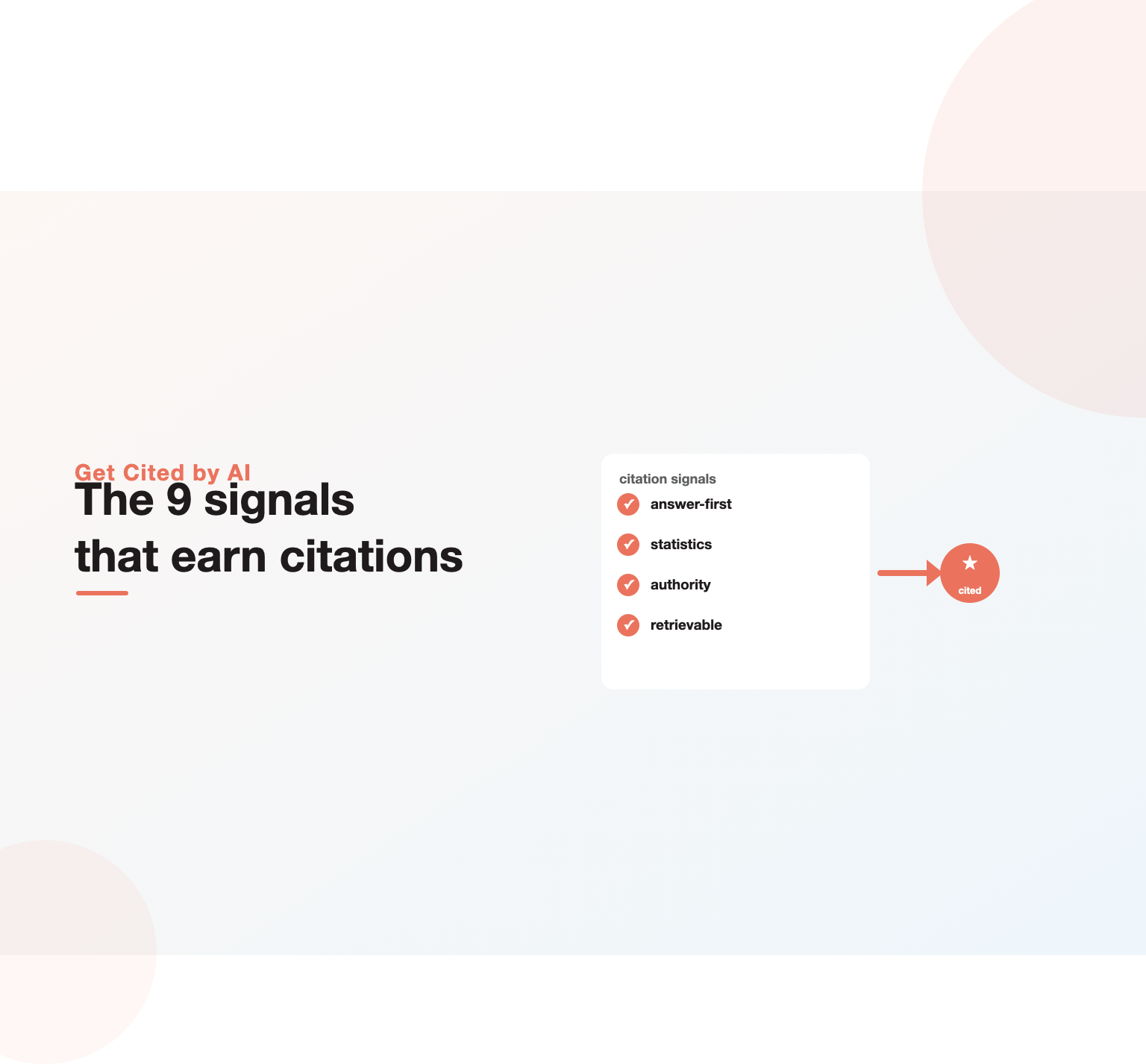
No single factor guarantees a citation. What earns one is the combination of signals below, working together, so that when an engine composes an answer on your topic your content is the easiest, safest, most useful source to build from. Understanding how to get cited by AI means understanding each of these levers and, more importantly, how they reinforce one another.
1. Answer the question directly and early
Engines extract best from passages that make a clean, self-contained point, so the first signal is answer-first structure. Lead a section with a direct answer to the question it addresses, then elaborate, rather than building toward a conclusion the engine has to infer. Write sentences that stand on their own, because a passage lifted out of context still has to make sense as a citation. A page that states its answers plainly gives an engine ready-made material to quote, while content that buries the point forces the engine to look elsewhere.
2. Back claims with specific statistics
A relevant, specific number is one of the strongest citation magnets there is, because it gives an engine a concrete, attributable fact to include. Vague assertions offer nothing to quote; the same point expressed as a precise statistic with its context becomes a clean building block. Content rich in solid, sourced figures is drawn on more often than content that only asserts, so quantifying your claims wherever you legitimately can is among the most direct ways to influence whether AI cites you. Original data is especially powerful, since it makes you the primary source an engine must reference.
3. Include quotable, standalone statements
Beyond statistics, crisp, self-contained sentences that express a clear idea give engines ready-made lines to lift verbatim. A well-phrased definition, a sharp characterization of a concept, or a memorable articulation of a principle can each become the exact sentence an engine reproduces. Writing with quotability in mind, making each important point a clean, complete statement rather than a clause tangled in a longer argument, raises the odds that your phrasing, and your attribution, ends up in the answer.
4. Cite credible sources for your claims
Citing your own claims to reputable sources signals reliability and gives an engine corroboration it can trust. A page that references credible evidence reads as more trustworthy to systems built to avoid repeating unverified information, and it situates your page within a web of sources the engine can cross-check. This is a subtle but real signal in how to get cited by AI: a well-sourced page is a safer source to cite, because the engine has more reason to believe what it says is accurate.
5. Build genuine topical authority
Authority is frequently the deciding signal, because engines weigh who is making a claim, not just how well it is phrased. Demonstrable expertise on a topic, real authorship by identifiable experts, and a track record of depth all make an engine more willing to draw on you. Going deep on a well-defined subject, rather than spreading thin, is how a focused brand earns the topical authority that makes it a default source. Without authority, even perfectly formatted, well-sourced content struggles to be cited, because the engine has no reason to trust it over a recognized voice.
6. Keep your entity information consistent
Engines build a model of the entities they encounter, so the sixth signal is entity clarity and consistency. Describing your brand, people and offerings the same way across your site and the wider web, and reinforcing it with structured data, helps an engine identify you correctly and trust the picture it has formed. Contradictions, an out-of-date description here, an inconsistent detail there, weaken that picture and give the engine a reason to hesitate. Consistent, well-structured entity information is a quiet but important citation signal, because an engine cites sources it can confidently identify.
7. Make your content technically retrievable
None of the content signals matter if an engine cannot access your page, so technical retrievability is a prerequisite. Your important content must be crawlable and present in the initial HTML rather than hidden behind heavy client-side rendering, because an engine gathering candidate sources cannot include what it cannot read. Clean, semantic markup helps it understand structure, and fast, stable pages are more reliable candidates. A single technical barrier can quietly remove you from consideration entirely, no matter how good the content behind it is.
8. Keep information fresh and accurate
Engines favor information that appears current and maintained, so freshness is the eighth signal. Content that is visibly out of date, or contradicted by more recent sources, is a weaker citation candidate than content kept accurate and current. Reviewing and updating your important facts, and signaling clearly when content was last updated, keeps your pages in the state engines prefer to reproduce. Accuracy compounds this: a source caught stating something wrong loses the trust that citation depends on, so keeping your facts right is as much a citation signal as keeping them fresh.
9. Earn a credible presence across the web
The final signal reaches beyond your own site. Since engines cross-check and weigh reputation, being referenced, reviewed and discussed on other credible sites strengthens the trust an engine places in you, and being described consistently everywhere removes the contradictions that make it hesitate. A brand mentioned by many independent, trustworthy sources becomes one the engine treats as an obvious source. This cross-web reputation is where citation overlaps with digital PR, and it is often what separates two otherwise similar pages: the one the wider web corroborates is the one that gets cited.
How to prioritize the signals
The nine signals are not equally urgent for every brand, and knowing how to get cited by AI includes knowing where to start. Technical retrievability comes first, because a page an engine cannot access gains nothing from any other improvement. Next comes answer-first structure and evidence, statistics, quotes and citations, because these are fast to add and directly increase what an engine can extract. Authority and cross-web reputation are slower to build but often decisive, so they should start early even though they mature over months. Entity consistency and freshness are ongoing maintenance that protect the value of everything else.
A useful way to sequence the work is to fix anything that blocks retrieval, then make your highest-value pages answer-first and evidence-rich, then invest continuously in the authority and reputation that make engines trust you. This ordering front-loads the changes with the fastest impact while starting the slow-burn work that ultimately decides most citations. Treating the nine signals as a prioritized program, rather than a flat checklist, is how a team turns limited effort into the largest gain in AI visibility.
Measuring whether it works
You can measure progress on how to get cited by AI directly, by observing the answers themselves. For your priority questions, check whether the major engines cite or reflect your content, how you are described, and which competitors appear instead, then track how that changes as you build the signals. Because answers vary, test each question several times and across phrasings, but the pattern of where you appear and where you are absent is usually clear enough to guide effort. Each gap, a question where an engine draws on a competitor but not you, is a specific opportunity that usually maps to a missing signal.
This turns citation into a feedback loop rather than a guessing game. When an engine cites a competitor’s statistic instead of yours, that points to evidence you should publish more clearly; when it omits you from a topic you should own, that points to authority or retrievability to shore up. Treating each answer as evidence, and each gap as a task tied to one of the nine signals, keeps the work focused on the outcomes that matter. For a broader view of measurement, our overview of how brands win AI search connects these observations to the actions that move them, and our analysis of the most cited websites in AI answers shows the signals at scale.
How the signals fit the bigger picture
Learning how to get cited by AI is really learning the fundamentals of the broader discipline of optimizing for AI answers, applied as a concrete checklist. The same nine signals underpin visibility across ChatGPT, Gemini, Perplexity and AI Overviews, because these systems reward the same things: retrievability, clarity, evidence, authority and trust. This is why building the signals pays off across every engine at once rather than requiring a separate effort for each. For the umbrella that connects these surfaces, our guide to AI search optimization frames the wider practice, and our explainer on LLM SEO goes deeper on the strategy behind the signals.
Placing the signals in this context keeps effort efficient and honest. There is no shortcut that substitutes for being a genuinely clear, well-evidenced, authoritative, trustworthy source, and the engines keep getting better at telling real signals from imitations. The brands that internalize the nine signals, and build them into how they publish rather than bolting them on afterward, are the ones that become default citations in their category. Understanding how to get cited by AI, in the end, is understanding that citation is earned the same way trust always has been: by being clear, being right, and being recognized for it. Our comparison of AEO versus GEO shows how these fundamentals apply across the specific surfaces.
Getting started
For a brand beginning this work, the path is concrete. Audit your most important pages against the nine signals: are they retrievable, answer-first, evidence-rich, well-sourced, authoritative, consistent, fresh, and corroborated across the web. Fix the blockers first, then strengthen the fastest-impact content signals, then begin the sustained authority and reputation work that decides most citations over time. Check how the engines currently answer your priority questions to see where you stand, and use the gaps to prioritize. This audit-and-build loop is the practical core of how to get cited by AI.
From there it becomes an ongoing program, and a partner can help you run it. Our guide to building topical authority covers the slowest, most decisive signal in depth, and if you want expert help earning citations across the AI engines, our answer engine optimization services team builds and runs exactly this program, with our generative engine optimization services extending it to every generative surface. As AI answers take over more of search, the brands that master these nine signals now will own the citations their competitors are only beginning to realize they have lost.
Why brands fail to get cited
It is worth naming the patterns that keep otherwise good brands out of AI answers, because avoiding them is often faster than any positive tactic. The most common failure is treating citation as a keyword problem, stuffing pages with a target phrase in the belief that repetition drives inclusion, when engines reward clarity, evidence and trust and largely ignore keyword density. A second is asserting without evidence: pages full of confident but unsupported claims give an engine nothing concrete or citable to build with. A third is neglecting authority, publishing well-formatted content from a source the engine has no reason to trust, which loses to a trusted source every time. Each of these hands the engine a reason to look elsewhere, and our roundup of the common mistakes that kill your citation rate catalogues them in depth.
A subtler failure is inconsistency, describing your brand or your facts differently across pages and profiles, which fragments the picture an engine forms and undermines its confidence. Another is impatience: because the authority signals build over months, brands sometimes abandon the work before it compounds, or expect a single change to move an engine’s synthesized view of a whole category. The productive mindset treats citation as the reward for genuine substance and trust, built steadily, rather than a switch to flip. Avoiding these failures removes the specific obstacles between your content and the answer, and clears the way for the nine signals to do their work.
Getting cited across different engines
The nine signals apply across every major AI engine, but each surface has its own emphasis worth knowing. On ChatGPT, broad, consistent reputation across the web and its own browsing weigh heavily, so being the consensus answer matters. On Gemini and Google’s AI Overviews, the signals are filtered through Google’s index and E-E-A-T, so traditional search authority is unusually decisive. On generative surfaces generally, quotable statistics and cited claims are especially powerful because they give the engine clean material to synthesize. The reassuring point is that the underlying signals do not change from engine to engine; only their relative weight does.
This is why a single, well-built foundation pays off everywhere rather than requiring a separate program per engine. A brand that is retrievable, answer-first, evidence-rich, authoritative and consistent will be cited across ChatGPT, Gemini, Perplexity and AI Overviews alike, because all of them are ultimately looking for the same thing: a clear, trustworthy source they can safely build an answer from. Rather than chasing engine-specific tricks that age quickly, the durable strategy is to build the nine signals well and let each engine draw on them in its own way. Our guide to the answer-first writing the first signal depends on shows how to start.
Turning the signals into a workflow
The signals become far more powerful when they are built into how you publish rather than applied after the fact. A practical workflow starts every important piece with the question it answers, drafts the direct answer first, and then supports it with at least one relevant statistic and a credible citation. It assigns a real author with demonstrable expertise, marks up the key entities, and confirms the page is crawlable before it ships. It sets a review cadence so facts stay fresh, and it feeds off-page reputation work, mentions, reviews and references, in parallel. Embedding the nine signals into this routine means new content is citation-ready by default instead of being retrofitted later.
Making the signals a standard also lets a whole team contribute consistently, since each signal maps to a clear owner: writers own answer-first structure and quotable evidence, editors own accuracy and freshness, technical owners own retrievability and structured data, and marketing owns the cross-web reputation that decides so many citations. Coordinated this way, the signals stop being a checklist someone runs occasionally and become the way the organization produces content. For the slowest and most decisive of them, our guide to building topical authority goes deep, and the broader AI search optimization playbook places the workflow in context.
Why original research is the strongest signal
Among all the levers, publishing original research and proprietary data deserves special mention, because it combines several signals into one durable asset. A unique statistic that only you have produced is exactly the kind of concrete, attributable fact an engine reaches for, and because you are the sole source of it, an engine that wants to state that fact has little choice but to reference you. Original data also builds authority, since producing genuine research signals expertise, and it attracts the external mentions and links that strengthen cross-web reputation. A single well-executed study can therefore earn citations across many related questions for a long time, functioning as a compounding asset rather than a one-off page.
This is why brands serious about AI visibility increasingly invest in original research as a deliberate strategy. It does not have to be large: a focused survey, an analysis of your own anonymized data, or a benchmark of your category can each produce the kind of unique, citable numbers that engines favor. The key is to present the findings clearly, with the specific figures stated plainly and sourced to your study, so an engine can lift them cleanly. Paired with the other signals, original research turns a brand from one of many possible sources into the primary source for the facts it uncovered, which is the strongest position to hold when engines are choosing what to cite.
Citation is earned, not gamed
A theme runs through all nine signals worth making explicit: AI citation rewards genuine quality and trust, and resists manipulation. The engines are built by companies with strong incentives to cite reliable sources and to detect and discount attempts to trick them, and they keep improving at it. Tactics that try to shortcut the signals, keyword stuffing, fabricated authority, thin content dressed up with markup, tend to fail and grow less effective over time, while the durable work of being clear, evidenced, authoritative and trustworthy grows more rewarded. This is good news for brands willing to do real work, because it means the advantage they build is defensible rather than a loophole that closes.
It also reframes the whole effort in a healthy way. Rather than hunting for a trick that gets you cited, the goal is to become the kind of source that deserves to be cited, clear, correct, expert and recognized, and then to make that quality legible to the engines through structure and technical health. The brands that internalize this, and treat the nine signals as a description of genuine quality rather than a set of hacks, are the ones that become lasting fixtures in AI answers. In the end, being cited by AI is a byproduct of being genuinely worth citing, which is why the signals reward substance and why building them is an investment rather than an expense.
Key Takeaways
- Start by fixing retrievability, then make your top pages answer-first and evidence-rich, because those changes increase citations fastest.
- Add specific statistics, quotable statements and credible citations to your key claims, so engines have concrete, trustworthy material to lift.
- Invest early and continuously in genuine topical authority and a credible cross-web reputation, since these usually decide who gets cited.
- Maintain consistent entity information and keep facts fresh and accurate, so engines can identify and trust you reliably.
- Measure by observing real AI answers for your priority questions, and treat each gap as a task mapped to one of the nine signals.

Frequently asked questions
How do you get cited by AI?
You get cited by making your content easy to retrieve, extract and trust: publish answer-first content, back claims with statistics and credible sources, build genuine topical authority, keep entity information consistent, and ensure pages are technically crawlable. AI engines cite the sources they can gather, quote cleanly and rely on, so how to get cited by AI comes down to being the clearest, best-evidenced, most trustworthy source on the point the engine is making.
What matters most for getting cited?
No single factor guarantees it, but authority is frequently decisive, because engines are built to avoid repeating unreliable sources. That said, authority only pays off when paired with retrievability, answer-first structure and concrete evidence. The signals work together: a page needs to be accessible, clearly written, well-evidenced and trustworthy at once, which is why citation rewards a combination rather than any one trick.
Do statistics really help you get cited?
Yes, notably. A relevant, specific statistic gives an engine a concrete, attributable fact to include, which vague assertions cannot. Content rich in solid, sourced figures is drawn on more often, and original data is especially powerful because it makes you the primary source an engine must reference. Quantifying your claims wherever legitimate is one of the most direct ways to increase citations.
How long does it take to get cited by AI?
Fixing retrievability and adding evidence and answer-first structure can influence citations relatively quickly for questions that trigger live retrieval, while the authority and reputation signals build over months. Since engines cite few sources and favor those they have learned to trust, early and consistent work on the nine signals tends to compound, but it is a sustained program rather than a one-time change.
Can small brands get cited by AI?
Yes, often more easily than in classic search. Because citation depends heavily on topical authority, clarity and evidence rather than raw domain size, a focused brand that becomes the clearest, best-evidenced, most trustworthy source on a specific topic can be cited even against larger competitors. Concentration and substance are how smaller brands earn citations while broad, shallow sites are passed over.
Does original research really help get cited?
Yes, it is one of the strongest moves available. A unique statistic only you have produced is exactly the concrete, attributable fact an engine reaches for, and because you are its sole source, an engine stating that fact essentially has to reference you. Original data also signals expertise and attracts external mentions, so it strengthens several signals at once and can earn citations across many related questions for a long time, as our look at the most cited websites in AI answers illustrates.
Can I just add schema markup to get cited?
Schema helps, but it is not sufficient on its own. Structured data makes your entities and content clearer to engines, which supports retrievability and identification, but it cannot substitute for the substance, evidence and authority the other signals provide. A page with perfect markup but thin, unsupported content will rarely be cited, because the engine still has no trustworthy material to build from. Treat schema as one enabling signal among nine, not a shortcut past the rest.
Is getting cited by AI different from ranking on Google?
They overlap but differ. Ranking aims for a position in a list of links; getting cited aims for inclusion in a generated answer. Many signals are shared, clarity, authority, technical health, but citation places extra weight on quotable evidence and trustworthiness, because the engine is building a statement rather than returning a link. Strong SEO helps, but the nine signals sharpen it toward being drawn into answers.
Ready to put this into practice?
Talk to the team that runs SEO, AI search and paid growth programs every day.
Book a Strategy Call →