 Skip to content
Enterprise SEO: How to Win Search at Scale
Enterprise SEO is search optimization at scale, across huge sites, many teams and complex tech. Why it is different, the technical + organisational playbook, and how to measure it.
Quick Answer
Enterprise SEO is the practice of doing search optimization at scale, for large websites with thousands or millions of pages, multiple stakeholders, and complex technical stacks. It differs from standard SEO less in its principles than in its constraints: the same fundamentals of crawlability, relevance and authority apply, but executing them across a huge site with competing teams, legacy technology and slow approval cycles is the real challenge. Enterprise SEO is therefore as much about process, governance and prioritisation as it is about keywords and links, because at scale the bottleneck is rarely knowing what to do, it is getting it shipped across the organisation.
Key Highlights
- Enterprise SEO applies the same core principles as regular SEO, but at a scale where process, prioritisation and cross-team execution become the deciding factors.
- The hard problems are usually organisational, competing roadmaps, slow deployments, legacy platforms, not a lack of SEO knowledge.
- Technical SEO at scale, crawl budget, templates, site architecture, is high-leverage because one template fix can affect millions of pages at once.
- Content and internal linking must be systematised, not handcrafted page by page, to work across a large site.
- Measurement shifts toward segments, templates and business outcomes rather than individual keyword rankings.
What enterprise SEO actually is
Enterprise SEO is search optimisation practised under conditions of scale and complexity: very large sites, big teams, multiple decision-makers, and technical systems that were rarely built with search in mind. The label is less about company size than about those conditions. A mid-sized business with a million-page catalogue faces enterprise SEO problems, while a large company with a small brochure site may not. What defines the discipline is that the number of pages, the number of people involved, and the technical constraints are all large enough that you cannot simply optimise page by page, by hand. You have to optimise systems, templates and processes instead.
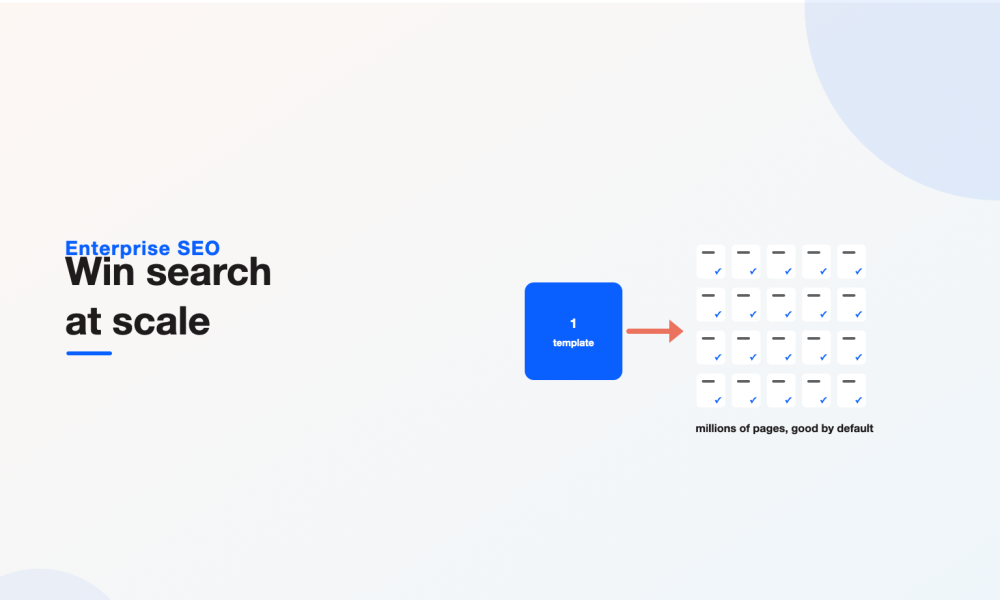
That shift, from optimising pages to optimising systems, is the heart of enterprise SEO. On a small site an SEO can personally rewrite every title, tune every page and fix every issue. At enterprise scale that is impossible; there are too many pages and too many teams touching them. So the enterprise SEO’s job becomes designing the templates, rules and workflows that make thousands or millions of pages good by default, and building the internal influence to get those changes shipped. The winners treat SEO as an operating discipline embedded across engineering, content and product, not a task list owned by one person.
How it differs from standard SEO
The principles of enterprise SEO are the same as any SEO: help search engines crawl and understand your pages, match real search intent with genuinely useful content, and earn the authority that makes you a trusted result. What changes is everything around execution. Across a large site, small inefficiencies multiply, a wasteful crawl pattern or a weak template repeated across a million URLs becomes a serious problem, while a single template improvement becomes a massive win. Prioritisation matters far more, because you can never do everything, and the opportunity cost of the wrong project is huge.
The other big difference is organisational. In standard SEO the person who decides is usually the person who executes. In enterprise SEO the person who knows what to do rarely controls the codebase, the CMS, the content calendar or the release schedule; they must persuade the teams who do. This is why enterprise SEO leans so heavily on stakeholder management, business cases and prioritisation frameworks. A brilliant recommendation that never ships is worth nothing, so a large part of the job is translating SEO opportunities into the language of revenue and roadmap so they actually get built. The technical and content work is necessary, but the ability to move an organisation is what separates enterprise SEO programmes that grow from those that stall.
The technical foundation at scale
Technical SEO is disproportionately important in enterprise SEO because leverage is enormous: fixes applied at the template or platform level cascade across the whole site. Crawl budget becomes a genuine concern when a site has millions of URLs, so controlling what search engines can and should crawl, through clean architecture, sensible pagination, canonicalisation, and pruning low-value pages, directly affects how much of your important content gets discovered and refreshed. For a small site crawl budget is irrelevant; at enterprise scale it can decide whether your new pages get indexed at all.
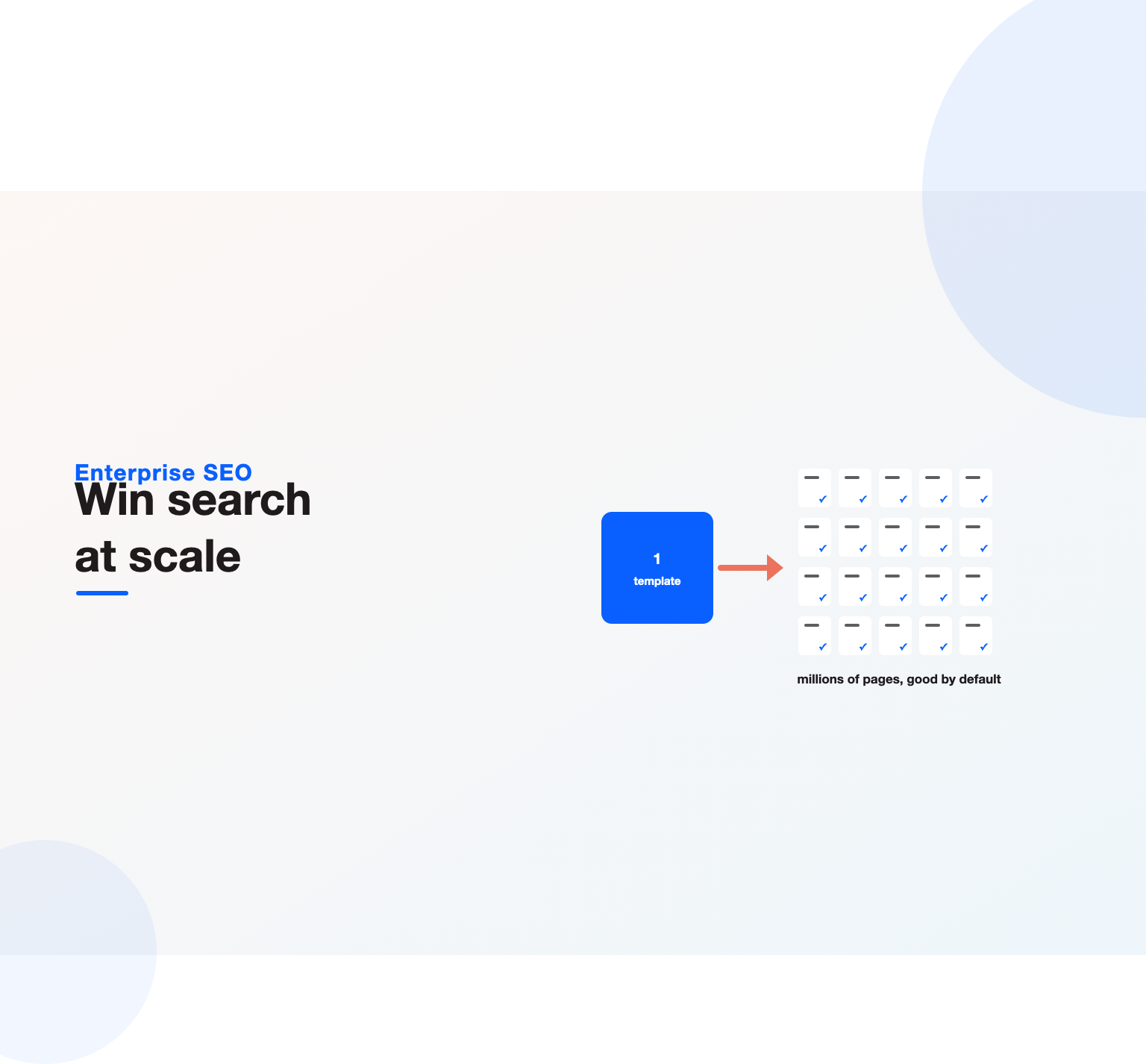
Site architecture is the other high-leverage technical lever. A logical, shallow structure with strong internal linking helps both users and engines find and value the right pages, and it distributes authority through the site efficiently. Getting the templates right, clean, fast-rendering, well-marked-up with structured data, means every page built on them inherits good SEO by default, which is the only way to keep quality high across millions of pages. Rendering matters especially where large sites rely on heavy JavaScript frameworks, because content the engine cannot render is content it cannot rank. In enterprise SEO, the technical foundation is not a checklist to complete once; it is a system to maintain as the site and its platforms constantly change.
Content and keywords at scale
Enterprise SEO cannot rely on hand-crafting each page, so content strategy becomes a question of systems and prioritisation. Keyword research at scale means mapping the whole demand landscape of a category, then deciding which clusters justify investment and which templates or programmatic approaches can serve large sets of similar pages, such as product, location or category pages, at consistent quality. The goal is to cover genuine demand comprehensively without producing thin, duplicative pages that dilute the site and waste crawl budget, a constant risk when generating pages at scale.
Quality control is therefore central to enterprise search content. Programmatic and templated pages are powerful, but only when each one genuinely serves a real query with useful, differentiated information; the same approach applied carelessly produces the doorway-style bloat that engines penalise. The strongest enterprise programmes pair scaled page generation with editorial standards and data quality, so a template produces thousands of pages that are each actually helpful. Meanwhile, high-value head and mid-tail topics still earn deliberate, expert, hand-crafted content, often the hub pages that anchor a cluster. Balancing systematised coverage with genuine depth on the pages that matter most is one of the defining skills of SEO at scale.
Not sure why your pages are not ranking or bringing enquiries?
Our team reviews your current setup and shows you where the opportunities are. See how our SEO services work.
Internal linking and site architecture
Across a large site, internal linking is one of the most powerful and most underused levers in the discipline. Because authority flows through links, how you connect your pages determines which ones engines treat as important, and a deliberate internal-linking strategy can lift priority pages without a single new backlink. This has to be systematised, through breadcrumb structures, hub-and-spoke topic clusters, contextual links generated by rules, and related-content modules, so that new pages are automatically woven into the site rather than stranded as orphans that engines rarely crawl or rank.
Architecture and internal linking are two sides of the same lever. A clean hierarchy that keeps important pages a few clicks from the home page, combined with strong topical clustering, tells engines what your site is about and where its authority should concentrate. Our guide to technical SEO covers the crawlability foundations this depends on, and the same clustering discipline underpins good on-page SEO. In large-site SEO, getting architecture and internal linking right is often the highest-return work available, precisely because it improves so many pages at once and compounds as the site grows.
The organisational challenge
The defining difficulty of the practice is rarely technical knowledge; it is getting things done inside a large organisation. SEO changes compete with every other priority for engineering time, and they often lose because their value is harder to see on a roadmap than a shiny new feature. Legacy platforms constrain what is possible, approval chains slow everything down, and different teams, product, engineering, content, brand, each own a piece of the site with their own goals. An enterprise search who cannot navigate this reality will produce excellent recommendations that never ship.
Winning at this work therefore demands skills that look more like product management and internal politics than keyword research. It means building business cases that translate SEO opportunities into projected revenue, so leadership can prioritise them against everything else. It means earning credibility with engineering by bringing well-scoped, low-friction requests rather than vague asks. And it means establishing SEO as a consideration baked into how the organisation builds, through documentation, guardrails and review steps, so quality is protected by default rather than fought for page by page. The most successful SEO at scale programmes are the ones that stop being a lobbying effort and become part of how the company operates.
Process, governance and workflow
Because execution is the bottleneck, mature large-site SEO runs on process and governance rather than heroics. That means clear ownership of SEO across teams, documented standards for what a good page looks like, and guardrails built into the CMS and development workflow so that common mistakes, a missing canonical, an accidental noindex, a broken template, are caught before they ship rather than discovered months later in a traffic drop. A single bad release at enterprise scale can deindex thousands of pages, so prevention through process is worth far more than reactive firefighting.
Governance also covers how change is prioritised and tracked. A good SEO at scale programme maintains a prioritised backlog scored by impact and effort, a testing capability to validate changes before rolling them out site-wide, and monitoring that alerts the team to indexation, traffic or technical regressions quickly. Automated auditing that continuously checks the site for issues is essential when no human can manually review millions of pages. This operational backbone, ownership, standards, guardrails, prioritisation and monitoring, is what lets the discipline scale without quality quietly eroding, and it is usually the difference between a programme that compounds and one that lurches from crisis to crisis.
Enterprise SEO and AI search
The rise of AI Overviews and answer engines raises the stakes for large-site SEO rather than replacing it. The same foundations that help large sites rank, clean technical health, strong authority, well-structured, genuinely useful content, are what make their pages eligible to be cited in AI-generated answers. For enterprises, the scale advantage can become an AI-search advantage: a large, authoritative, well-organised site has enormous surface area to be drawn on by answer engines, provided its content is structured and trustworthy. Our overview of AI search optimization covers how that visibility is earned.
What the practice must adapt is measurement and content emphasis. As AI answers absorb informational queries, some enterprise content will earn citations and influence rather than direct clicks, and programmes need to account for that shift instead of judging every page on clicks alone. The practical implication is to keep investing in the fundamentals, because they serve both classic rankings and AI citations, while extending measurement to capture presence in AI answers. Handled well, an enterprise’s existing scale and authority make it one of the best-positioned kinds of site to win in AI search, which is why enterprise search and AI-search readiness increasingly go hand in hand.
In-house team, agency, or both
Enterprise SEO usually requires more capacity and specialism than a single hire can provide, so most large organisations run some blend of in-house team and external support. An in-house team brings essential context, relationships and continuity; they understand the business, know which doors to knock on, and can push SEO into daily operations in a way no outsider can. What in-house teams often lack is bandwidth and breadth across the many specialisms this work touches, from technical and content to analytics and digital PR. Our comparison of in-house SEO versus an agency weighs the trade-offs in detail.
A specialist agency or consultancy complements the in-house team by adding senior expertise, extra execution capacity, and an outside perspective on priorities and pitfalls, which is valuable precisely because internal teams can get too close to their own site. The strongest setups pair an empowered internal owner with external specialists, so strategy stays connected to the business while execution gets the depth and scale it needs. For organisations that want that specialist partnership, our enterprise SEO services provide exactly this kind of support alongside an in-house team. Choosing the right mix depends on your internal maturity, but very few enterprises succeed at SEO with neither genuine internal ownership nor specialist depth.
Measuring enterprise SEO
Measurement in SEO at scale looks different from small-site SEO because tracking individual keyword rankings across millions of pages is neither feasible nor useful. Instead, mature programmes measure by segment and template, grouping pages by type, product, category, location, and watching how each segment performs, so they can see which templates and clusters are winning and which need work. This segment-level view turns an overwhelming site into a manageable set of levers, and it reveals systemic issues, a whole template underperforming, that page-by-page tracking would miss.
Above all, large-site SEO measurement ties back to business outcomes: organic traffic to the pages that drive revenue, conversions and pipeline from organic, and the value of the segments SEO is improving. Leadership funds SEO at scale on the strength of its contribution to the business, not its keyword positions, so connecting SEO metrics to revenue is essential both to prove value and to prioritise the right work. Alongside outcomes, technical health metrics, indexation coverage, crawl efficiency, template compliance, act as leading indicators that catch problems early. Measured this way, across segments, outcomes and technical health, the discipline becomes a manageable, accountable growth programme rather than an unmeasurable sprawl.
Getting started with enterprise SEO
For an organisation beginning to take large-site SEO seriously, the path starts with understanding the site at a systems level: audit the templates, architecture and technical health, and identify where scale is either helping or hurting. Because leverage is highest at the template and architecture level, the earliest wins usually come from fixing systemic issues, crawl waste, weak templates, poor internal linking, that improve many pages at once, rather than optimising individual pages. In parallel, establish who owns SEO across teams and how changes get prioritised and shipped, because that process is what will determine whether anything actually happens.
From there, the practice becomes an ongoing programme: a prioritised backlog scored by impact, guardrails that protect quality by default, segment-level measurement tied to revenue, and steady investment in the technical, content and authority fundamentals that serve both search and AI visibility. The organisations that treat it this way, as an operating discipline embedded across the business rather than a project owned by one team, are the ones that turn their scale from a liability into a compounding advantage. If you want specialist support to build and run that programme, our enterprise SEO services team works alongside enterprise in-house teams to do exactly that, and the broader SEO services practice extends the same rigour across every part of search. Done well, enterprise search turns a large, unwieldy site into the most durable growth channel a big organisation has.
Common enterprise SEO mistakes
A few predictable mistakes derail large programmes. The most common is treating the discipline as a page-by-page task rather than a systems problem, hand-optimising a few hundred pages while millions inherit a weak template. A second is neglecting the organisational work, producing flawless recommendations with no plan to get them shipped, so nothing changes. A third is scaling content without quality control, generating thousands of thin, near-duplicate pages that waste crawl budget and invite penalties instead of covering demand usefully. Each of these turns effort into motion without results.
A subtler mistake is ignoring measurement, chasing individual keyword rankings across a giant site instead of watching segments and business outcomes, so the team cannot tell what is actually working. Avoiding these traps is often faster than any positive tactic: fix the template rather than the page, invest in shipping rather than just recommending, control quality as you scale, and measure by segment and revenue. The same fundamentals that decide rankings also decide whether SEO is worth the investment, and our honest take on whether SEO is worth it and how long SEO takes to work set realistic expectations for a large programme.
Want a team to run this SEO work for you?
Book a free 30-minute strategy call and leave with a clear next step for your business.
Where to focus first
Because you can never do everything at enterprise scale, sequencing matters as much as the work itself. The highest-return starting point is almost always technical and architectural: fix crawl waste, strengthen templates, and improve internal linking, because those changes lift many pages at once. Next comes closing obvious content gaps in high-value clusters, informed by proper keyword research, and shoring up the authority of priority pages through internal links and, where justified, link building. Only after the systemic foundations are solid does page-level optimisation of individual high-value pages become worthwhile.
This sequencing keeps a programme from spreading itself thin. It also produces early, visible wins, systemic fixes that move whole segments, which is exactly what an SEO at scale needs to build the internal credibility that unlocks bigger investment. Framing the roadmap this way, biggest-leverage systemic work first, then targeted depth, is how the programme compounds rather than stalls, and it gives leadership a clear, defensible story for why each project comes when it does. For a full grounding in the fundamentals behind this sequence, our complete guide to SEO is a useful companion.
Enterprise SEO in the wider marketing mix
Large-site SEO does not operate in isolation; it works best when connected to the rest of a company’s marketing. Its data on what buyers search for informs product and content decisions across the business, and its owned-search visibility reduces reliance on paid channels over time, an economic argument our comparison of SEO versus PPC lays out. For software companies in particular, aligning search with product-led growth turns search into a scalable acquisition channel, as our guide to SaaS SEO explains.
Positioning search as a connected growth channel rather than a siloed technical function is also how it earns sustained investment. When leadership sees search driving qualified pipeline and lowering blended acquisition cost, SEO stops competing for scraps of the roadmap and becomes a priority in its own right. That shift, from tolerated cost centre to recognised growth engine, is the ultimate goal of a mature programme, and it is achieved by relentlessly tying the work to business outcomes and by choosing the right delivery model, whether that is an internal team, a partner, or the blend our guide to choosing an SEO agency helps you weigh.
Key Takeaways
- Optimise systems, templates, architecture and process, not individual pages, because that is where leverage lives at enterprise scale.
- Treat execution as the bottleneck: build business cases, earn engineering trust, and bake SEO into how the organisation ships.
- Prioritise high-leverage technical work (crawl budget, templates, internal linking) that improves many pages at once.
- Systematise content and internal linking with strict quality control to avoid thin, duplicative pages.
- Measure by segment and business outcome, not individual keyword rankings, and monitor technical health as an early-warning system.
Frequently asked questions
What is enterprise SEO?
Enterprise SEO is search optimisation practised at scale, for large websites with many pages, multiple stakeholders and complex technical systems. The core principles match regular SEO, but executing them across a huge site with competing teams, legacy platforms and slow release cycles is the real challenge, so this work is as much about process, prioritisation and cross-team influence as it is about keywords and links.
What size company needs this?
It is defined by conditions, not headcount. Any organisation whose site is large enough that pages cannot be optimised by hand, that has multiple teams touching the site, or that runs on complex legacy technology faces these problems, even a mid-sized business with a huge catalogue. Conversely, a big company with a small, simple site may not. If your bottleneck has shifted from knowing what to do to getting changes shipped across teams and templates, you are already operating at this scale and need the systems-and-process approach rather than page-by-page tactics.
How is enterprise SEO different from regular SEO?
The fundamentals are the same; the constraints differ. At scale, small inefficiencies multiply and single template fixes create huge wins, so prioritisation matters enormously. The biggest difference is organisational: the person who knows what to do usually does not control the code, CMS or roadmap, so SEO at scale depends heavily on stakeholder management and business cases to get changes shipped.
Why is technical SEO so important for enterprise sites?
Because leverage is enormous. On a site with millions of URLs, crawl budget becomes a real constraint, and a fix applied at the template or platform level cascades across the whole site. Clean architecture, efficient crawling, fast rendering and solid templates mean every page inherits good SEO by default, which is the only practical way to keep quality high across a very large site.
How do you do keyword research and content at enterprise scale?
You map the whole demand landscape of a category, decide which clusters justify investment, and use templates or programmatic approaches for large sets of similar pages, paired with strict quality control so each page genuinely serves a real query. High-value hub and head topics still earn deliberate, expert content. The goal is comprehensive coverage without thin, duplicative pages that waste crawl budget.
Should enterprise SEO be handled in-house or by an agency?
Usually both. An in-house team brings business context, relationships and continuity, while a specialist agency adds senior expertise, extra capacity and an outside perspective. The strongest setups pair an empowered internal owner with external specialists, so strategy stays connected to the business while execution gets the depth and scale large-site SEO requires. Very few enterprises succeed with neither.
How do you measure enterprise SEO?
By segment and business outcome rather than individual keyword rankings. Group pages by type, product, category or location and track how each segment performs, then tie results to revenue and pipeline. Technical-health metrics like indexation coverage and crawl efficiency act as leading indicators. This makes a sprawling site measurable and keeps the programme accountable to the business.
How much does enterprise SEO cost?
It varies widely with the size of the site, the competitiveness of the market, and how much execution is handled in-house versus by a partner, but enterprise programmes sit well above small-business SEO because the scope, technical work and cross-team coordination are far larger. The right way to judge it is by return: large-site SEO should be measured against the qualified pipeline and revenue it drives, not its monthly cost. Our transparent look at how much SEO costs frames the ranges and the value question.
Does AI search change enterprise SEO?
It raises the stakes rather than replacing it. The same foundations that help large sites rank also make their pages eligible for citation in AI answers, and an enterprise’s scale and authority position it well to win AI visibility. The main adaptation is measurement: as AI answers absorb some informational queries, programmes should track presence and influence in AI answers alongside clicks, while continuing to invest in the shared fundamentals.
Ready to put this into practice?
Talk to the team that runs SEO, AI search and paid growth programs every day.
Book a Strategy Call →