
Gemini SEO: How to Get Cited by Google’s Gemini and AI Overviews
Gemini SEO gets your brand cited by Google's Gemini and AI Overviews. Why it rewards E-E-A-T and Google's index, the content and schema that work, and how to measure it.
Quick Answer
Gemini SEO is the practice of optimizing your content and brand so Google’s Gemini models mention, cite or draw on you when they generate answers, including in AI Overviews. Because Gemini is built on Google’s index and ranking systems, it rewards the signals Google already values, strong E-E-A-T, authoritative content, solid technical SEO and structured data, combined with the answer-first clarity that generative systems favor. In practice, Gemini SEO extends good Google SEO into Google’s generative surfaces rather than replacing it, so brands with genuine search authority start with a real advantage.
Of all the AI assistants competing for attention, Gemini has an advantage none of the others can match: it is built by the company that already indexes the web. When Gemini answers a question or powers an AI Overview, it draws on Google’s understanding of your site, your authority and your content, the same understanding that has decided your rankings for years. That makes Gemini SEO a distinctive discipline. Getting mentioned by Gemini is less about starting from scratch and more about extending the search visibility you have already earned into Google’s generative surfaces. This guide explains how Gemini sources its answers, why it rewards the signals Google has always valued, and the concrete steps that put your brand into its responses. If you have spent years building genuine authority in Google Search, much of that work is already an asset here, and the task is to point it deliberately at Google’s generative surfaces rather than to start over with an unfamiliar playbook. That head start is real, and this guide is written to help you use it rather than to send you chasing tactics that have little to do with how Gemini actually works.
Key Highlights
- Gemini is built on Google’s index and ranking systems, so Gemini SEO rewards the same authority and quality signals that drive traditional Google rankings.
- Strong E-E-A-T, authoritative content and clean technical SEO are the foundation, since Gemini inherits Google’s judgments about which sources to trust.
- Answer-first structure and clear, well-organized content help Gemini extract and reuse your material in generated answers and AI Overviews.
- Structured data and consistent entity information help Gemini understand who you are and represent you accurately.
- Spanning Search, Workspace and its own app, Gemini lets presence in its answers compound the visibility you already earn in Google.
What Gemini SEO means
At its core, it is the work of making your brand a source that Google’s Gemini models rely on when they generate answers. The reason it deserves its own name, rather than folding entirely into general AI optimization, is that Gemini’s relationship to Google changes the playbook. Where a standalone assistant has to form its own view of your brand, Gemini can lean on Google’s existing, deeply developed understanding of your site, an understanding shaped by years of crawling, ranking and quality assessment. The practice is therefore about ensuring that understanding is strong and positive, and that your content is structured so Gemini can readily use it when it composes a response.
This gives Gemini SEO a dual character. On one hand it demands everything modern AI optimization asks for: clear, answer-first content, genuine authority, and consistent information a model can trust. On the other hand it rewards the traditional Google signals more directly than any other assistant, because Gemini is drawing on the very systems those signals feed. A brand that has earned real authority in Google Search, with quality content, credible backlinks and clean technical foundations, has already done much of the work of Gemini SEO, and its task is to extend that foundation into the generative formats Gemini produces rather than to build a wholly new presence.
How Gemini sources its answers
To optimize for Gemini you have to understand where its answers come from, and the short version is that Google’s index is central. Gemini models are trained on broad knowledge, but when they answer questions that need current or specific information, they draw on Google’s live understanding of the web, the same index and quality systems that power Search. This is most visible in AI Overviews, where the generated summary is assembled from sources Google’s systems surface and trust. The practical implication for Gemini SEO is direct: being well-understood and well-regarded by Google Search is the strongest lever you have, because that is the judgment Gemini inherits when it decides which sources to build an answer from.
Gemini also reaches beyond Search into Google’s wider ecosystem, including Workspace apps and its own assistant, and it is multimodal, able to work with text, images and more. But across these surfaces the underlying reliance on Google’s understanding of quality and authority remains a constant. This is why Gemini SEO does not ask you to chase a separate, mysterious algorithm; it asks you to be the kind of source Google already trusts and to present your content clearly enough for a generative model to use. The brands that win are the ones whose Google foundations are strong and whose content is structured for extraction, because both of those feed directly into how Gemini composes its answers.
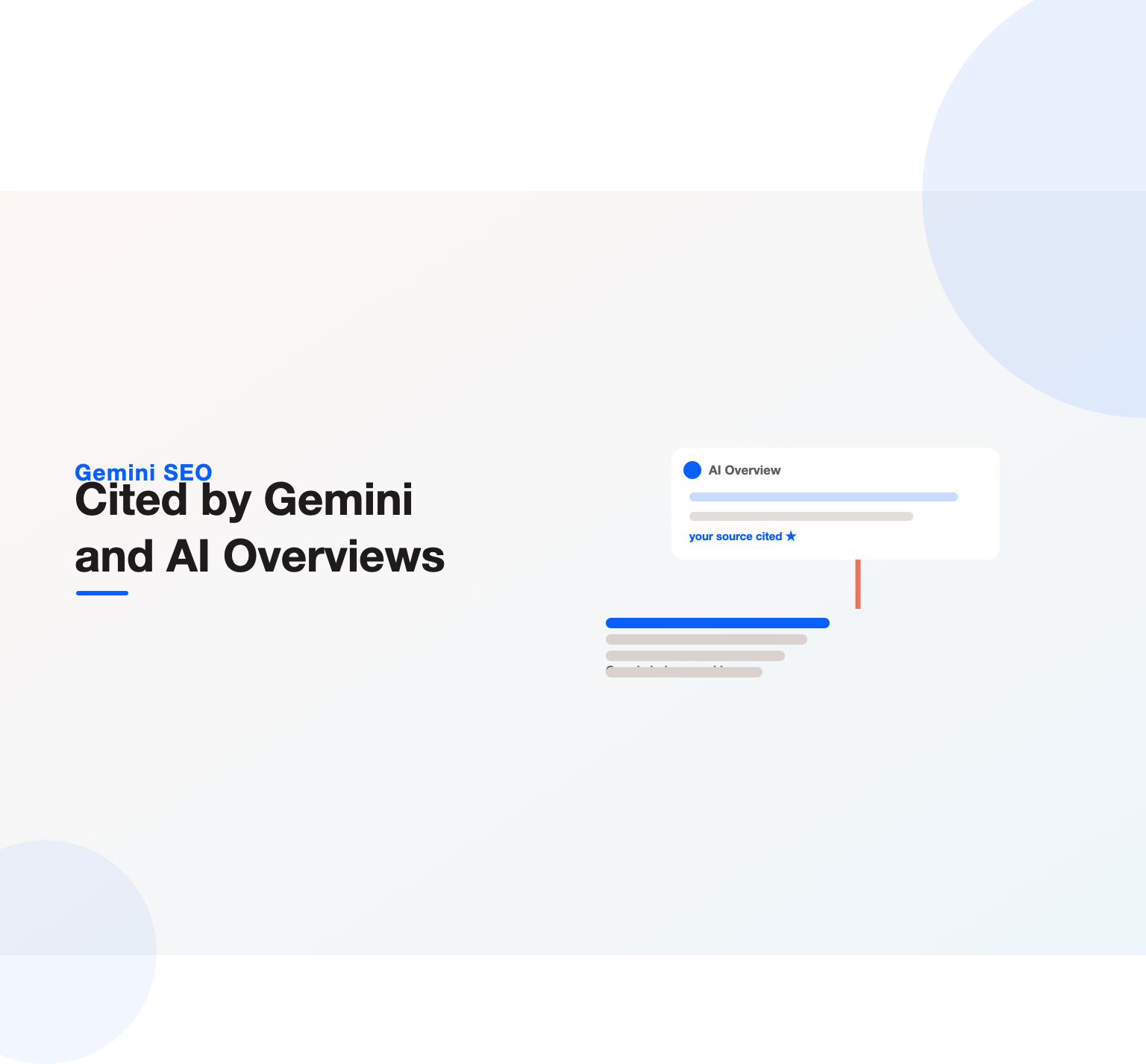
E-E-A-T is the foundation
Since Gemini inherits Google’s quality judgments, E-E-A-T, experience, expertise, authoritativeness and trustworthiness, sits at the center of Gemini SEO. Google has spent years refining its ability to assess whether content comes from a credible, experienced source, and Gemini benefits from that assessment when it chooses what to draw on. Content that demonstrates real expertise, is written or reviewed by identifiable experts, and comes from a site with a strong reputation is exactly what Gemini is most comfortable using. Building genuine E-E-A-T, through expert authorship, depth, accuracy and a credible reputation, is therefore not a general nicety but the specific foundation Gemini SEO rests on.
This makes Gemini SEO unusually aligned with sustainable, quality-first SEO. The tactics that game rankings tend to fail here, because the same systems that increasingly discount them in Search discount them in what Gemini surfaces. What works is the durable work: demonstrating first-hand experience, showing expertise clearly, earning authority through genuine recognition, and being trustworthy in your claims and transparent about who you are. A brand that invests in real E-E-A-T builds a foundation that pays off in traditional rankings and in Gemini’s generated answers at once, which is one of the reasons Gemini SEO rewards patience and substance over shortcuts.
Content and structure for Gemini
Strong authority gets Gemini to trust you; clear structure lets it use you. Like other generative systems, Gemini extracts and reuses content most easily when it is organized around real questions and states its answers directly. Leading a section with a concise, self-contained answer, using headings that mirror how people ask about a topic, and expressing key facts as clean, standalone statements all make your content easier for Gemini to draw into an answer or an AI Overview. This answer-first discipline is a core part of the practice, because even a highly authoritative page is less useful to the model if its substance is buried in long, meandering prose.
Depth and comprehensiveness matter alongside clarity. Google has long favored content that thoroughly satisfies a query, and Gemini reflects that preference when it selects sources to synthesize. Content that genuinely and completely answers the questions around a topic, organized so each part is easy to locate and extract, gives Gemini both the substance and the structure it needs. The most effective content for Gemini is therefore both authoritative and well-architected: deep enough to be the best answer, and clear enough that a generative model can lift the relevant piece cleanly. Pairing real depth with answer-first structure is how you make your content the material Gemini prefers to build from.
Structured data and entities
Structured data plays a natural role in this work because it speaks Google’s language directly. Schema markup that describes your organization, articles, products, authors and their relationships gives Google, and by extension Gemini, an explicit, machine-readable account of your entities rather than leaving everything to be inferred. As Gemini relies on Google’s understanding of the web, anything that sharpens that understanding, clear structured data, consistent entity information, an accurate representation of who you are, helps Gemini represent you correctly in its answers. Implementing relevant schema and keeping it accurate is a concrete, high-value Gemini visibility task precisely because it feeds the systems Gemini draws on.
Entity consistency reinforces this. Google builds a model of the entities it encounters, and contradictions, an out-of-date description here, an inconsistent detail there, weaken that model and the confidence Gemini can place in it. Describing your brand, people and offerings consistently across your site and the wider web strengthens Google’s entity understanding and, through it, Gemini’s ability to represent you accurately. This is where the discipline overlaps with broader entity and knowledge-graph work: the clearer and more consistent your entity footprint, the more reliably Gemini can identify you as the right source and reflect you correctly when it generates an answer.
How Gemini SEO relates to the wider discipline
This is one platform-specific instance of optimizing for AI answers, and it shares its foundations with the adjacent disciplines. The clear, authoritative, well-structured content that helps with Gemini also helps with ChatGPT, Perplexity and other assistants, because all of them reward quality and clarity. What is distinctive about Gemini is its deep reliance on Google’s index and ranking systems, which makes traditional SEO signals and E-E-A-T more directly decisive than they are for assistants that form their own view. For the umbrella that connects these efforts, our guide to AI search optimization frames the wider practice, and our explainer on LLM SEO covers the model-facing strategy in depth.
Treating this practice as part of this broader discipline keeps effort efficient. Rather than building a separate program for Gemini, the productive approach is to do the core work, quality content, genuine authority, clean technical foundations and consistent information, well once, and then lean into the Google-specific signals that Gemini rewards most. Given how closely Gemini is tied to Search, much of this work is simply excellent, sustainable Google SEO expressed with answer-first clarity. Understanding both the shared fundamentals and Gemini’s Google-rooted particulars is what lets a brand appear in its answers without reinventing its strategy, and our comparison of ChatGPT SEO shows how the emphasis differs across assistants.
Measuring Gemini SEO
You can measure Gemini visibility fairly directly, because Google’s generative surfaces are observable. For your priority questions, check how Gemini and AI Overviews respond, whether your content is cited or reflected, and which competitors appear, then track how that changes as you strengthen your foundations. Since AI Overviews are tied to Search, your traditional rankings and visibility for a query are a strong leading indicator: content that ranks well and is well-structured is far more likely to feed the generated summary. Watching both your rankings and your presence in Gemini’s answers gives a fuller picture than either alone.
This measurement turns the practice into a practical feedback loop that connects to work you already do. When you are absent from an AI Overview on a topic you should own, the fix is usually the familiar one: strengthen the content’s depth and authority, sharpen its structure, and improve its standing in Search. When Gemini misrepresents you, that points to entity or consistency issues to correct. Treating each generated answer as evidence, and each gap as a task tied to your broader Google presence, keeps optimizing for Gemini grounded in durable improvements rather than surface tricks. Our overview of how brands win AI search connects this measurement to the actions that move it.
Getting started with Gemini SEO
For a brand beginning this work, the path builds on foundations you may already have. Start by strengthening the Google fundamentals: genuine E-E-A-T, deep and accurate content, clean technical SEO and relevant structured data, because these feed directly into what Gemini surfaces. Then make your most important content answer-first and well-structured, so Gemini can extract and reuse it cleanly. Check how Gemini and AI Overviews currently answer your priority questions to see where you appear and where you are absent, and use those gaps to prioritize the content and authority work that will close them.
From there, Gemini visibility becomes an ongoing extension of your Google strategy: keep raising content quality and authority, maintain consistent entity information and structured data, and re-check Gemini’s answers regularly to confirm your presence is growing. Because Gemini rewards durable, quality-first signals, the effort compounds and is unusually resistant to being undone by algorithm changes, since it aligns with where Google has been heading for years. If you want a partner to build and run that program across Gemini and the other assistants, our answer engine optimization services team does exactly this work, and our generative engine optimization services extend it to every generative surface. As Google weaves Gemini through more of Search and its products, being a source it draws on becomes an increasingly valuable extension of the visibility you already work to earn.
A Gemini SEO checklist
It helps to turn the approach into a checklist you can run against any important page. Does the content demonstrate genuine experience and expertise, with identifiable expert authorship. Is it deep and comprehensive enough to be the best answer to its query. Is it technically sound and crawlable, so Google can fully understand it. Does it include accurate, relevant structured data for your key entities. Does it lead with clear, self-contained answers a generative model can extract. Is your brand and entity information consistent across the site and the wider web. Running this list against your highest-value pages is the fastest way to make them strong candidates for Gemini’s answers, and it grounds the practice in the same durable quality work that improves your Google rankings.
The value of the checklist is that it keeps the work aligned with sustainable practice rather than chasing a separate set of tricks. Every item on it is something Google has rewarded for years and something a generative model benefits from, so the work does double duty. It also lets a team contribute consistently: writers can own depth, expertise and answer-first structure, while technical owners handle crawlability and structured data. For the writing habits that pair with this, our guide to answer-first content is a useful companion, and our overview of how engines choose which brands to cite explains why these signals carry weight.
Common Gemini SEO mistakes
Several avoidable errors undercut this work. The most common is treating it as a novelty disconnected from your existing Google work, when in fact strong traditional SEO and E-E-A-T are the foundation Gemini draws on, so neglecting your core Google presence undermines the very thing Gemini rewards. A second mistake is relying on ranking tricks or thin, low-authority content, which the same systems that increasingly discount them in Search discount in what Gemini surfaces. A third is ignoring structure, publishing authoritative content in a form so dense that a generative model cannot cleanly extract it, which wastes the authority you worked to build.
A subtler mistake is inconsistency in your entity information, describing your brand or key facts differently across pages and profiles, which weakens Google’s model of who you are and, through it, Gemini’s ability to represent you accurately. The productive mindset treats it as the natural extension of quality-first Google SEO: genuine authority, deep content, clean technical foundations, consistent entities, and answer-first structure, all working together. Avoiding these mistakes removes the specific reasons Gemini might overlook or misrepresent you, and our roundup of the common mistakes that hurt AI citation catalogues the broader patterns to steer clear of.
Gemini across Google’s products
Part of what makes this practice valuable is that Gemini appears in more places than a standalone assistant. It powers AI Overviews in Search, it is woven into Workspace tools, and it drives Google’s own Gemini app and assistant experiences. Presence in Gemini’s answers therefore has the potential to surface your brand across a wide surface area of touchpoints that people already use daily, from a search summary to an assistant reply. This breadth is why Gemini SEO can compound the value of your existing Google visibility: the same authority and clarity that get you surfaced in one Gemini-powered context tend to help across the others, since they all draw on Google’s shared understanding of quality.
This ecosystem reach also reinforces why the fundamentals matter more than any single tactic. Since these surfaces share Google’s underlying systems, there is no separate trick for each one; the way to appear across them is to be a genuinely trusted, well-structured source that Google understands well. That is a reassuring simplification for anyone doing Gemini SEO, because it means the effort concentrates rather than fragments. A single investment in real authority, clean structure and consistent information pays off wherever Gemini shows up, and our broader guide to AI search optimization places this ecosystem effect within the wider shift toward AI-mediated search.
Where Gemini is heading
Google is weaving Gemini through more of Search and its wider product suite, and the trajectory points to generative answers handling a growing share of how people find information. As that unfolds, being a source Gemini draws on will shift from an advantage to a baseline expectation, and the brands that built strong Google foundations and clear, extractable content early will hold positions later entrants struggle to take, since Gemini keeps leaning on the authority Google has already assessed. The reassuring part is that the durable, quality-first work Gemini SEO calls for is unusually resistant to disruption, because it aligns with the direction Google has been moving for years rather than betting on a fleeting tactic.
For brands, the implication is to treat Gemini SEO as a natural extension of a serious Google strategy, pursued now rather than deferred. The surface is expanding, and the foundations that earn a place in Gemini’s answers, genuine expertise, depth, trust and clarity, compound over time and rarely need to be undone. Investing while many competitors still treat generative answers as separate from their core SEO is how a brand becomes a default source across Google’s generative surfaces before the field crowds. As Gemini becomes more central to how Google works, being one of the sources it relies on becomes an increasingly valuable extension of the search visibility you already work to build, and our look at how buyers use AI to choose vendors shows why that presence increasingly shapes who gets considered.
Related reading
- AI Search Optimization: The Definitive Guide
- ChatGPT SEO: Get Your Brand Named by ChatGPT
- LLM SEO: How to Get Recommended by AI Models
- Generative Engine Optimization: The Practical Guide
- How Brands Win AI Search
Key Takeaways
- Strengthen your core Google E-E-A-T and technical SEO first, since Gemini inherits those judgments.
- Make your top pages answer-first and add accurate structured data for your key entities.
- Keep your brand and entity information consistent across your site and the wider web.
- Check AI Overviews and the Gemini app for your priority questions, and close the gaps you find.
Frequently asked questions
What is Gemini SEO?
Gemini SEO is the practice of optimizing your content and brand so Google’s Gemini models mention, cite or draw on you when they generate answers, including in AI Overviews. Because Gemini is built on Google’s index and ranking systems, it rewards the signals Google already values, E-E-A-T, authority, technical SEO and structured data, combined with answer-first clarity, so it largely extends good Google SEO into generative surfaces.
How is Gemini different from ChatGPT for SEO?
The biggest difference is Gemini’s deep reliance on Google’s index and ranking systems, which makes traditional SEO signals and E-E-A-T more directly decisive. ChatGPT leans more on training-data reputation and its own browsing, so consensus across the web matters heavily there. For Gemini, being well-understood and well-ranked by Google Search is the strongest lever, which means the discipline overlaps more tightly with classic Google optimization.
Does traditional SEO help with Gemini?
Yes, more directly than with any other assistant. Since Gemini draws on Google’s understanding of the web and AI Overviews are tied to Search, strong rankings, genuine E-E-A-T, clean technical SEO and structured data all feed into what Gemini surfaces. In practice much of this practice is simply excellent, sustainable Google SEO expressed with answer-first structure, so the two reinforce each other rather than competing.
How does structured data help Gemini SEO?
Structured data gives Google, and by extension Gemini, an explicit, machine-readable account of your entities and their relationships, which sharpens the understanding Gemini relies on. Clear schema for your organization, authors, products and content, kept consistent with how you are described across the web, helps Gemini identify you correctly and represent you accurately in its answers, making it a concrete, high-value task.
What role does E-E-A-T play?
A central one. Since Gemini inherits Google’s quality judgments, experience, expertise, authoritativeness and trustworthiness strongly influence which sources it draws on. Content that demonstrates real expertise, is written or reviewed by identifiable experts, and comes from a reputable site is exactly what Gemini is most comfortable using, so building genuine E-E-A-T is the foundation optimizing for Gemini rests on rather than an optional extra.
How do I measure Gemini SEO?
Check how Gemini and AI Overviews answer your priority questions, whether your content is cited or reflected, and which competitors appear, then track changes as you improve. Because AI Overviews are tied to Search, your rankings and visibility for a query are a strong leading indicator, so watching both rankings and presence in Gemini’s answers gives the fullest picture and points to the specific content or authority work to do.
Does Gemini use my Google Business Profile and reviews?
For local and business queries, Google’s understanding of your business, including your Business Profile, categories, and reviews, feeds the same systems Gemini draws on, so keeping that information accurate and complete helps Gemini represent you correctly. As with the rest of this work, the principle is consistency: the clearer and more accurate your presence is across Google’s properties and the wider web, the more reliably Gemini can identify and describe your business in its answers.
Do I need to do anything different for AI Overviews versus the Gemini app?
Not fundamentally. Both draw on Google’s understanding of quality and authority, so the same foundations, genuine E-E-A-T, deep and well-structured content, clean technical SEO and consistent entities, serve you across AI Overviews in Search and the standalone Gemini app. There is no separate trick for each surface; strengthening the shared foundation is what improves your presence everywhere Gemini appears, which is what makes the effort concentrate rather than fragment.
How does Gemini SEO fit with a broader AI search strategy?
It is the Google-rooted piece of a wider effort. The clear, authoritative, well-structured content that wins with Gemini also helps with ChatGPT, Perplexity and other assistants, so most of the work overlaps. What is distinct is Gemini’s heavy reliance on Google’s index and E-E-A-T, which means your traditional Google strength matters more here than anywhere else. A complete strategy does the shared fundamentals once and then leans into each platform’s specifics, with Gemini’s specifics being, in large part, excellent sustainable Google SEO.
Is Gemini SEO worth the effort if AI Overviews reduce clicks?
Yes, and arguably more so. As AI Overviews answer more queries directly, the exposure that once came from a ranked link increasingly comes from being cited or reflected in the overview itself, so a brand absent from Gemini’s answers loses visibility it used to capture through rankings alone. Investing in the content and authority that get you into those answers is how you defend and extend your presence as the surface shifts, rather than watching AI Overviews absorb attention you no longer receive. The brands that treat this as a reason to strengthen their foundations, not retreat, are the ones that keep their visibility as search changes.
Can smaller brands win at Gemini SEO?
Yes, especially by concentrating on genuine E-E-A-T and depth within a focused topic. Given that Gemini rewards quality and authority signals rather than raw size, a smaller brand that becomes a clearly expert, well-structured, trustworthy source on its niche can be surfaced in Gemini’s answers even against larger competitors. Focus and quality are how smaller brands win at Gemini visibility while broad, shallow sites are passed over.
Ready to put this into practice?
Talk to the team that runs SEO, AI search and paid growth programs every day.
Book a Strategy Call →