 Skip to content

How to Write Answer-First Content That AI Engines Extract
How to write answer-first content AI engines extract: lead every section with a clear, self-contained answer, then support it. The technique, with examples.
Quick Answer
Answer-first content leads each section with a direct, self-contained answer, then supports it, so AI engines can lift a clean, correct passage into their responses. Writing this way, plus quotable statements and clear structure, is the single highest-leverage habit for earning AI citations.
To write answer-first content that AI engines extract, lead every section with a clear, self-contained answer in the first one or two sentences, then follow with the detail, evidence and nuance that support it. Answer engines lift clean, complete passages; content that states the answer up front gives them exactly that, while content that buries it forces them to a clearer source. This guide shows you the answer-first technique step by step, with examples of the pattern and the mistakes that stop your content being extracted.
Key Highlights
- Lead every section with a clear, self-contained answer in the first one or two sentences.
- Follow the answer with the detail, evidence and nuance that support it.
- Use question-shaped headings that mirror how people actually ask.
- Keep each answer self-contained so it can be lifted without surrounding context.
- Answer-first does not mean shallow, it means front-loading the conclusion, then proving it.
What answer-first writing means
In practice, answer-first writing means putting the direct answer to a question at the very start of the section that addresses it, before the context, caveats and elaboration. It inverts the way many people naturally write, which is to build up to a conclusion. For answer engines, and for busy readers, that build-up is friction. The engine wants a clean, self-contained statement it can lift and attribute; the reader wants the answer before they decide whether to read on. In many cases, answer-first structure serves both, and it is the single highest-return writing habit for citability.
Why AI engines reward answer-first writing
Answer engines build responses by extracting passages from sources and synthesising them. A passage that contains a complete, standalone answer is easy to lift and attribute; a passage where the answer is scattered across several paragraphs, or dependent on earlier context, is hard to use. When your content leads with the answer, you hand the engine a ready-made building block, which makes you the path of least resistance. When you bury it, you make the engine work, and it will usually just pick a source that did the work for it. For most teams, answer-first writing is, in effect, formatting your content for how extraction actually happens.
How to write answer-first content: the basic pattern
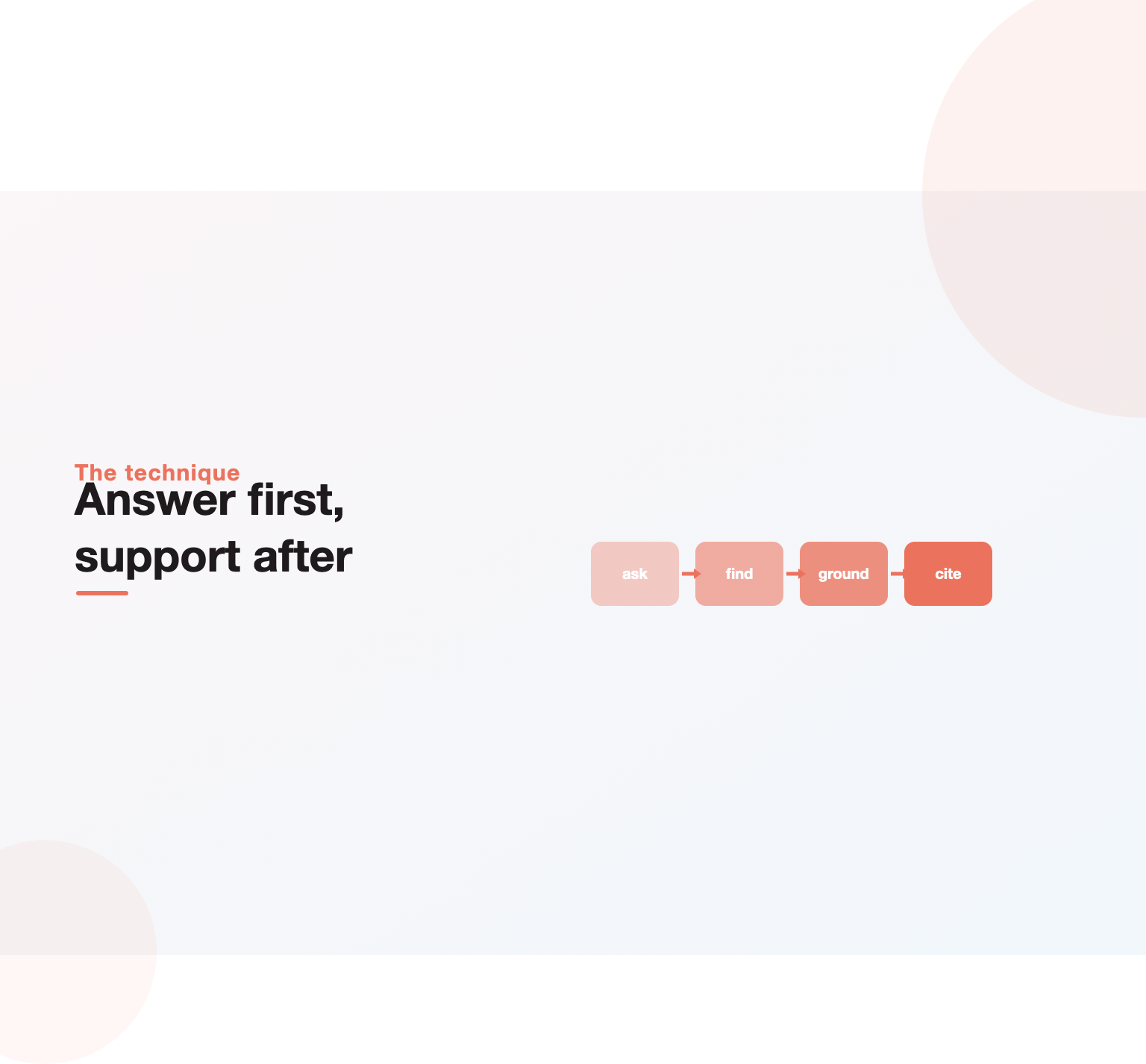
The core pattern is simple: question-shaped heading, then a direct answer in the first one or two sentences, then the support. If the heading asks how long something takes, the next sentence states the timeframe before explaining what affects it. If it asks what something is, the next sentence defines it plainly before elaborating. The answer should stand on its own, meaning a reader who saw only those first sentences would still get a correct, useful response. Everything after it, the reasoning, examples, caveats and depth, earns the reader’s trust and gives the engine supporting context, but the answer comes first. Learning how to write answer-first content starts with this pattern.
A before-and-after example
Consider the question of how long SEO takes. The buried version opens with several sentences about how it depends on many factors, competition, the site’s history, the resources available, before eventually, somewhere in the third paragraph, admitting it is usually three to six months. The answer-first version opens with the answer: meaningful results typically take three to six months, then explains what shortens or lengthens that. Both contain the same information; only the second hands the engine a clean, liftable answer and respects the reader’s time. The difference is not more work, just a reordering, and it is the difference between being cited and being skipped.
Use question-shaped headings
In short, answer-first content works best under headings phrased as the questions people actually ask, because they help the engine match your passage to a query and signal exactly what the answer below addresses. A heading that reads as the real question, in the words a user would use, does double duty: it organises the page for readers and it maps your content to the prompts you want to be cited for. Vague, clever or label-style headings miss this, so favour the plain question over the witty phrase when citability is the goal.
Keep answers self-contained
A passage the engine can lift must make sense on its own, without depending on something three paragraphs earlier. Avoid opening an answer with this, that or as mentioned above, which break the moment the passage is extracted. Restate the subject where it matters, define terms the first time they appear in a section, and make each answer able to travel on its own. This feels slightly repetitive when reading top to bottom, but it is exactly what makes individual passages extractable, and readers arriving mid-page from a search benefit too.
Answer-first does not mean shallow
A common worry is that leading with the answer makes content thin or gives everything away. It does the opposite. Stating the answer first earns you the reader’s attention to go deeper, and the depth, the reasoning, evidence, examples and nuance, is what builds trust and demonstrates the expertise that makes you citable in the first place. Equally, answer-first is about order, not amount. Lead with the answer, then prove you understand it better than anyone else. The best answer-first content is both immediately useful and genuinely deep.
In practice, answer-first for different question types
Learning how to write answer-first content means adapting the opening to the kind of question being asked. For a definition question, lead with a one-sentence definition, then elaborate. For a how-long or how-much question, lead with the number or range, then the factors. For a how-to, lead with a short statement of the overall approach or the first decisive step, then the detail. For a should-I or which-is-better question, lead with a clear recommendation and the condition it depends on, then the reasoning. In every case the pattern is the same, resolve the question immediately, then support, but the shape of that opening answer changes with the question. Recognising the question type and answering it in its natural form is what makes the passage feel complete enough to lift.
The inverted pyramid, adapted for AI
In practice, answer-first writing is the old journalistic inverted pyramid, tuned for answer engines. Journalists put the most important information first so a reader who stops early still gets the story; you put the answer first so an engine that extracts only the opening still gets a correct, complete response. The adaptation for AI is that each section, not just the article, needs its own pyramid, because engines extract at the passage level. So rather than one big answer at the top of the page and detail below, you write many small pyramids: each question-shaped section opens with its own answer and narrows into its own support. Think of the page as a stack of self-contained answers, each independently liftable, rather than one long argument that only makes sense read start to finish. That is the essence of how to write answer-first content.
How much to put in the opening answer
The opening answer should be complete enough to stand alone but tight enough to lift, usually one to three sentences. It must contain the actual answer, not a promise of one, so a reader or engine seeing only those sentences gets real value. The test is whether the opening could be quoted on its own and still be correct and useful. Too short, and it is a teaser that answers nothing; too long, and the answer dilutes into the support and stops being cleanly extractable. Aim for the shortest complete answer, then let everything after it add the depth, evidence and nuance that earn trust and demonstrate expertise without cluttering the liftable core.
In many cases, answer-first, voice, and featured snippets
The same technique that wins AI citations also wins featured snippets and voice answers, because all three reward a clean, extractable response. A featured snippet is Google lifting a concise answer from a page; a voice assistant reads a single answer aloud; an AI engine synthesises from extractable passages. Content written answer-first is optimised for all of them at once, which is why the habit pays off across every answer surface rather than just one. If you already optimise for featured snippets, you are most of the way to answer-first AEO; if you are starting fresh, know that the effort compounds across search, voice and AI simultaneously.
How to write answer-first content: a worked rewrite
Take a section headed with a vague label like Our approach, opening with a paragraph about the company’s philosophy before eventually explaining what it actually does. The answer-first rewrite is mechanical. First, change the heading to the real question a user asks, such as how the process works. Second, move the concrete answer, the actual steps or method, into the first two sentences. Third, make that opening self-contained by restating the subject rather than relying on earlier context. Fourth, keep the philosophy and colour, but move it below the answer as supporting detail. Nothing is deleted; it is reordered so the answer leads. Do this across a page’s key sections and you convert content an engine skipped into content it can lift, usually in an afternoon of editing rather than a rewrite.
Balancing answer-first with brand voice
A fair worry is that leading with the answer makes content feel robotic or strips out the brand voice and storytelling that differentiate you. It does not have to. In many cases, answer-first governs the order and the opening of each section, not the entire personality of the page. Lead with the clean answer so it is extractable, then let your voice, perspective, examples and narrative carry the supporting depth beneath it. The best answer-first content reads as confident and clear, gets to the point, then earns attention with genuine insight and character. Readers appreciate not being made to hunt for the answer, and the space below the opening is more than enough for the storytelling and personality that build brand. Clarity and character are not in tension; burying the answer just makes you seem evasive.
Testing whether your content is extractable
You can check extractability directly rather than guessing. Read only the first two sentences of each section: do they answer the section’s question on their own? If yes, that passage is liftable; if you have to read further to find the answer, it is not. Run the real questions through the answer engines and see whether they quote you, a competitor, or no one, and study what the cited sources did that you did not. Check that your answers exist as real text, not locked in images or tables. This quick, repeatable test turns extractability from an abstract goal into a concrete checklist, and re-running it after edits shows whether your changes actually made the content easier to lift.
Where answer-first matters most on your site
You do not have to rewrite every page at once, so start where answer-first pays off most. Prioritise the pages targeting the questions your buyers actually ask an engine, the informational and consideration-stage content where citations are won, and the pages you already rank for but that are not being cited, which usually just need their answers surfaced. High-traffic pages that convert poorly are also strong candidates, since a clearer answer up front helps both engines and readers. Lower down the list sit deep archival pieces and pages that will never be query targets. Sequencing this way means your first editing effort lands on the pages most likely to turn answer-first structure into actual citations, rather than spreading thin across a whole site. Once the priority pages are answer-first, make the pattern the default for everything new, so you never have to run a big retrofit again.
How to write answer-first content: quick reference
To make answer-first writing stick, keep a short reference in mind as you draft. Give every section a heading phrased as the real question a user asks. Put the direct answer in the first one or two sentences, complete enough to stand on its own. Make that opening self-contained, restating the subject rather than leaning on earlier context, so it survives being lifted. Then add the depth, evidence, examples and nuance beneath it. Keep key answers in real text, never trapped in an image or an unlabelled table. And avoid opening with hedging like it depends without a real answer following quickly. Run a draft against those few rules and it will be far more extractable than content written by instinct. Over time the pattern becomes automatic, and you stop having to think about it, which is when your whole body of content starts consistently handing engines the clean, liftable answers that earn citations.
Common mistakes that block extraction
A few habits reliably stop content being extracted: long throat-clearing introductions before any answer, answers hedged into meaninglessness, key information locked in tables or images the engine cannot read as text, and answers split across bullet points that lose meaning out of context. Watch for the tell-tale phrases, it depends, there are many factors, and make sure a real answer follows them quickly rather than replacing them. If you audit your top pages for these patterns and fix them, you will often see extraction and citations improve without writing a single new page. Our guide to common AEO mistakes covers more.
We write and restructure content answer-first so answer engines lift and cite it, across Google AI Overviews, ChatGPT, Perplexity and Gemini.
Where this fits in the bigger AEO picture
This guide is one piece of a larger system. For the whole framework, read the complete answer engine optimization guide and, if you are new, what AEO actually is. The mechanics behind it are in how AEO works and how engines choose which brands to cite, and the authority side in the E-E-A-T guide and building topical authority. Read together they turn individual tactics into a coherent, compounding program.
For most teams, answer-first templates for different page types
The pattern adapts to every kind of page. These templates show how to open each one.
Service pages
Start with what the service is, who it is for and the result it delivers, in two sentences. Then add how it works, what it costs or how pricing is set, and how long it takes. For example: “Our bookkeeping service handles monthly reconciliation, payroll and quarterly tax filings for small businesses with up to 50 employees. Most clients save around ten hours a month and pay a fixed monthly fee based on transaction volume.”
Product pages
Open with what the product does and the main reason to choose it, then list key specifications in plain text. Avoid starting with brand slogans, which give engines nothing to extract.
Comparison pages
Open with the verdict: which option suits which situation. “Tool A suits small teams that need simple scheduling; Tool B suits agencies that manage many clients.” Then support the verdict with a table and detailed sections.
Location pages
Open with the service, the area covered and how to get in touch, then answer the questions local customers ask, such as response times, local prices and parking or access.
Glossary and definition pages
Open with a one-sentence definition that could stand alone, followed by an example and a note on how the term is used in practice.
Example answer sentences that work
Good opening answers share a few traits: they name the subject, state the answer directly and include a specific detail. Compare these pairs.
Weak: “There are many factors to consider when choosing a CRM.” Strong: “The best CRM for a small sales team is usually one with built-in email tracking, a simple pipeline view and a price under a set amount per user per month.”
Weak: “Timelines can vary depending on the project.” Strong: “Most small business websites take six to ten weeks to build, depending on the number of pages and how quickly content is supplied.”
Weak: “SEO is an important part of digital marketing.” Strong: “SEO is the process of improving a website so it appears higher in search results for the queries your customers use.”
The strong versions can be quoted on their own and still make sense, which is exactly what AI engines need.
An editing checklist for answer-first pages
Before publishing, read the page with these questions in mind. Does the first paragraph answer the main question without needing the rest of the page? Does each heading say what the section answers? Does each section open with its key point? Are there specific facts, figures or examples rather than general claims? Are sources linked for any statistics? Is the page free of long introductions, repeated points and filler phrases? Is the main content visible in plain HTML rather than hidden in tabs or images?
If any answer is no, fix it before publishing. Google’s guidance on creating helpful content supports the same principles: content written for people first is also easier for machines to understand.
Training writers to work answer-first
Writers used to storytelling or academic styles often find the shift difficult at first. Three exercises help. First, ask them to write the answer to the page’s main question in one sentence before drafting anything else. Second, have them rewrite three existing articles by moving the conclusion to the top, then compare the before and after. Third, run the finished drafts through an AI assistant and ask it to summarise the page; if the summary misses the main point, the structure needs work.
Share examples of pages that are cited by AI engines in your industry, and discuss why they were chosen. Seeing real results builds understanding much faster than rules. Once the habit forms, most writers find answer-first drafting quicker, because the structure is decided before they start.
In short, answer-first and conversion
Some teams worry that answering the question immediately will reduce conversions. In practice the opposite is common. Readers who find a clear answer quickly trust the page more and are more willing to read further, download a resource or contact the company. Place calls to action after the opening answer and again after the most useful sections, where readers have already received value. Learning how to write answer-first content well therefore supports both visibility and lead generation, rather than trading one for the other. If you would like help applying it across your site, our AEO services team can review and rewrite your key pages.
Common questions about answer-first writing
Does answer-first work for long-form content? Yes. Long guides benefit even more, because each section can follow the same pattern. Readers can scan headings, find the section they need and get the answer immediately, while those who want depth keep reading.
What about storytelling? Stories still work, but place them after the answer. A short anecdote that illustrates the point is more effective once the reader knows what the point is.
How long should the opening answer be? Usually 40 to 60 words for the main question and one or two sentences for each section. Long enough to be complete, short enough to quote.
Should every heading be a question? Not necessarily. Question headings work well where readers ask a specific question; clear statement headings work for steps and lists. The key is that each heading tells the reader exactly what the section delivers.
Does it matter where the answer sits on the page? Yes. The closer the answer is to the top of the page or section, the more likely it is to be extracted. Answers buried after several paragraphs of context are often missed.
Rolling out answer-first across a site
Most sites have far more pages than a team can rewrite at once. Start with the pages that matter most to revenue and the questions buyers ask most often. Rewrite the opening of each one, then the section openings, then improve facts and sources. Track citations for those pages before and after.
Once the first group shows results, create a short internal guide on how to write answer-first content for your brand, with examples from your own pages, and make it part of every new brief. Over time, every new page follows the pattern from the start, and the backlog of older pages shrinks with each quarterly review. Our guide to what makes content citable covers the other qualities engines look for once structure is in place, and it pairs well with any effort to learn how to write answer-first content at scale.
Finally, measure the effect. Record which pages were rewritten and when, then check citations and Search Console data eight weeks later. Clear evidence that answer-first pages perform better is the strongest argument for making the approach standard across every team that publishes on your site.
Share the results with writers as well as managers. When writers see that their rewritten openings are now quoted by AI engines, or that a page moved up in search results after restructuring, the habit becomes self-reinforcing. Over a few months, answer-first writing stops feeling like a rule imposed from outside and becomes simply the way the team writes, which is when the approach delivers its full value across the entire site.
The payoff compounds: every new page published in this style adds another clear, quotable answer to your site, and each one makes the next easier to write well.
Start with one page this week, measure the result and build from there.
Key Takeaways
- Lead every section with a direct, self-contained answer.
- Write standalone sentences that survive being quoted out of context.
- Add specific statistics and cited claims engines can lift.
- Structure with question-shaped headings and clean formatting.
Frequently asked questions
How do you write answer-first content?
Lead every section with a clear, self-contained answer in the first one or two sentences, under a question-shaped heading, then follow with the supporting detail, evidence and nuance. The opening answer should make sense on its own so an engine can lift and attribute it.
Why do AI engines prefer answer-first content?
Engines build answers by extracting and synthesising passages. A passage that leads with a complete, standalone answer is easy to lift and attribute, so answer-first content is the path of least resistance. Buried answers force the engine to a clearer source instead.
Does answer-first writing make content too short or shallow?
No. For most teams, answer-first is about order, not amount. Leading with the answer earns attention for the depth that follows, and that depth, reasoning, evidence and examples, is what builds the trust and expertise that make content citable. Lead with the answer, then go deep.
What is a question-shaped heading?
A heading phrased as the actual question a user would ask, in their words, rather than a vague label or clever phrase. It helps engines match your passage to a query and signals exactly what the answer beneath it addresses.
What stops my content from being extracted?
Common blockers are long introductions before any answer, answers hedged into vagueness, key information locked in images or tables the engine cannot read, and answers that depend on earlier context so they break when lifted. Fixing these usually improves extraction quickly.
Can I make existing content answer-first without rewriting it?
Often yes. Much of the work is reordering: move the answer to the top of each section, add question-shaped headings, make opening sentences self-contained, and surface answers currently buried in tables or images. This targeted editing improves extraction without a full rewrite.
Ready to put this into practice?
Talk to the team that runs SEO, AI search and paid growth programs every day.
Book a Strategy Call →