 Skip to content

What Is SEO Consulting? A Complete Guide
What is SEO consulting? A plain-English guide to the advisory model: what a consultant does, the process, deliverables, costs, freelance vs agency, and how to tell if it is worth it.
Quick Answer
SEO consulting is a professional advisory service in which an experienced specialist audits your website, diagnoses why it is not winning organic search traffic, and hands you a prioritised plan to fix it. Put simply, what is SEO consulting if not a diagnosis-and-roadmap engagement: the consultant supplies the strategy, technical direction, and expertise, while your team (or a separate delivery team) executes the work. It differs from a full-service retainer because you are buying judgement and a plan rather than hands-on production. Most engagements pair a deep audit with an ongoing advisory relationship so the strategy adapts as rankings, algorithms, and business goals shift.
Key Highlights
- Advisory, not just execution. A capable SEO consultant sells strategy, prioritisation, and accountability; delivery can sit with your team, a freelancer, or an agency.
- Starts with a diagnosis. Every credible engagement opens with a technical, content, and off-site audit that explains why performance has stalled.
- Outputs a prioritised roadmap. You should leave with a ranked list of fixes tied to revenue impact, not a generic checklist.
- Priced by scope, not headcount. US SEO consulting rates commonly run project fees or monthly advisory retainers rather than per-hour production billing.
- Best when you have execution capacity. The value compounds when someone can act on the advice; if nobody can, a done-for-you service fits better.
What is SEO consulting, defined properly?
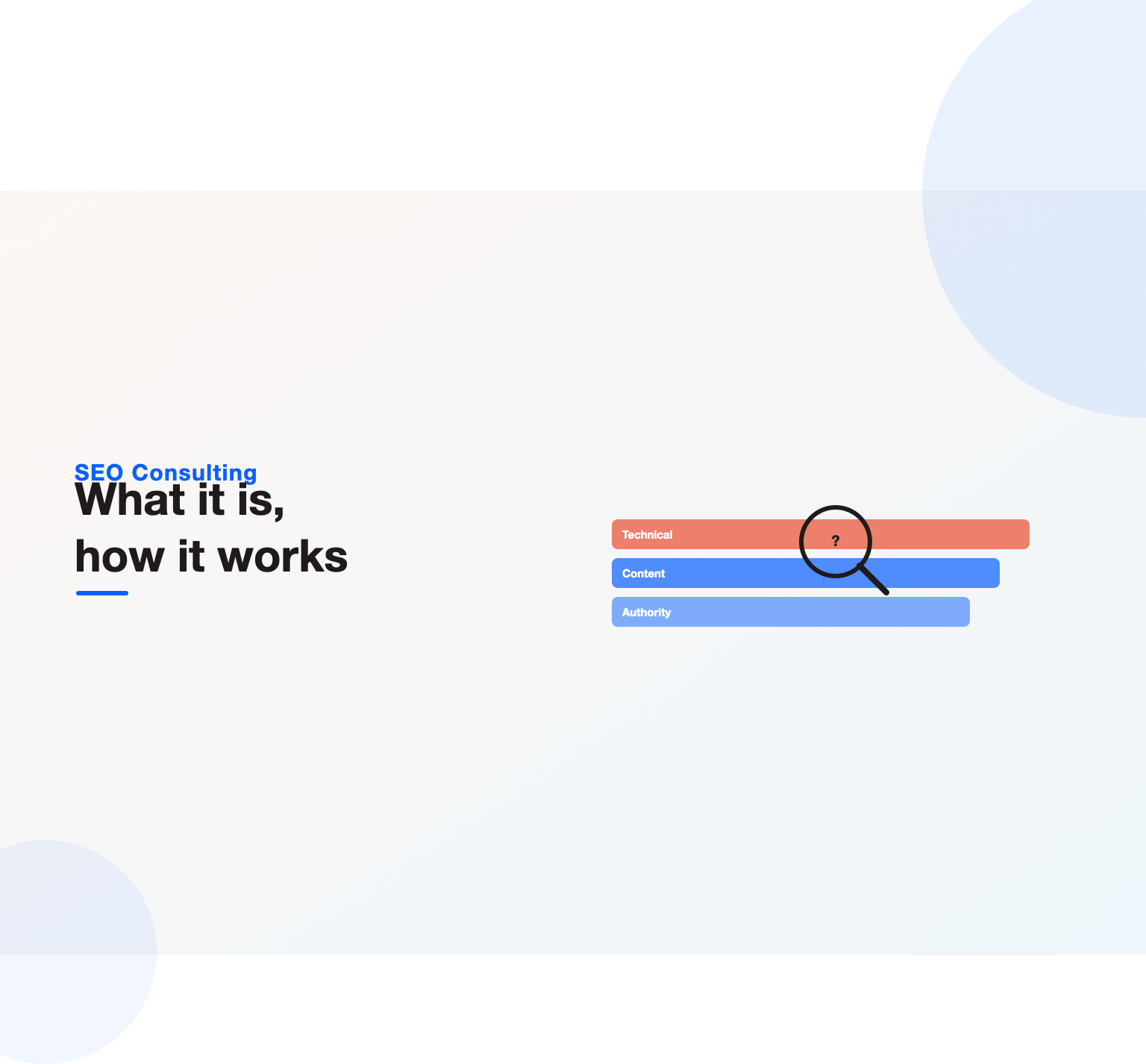
At its core, what is SEO consulting comes down to transferring hard-won search expertise into a decision your business can act on. A consultant looks at three layers of your site, technical foundations, content and relevance, and authority signals, then explains which layer is holding you back and what to do about it in what order. Google’s own Search Central documentation is public, so the value a consultant adds is not secret knowledge; it is the judgement to apply that knowledge to your situation, with your constraints, competitors, and budget.
Think of the role like a structural engineer rather than a builder. The engineer does not lay every brick, yet the building stands because of their calculations. A good adviser reduces the guesswork that makes in-house SEO so slow and expensive, and that reduction in wasted effort is the real product. When people ask what is SEO consulting worth paying for, the honest answer is: the cost of the mistakes you avoid and the months of flat traffic you skip.
The model also sits between two other models buyers confuse it with. A managed SEO service does the work for you end to end. Hiring in-house builds the capability inside your company. It is the middle path: you keep control and ownership, but you rent senior expertise to point that control in the right direction.
What does an SEO consultant actually do?
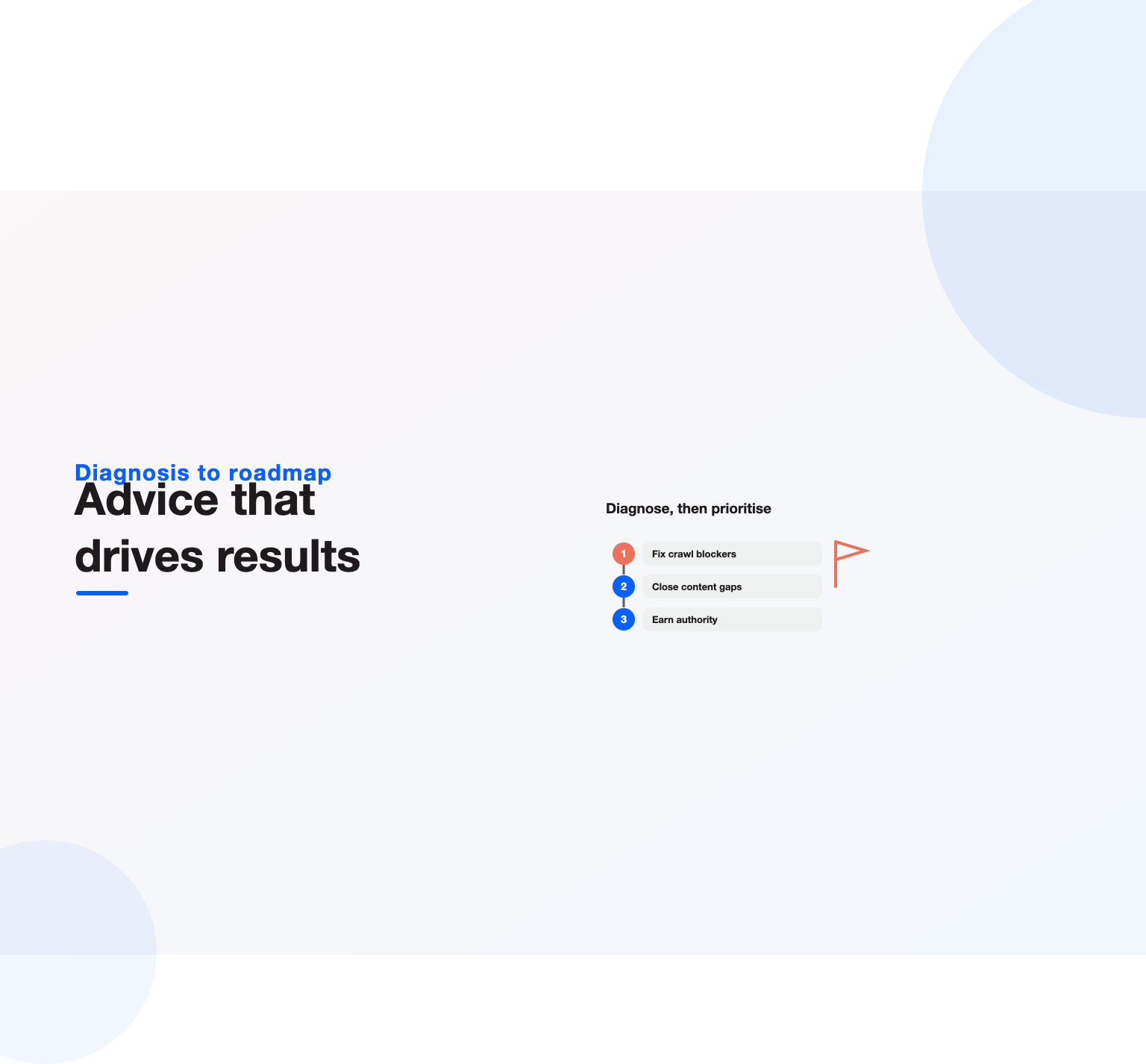
Day to day, an SEO consultant moves between diagnosis, strategy, and enablement. On the diagnostic side they run crawls, review server logs, study Search Console data, and map your rankings against competitors to find where demand exists that you are not capturing. On the strategy side they translate those findings into a sequenced plan: fix crawl-blocking issues first, then close the highest-value content gaps, then earn the links that lift the whole domain.
Enablement is the part buyers underrate. A strong consultant trains your writers on search intent, briefs your developers on technical fixes in language they respect, and sets up the reporting that proves whether the plan is working. Rather than hoarding knowledge to stay indispensable, the best advisers make your team measurably better at SEO. That is why what is SEO consulting is often described as “teaching your organisation to fish” instead of handing over fish forever.
Specific deliverables usually include a full SEO audit, a keyword and content strategy grounded in real keyword research, a technical fix list for engineering, an internal-linking and site-architecture plan, and a measurement framework. Some consultants stop at the plan; others stay on as a fractional head of SEO who reviews progress every month.
SEO consulting vs managed services vs an in-house hire
Buyers rarely struggle with the definition; they struggle with the choice between models. Managed SEO consulting services and done-for-you retainers overlap, so it helps to separate them by what you are actually buying.
With consulting you buy a brain and a plan. You retain execution, which keeps cost lower and institutional knowledge inside your walls, but you need people who can act. With a managed service you buy outcomes and capacity; it costs more and you own less of the process, yet it moves fast when you have no internal team. With an in-house hire you buy dedicated focus, but you also carry salary, ramp-up time, and the risk that one generalist cannot cover technical, content, and link building at a senior level.
A practical rule: choose consulting when you have execution capacity but lack senior direction; choose a managed service when you have budget but no team; choose in-house when SEO is a permanent, core channel worth a full salary. Many growing companies blend them, a consultant sets strategy while an agency or freelancer delivers under that strategy.
The SEO consulting process, step by step
Although every consultant has their own rhythm, credible engagements follow a recognisable arc. Understanding it helps you judge whether a proposal is serious or shallow.
1. Discovery and goal-setting. Good advisers start with your business model, margins, and revenue goals, not keywords. Rankings that do not move money are vanity, so the plan must trace back to pipeline or sales.
2. The audit. Next comes the diagnosis, a technical crawl, a content and relevance review, a backlink and authority assessment, and competitor benchmarking. This is where what is SEO consulting proves its value, because the audit reframes a vague “our traffic is flat” into specific, fixable causes.
3. Strategy and roadmap. Findings become a prioritised roadmap ranked by impact and effort. A consultant who cannot tell you what to do first has not finished the job.
4. Enablement and handoff. The consultant briefs the people who will execute, whether that is your team or a partner, and sets up dashboards so progress is visible.
5. Ongoing advisory. Because search shifts constantly, many buyers keep a monthly retainer where the consultant reviews results, adjusts priorities, and keeps the strategy honest against algorithm updates like Google’s core ranking systems.
What SEO consulting deliverables look like in practice
Vague promises are the fastest way to spot a weak consultant. Strong engagements produce tangible artefacts you can hold your team accountable to. Expect a written audit with severity ratings, a keyword-to-URL map showing which page targets which intent, a technical ticket list your developers can drop straight into their sprint, a content calendar tied to search demand, and a reporting view that connects organic sessions to leads or revenue.
Deliverables also reveal philosophy. A specialist who leans on technical SEO and site architecture will hand you engineering-ready specs; one focused on authority will hand you a digital-PR and link plan; the strongest cover the full stack. When evaluating what an engagement will actually give you, ask to see a sample audit and roadmap from a past client. Redacted examples are fine; refusal to show any is a red flag.
Not sure why your pages are not ranking or bringing enquiries?
Our team reviews your current setup and shows you where the opportunities are. See how our SEO services work.
How much does SEO consulting cost?
Pricing is where expectations and reality often collide. In the US market, SEO consulting cost usually takes one of three shapes: a one-off audit-and-strategy project, a monthly advisory retainer, or an hourly rate for ad-hoc guidance. Project audits commonly land in the four-to-five-figure range depending on site size; advisory retainers scale with how much ongoing involvement you want; senior specialists command premium hourly rates because you are paying for years of pattern recognition.
Cheap consulting is rarely a bargain. A low rate usually signals a junior consultant, a templated audit, or advice that ignores your specific competitive landscape. Because the deliverable is judgement, the difference between mediocre and excellent advice is enormous even though the invoice looks similar. For a deeper breakdown of how pricing is built, our guide on how much SEO costs walks through the drivers. The reframed question is not “how cheap can this be” but “what is SEO consulting going to return against what it costs”, and that ratio, not the sticker price, is what matters.
Freelance SEO consultant vs agency vs boutique adviser
The label on the invoice changes the experience more than buyers expect. A freelance SEO consultant offers direct access to one expert, lower overhead, and flexibility, but limited bandwidth and a single point of failure if they are ill or overbooked. Agencies bring a bench of specialists across technical, content, and links, plus process and continuity, at a higher price and sometimes with a more junior account manager between you and the senior talent.
A boutique adviser or consultancy tries to combine the two: senior-led attention with enough team behind it to cover the full discipline. There is no universally correct answer; the right fit depends on your site’s complexity, your internal capacity, and how much continuity you need. What matters is that a senior practitioner, not a sales rep, is the one shaping your strategy, because the entire premise of what is SEO consulting rests on the seniority of the person giving the advice.
Is SEO consulting worth it, and who is it for?
SEO consulting earns its fee when three conditions hold: search represents real demand for what you sell, you have someone who can execute the advice, and you are willing to give the strategy the six-to-twelve months organic growth genuinely takes. When those hold, a consultant compresses the learning curve dramatically, and the avoided cost of wrong turns often dwarfs the fee.
It is a poor fit in the opposite cases. If your buyers do not search for your category, paid channels may serve you better in the short term. If nobody on your side can act on a roadmap, you are paying for a plan that will gather dust; a managed service fits better there. And if you expect results next month, no adviser can help, because search rewards sustained, compounding effort. Deciding whether SEO consulting is worth it is really a question of readiness, and an honest consultant will tell you when the timing is wrong. For businesses weighing the channel itself, our piece on whether SEO is worth it is a useful companion read.
How to choose an SEO consultant
Because anyone can print the title on a business card, evaluation matters. Start with evidence: ask for case studies that show traffic and business results, not screenshots of rankings for keywords nobody searches. Probe their diagnostic thinking by describing a problem and listening to how they reason; a strong consultant asks sharp questions before proposing anything.
Watch for three warning signs. Guarantees of a specific ranking are a myth, since no one controls Google’s results. Secrecy about methods usually hides thin or risky tactics. And a refusal to talk about measurement means they are not planning to be accountable. Good advisers are transparent about approach, realistic about timelines, and comfortable being judged on outcomes. Our guide on how to choose an SEO partner covers the vetting questions in more depth. Ultimately, understanding what is SEO consulting protects you here, because a buyer who knows the model can tell substance from sales patter in the first conversation.
When to hire a consultant vs do SEO yourself
Doing SEO yourself is viable for small sites in low-competition niches, and plenty of founders have taught themselves the basics using free resources. The trade-off is time and opportunity cost: the months you spend learning are months competitors spend compounding. A consultant makes sense the moment the stakes exceed your certainty, a site migration, a traffic drop you cannot explain, a competitive category, or a growth target that leaves no room for slow trial and error.
A middle path works well for many teams: bring in a consultant for a one-time audit and roadmap, execute it yourself, then reconvene quarterly for a strategic review. That structure gives you senior direction at the decision points that matter while keeping ongoing cost low. It is, in effect, what is SEO consulting distilled to its most efficient form, expertise where it changes outcomes, ownership everywhere else. If you would rather hand the whole channel over, our complete guide to SEO and our SEO consulting services lay out both routes.
The three layers an SEO consultant evaluates
To make the discipline concrete, it helps to see the three layers every serious audit examines, because the consultant’s job is to find which one is the true bottleneck. The first layer is technical health: can search engines crawl, render, and index your pages quickly and without errors? Broken canonicalisation, slow Core Web Vitals, and crawl traps silently cap even excellent content. Our on-page SEO guide covers the fundamentals a consultant checks here.
The second layer is content and relevance: does each page match a real search intent better than the pages currently ranking? Thin, duplicated, or intent-mismatched pages are the most common reason growth stalls, and fixing them is often the fastest win. The third layer is authority: do enough trustworthy sites reference yours, and is that authority distributed to the pages that need it? Building it is the work our guide to off-page SEO explains. A skilled adviser weighs all three and refuses to prescribe link building when the real problem is a crawl blocker, sequencing is the whole point.
Common problems SEO consulting solves
People rarely buy advisory help in the abstract; they buy it when something is wrong or about to change. A sudden traffic drop is the classic trigger, and diagnosing whether it stems from an algorithm update, a technical regression, or lost links is exactly the pattern-recognition an experienced adviser brings; our walkthrough on recovering from a Google traffic drop shows the process.
Site migrations are another high-stakes moment. Replatforming or redesigning without a migration plan is the fastest way to erase years of rankings overnight, which is why teams bring in a specialist before, not after, the launch, our website migration guide details the safeguards. A long plateau is a subtler trigger: traffic is fine but has stopped growing, and an outside diagnosis usually finds the ceiling the internal team has stopped seeing. New sites hire advisers to avoid building on weak foundations they will pay to fix later. In each case, the real service is replacing expensive trial and error with a diagnosis grounded in years of pattern recognition across many different sites.
SEO consulting for different business types
The advice changes shape with the business. For a startup, the priority is usually foundation and focus: picking a winnable niche of search demand rather than chasing head terms a young domain cannot rank for yet. For an ecommerce brand, the work centres on scalable category and product-page architecture, faceted-navigation control, and technical performance across thousands of URLs.
For a local business, the emphasis shifts to local SEO signals, proximity, reviews, and a well-optimised Business Profile, where a small amount of expert direction goes a long way. For an enterprise site, the challenge is coordination: aligning dozens of stakeholders, protecting crawl budget across huge templates, and governing content quality at scale. A SaaS company needs a blend of bottom-of-funnel comparison content and top-of-funnel education mapped to a long buying cycle. One reason understanding what is SEO consulting matters is that a good adviser tailors the model to your context instead of reheating a generic playbook.
Where SEO consulting meets AI search (AEO and GEO)
The definition is broadening as search itself changes. Buyers now find answers inside AI assistants and AI Overviews, not only in ten blue links, so modern advisory work increasingly covers being cited by those systems. That is the terrain of answer engine optimization, structuring content so engines can extract a clean answer, and generative engine optimization, which focuses on becoming a source large language models trust and quote.
A forward-looking consultant now audits not just your Google rankings but your visibility inside AI answers, because the two increasingly draw on the same foundations: clear structure, genuine authority, and content that actually resolves the query. According to research summarised by industry analysts, a growing share of searches end without a click to a website, which raises the value of being the cited source rather than merely a ranked link. Any adviser who ignores this shift is answering a version of what is SEO consulting that is already a few years out of date.
Want a team to run this SEO work for you?
Book a free 30-minute strategy call and leave with a clear next step for your business.
How to measure whether SEO consulting is working
Accountability is what separates a real engagement from an expensive opinion, so measurement deserves its own conversation before you sign. The mistake most buyers make is judging progress by rankings alone. Positions are a leading indicator, useful early, but they are volatile and easy to cherry-pick; a report full of rankings for terms nobody searches is a distraction, not proof.
A sound measurement framework works in three tiers. Leading indicators come first: crawl and index health, Core Web Vitals, and the number of priority pages that are technically eligible to rank. These move within weeks and show the foundation is being fixed. Mid-funnel indicators come next: impressions and average position in Search Console for your target query clusters, which reveal whether relevance is improving before clicks arrive. Lagging indicators are the ones that pay the bills: organic sessions to money pages, conversions, qualified leads, and ultimately revenue attributable to organic search.
Good advisers agree the scorecard with you up front and report against it on a predictable cadence, and they connect every metric back to a business outcome rather than a vanity chart. Our guide to SEO reporting breaks down what a trustworthy report should contain. The reason measurement matters so much to the definition is simple: what is SEO consulting if you cannot tell whether the advice worked? Without an agreed scorecard, you are buying reassurance instead of results, and the engagement quietly drifts into activity for its own sake.
Questions to ask before signing an SEO consulting engagement
A short, pointed conversation surfaces more than any pitch deck. Before committing budget, put these questions to any prospective adviser and weigh how directly they answer.
- “Walk me through how you would diagnose our problem.” A strong consultant reasons out loud, asks for data, and resists prescribing before diagnosing. Instant answers without questions signal a templated approach.
- “Can you show a redacted audit and roadmap from a past client?” Real artefacts prove the deliverable is substantive. Vague promises usually mean vague work.
- “How will we measure success, and how often will you report?” The answer should name business metrics and a cadence, not just rankings.
- “Who will actually do the strategic work, you or a junior?” Continuity with a senior practitioner is the whole point; make sure the person in the room is the person on the account.
- “What would you tell us not to do?” Honest advisers cut scope and decline low-value work. Someone who says yes to everything is selling, not advising.
How a consultant handles these questions tells you whether you are hiring judgement or buying a commodity. The exercise also sharpens your own thinking, because articulating what you need forces clarity on goals and capacity. That clarity is itself part of the return: even the vetting stage of what is SEO consulting pushes you to define success before a single fix ships, and a well-run SEO consulting engagement should feel like that from the first call onward.
Three myths that confuse buyers
Because the category is crowded with marketers of varying quality, a few persistent myths cloud the decision. The first is that an adviser will personally do all the work. In reality the model is advisory by design; execution capacity has to come from somewhere, and pretending otherwise leads to disappointment on both sides. The second myth is that results should appear within a month or two. Organic search is a compounding channel, and meaningful movement typically takes two to three quarters, so any promise of overnight wins should lower your trust, not raise it.
The third myth is that a bigger invoice guarantees better advice. Price correlates loosely with seniority, but the real variable is fit and judgement: a senior specialist who understands your market will outperform a large, generic team every time. Seeing past these myths is half the battle, because it lets you buy on evidence and reasoning rather than on promises and polish, and it keeps your expectations anchored to how search actually rewards patient, well-sequenced work over time. A consultant worth hiring will happily debunk all three in your first conversation and set expectations you can actually plan around, which saves you from costly detours down the line.
Key takeaways
- Consulting is advice plus a plan, not production. You buy senior strategy and prioritisation; execution stays with your team or a delivery partner.
- It always starts with a diagnosis. A real audit explains why traffic is flat and what to fix first, a generic checklist is not consulting.
- Fit depends on readiness. It pays off when search demand exists, someone can execute, and you allow six to twelve months.
- Price for return, not for cheapness. The value is avoided mistakes and compounded growth, so judge cost against expected return.
- Vet for evidence and transparency. Case studies with business results, clear methods, and accountable measurement separate real advisers from sales patter.
Frequently asked questions
What is SEO consulting in simple terms?
It is an advisory service where an expert audits your website, explains why it is underperforming in search, and gives you a prioritised plan to fix it. You get the strategy and direction; your team or a delivery partner does the hands-on work.
How is SEO consulting different from an SEO service?
A managed SEO service executes the work for you end to end. It sells the strategy, prioritisation, and expertise while you keep control of execution. It usually costs less and keeps knowledge in-house, but it needs someone able to act on the advice.
How much does SEO consulting cost?
US pricing typically takes the form of a one-off audit-and-strategy project, a monthly advisory retainer, or a senior hourly rate. Costs scale with site size and how much ongoing involvement you need. Judge the fee against the return it drives, not the sticker price alone.
Is SEO consulting worth it for a small business?
It is worth it when your customers search for what you sell, you have capacity to execute the plan, and you can give organic growth six to twelve months. If buyers do not search your category or nobody can act on the roadmap, a different approach may serve you better first.
What does an SEO consultant do day to day?
They diagnose technical, content, and authority problems; turn findings into a sequenced roadmap; brief the people who will execute; and set up reporting that ties organic traffic to revenue. Many also stay on as a fractional head of SEO reviewing progress monthly.
Should I hire a freelance SEO consultant or an agency?
A freelancer offers direct senior access and lower overhead but limited bandwidth. Agencies bring a full bench and continuity at higher cost. The right choice depends on your site’s complexity and internal capacity, what matters is that a senior practitioner shapes the strategy.
Can I do SEO myself instead of hiring a consultant?
Yes, for small sites in low-competition niches, using free resources like Google Search Central. The cost is your time and the months competitors spend compounding. A consultant makes sense once the stakes, a migration, a traffic drop, or a competitive market, exceed your certainty.
How long before SEO consulting shows results?
Strategy can be delivered in weeks, but organic results generally take six to twelve months to compound, depending on your starting authority and competition. Any consultant guaranteeing fast, specific rankings is misrepresenting how search works.
Ready to put this into practice?
Talk to the team that runs SEO, AI search and paid growth programs every day.
Book a Strategy Call →