 Skip to content

Branding Ideas That Build Recognition and Trust
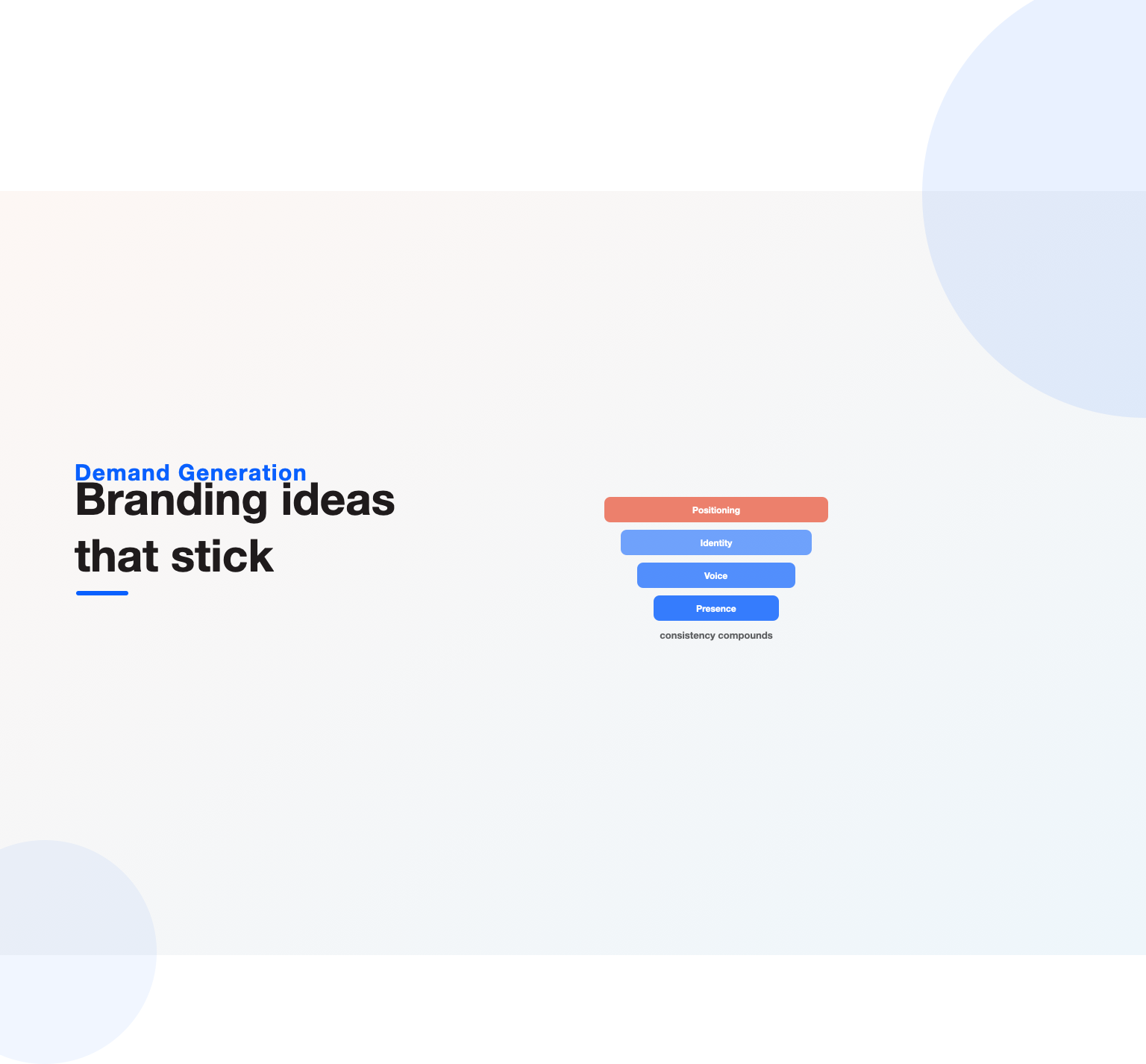
The branding ideas that build recognition and trust: clear positioning and personality, a consistent visual identity and voice, a genuine story, and advocacy, applied consistently everywhere.
Quick Answer
The most effective branding ideas are the ones that make a business recognisable, trusted, and distinct, not just a new logo. The strongest span a few areas: defining a clear brand positioning and personality, building a consistent visual identity, developing a distinctive brand voice, telling a genuine story, showing up consistently across every touchpoint, and turning customers and employees into advocates. Each does a specific job in building the recognition and trust that make people choose and stay with a business. The best branding ideas are chosen to fit the business and applied consistently over time, because a brand is built through repeated, coherent impressions rather than a single clever asset, which is why consistency matters more than any individual idea.
Key Highlights
- Effective branding ideas build recognition and trust, not just a logo.
- Clear positioning and personality come before any visual or verbal execution.
- A consistent visual identity and voice make a business instantly recognisable.
- A genuine story and consistent presence build the trust that drives choice.
- Customers and employees are powerful, underused branding channels.
- Consistency over time matters more than any single clever idea.
Start with positioning and personality
Before any visual or verbal branding ideas, the foundation is positioning: a clear sense of who you serve, what you stand for, and what makes you different. Every later idea, the logo, the voice, the story, expresses this foundation, and without it they express nothing coherent. A business that jumps to designing a logo before deciding what it stands for ends up with a pretty asset attached to no clear meaning.
Personality is the human dimension of that foundation: if your brand were a person, how would it speak, what would it value, how would it make people feel. As a matter of brand strategy, this personality is what makes a business feel distinct and relatable rather than generic, and it guides every choice that follows. Defining positioning and personality is unglamorous compared with the creative work, but it is what makes that work cohere. In practice, the point is that the most important branding ideas are decisions, not designs: decide what you stand for and how you want to feel to people first, and every execution afterwards has something true to express.
Build a consistent visual identity
Among the branding ideas people picture first, a visual identity, logo, colours, typography, imagery, is the most visible, and its power comes from consistency rather than cleverness. A distinctive, well-applied visual system makes a business instantly recognisable across every place it appears, and that repeated recognition is what builds familiarity and trust over time. A logo that changes look from one touchpoint to the next teaches people nothing to remember.
The idea that matters more than any single design choice is a documented, consistently applied system: the same colours, fonts, and style everywhere, from the website to social to packaging to email. Consistency is what turns a set of pretty assets into a recognisable brand, because recognition is built by repetition. The visual identity should express the positioning and personality decided earlier, so it feels true rather than arbitrary. The takeaway is that a good visual identity is not the most striking one but the most consistently applied one, because a brand people recognise instantly, wherever they meet it, is worth far more than a beautiful logo used inconsistently.
Develop a distinctive brand voice
Just as a visual identity makes a business recognisable to the eye, a distinctive voice makes it recognisable in words, and it is among the most underused branding ideas. How a business writes and speaks, its tone, vocabulary, and attitude, across its website, emails, social posts, and support, shapes how people feel about it as much as any visual. A consistent, characterful voice makes a brand feel like a coherent personality rather than a faceless entity.
In practice the aim is to define the voice deliberately, warm or precise, playful or authoritative, and apply it consistently everywhere, so a customer hears the same personality whether reading an ad or a support reply. This voice should flow from the personality defined at the start, giving it a consistent human character. Done well, a distinctive voice differentiates a business in a crowded market where visuals alone can blur together, because how you sound is harder to copy than how you look. The upshot is that voice is a branding asset every business already owns and most underuse, and defining and applying it consistently costs nothing but attention while adding real distinctiveness.
Tell a genuine brand story
Some of the most powerful branding ideas involve storytelling: the narrative of why the business exists, what it believes, and who it serves, told genuinely rather than as marketing gloss. People connect with stories far more than with feature lists, and a genuine story, the problem that sparked the business, the values behind it, the people it serves, gives a brand meaning that a logo alone never could.
The reason storytelling works is that it makes a brand relatable and memorable, turning a transaction into a relationship built on shared values. The discipline is authenticity: a story that is true and specific resonates, while an invented or generic one rings hollow and can damage trust when the gap shows. The best brand stories are woven through everything, the about page, the content, the way the business talks, rather than told once and forgotten. Ultimately, the point is that a genuine story is one of the most durable branding assets there is, because it gives people a reason to care that competitors cannot copy, and it deepens the trust that turns a customer into a loyal advocate.
Show up consistently across every touchpoint
The branding idea that ties all the others together is consistency across every touchpoint, because a brand is the sum of every impression a person forms of it. The website, social channels, emails, packaging, customer service, even the way the phone is answered, all shape the brand, and when they align around the same identity, voice, and values, they compound into a strong, coherent brand. When they contradict each other, they build confusion instead.
The idea in practice is to treat every touchpoint as a branding opportunity and to apply the same identity and voice everywhere, so each interaction reinforces the same impression. This is less a single creative act than an operational discipline, ensuring the brand shows up the same way whether a customer meets it on Instagram, in an email, or in a support call. As a driver of brand awareness, consistency is what makes repeated impressions add up rather than cancel out. Above all else, the strongest branding idea is not a clever campaign but relentless consistency, because a brand experienced coherently everywhere becomes familiar and trusted far faster than one that looks different in every place.
Turn content into a branding channel
Content is among the most practical branding ideas because it lets a business demonstrate its expertise and personality rather than just claim them. Genuinely useful content, guides, videos, a newsletter, a point of view, builds a brand by showing what it knows and how it thinks, earning trust through value rather than assertion. Every useful piece reinforces the brand as a helpful authority in its field.
The idea works because expertise shown is far more convincing than expertise claimed, and content that consistently helps its audience builds the kind of trust advertising cannot buy. Carrying the brand’s voice and point of view, content also makes the personality tangible across every piece. Building this deliberately, as part of a wider content marketing strategy, turns publishing into brand-building that also attracts customers, and pairing it with a disciplined SEO program means the brand is discovered by the people searching for what it knows. Distributed further through a considered social media presence, that same content keeps the brand’s voice and point of view in front of an audience between purchases, so each useful piece of content works twice over, once to attract a new visitor and again to reinforce recognition with an existing one. Put plainly, the point is that content is branding in action, a way to build recognition and trust by being useful, which is why it belongs on any serious shortlist of branding ideas.
Make customers and employees your advocates
Some of the most credible branding ideas cost little because they turn people who already trust you into your voice. Customers who love a brand and share it, through reviews, referrals, and word of mouth, carry a credibility no advertising can match, and employees who genuinely believe in the brand become its most authentic ambassadors. Both extend the brand’s reach with the trust that only comes from real people.
The move is to earn and enable this advocacy deliberately: deliver an experience worth talking about, make it easy for happy customers to share, and give employees a brand they are proud to represent. Advocacy works because people trust peers and insiders far more than marketing, so a recommendation carries weight a campaign never could. It also compounds, since each advocate reaches others who may become advocates in turn. The lesson is that a brand is not only what a business says about itself but what its customers and people say about it, and cultivating those voices is one of the most credible and cost-effective branding ideas available to any business with something genuinely worth advocating for.
Building a brand in the Indian market
In India, the effective branding ideas share the global logic but carry local texture worth planning for. Trust and relationships weigh heavily, so genuine storytelling, visible social proof, and consistent, reliable experience build brands faster than flashy but hollow campaigns. A diverse, multilingual market rewards brands that feel locally relevant, and regional-language expression often deepens connection in ways a single national identity cannot.
Distribution has local texture too. Mobile-first consumption and channels like WhatsApp and regional social platforms shape where a brand shows up and how it must look and sound to fit. Community and word of mouth are especially powerful, which raises the value of advocacy-led ideas. Coordinating a consistent brand across all these touchpoints, sustaining recognition through steady lifecycle messaging, and pairing it with a coordinated demand generation program so the brand attention converts to demand, is what turns branding into business results in India rather than into awareness that never pays off. The lesson is to adapt the universal ideas to how the Indian market actually perceives, trusts, and talks about brands.
Choosing which branding ideas to run
Faced with a long list, the mistake is to treat these branding ideas as a checklist and attempt all at once, which produces a scatter of half-finished gestures rather than a coherent brand. The right approach is to start with the foundation, positioning and personality, because every other idea depends on it, then build the identity and voice that express it, then apply them consistently everywhere before reaching for advanced ideas like advocacy programs.
Choosing well means sequencing by dependency rather than by excitement. A business with no clear positioning should fix that before redesigning a logo; one with a solid identity but inconsistent application should focus on consistency before adding new channels. Better to apply a simple, coherent brand consistently than a sophisticated one sporadically, because consistency is what builds recognition. The lesson is that branding is cumulative: get the foundation right, express it in identity and voice, apply it relentlessly, and only then layer on the ideas that amplify it, so each idea builds on a coherent base rather than adding to a confusing pile.
Measuring whether branding is working
Branding is often called unmeasurable, but the branding ideas that matter do leave signals worth tracking, even if less directly than a sales campaign. Awareness, meaning how many people recognise you, brand recall in your category, the sentiment of what people say, branded search volume, and the share of customers who come through word of mouth all indicate whether the brand is strengthening. Watching these over time shows whether the ideas are compounding.
The discipline is to accept that branding pays off over a longer horizon than direct response, and to judge it on trend rather than on a single month. A strengthening brand shows up as rising branded search, more referral and direct traffic, easier conversions because trust is already there, and pricing power. Connecting these signals to the wider funnel, often through a coordinated revenue operations view, keeps branding accountable without demanding it prove itself like a promotion. The lesson is that branding is measurable enough to steer, provided you measure the right signals over the right horizon rather than expecting an immediate, campaign-style return.
Keep the brand consistent as you grow
A challenge that catches many businesses is holding the brand together as more people and channels get involved. What one founder kept coherent by instinct starts to drift once a team writes the copy, designs the posts, and answers the support tickets, each interpreting the brand slightly differently. Left unmanaged, this drift quietly erodes the recognition that consistency built, until the brand looks and sounds subtly different in every place a customer meets it.
The safeguard is light governance: a short, clear guide to the visual identity and voice, a few living examples of the brand done well, and a habit of reviewing new material against them. This is not bureaucracy but the practical means of keeping a growing team expressing one coherent brand, and it matters more as the business scales, not less. Documenting the positioning, personality, identity, and voice so anyone can apply them the same way is what lets a brand stay recognisable while more hands touch it. Coordinating that consistency across teams and tools, often supported by the same connected view a revenue operations setup provides, keeps the customer experience coherent from first touch to repeat purchase. The point is that consistency is not a one-time setup but an ongoing discipline, and building the light guardrails early is what lets a brand grow without losing the coherence that made it strong, a principle that underpins any lasting content and brand strategy.
Common mistakes with branding ideas
- Starting with the logo. Designing visuals before deciding positioning produces a pretty asset with no clear meaning.
- Inconsistency. Applying the identity and voice differently across touchpoints builds confusion instead of recognition.
- Chasing trends. Copying a fashionable look rather than expressing a genuine identity makes a brand forgettable.
- Inauthentic storytelling. An invented or generic story rings hollow and damages trust when the gap shows.
- Treating branding as one-off. A brand is built by repeated impressions, not a single campaign or redesign.
- Ignoring advocates. Neglecting customers and employees forgoes the most credible branding channel there is.
Each mistake is the inverse of a sound principle, which is why studying strong branding ideas is also the fastest way to learn what to avoid.
A worked example of building a brand
An example ties these ideas together. Picture a new consultancy with a logo, a website, and little else that feels distinct. Rather than commissioning a flashy rebrand, the founders start with the foundation: they decide exactly who they serve, what they believe about the problem, and how they want to feel to clients, confident and plain-speaking rather than corporate. That single decision gives every later choice something true to express, and it takes a workshop rather than a budget.
From there, they build a simple visual system and a documented voice that match that personality, and apply both the same way across the website, proposals, email, and social. They write a genuine story of why the firm exists, and they publish useful content that shows how they think, carrying the same voice throughout. Over months, clients begin to recognise the firm instantly and to describe it back in the words the founders chose, a sign the brand is landing. As a matter of disciplined brand management, nothing here was expensive; the work was deciding what to stand for and then showing up that way relentlessly. Pairing the content with a disciplined SEO program means the brand is found by the people searching for what it does, and feeding the attention it earns into a coordinated demand generation program turns recognition into enquiries. The example shows the whole sequence: decide, express, apply consistently, and let repeated impressions compound into a brand.
Building a brand on a small budget
A common worry is that strong branding demands a big budget, yet the most valuable parts cost attention rather than money. Deciding a clear positioning and personality is free; documenting a consistent visual system and voice is cheap; applying them the same way everywhere is a discipline, not an expense. The businesses with the strongest brands are frequently not the ones that spent the most but the ones that decided who they were early and stayed coherent, which any business can do regardless of budget.
Where money helps, it is best spent on the foundations rather than on flourishes: a professional take on the core identity, or expert help defining positioning, pays back across every later touchpoint, while an expensive campaign on a shaky foundation does not. Much of the ongoing work, content, social presence, customer experience, uses channels a small team already has, and a considered social media presence extends the brand at little cost. Keeping the customer experience genuinely good, and turning happy customers into advocates through steady email marketing and word of mouth, builds brand without a media budget at all. What matters most is not spend but the discipline to decide, apply consistently, and stay patient, which is why a small business that commits to coherence over time can build a brand that outshines larger, better-funded but scattered competitors.
How the ideas fit together
Seen whole, these branding ideas are not a menu to pick one from; they are layers of one coherent brand, and their value comes from how they build on each other. Positioning and personality form the foundation; visual identity and voice express it; story gives it meaning; consistent presence across touchpoints makes it recognisable; and content, advocacy, and community amplify it. A gap anywhere weakens the whole, because a brand experienced incoherently confuses rather than compounds.
Thinking in these terms turns a list of ideas into a system, where each layer reinforces the others and the brand grows stronger with every consistent impression. That is why the foundation matters more than the flourishes, and why consistency beats cleverness in the long run. A brand also does not work in isolation: the recognition and trust it builds make every other marketing effort convert better, which is why it pairs so naturally with the wider growth engine. For how brand attention becomes pipeline, our guide to demand generation strategies covers the creation and capture of the demand a strong brand makes easier to win.
Key Takeaways
- Effective branding ideas build recognition and trust across every touchpoint, not just a logo.
- Positioning and personality are the foundation every other idea expresses.
- A consistent visual identity and a distinctive voice make a business instantly recognisable.
- A genuine story and consistent presence build the trust that drives choice and loyalty.
- Content, customers, and employees are powerful, cost-effective branding channels.
- In India, trust, storytelling, local relevance, and word of mouth shape what works.
- Consistency over time matters more than any single clever idea, so sequence by foundation first.
Frequently asked questions
What are the best branding ideas for a small business?
The best branding ideas for a small business start with the foundation rather than the flourishes: define a clear positioning and personality, build a simple but consistent visual identity and voice, and apply them the same way across every touchpoint. From there, useful content and turning happy customers into advocates build recognition and trust at low cost. A small business rarely needs an expensive rebrand; it needs a coherent identity applied consistently and genuinely. Consistency and authenticity, not budget, are what make small-business branding work over time.
Is branding just a logo?
No. A logo is one visible element, but branding is the whole impression a business creates, its positioning, personality, visual identity, voice, story, and the experience it delivers at every touchpoint. A brand lives in how people recognise, feel about, and talk about a business, not in a single mark. Treating branding as just a logo is the most common mistake, because it puts a pretty asset in front of no clear meaning. The logo should express a brand already defined by positioning and personality, not stand in for one.
Where do I start with a brand identity?
Start by deciding what you stand for and who you serve, then define a personality, how the brand should feel and sound. Express that in a visual identity, logo, colours, typography, and a voice, tone and vocabulary, that fit the personality rather than chasing trends. Document both so they can be applied consistently, then use them the same way across every touchpoint. A strong identity comes less from brilliant design than from a clear foundation applied with relentless consistency, because recognition is built by repetition, not by any single striking asset.
Do brands take years to build?
Building a brand is a long game measured in years rather than weeks, because a brand is built through repeated, consistent impressions over time. You can define positioning, identity, and voice quickly, but the recognition and trust that make a brand valuable accumulate gradually as people encounter it again and again coherently. That is why consistency matters so much and why quick rebrands rarely deliver lasting results. The businesses with the strongest brands are usually the ones that decided who they were early and then showed up the same way, patiently, for a long time.
Can you measure branding?
Yes, though less directly than a sales campaign and over a longer horizon. Signals worth tracking include brand awareness and recall, the sentiment of what people say, branded search volume, and the share of customers arriving through referral and direct traffic. A strengthening brand shows up as rising branded search, easier conversions because trust already exists, and greater pricing power. The key is to judge branding on trend over time rather than on an immediate return, and to connect these signals to the wider funnel so the brand’s contribution stays visible and accountable.
How is branding different from marketing?
A brand defines who a business is, its identity, personality, values, and how it wants to be perceived, while marketing is the activity of promoting the business and driving specific actions. Branding is the foundation; marketing is the execution that draws on it. Strong branding makes marketing more effective, because a recognisable, trusted brand converts better and costs less to promote, while marketing without clear branding tends to be generic and forgettable. The two work together: branding builds the recognition and trust, and marketing puts them to work to win and keep customers.
Ready to put this into practice?
Talk to the team that runs SEO, AI search and paid growth programs every day.
Book a Strategy Call →