 Skip to content

Facebook Ads Optimization: What Actually Works Now
Facebook ads optimization has changed. Learn why creative, tracking and simple structure now matter more than manual tinkering, and how to optimize by cost per result.
Quick Answer
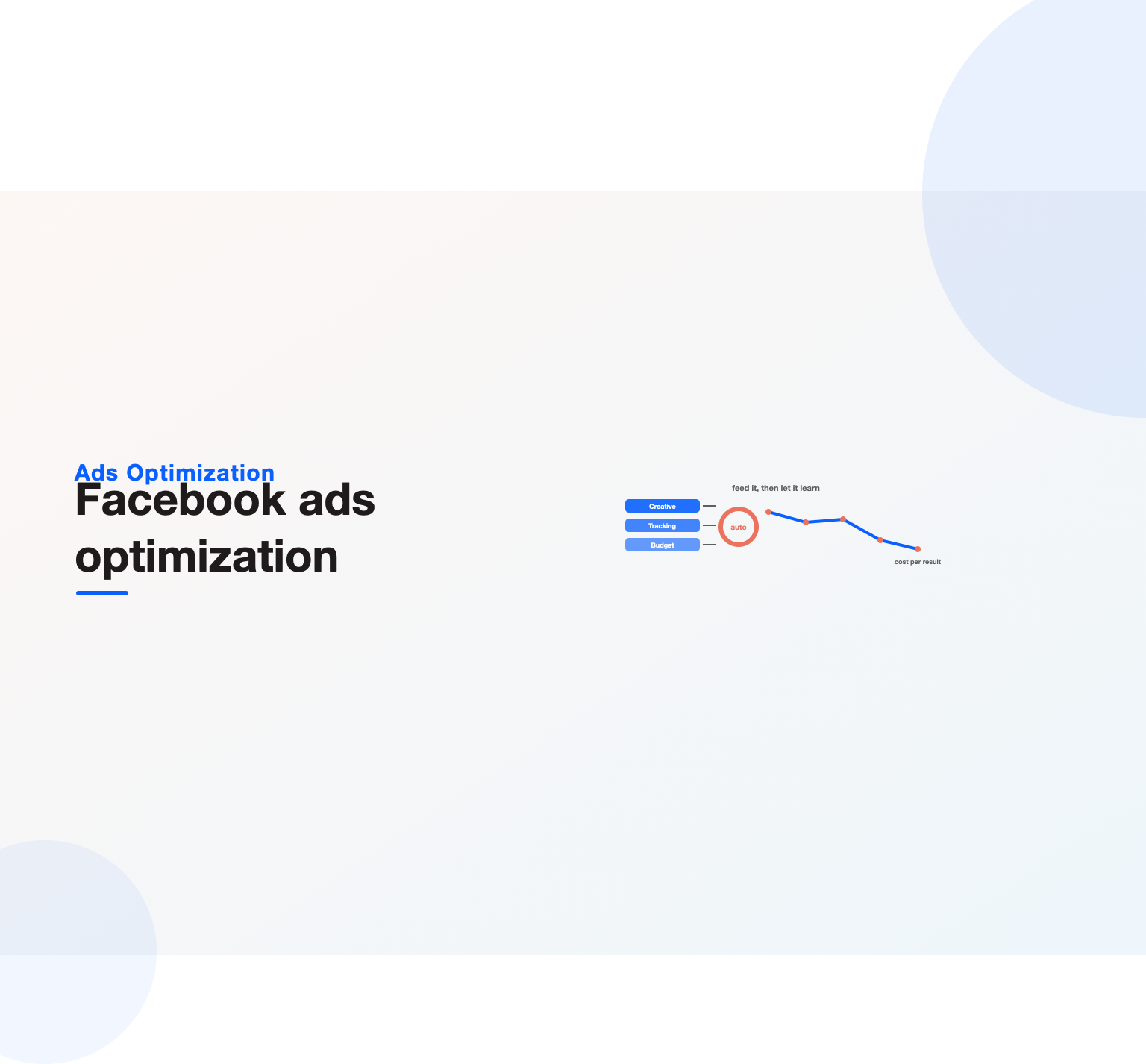
Facebook ads optimization is the ongoing work of improving a Meta advertising account so it produces more results at a lower cost, and on today’s Meta it looks very different from the manual tinkering of years past. Since the platform’s automation now handles much of the targeting, placement and bidding, the highest-leverage optimization work has shifted to feeding the system well: producing strong, varied creative, keeping conversion tracking accurate, structuring accounts simply so the automation can learn, and giving campaigns enough budget and data to optimize. Rather than micromanaging audiences and bids, effective facebook ads optimization means improving the inputs the automation relies on, testing creative relentlessly, and judging everything by cost per result rather than vanity metrics. The old instinct to constantly adjust settings often hurts far more than it helps, because it disrupts the very learning the system needs. Done well, optimization on Meta is about giving the automation better material and clearer goals, then reading the results honestly and refining deliberately, so the account gets steadily more efficient over time. This guide explains what actually moves the needle in facebook ads optimization now, and why the old playbook so often gets in its own way.
Key Highlights
- Facebook ads optimization now means feeding the automation well, not micromanaging audiences and bids, since the system handles most targeting and delivery.
- Creative is the biggest lever, so relentless creative testing and refreshing is the highest-return optimization work.
- Accurate conversion tracking is the foundation, because the automation optimizes toward whatever you measure.
- Simple account structure and enough budget and data let the system learn and lower cost.
- Over-tinkering hurts, because constant changes disrupt the learning the automation depends on.
- Judge everything by cost per result and return, never by cheap clicks or vanity metrics.
How optimization has changed
Anyone who learned Meta advertising a few years ago needs to understand that facebook ads optimization has changed fundamentally, because the platform has moved from advertiser control toward automation. Where optimization once meant building detailed audiences, adjusting bids, and managing placements by hand, the system now handles much of that itself, and trying to micromanage it the old way often works against the automation rather than with it. The levers that matter have shifted from settings to inputs, and understanding that shift is the starting point for optimizing effectively today. Advertisers who never make it, who keep optimizing the way they always did, often find their results stagnate not because they are doing nothing but because they are doing the wrong things energetically.
This does not mean optimization no longer matters; it means the high-value work is different. Instead of fiddling with audience settings, effective facebook ads optimization now concentrates on the things the automation cannot do for you: producing great creative, keeping measurement accurate, structuring the account so the system can learn, and reading results to refine strategy. Advertisers who cling to the old manual habits, endlessly adjusting bids and audiences, tend to underperform those who feed the automation well and let it work, which is why modern Meta Ads management looks more like creative and data operations than manual campaign tweaking. The account that gives the system the best inputs usually wins, and that is a very different game than winning by out-configuring everyone else.
Creative is the biggest lever
Since the automation handles targeting and delivery, the single biggest lever in facebook ads optimization is now creative, so the highest-return work you can do is producing and testing strong, varied ads. The system can only reach and convert people with the creative you give it, so improving your creative, better hooks, more relevant messages, fresh formats, directly improves what the account can achieve, while thin or stale creative caps performance no matter how good the automation. This makes creative testing not one optimization task among many but the central one, the activity that most determines whether an account improves. An advertiser with a strong creative engine and mediocre everything else usually beats one with perfect settings and weak ads, which would have sounded strange a few years ago but is simply how the platform works now.
Optimizing through creative means running a continuous engine: testing genuinely different ads, keeping winners, cutting losers, and feeding a steady stream of fresh creative to replace ads as they fatigue. Since creative is the main driver, the advertisers who optimize best are the ones who produce and test the most, which is a real shift from the era when audience tuning was the core skill. Building that creative testing habit, of the kind that drives strong facebook ad creative, is the most impactful optimization work available on Meta today, and it feeds the automation exactly what it needs to lower cost and lift results.
Conversion tracking is the foundation
Every optimization decision, and every decision the automation makes, depends on accurate conversion data, so getting conversion tracking right is the foundation of facebook ads optimization. The system optimizes relentlessly and single-mindedly toward the conversions you tell it to value, so if your tracking is broken, measuring the wrong action, or missing, the automation will confidently optimize toward the wrong outcome and waste budget efficiently. Before any other optimization, verifying that the Meta pixel and conversions setup are measuring the right actions accurately is essential.
Privacy changes have made measurement harder and more important at once, as the signals the pixel can capture have weakened, which is why the server-side conversions setup has become important for keeping the automation well fed with data. As the whole system leans so heavily on conversion signals, protecting and strengthening them directly improves optimization, and feeding conversion values, not just counts, lets the automation optimize toward profit rather than volume. Getting measurement right is not a technical afterthought but the base everything else rests on, the same discipline that keeps facebook ads cost readable, and it matters across every account running automation, including Meta ads for ecommerce brands.
Simplify your account structure
Modern facebook ads optimization favors simpler account structures than the sprawling setups advertisers once built, because the automation works better with consolidation than with fragmentation. Splitting budget across many tiny audiences and campaigns starves each of the data the system needs to learn, so consolidating into fewer, broader campaigns gives the automation the volume to optimize effectively. The old instinct to build many narrow audiences now often hurts, since it fragments the data and boxes the system in rather than letting it find the best people.
The principle is to give the automation room to work: broader targeting, consolidated campaigns, and enough conversions flowing through each to let the system learn. This is a genuine reversal of older best practice, where tight segmentation was prized, and advertisers who cling to fragmented structures often underperform those who simplify and let the automation optimize across a larger pool. Structuring the account simply, so each campaign has the data to learn and the automation is not constrained, is a core part of optimizing on modern Meta, and it pairs naturally with the broad-targeting-plus-strong-creative approach that also powers Advantage Plus.
Give campaigns budget and time to learn
Automated systems need data and stability to optimize, so a key part of facebook ads optimization is giving campaigns enough budget to gather results and enough time to learn before judging or changing them. A campaign starved of budget gathers too few conversions for the automation to find patterns, so it stays stuck spending inefficiently for far longer than it should, while a campaign changed constantly never exits the learning phase because every significant edit resets it. Both starvation and over-tinkering prevent the system from doing its job, and they are surprisingly common because each feels like diligent management when it is actually sabotage. A campaign needs to be fed and then largely left alone to learn, which runs against the grain of anyone who equates activity with effort.
The discipline is patience and adequate funding. Giving a campaign enough budget to generate meaningful conversions, and then letting it run and learn without constant interference, is what allows the automation to settle into efficient performance, after which lighter, deliberate adjustments refine it without knocking it back into learning. Those who fund campaigns properly and resist the urge to fiddle get far more from the automation than those who starve or constantly disrupt their campaigns, which is a genuinely hard shift for anyone trained to optimize by frequent manual adjustment and quick reactions. Matching budget to the data the system needs, and pairing it with patience, is central to modern optimization and to planning a realistic Meta ads for D2C brands account.
Stop over-tinkering
One of the biggest optimization mistakes on modern Meta is the very thing that felt like good practice before: constant manual adjustment, which now disrupts the automation more than it helps. Every significant change, to budget, targeting, or creative, can reset a campaign’s learning, so an advertiser who reacts to every daily fluctuation by adjusting something keeps their campaigns perpetually unstable and never lets the system optimize. The instinct to always be doing something, so natural to hands-on advertisers, actively works against automated delivery.
Effective facebook ads optimization now requires restraint: making deliberate, meaningful changes and then giving them time to prove out, rather than twitchy daily interventions. This does not mean neglecting the account, but intervening thoughtfully, when data genuinely warrants it, rather than reflexively. Reading performance over sensible windows rather than reacting to noise, and changing one meaningful thing at a time and then waiting, is how you improve an account without destabilizing it. Learning to do less, and to let the automation work between deliberate refinements, is one of the hardest and most valuable shifts for advertisers used to constant manual optimization, and it applies across every account, including Meta ads for real estate.
Optimize by cost per result
The metric that should anchor facebook ads optimization is cost per result and the return it produces, not vanity numbers like clicks, impressions or cheap cost per thousand impressions that mean nothing if they do not turn into business. A campaign with cheap clicks but a high cost per result is expensive where it counts, while one with pricier engagement that converts efficiently is a bargain, so optimizing toward the real outcome, and ideally its value, keeps decisions grounded in results rather than the surface metrics that are easy to move but rarely matter. Everything you optimize should be judged by whether it lowers cost per result.
This also guards against being fooled by the automation’s flattering numbers, since a campaign can report impressive conversions that overlap with demand you would have won anyway. Measuring incrementality where you can, and always judging by cost per result and return rather than reported vanity metrics, keeps optimization honest and pointed at business outcomes. Tying every optimization decision back to cost per result, and feeding that outcome data back to the system, is what turns activity into genuine improvement, the same relentlessly result-focused discipline that separates accounts that genuinely improve from those that merely stay busy, whatever the vertical, including Meta ads for SaaS.
Scaling without breaking performance
Scaling a working campaign is its own optimization challenge, because the way you add budget can either preserve or destroy the performance you were scaling. Increasing spend too aggressively often pushes a campaign back into learning and disrupts the results that made it worth scaling, so raising budget in measured steps and letting performance stabilize between increases usually preserves efficiency far better than doubling overnight. Patience in scaling protects the very performance you are trying to grow, which is a counterintuitive but reliable rule.
Scaling also means finding where more budget can profitably go, which is often more creative and new angles rather than simply more spend on the same ads, since a fixed set of creative reaches diminishing returns as it saturates its best audience. Feeding the scaling campaign fresh creative, and watching cost per result as spend climbs to see when you reach the limit of profitable scale, keeps growth efficient rather than watching returns erode as the number rises, a balance that experienced management maintains across accounts, including fast-scaling Meta ads for D2C brands.
A modern optimization routine
Putting it together, a modern facebook ads optimization routine looks different from the old daily bid-and-audience tinkering. It centers on a continuous creative cycle, producing, testing and refreshing ads, supported by keeping measurement accurate, maintaining a simple structure, funding campaigns to learn, and reading results by cost per result. Regular light checks confirm tracking is working, spend is pacing, and nothing has broken, while deeper reviews assess creative performance, refresh the pipeline, and refine strategy, all without the constant twitchy interventions that destabilize automated campaigns.
The rhythm is steady rather than frantic: feed the automation strong creative and clean data, let it learn, read results honestly, and refine deliberately. Teams that adopt this modern routine, heavy on creative and measurement, light on manual settings tinkering, get steadily improving performance, while those still running the old daily-adjustment playbook fight against the automation and wonder why results do not improve. Building this routine is the practical heart of optimizing on today’s Meta, and it is what a well-run account, whatever the sector, including Meta ads for home services, actually does day to day.
Reading the data the account gives you
Optimization is only as good as your ability to read what the account is telling you, so knowing which signals matter and which are noise is part of the skill. Cost per result over a sensible window is the headline, but the diagnostics beneath it, which creatives are driving results, where the automation is finding conversions, how frequency and fatigue are trending, tell you why and point to what to change. Reading these signals critically, rather than reacting to a single day or chasing every wobble, is what turns raw data into good decisions.
The discipline is to let the data guide deliberate action rather than reflexive tinkering. When creative-level results show which ads work, you produce more like the winners and retire the losers; when frequency climbs and performance sags, you refresh; when a campaign has too little data to read, you give it more time or budget rather than judging it prematurely. Building this habit of reading the account honestly and acting on genuine signals, not noise, is what separates optimization that improves an account from activity that merely disturbs it, a discipline that a clear view of facebook ads cost underpins in every vertical, including Meta ads for coaches and course creators.
Optimizing the full funnel together
Optimization works best when you improve the whole funnel rather than one campaign in isolation, because the parts feed each other. Prospecting brings new people in, retargeting re-engages those who did not convert, and the creative and offers carry them through, so lifting one stage without regard to the others can shift a bottleneck rather than remove it. Reading the funnel as a system, where does interest leak, which stage limits results, shows where optimization effort will actually pay off rather than just moving numbers around.
This means coordinating creative, targeting and measurement across prospecting and retargeting rather than optimizing each alone, so improvements compound instead of competing. An account optimized as a whole, with awareness feeding demand that retargeting converts, outperforms one where each campaign is tuned in isolation, and building that coordinated view is a mark of a mature account. Thinking in terms of the whole funnel keeps optimization pointed at total results rather than a single campaign’s reported numbers, an approach that pays off across sectors, including Meta ads for ecommerce brands with long consideration cycles.
Common optimization mistakes
Several recurring errors undermine facebook ads optimization on modern Meta. The most damaging is running it on broken conversion tracking, which sends the automation optimizing toward the wrong goal. Close behind is over-tinkering, resetting learning with constant changes, and its cousin, starving campaigns of the budget and data they need to optimize. Neglecting creative, treating it as a side task rather than the main lever, caps performance no matter what else you do, and clinging to fragmented, over-segmented account structures quietly fights against the very automation you depend on.
Other common mistakes include optimizing for vanity metrics like cheap clicks instead of cost per result, judging campaigns over too short a window and reacting to noise, and trying to micromanage an automated system that works better with good inputs and room to learn. The thread through these errors is applying old manual habits to a platform that now rewards feeding automation well. Accounts that prioritize creative, keep tracking clean, simplify structure, fund and stabilize campaigns, and judge by cost per result get the improving performance modern optimization delivers, while those who keep tinkering the old way struggle against the system, a difference a careful account review reliably reveals.
When to get help with optimization
A capable advertiser can run modern facebook ads optimization by understanding that the levers are creative, measurement and structure rather than manual tinkering, and for a smaller account, feeding the automation good creative and clean data while resisting the urge to fiddle is a realistic, high-return approach. The core ideas, prioritize creative, keep tracking accurate, simplify and fund campaigns, judge by cost per result, stop over-tinkering, are more about mindset than technical difficulty, and adopting them meaningfully improves most accounts.
Expert help pays off as the creative and measurement demands scale, when producing enough strong creative to feed the automation is substantial work, when server-side tracking and incrementality measurement get complex, or when scaling profitably requires reading how cost moves with spend across many campaigns. An experienced practitioner runs the creative engine, keeps measurement sound, structures for the automation, and judges by real results rather than vanity metrics, so folding optimization into ongoing Meta Ads services, whether for retail or a niche like real estate, often improves performance by more than the cost, especially now that the work is more operational than manual. Whichever route you take, the essentials of facebook ads optimization stay the same: feed the automation strong creative and clean data, simplify and fund campaigns, stop over-tinkering, and judge by cost per result.
The hardest part of modern facebook ads optimization, for anyone who learned the craft in the manual era, is doing less. Every instinct trained on the old platform says to adjust, segment, and intervene, and yet the platform now rewards the opposite: strong inputs, simple structure, patience, and restraint, with the effort redirected from settings to creative and measurement. Those who make that shift, who spend their energy producing better ads and keeping their data clean rather than tweaking audiences and bids, consistently get more from Meta than those still fighting the automation for control it no longer gives, whatever the vertical, including Meta ads for lawyers. Before planning new tests, study what already works in your market with the Meta Ads Library.
Key Takeaways
- Facebook ads optimization now means feeding the automation well, creative, tracking, structure, budget, not micromanaging audiences and bids.
- Creative is the biggest lever, so relentless testing and refreshing is the highest-return optimization work.
- Keep conversion tracking accurate, because the automation optimizes toward whatever you measure.
- Simplify account structure and fund campaigns so the system has the data and volume to learn.
- Stop over-tinkering, since constant changes reset learning and destabilize automated campaigns.
- Judge everything by cost per result and return, feeding outcomes back so the automation optimizes for quality.
Frequently asked questions
What is Facebook ads optimization?
Facebook ads optimization is the ongoing work of improving a Meta advertising account so it produces more results at a lower cost. On today’s Meta, where automation handles much of the targeting, placement and bidding, optimization has shifted from manual tinkering to feeding the system well: producing strong, varied creative, keeping conversion tracking accurate, structuring accounts simply so the automation can learn, funding campaigns adequately, and judging everything by cost per result. The old instinct to constantly adjust audiences and bids now often hurts, because it disrupts the learning the automation needs. Modern optimization is about giving the system better inputs and clearer goals, then reading results honestly and refining deliberately, so the account gets more efficient over time.
How do I optimize my Facebook ads?
Focus on the levers that matter now. First verify conversion tracking is accurate, since the automation optimizes toward whatever you measure. Then prioritize creative, testing genuinely different ads, keeping winners, and feeding a steady stream of fresh creative, because creative is the biggest lever. Simplify your account structure into fewer, broader campaigns so the system has the data to learn, and fund campaigns enough to gather meaningful conversions. Crucially, stop over-tinkering, make deliberate changes and give them time rather than reacting to daily noise, since constant edits reset learning. Finally, judge everything by cost per result and return, feeding outcome data back so the automation can optimize toward quality rather than vanity metrics.
Why is over-tinkering bad for Facebook ads?
Meta’s automation needs stability and data to optimize, and, and every significant change, to budget, targeting or creative, can reset a campaign’s learning phase. An advertiser who reacts to every daily fluctuation by adjusting something keeps their campaigns perpetually unstable, so the system never settles into efficient delivery. The instinct to always be doing something, natural to hands-on advertisers trained on manual optimization, now actively works against automated campaigns. Effective optimization requires restraint: making deliberate, meaningful changes and then giving them enough time to prove out, reading performance over sensible windows rather than reacting to noise. Learning to do less, and to let the automation work between deliberate refinements, is one of the hardest but most valuable modern shifts.
Should I use broad or narrow targeting on Facebook now?
Broad targeting paired with strong creative generally works better on modern Meta, which is a reversal of older best practice. Since the automation is good at finding the people most likely to convert within a large pool, giving it a broad audience and letting it optimize often outperforms tight manual segmentation, which can box the system in and fragment the data it needs to learn. Splitting budget across many narrow audiences starves each of conversions, while consolidating into broader campaigns gives the automation the volume to learn effectively. The advertiser’s job shifts from defining precise audiences to providing strong creative and clean signals, then letting the system find the buyers. Test to confirm, but broad-plus-strong-creative is the modern default.
What metric should I optimize Facebook ads for?
Cost per result, and ideally the return it produces, not vanity metrics like clicks, impressions or cheap cost per thousand impressions. Those intermediate numbers mean nothing if they do not turn into the outcome you actually want, so a campaign with cheap clicks but a high cost per result is expensive where it counts, while pricier engagement that converts efficiently is a bargain. Optimize toward the real result, feed its value back to the system where you can, and be wary of the automation’s flattering reported conversions, which may overlap with demand you would have won anyway. Measuring incrementality where possible and always judging by cost per result keeps optimization pointed at genuine business outcomes rather than surface activity.
Does account structure still matter for Facebook ads?
Yes, but the ideal structure has changed. Modern Meta favors simpler, more consolidated structures than the sprawling, heavily segmented setups advertisers once built, because the automation works better with consolidation than fragmentation. Splitting budget across many tiny audiences and campaigns starves each of the data the system needs to learn, so consolidating into fewer, broader campaigns gives the automation the volume to optimize. The old best practice of tight segmentation now often hurts by fragmenting data and constraining the system. Structure the account simply, so each campaign has enough conversions flowing through it to learn and the automation has room to find the best people, rather than building many narrow audiences the way advertisers used to before the automation caught up.
Ready to put this into practice?
Talk to the team that runs SEO, AI search and paid growth programs every day.
Book a Strategy Call →