 Skip to content

AI Visibility: How to Get Your Brand Cited by AI
AI visibility is your brand's presence in AI answers across AI Overviews, ChatGPT, Perplexity, and Gemini. What it is, how AI systems choose who to cite, how to measure it, and how to improve it.
Quick Answer
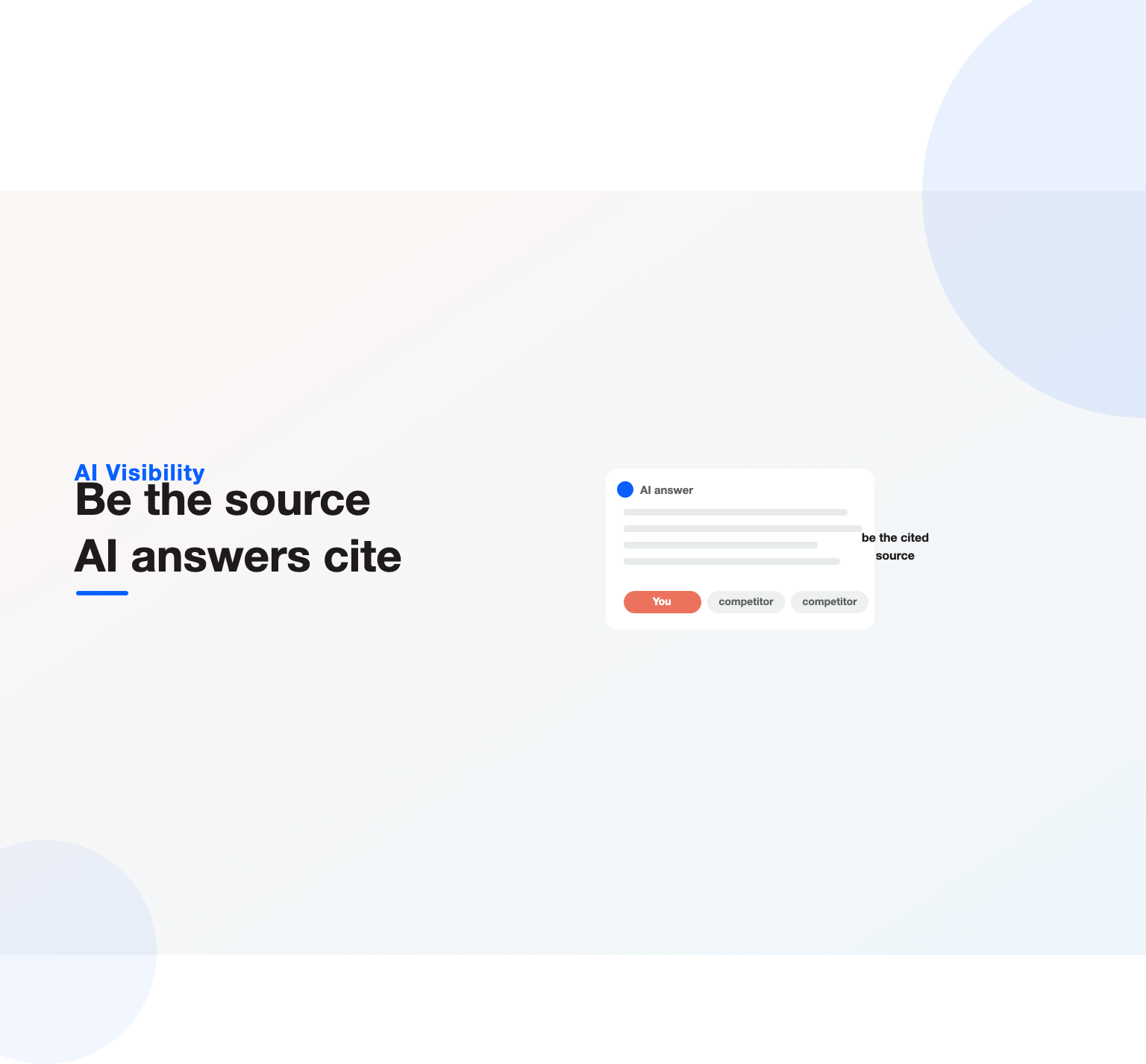
AI visibility is how often and how prominently your brand appears in the answers generated by AI systems like Google’s AI Overviews, ChatGPT, Perplexity, and Gemini, when people ask questions related to what you offer. It is becoming as important as traditional rankings, because a growing share of searches are answered directly by AI that cites a handful of sources, and being one of those cited sources puts your brand in front of buyers at the moment of research. Improving AI visibility means creating clear, authoritative, well-structured content that AI systems can confidently extract and cite, building the brand authority those systems trust, and measuring your presence in AI answers the way you would track rankings, so you can see where you appear, where you do not, and what to fix.
Key Highlights
- AI visibility measures how present your brand is in AI-generated answers, a new axis of search performance distinct from, but built on, traditional rankings.
- It matters because AI answers increasingly mediate discovery, citing only a few sources, so being cited captures attention that used to come from ranking on the results page.
- AI systems favor clear, authoritative, well-structured content from trusted brands, so the fundamentals that earn AI citations overlap heavily with good SEO.
- You can measure AI visibility by systematically querying the major AI engines with your buyers’ real questions and recording where and how you appear.
- Improving it combines content quality, clear structure, strong brand authority, and technical accessibility, then tracking presence in AI answers as an ongoing KPI.
What AI visibility is, and why it matters now
AI visibility is the degree to which your brand, content, and products appear in the answers that AI systems generate, whether as a cited source, a recommended option, or a mentioned authority. It spans every surface where AI answers questions: the AI Overviews that appear atop Google results, the responses of assistants like ChatGPT and Gemini, and answer engines like Perplexity that are built around citing sources. Where traditional visibility is about ranking on a page of results, AI visibility is about being part of the answer itself.
It matters now because behavior is shifting. More people are asking AI systems questions they used to type into a search box, and even within traditional search, AI Overviews increasingly answer queries before a user scrolls to any link. In that environment, a brand can rank well in the classic sense and still be invisible in the AI answer that most users actually read, or it can be cited prominently in AI answers and gain influence it never had on the standard results page. AI visibility captures this new reality, and treating it as a distinct thing to measure and improve is how brands stay discoverable as the interface to information changes underneath them.
How AI visibility differs from traditional rankings
AI visibility and traditional rankings are related but not the same, and understanding the difference is what keeps a strategy from misfiring. A ranking is your position in a list of links for a query; visibility in AI answers is your presence in a generated answer, which may cite you, paraphrase you, or recommend you without a conventional ranking at all. The two often correlate, since AI systems frequently draw on high-ranking, authoritative pages, but they can diverge: a page can rank modestly yet be cited by an AI for its clarity, or rank well yet be passed over because its content is hard to extract.
The practical implication is that you cannot fully measure or manage AI-answer presence with traditional rank tracking alone, because rankings do not tell you whether an AI actually cited you in its answer. It requires its own measurement, checking what the AI systems say, not just where you sit in a list. It also rewards slightly different content choices, favoring clear, extractable, well-structured answers that a machine can confidently lift and attribute. Recognizing presence in AI answers as a distinct axis, overlapping with rankings but not identical to them, is the starting point for building content and measurement that address both.
Where AI visibility happens: the surfaces that matter
This visibility plays out across several surfaces, and knowing them tells you where to look and what to optimize. Google’s AI Overviews are the highest-volume surface for most brands, since they appear above traditional results for a growing set of queries and cite the sources they draw from, so being one of those citations is prime real estate. Assistant chatbots like ChatGPT and Gemini answer questions conversationally and increasingly name sources and recommendations, reaching users who never touch a search engine at all.
Answer engines like Perplexity are built explicitly around citing sources for every answer, making them a clear place to see and pursue your presence in AI results, while Microsoft’s Copilot brings AI answers into Bing and the wider Microsoft ecosystem. Each surface behaves a little differently in how it selects and presents sources, but they share the same underlying logic: they choose clear, credible, relevant content from trusted sources to build their answers. Mapping which surfaces matter for your audience, and checking your presence on each, is how you turn the abstract idea of being cited by AI into a concrete set of places to measure and improve.
How AI systems choose what to cite
Improving visibility in AI answers starts with understanding what AI systems look for, and while the exact mechanisms are proprietary, the patterns are consistent. These systems favor content that directly and clearly answers the question, because they are assembling an answer and need sources they can extract cleanly. They favor authoritative, trustworthy sources, since citing a credible brand makes the answer more reliable, which means the same brand and expertise signals that help traditional rankings also help here, which is why understanding how AI engines choose which brands to cite is so useful. And they favor well-structured, factual content that is easy to parse, because clarity makes extraction and attribution safer.
Relevance and specificity matter too: AI systems cite the source that best matches the precise question, so comprehensive content that genuinely covers a topic is more likely to be drawn on across the many specific questions within it. Freshness and consistency help, since current, internally-consistent information is safer to cite than stale or contradictory content. The through-line is that AI systems are trying to give the best, most trustworthy answer, so they reward content that is genuinely the best, most trustworthy answer, which means earning AI-answer presence is largely a matter of deserving it through clarity, authority, and depth rather than gaming a formula.
How to measure AI visibility
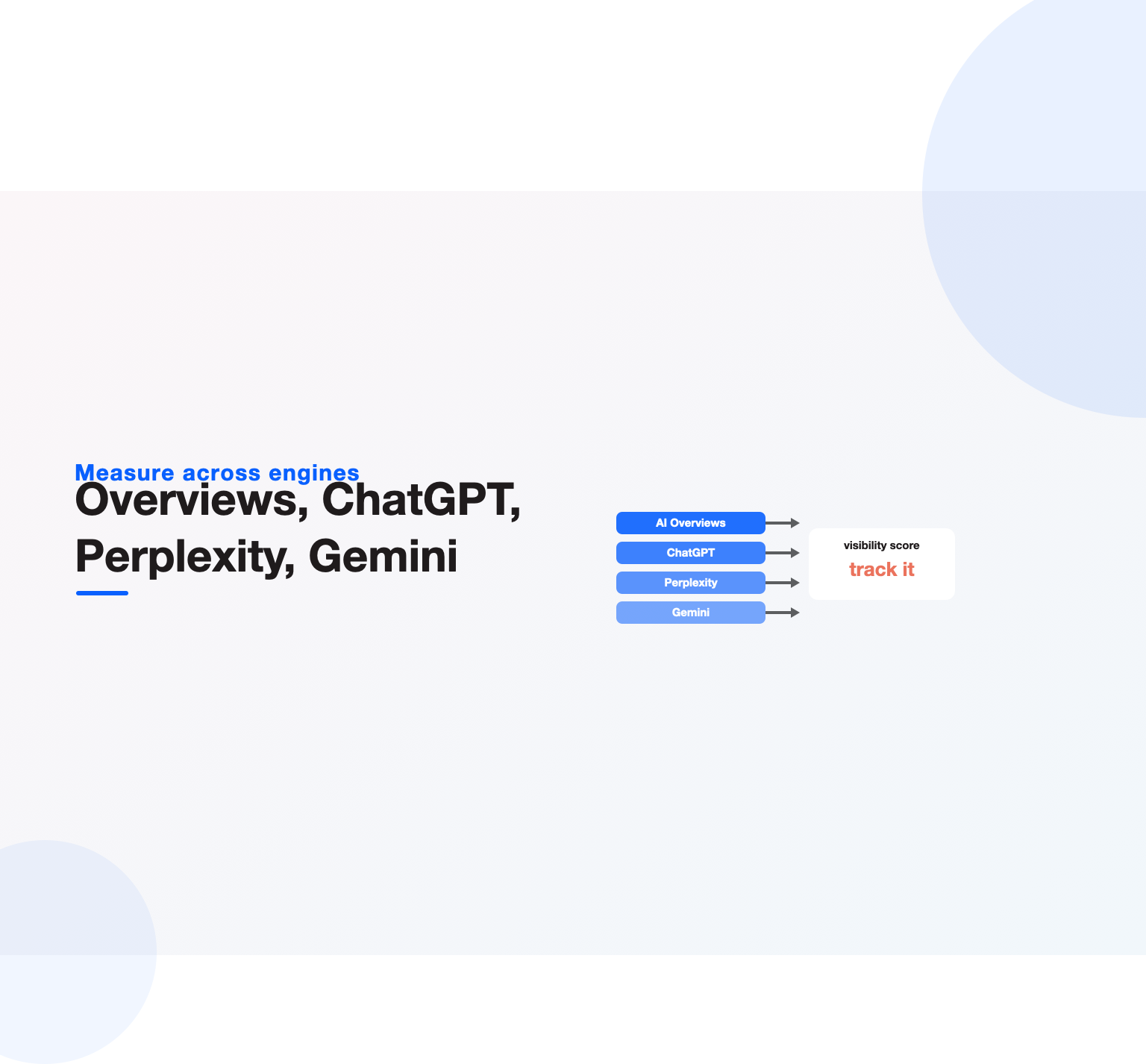
You cannot manage presence in AI answers without measuring it, and the good news is that you can measure it directly by asking the AI systems themselves. Build a list of the real questions your buyers ask across their journey, the problems, comparisons, and decisions relevant to what you offer, then query the major AI engines, AI Overviews, ChatGPT, Perplexity, and Gemini, with those questions and record the results. Note whether your brand appears, whether it is cited or recommended, how prominently, and which competitors show up instead, building a picture of where you are visible and where you are absent.
Done systematically, this becomes a repeatable audit rather than a one-off check. Track your presence across a consistent set of questions over time so you can see whether visibility is improving, watch which competitors dominate the answers you want to appear in, and identify the specific questions where you should be cited but are not, which become your priorities. This is essentially running a small research study on your own market, and it is exactly the kind of measurement our AI search optimization services build for clients, turning this visibility from an unknown into a tracked metric you can act on the way you act on rankings.
How to improve your AI visibility
Improving your presence in AI results combines content, authority, and technical accessibility, and it builds directly on strong SEO foundations. On content, create clear, comprehensive, genuinely authoritative material that directly answers the questions your buyers ask, structured so the key answer is easy to find and extract, the answer-first approach a strong content strategy already uses, with clear headings and factual, well-organized information. This is the single biggest lever, because AI systems cite content they can confidently understand and attribute, and clarity plus depth is what makes content citable.
On authority, invest in the brand and expertise signals that make AI systems trust you: demonstrable expertise, a recognized brand, and the kind of reputation that both search and AI systems favor when choosing sources. On the technical side, make sure your content is accessible to the crawlers these systems use, which often means ensuring important content is in the HTML rather than hidden behind scripts, since many AI crawlers do not execute JavaScript. Accurate structured data helps machines understand your content precisely. Together these mirror the fundamentals of good SEO, which is why being cited by AI work integrates naturally with a broader SEO program rather than standing apart from it.
AI visibility and content structure
Because AI systems extract and assemble answers, how you structure content has an outsized effect on visibility in AI answers. Leading with a direct, concise answer to a question, then expanding on it, gives an AI a clean passage it can lift and cite, whereas burying the answer in the middle of a long, meandering section makes extraction harder and citation less likely. Clear headings that map to real questions, factual statements that stand on their own, and logically organized sections all make content easier for a machine to parse and attribute confidently.
This does not mean writing for machines at the expense of people, because the same clarity that helps AI systems also helps human readers, and content that genuinely serves people is what these systems aim to surface. The goal is content that is both genuinely useful and cleanly structured: comprehensive enough to be authoritative, and organized enough to be extractable. Formatting that presents information clearly, direct answers, well-labeled sections, and factual precision, is a practical, controllable way to improve AI-answer presence without any tricks, simply by making your genuine expertise easy for both people and AI to use.
Tracking AI visibility as an ongoing metric
Presence in AI answers is not a one-time project but a metric to track continuously, the way you track rankings and traffic. Establish a baseline by auditing your presence across your key questions and engines, then re-measure on a regular cadence to see how it changes as you improve content and as the AI systems themselves evolve. Because these systems update frequently, visibility can shift without warning, so ongoing tracking is what lets you catch changes, spot new opportunities, and prove the impact of your work.
Fold this visibility into your broader reporting so it sits alongside traditional metrics rather than in a silo, giving stakeholders a complete picture of search performance across both classic and AI surfaces. Report where you appear, how that is trending, and which high-value questions you are winning or losing, and connect it to business outcomes where you can, since presence in AI answers at the research stage influences decisions even when it does not produce an immediate click. Treated as a tracked, reported metric, your presence in AI results becomes a manageable part of your marketing rather than an intangible you can only guess at, which is the point our guide to SEO reporting makes about any metric worth acting on.
How AI visibility relates to AEO and GEO
Being cited by AI is the broad outcome that two more specific disciplines work toward, and it helps to see how they fit. Answer engine optimization focuses on earning citations inside answer engines, the practice covered in our guide to answer engine optimization, while generative engine optimization targets visibility inside generative assistants, as our generative engine optimization work describes. Both are routes to the same destination: being present and cited when AI systems answer questions about your market.
Treating visibility in AI answers as the umbrella goal keeps these efforts coherent rather than fragmented. You are not doing three unrelated things; you are building the clear, authoritative, accessible content and brand authority that make you visible across answer engines, generative assistants, and AI Overviews alike, then measuring your presence across all of them. Optimizing specifically for Google AI Overviews or for a particular assistant are tactics within that larger goal. Seeing AI-answer presence as the outcome, and AEO and GEO as complementary means to it, is what lets a brand pursue the whole opportunity systematically instead of chasing each surface in isolation.
AI visibility for different business types
What presence in AI answers looks like in practice varies by business, and tailoring the effort matters. For ecommerce, presence in AI answers about products, comparisons, and recommendations increasingly shapes what shoppers consider, so structured, data-rich product and category content, the foundation of ecommerce SEO, is what AI shopping features draw on. For B2B, buyers use AI to shortlist vendors and research solutions, so being cited as an authority in your category directly influences pipeline, which is why AI presence is becoming central to B2B SEO.
For local businesses, AI answers to near-me and local-intent questions determine who gets surfaced, so accurate, authoritative local information is the lever. For service providers and publishers, being the cited expert on the questions your audience asks builds authority and referral value even when a click does not immediately follow. Across all of them the underlying work is the same, clear authoritative content, strong brand signals, and technical accessibility, but where you focus, which questions and surfaces you prioritize, should follow how your particular buyers use AI to research and decide.
Building an AI visibility program
Turning this visibility from an idea into results means running it as a program rather than a one-off effort. Start by auditing your current presence, querying the engines with your buyers’ real questions to establish a baseline of where you appear and where competitors dominate. Use that audit to prioritize: identify the high-value questions where you should be cited but are not, and target the content and authority work that would win them. Then create or improve the answer-first, authoritative content those questions demand, and make sure it is technically accessible to AI crawlers.
From there, make it continuous. Re-audit on a regular cadence, track your presence over time, and report it alongside your other search metrics so stakeholders see the full picture, connecting it to business outcomes where you can. Assign ownership so the work does not stall, and treat your presence in AI results as a standing part of your search strategy rather than a project with an end date, since the surfaces and their behavior keep evolving. Run this way, the effort compounds, and being cited by AI systems becomes a durable, managed asset, which is the outcome our AI search optimization program is built to deliver.
Why AI visibility is a first-mover advantage
One reason to prioritize AI visibility now is that the field is still early, and early movers gain a real edge. Many brands have not yet started measuring or optimizing their presence in AI answers, so the competition for citations is far thinner than for traditional rankings, and the sources AI systems learn to trust today shape the answers they give tomorrow. Establishing yourself as a cited authority while the space is uncrowded is easier and more durable than trying to displace entrenched sources later, much as winning citations in emerging surfaces like Google AI Mode rewards the brands that show up first.
The advantage compounds because AI systems favor sources with a track record of being clear, accurate, and authoritative on a topic. A brand that consistently earns citations builds a kind of reputation with these systems that reinforces itself, while brands that wait start from behind. This does not mean rushing out thin content to plant a flag, which fails for the reasons any low-quality content fails, but it does mean that genuine investment in AI visibility today pays off more than the same investment will once every competitor is doing it. The brands treating AI visibility as a priority now, measuring it, improving it, and reporting it, are positioning themselves to own the answers in their market as AI-mediated search becomes the default rather than the novelty, and that head start is hard for latecomers to reverse.
Common AI visibility mistakes
A few mistakes hold brands back as they pursue being cited by AI. The first is ignoring it entirely, assuming traditional rankings are enough while competitors quietly capture the AI answers that increasingly shape decisions. The second is trying to game it with thin or manipulative content, which fails for the same reason it fails in search: AI systems are built to find the best, most trustworthy answer, and shortcuts do not produce that. The third is treating visibility in AI answers as completely separate from SEO, missing that the same content quality, authority, and technical health drive both.
Another common error is not measuring at all, so a brand has no idea whether it appears in AI answers or how that is changing, and therefore cannot improve deliberately. And some brands neglect the technical basics, publishing important content in ways AI crawlers cannot access, so genuinely good material never gets cited. Avoiding these traps comes down to taking AI-answer presence seriously as a real, measurable axis of performance, building on SEO fundamentals rather than against them, and doing the honest work of being the best answer, which is what these systems are designed to reward. None of this requires guessing at hidden algorithms: it requires the same honest discipline that has always separated brands that earn trust from those that chase shortcuts, applied to a new set of surfaces where the rewards are still there for the taking.
Key Takeaways
- Presence in AI answers is your brand’s presence in AI-generated answers across AI Overviews, ChatGPT, Perplexity, and Gemini, a new axis of search performance built on SEO fundamentals.
- It matters because AI answers increasingly mediate discovery and cite only a few sources, so being cited captures attention that ranking alone no longer guarantees.
- AI systems cite clear, authoritative, well-structured content from trusted brands, so earning this visibility is largely a matter of deserving it through clarity, authority, and depth.
- Measure your presence in AI results directly by querying the major engines with your buyers’ real questions and recording where and how you appear, then track it over time.
- Improve it with answer-first, well-structured content, strong brand authority, and technical accessibility, and report it alongside traditional metrics rather than in a silo.
Frequently asked questions
What is AI visibility?
Being cited by AI is how often and how prominently your brand appears in the answers generated by AI systems such as Google’s AI Overviews, ChatGPT, Perplexity, and Gemini, when people ask questions related to what you offer. It can mean being cited as a source, recommended as an option, or mentioned as an authority. As AI increasingly answers questions directly, visibility in AI answers is becoming a core measure of whether a brand is discoverable in the way people now actually search.
How is AI visibility different from SEO rankings?
Rankings are your position in a list of links for a query, while AI-answer presence is your presence in a generated answer that may cite, paraphrase, or recommend you without a conventional ranking. The two often correlate because AI systems draw on authoritative, high-ranking content, but they can diverge, so you cannot fully measure presence in AI answers with rank tracking alone. It requires checking what the AI systems actually say, and it rewards clear, extractable content a machine can confidently cite.
How do I measure my AI visibility?
Measure it directly by building a list of the real questions your buyers ask, then querying the major AI engines, AI Overviews, ChatGPT, Perplexity, and Gemini, with those questions and recording whether and how prominently your brand appears, and which competitors show up instead. Repeating this across a consistent set of questions on a regular cadence turns it into a trackable audit, showing where you are visible, where you are absent, and whether your visibility is improving over time.
How can I improve my AI visibility?
Improve it by creating clear, comprehensive, authoritative content that directly answers your buyers’ questions, structured answer-first so AI systems can easily extract and cite it, and by building the brand and expertise signals those systems trust. Make sure your content is technically accessible to AI crawlers, which often means keeping important content in the HTML rather than behind JavaScript, and use accurate structured data. These steps build on strong SEO fundamentals, so this visibility work integrates with your broader SEO rather than replacing it.
Which AI systems matter for AI visibility?
The ones that matter most are Google’s AI Overviews, given their high volume and placement above traditional results, the major assistants ChatGPT and Gemini, and answer engines like Perplexity that are built around citing sources, with Microsoft Copilot relevant in the Bing and Microsoft ecosystem. Which matter most for you depends on where your audience researches, so mapping the surfaces your buyers actually use, and checking your presence on each, focuses the effort where it counts.
Why do AI systems cite some brands and not others?
AI systems cite content that clearly and directly answers the question, comes from an authoritative and trustworthy source, and is well-structured enough to extract and attribute confidently. They favor relevance and specificity, citing the source that best matches the precise question, and they prefer current, consistent information. In short, they try to give the best, most trustworthy answer, so they cite the brands whose content genuinely is the clearest, most authoritative answer, which is earned through quality rather than tricks.
Is AI visibility replacing SEO?
No, your presence in AI results is an extension of SEO rather than a replacement, because it is built on the same fundamentals: clear, authoritative, well-structured content, strong brand authority, and technical accessibility. Traditional rankings still matter, and AI systems often draw on high-ranking content, so the two work together. The shift is that visibility now includes being present in AI answers, which adds a new surface to optimize for and measure, using the same underlying work that drives good SEO.
Does AI visibility drive real business results?
Yes, because appearing in AI answers puts your brand in front of people at the research and decision stages, influencing which options they consider even when it does not produce an immediate click. Being cited by an AI as a recommended or authoritative source builds credibility and awareness that pay off later in the buyer journey, particularly for considered purchases where buyers research thoroughly. Tracking being cited by AI and tying it to outcomes is how you connect that influence to real business results.
Ready to put this into practice?
Talk to the team that runs SEO, AI search and paid growth programs every day.
Book a Strategy Call →