 Skip to content

AI SEO Services: Stay Visible in AI Answers
AI SEO services explained: using AI to optimize smarter and getting your brand cited inside AI answers from ChatGPT, Perplexity, Gemini and AI Overviews. Levers, measurement and how to choose.
Quick Answer
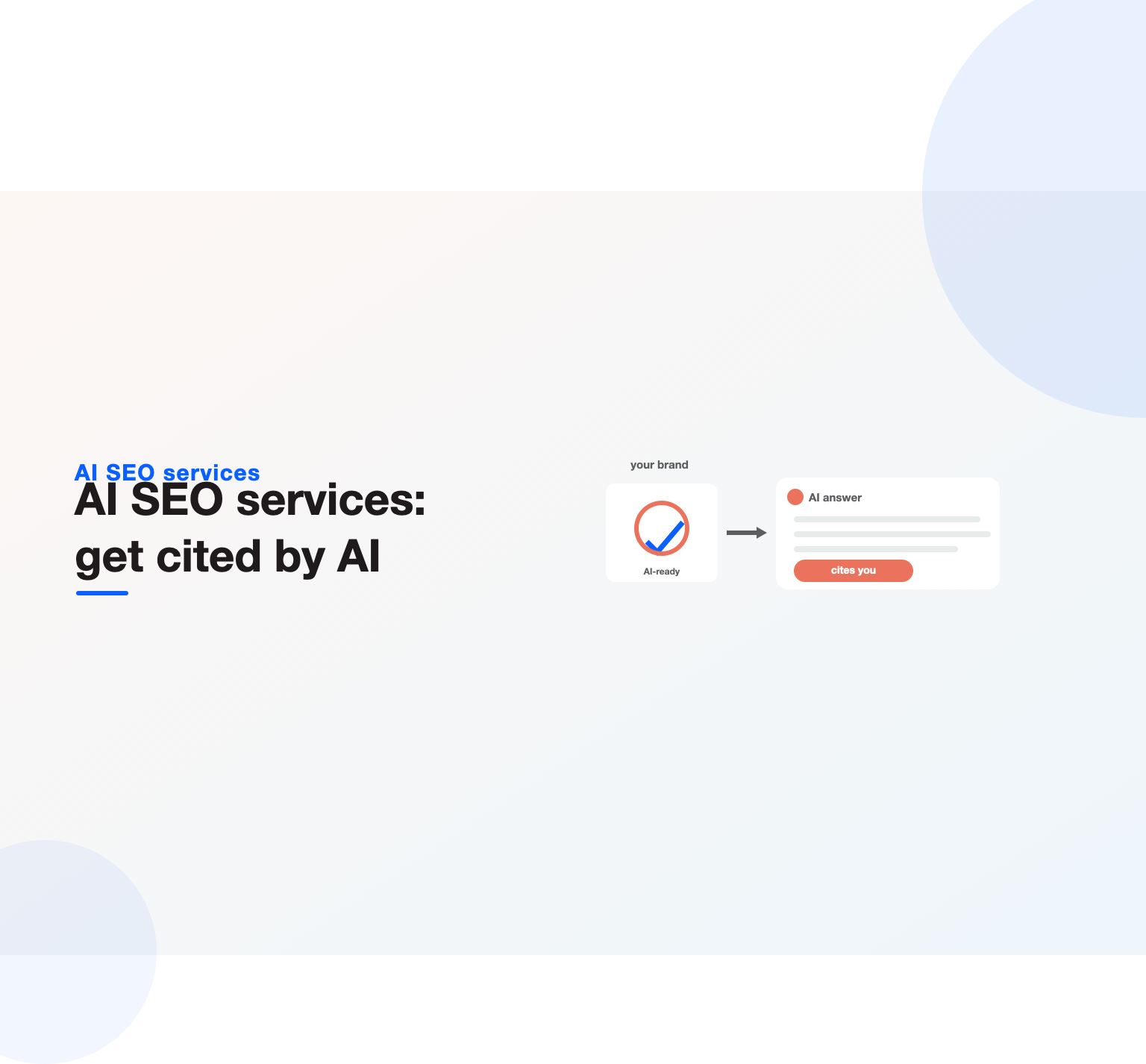
AI SEO services help a business stay visible as search shifts from a list of blue links to AI-generated answers. The work covers two connected fronts: using artificial intelligence to make traditional search work smarter and faster, and optimizing so your brand gets surfaced and cited inside AI answers from tools like ChatGPT, Perplexity, Gemini and Google AI Overviews. A good provider strengthens the entity behind your business, structures content so models can extract and quote it, earns the citations engines trust, and keeps your classic rankings healthy at the same time. The result is a brand that shows up whether a customer searches the old way or simply asks an assistant.
Key Highlights
- AI SEO services span two fronts: using AI to run search smarter, and optimizing to appear inside AI answers.
- Visibility now means being cited in AI Overviews and assistants, not only ranking in the classic results.
- The core levers are entity strength, extractable content structure, and citations from trusted sources.
- Traditional rankings still matter and reinforce AI visibility, so the strongest programs run both together.
- Measurement expands from rankings to citation presence, answer-set visibility and branded lift.
What AI SEO services actually cover
The phrase describes a discipline that has grown up around a genuine shift in how people find information. Search is no longer only a page of ranked links; increasingly it is a synthesized answer, assembled by a model that reads across many sources and names a few of them. AI SEO services exist to keep a business visible through that transition, and they work on two connected fronts. The first is using artificial intelligence inside the optimization workflow itself, to research faster, analyze content at scale and spot opportunities a manual process would miss. The second, and more strategically important, is optimizing so the brand appears inside the AI answers that now sit at the top of so many searches.
That second front is where the real change lies. When a generative engine answers a question, it decides which brands and facts to trust and produces a single response that cites a handful of them. A provider working this front shapes your presence so the engines understand who you are, judge you credible, and can lift a clean, quotable passage from your content to attribute to you. It is optimization aimed at the answer itself, a different target from a ranking position, requiring methods that traditional search work never needed.
Crucially, this does not replace classic search optimization, it extends it. The same clean, authoritative foundations that help a page rank also help a model trust and cite it, which is why the best providers treat the two as one connected program rather than separate silos. A business investing here is not abandoning its rankings; it is adding a forward-looking layer on top of healthy SEO services so it stays visible on every surface where customers now look, from the classic results to the assistant.
Why AI is reshaping search visibility
The urgency behind these services comes from a change in behavior that is already well under way. A growing share of research now happens inside AI assistants and answer features, where a user reads a summary and acts on it without visiting a traditional results page at all. Google AI Overviews place a generated answer above the classic links for a large and rising share of queries, and standalone assistants field questions that once went to a search box. In that world, being visible means being cited in the answer, and a brand absent from it loses consideration no matter how well its pages rank underneath.
What makes the moment pivotal is that authority in generative engines is still being decided. Because the surface is new, no incumbent has locked in dominance the way large sites have in classic search, so a business that invests early can establish itself as a cited source before the space matures. That window is exactly why so many companies are engaging providers now rather than waiting, since the citations and entity strength built today compound as the engines and their user base grow. Moving early is a genuine advantage that late entrants cannot easily buy back.
There is also a compounding relationship with the rest of search that makes this investment efficient. The authoritative content and clean structure built for AI visibility tend to help classic rankings too, and the trust earned supports presence across answer engines and traditional results alike. Framed properly, this is not a gamble on one channel but a strengthening of the whole search foundation, which is how the strongest programs treat it and why the return extends well beyond the AI answers themselves. Understanding what that scope of work costs, which our guide on SEO cost breaks down, helps a business budget for it sensibly.
The core levers an AI SEO service pulls
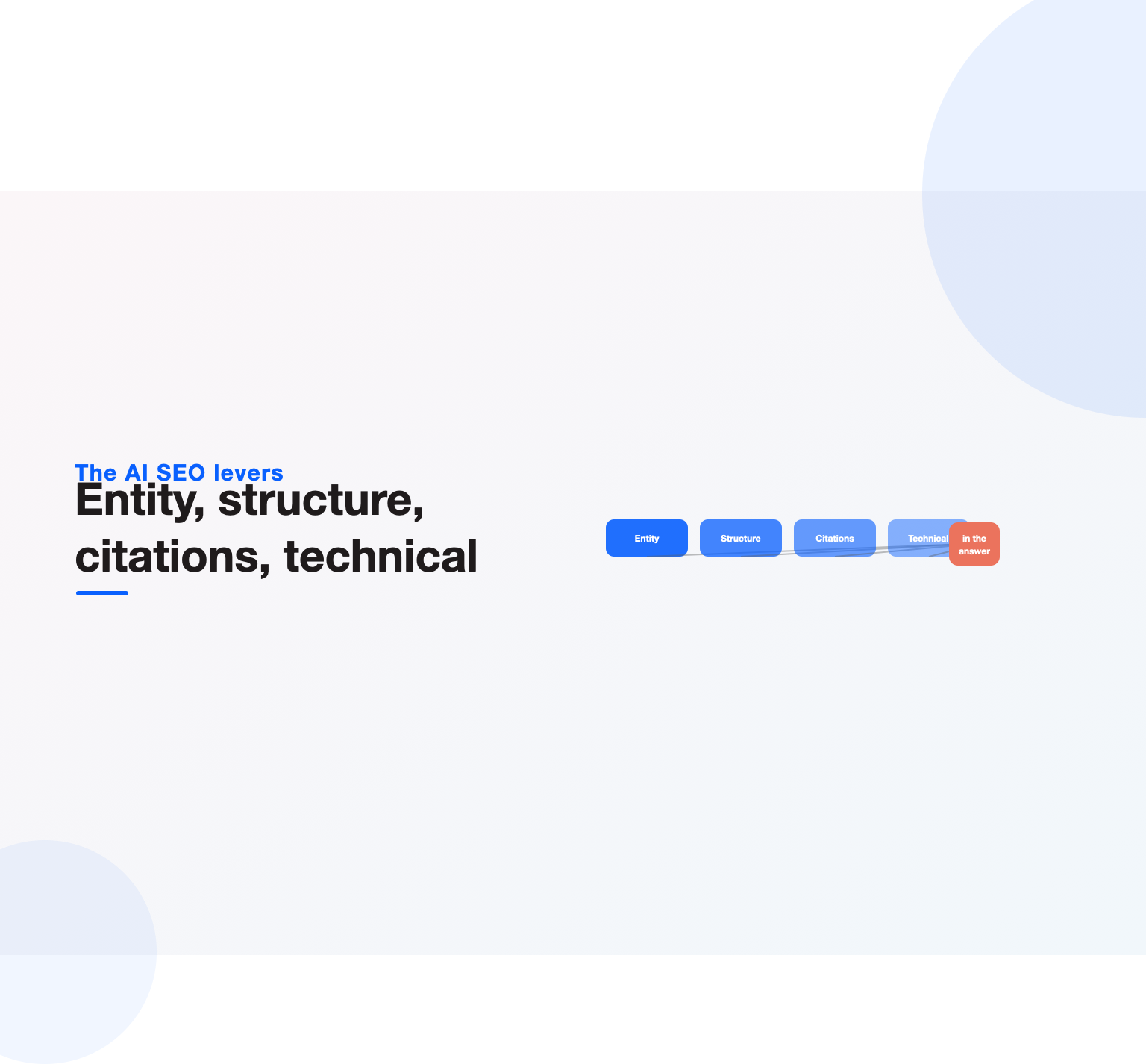
Effective work on this front rests on a few foundations, and a capable provider works all of them rather than leaning on one. Knowing these levers helps a business judge whether a prospective partner genuinely understands the discipline or is simply relabeling old tactics.
Entity strength comes first. Generative engines need to understand who you are, what you do and whether you are authoritative on a topic. A provider maps and strengthens your entity, ensuring consistent, accurate information about your brand across the sources engines already read, so a model can confidently identify and trust you as something worth citing. Without a clear entity, even excellent content struggles to be attributed to you.
Extractable content is the second lever. Models quote passages that are easy to lift, so the work structures pages for extraction: direct answers in the opening lines, question-shaped headings, crisp definitions, comparison tables and clean FAQ blocks. The aim is to make each important passage self-contained and quotable, so an engine can pull it and attribute it to your brand rather than a competitor who explained the same thing more clearly.
Citations and trust form the third. Generative engines weigh what credible third parties say about you, so earning mentions, references and reviews across authoritative sources raises the odds an engine treats your brand as a safe recommendation. This off-site trust building is patient, reputation-driven work, and it is frequently what separates the brands that get cited from those that do not, closely mirroring the citation-focused work a dedicated GEO agency performs.
Technical health underpins all of it. Fast, crawlable, well-structured pages with clean markup let engines read and understand your content reliably, and a healthy site is easier for both classic crawlers and AI systems to trust. Neglecting the technical base quietly caps everything above it, which is why a serious provider audits and fixes it before layering on the rest.
Not sure how visible you are in AI search?
Our team reviews your current setup and shows you where the opportunities are. See how our AI search optimization work.
How AI SEO differs from traditional SEO
The two overlap in foundations but differ in target, and understanding the distinction helps a business decide what it needs. Traditional optimization aims to rank your pages in the classic results, focusing on keywords, links and technical health to climb the list of links. AI-focused work aims to get your brand cited inside the generated answer, focusing on entity strength, extractable structure and the citations models trust. Both rely on clean, authoritative content, which is why the disciplines complement each other, but the second adds work aimed specifically at how engines synthesize and attribute answers.
The measurement changes as much as the tactics. Classic search is judged by rankings and organic traffic, while AI visibility is judged by whether you appear in the answers, how often, and for which questions, metrics traditional rank tracking cannot see. A provider working this front therefore brings new instrumentation, querying the engines directly for your priority prompts and logging where and how your brand appears. A business used to a rankings dashboard should expect its reporting to expand rather than simply shift, since both pictures matter and reinforce each other. This citation-focused axis is shared with answer engine optimization, which targets the same surfaces with the same underlying signals.
Using AI within the optimization workflow
The other side of these services is the intelligent use of AI to make the work itself faster and sharper. Modern optimization involves analyzing large volumes of content, queries and competitor data, and artificial intelligence accelerates that analysis dramatically, surfacing patterns, gaps and opportunities that a manual process would take far longer to find. Used well, it helps a team research topics, understand search intent at scale, and prioritize the work that will move the needle, freeing human expertise for judgment and strategy.
The important caveat is that AI in the workflow is a tool, not a substitute for expertise or quality. Content generated carelessly at scale tends to be generic, and both search engines and AI answer systems increasingly discount thin, undifferentiated material, so the winning approach uses AI to inform and accelerate genuinely expert work rather than to mass-produce it. A trustworthy provider is transparent about where it uses AI and where human judgment leads, and it holds every output to the same quality bar regardless of how it was produced. That discipline is what separates an AI-augmented program that compounds from one that quietly erodes trust.
Measuring AI SEO results
Because the target has expanded, measurement expands with it, and a serious provider tracks both the classic and the AI-focused picture. On the traditional side, rankings, organic traffic and conversions remain valid and important. On the AI side, the metrics that matter are citation presence, how often and where your brand appears in the answers for your priority questions, share of those answer sets relative to competitors, and branded lift as more people encounter you inside assistants. Together these show whether the investment is turning into visibility and, ultimately, customers.
Instrumenting the AI side takes deliberate effort, since rank trackers cannot observe it. The practical approach is to define the questions your buyers actually ask, query the major engines for them regularly, and log where and how your brand shows up over time, building a baseline and then a trend. Pairing that with your existing analytics gives a complete view of how visibility across every surface connects to leads and revenue. This observable, outcome-focused measurement keeps the program accountable and makes it clear where to invest next, rather than trusting that effort is quietly paying off.
What to expect from an AI SEO services engagement
A sensible engagement moves through recognizable phases rather than promising instant results, and knowing the shape helps a business judge a provider before signing. The opening weeks go to discovery and foundations: auditing the entity, mapping the questions your buyers ask the engines, checking where those engines currently source their answers, fixing technical health, and standing up measurement so there is a baseline to improve on. Good AI SEO services treat this groundwork as non-negotiable, because everything later depends on a clean entity and a clear picture of the starting position.
The middle stretch focuses on execution. This is where AI SEO services rebuild priority pages for extraction, strengthen the entity signals across the sources engines read, and begin the patient work of earning outside citations. Progress here is deliberate rather than instant, and a trustworthy provider narrates it honestly: first citations tend to appear on the narrower, lower-competition questions where the field is thin, then presence spreads to broader, higher-value questions as authority accumulates. A provider that promises the finish line in week one is not grounded in how citations are actually earned.
The closing phase of each cycle reads the early signals, doubles down on the questions showing movement, and plans the next cluster of work. Because the surface is observable, AI SEO services can point to concrete evidence, live answers where your brand now appears, rather than asking you to take progress on faith. Setting expectations on cost and timeline honestly from the outset matters here, since this is a compounding investment whose returns build as entities strengthen and citations accumulate, much as our guide on how to choose an agency for AI visibility emphasizes.
Red flags when evaluating AI SEO services
Because the category is young and demand is high, it has attracted providers who relabel ordinary work with new terminology, so a clear-eyed evaluation protects your budget. The clearest warning sign is a guarantee of specific placements inside AI answers: no provider controls what a model outputs, so a promise of guaranteed citations signals either a misunderstanding of how answers are sourced or a willingness to mislead. Credible AI SEO services commit to a method and to measurable movement in citation presence, not to outcomes they cannot control.
A second red flag is secrecy about method. A genuine provider can explain, in plain terms, how it strengthens your entity, structures content for extraction and earns citations, and it can show real examples of brands it has pushed into AI answers with the live questions where those citations appear. Vagueness, jargon offered in place of specifics, or an inability to name the engines it targets all suggest thin experience. The best AI SEO services are transparent precisely because their work is observable, and they invite you to verify their claims in the answers themselves.
A third warning is a content-only pitch: a provider that proposes simply publishing more articles, without touching entities, structure or citations, produces material that may rank yet never gets cited, present in the index but absent from the answer. Closing that gap between ranking and citation is the entire point, so AI SEO services worth hiring lead with the levers that earn citations rather than with volume. Watching how a prospective partner addresses that gap tells you most of what you need to know about whether it has done this work before.
Matching AI SEO services to your business
Not every business needs the same scope, and honest AI SEO services help you find the right level rather than selling the maximum. Companies whose buyers already ask assistants for recommendations, considered B2B purchases, professional services, software, healthcare and finance, benefit first and most, because being absent from those answers is a quiet, compounding loss. For them, a fuller program that strengthens entity, restructures priority pages and earns citations across authoritative sources is usually justified from the outset.
Businesses whose buyers have not yet moved heavily into AI answers can start narrower, focusing on the foundations that also help classic search, and expand as the behavior shifts in their market. The reassuring part is that the early work is shared: a clean entity, extractable content and a healthy technical base serve both goals at once, so nothing is wasted by starting modestly. A capable provider of AI SEO services helps you judge which case you are in and sequences the work so early wins fund later ones, connecting the new answer-focused metrics to the search data you already watch. Framed this way, the investment scales with the opportunity rather than being an all-or-nothing bet, which is exactly how a business new to the discipline should approach it, and how our answer engine optimization team structures a first engagement.
Doing it yourself versus hiring a provider
A capable in-house team can begin some of this work alone: strengthening the entity, restructuring priority pages for extraction and cleaning up technical health are all achievable, and starting there builds a useful understanding of how AI visibility is earned. For a business with modest needs and existing search skills, disciplined attention to these fundamentals delivers real early gains before any outside help is engaged.
The case for a provider grows with competition, with the pace of change on these surfaces, and with the ongoing, specialized nature of the work. Earning citations across authoritative sources, instrumenting AI-side measurement, keeping current as engines evolve, and doing all of it without letting quality slip is a continuous job that rewards focused expertise. A specialist also brings pattern knowledge from many campaigns, which shortens the path to results on a surface where few teams have deep experience yet. Weighing that cost against the value of staying visible as buyers move into AI answers, a question our guide on SEO for business helps frame, is the right way to decide.
Whichever route you choose, the priorities are the same, which is the reassuring part. Build a clear, trusted entity, structure content so models can extract it, earn genuine citations, keep the technical base healthy and measure presence in the answers. A provider accelerates and sustains that work and brings scarce expertise to it, but the fundamentals are knowable and durable. For businesses that want an end-to-end approach, a dedicated AI search optimization team runs the whole cycle so the brand stays visible across both classic search and AI answers.
Want a plan to grow your AI search visibility?
Book a free 30-minute strategy call and leave with a clear next step for your business.
How AI SEO connects to the rest of your visibility
The strongest reason to invest here is that the work does not stand alone; it strengthens every surface where customers find you. The clean entity and extractable content built for AI answers also lift classic organic rankings, and the same trusted business presence that earns citations helps you appear when someone searches locally, which is why teams often run this alongside local SEO. Rather than a separate channel competing for budget, AI-focused work is the layer that makes a connected search program more resilient as behavior shifts.
That connection also shapes how the work should be organized. Splitting AI visibility, classic rankings and citation building across separate vendors duplicates the shared foundations and invites conflicting guidance on entities and structure, which is where budget quietly leaks. A single team accountable for the whole picture, from traditional optimization to the citation-focused work a GEO agency handles, keeps everything aligned and lets each surface reinforce the others. When you evaluate a provider, ask how it would connect the new answer-focused metrics to the search data you already watch, and how it would sequence the work so early wins fund later ones, a discipline our guide on SEO for business explores in depth.
The future this investment prepares for
Search is unlikely to snap back to a page of ten blue links, so the businesses that adapt now are positioning for where discovery is heading rather than chasing a passing trend. As assistants and answer features handle more of the research that precedes a purchase, being cited in those answers becomes as important as ranking once was, and the authority that earns those citations takes time to build. Starting while the surface is young means entering the next phase of search with an established presence rather than scrambling to catch up once competitors have already been named. That is the durable case for treating AI search optimization as a foundational investment, not an experiment, and for choosing a provider that understands where the whole landscape is going rather than one selling a single tactic.
For a business weighing the move, the practical first step is modest: name the handful of buyer questions where being cited would matter most, and ask any prospective provider how it would earn a place in those specific answers. A credible reply talks about entity, structure and citations rather than volume of content, and it connects the effort to a realistic budget and timeline. Understanding what the work costs, which our guide on SEO cost lays out, and how it complements the citation-focused work a dedicated GEO agency performs, turns an intimidating new category into a clear, staged investment you can start small and scale as the signals prove out. Approached that way, even a cautious business can begin with a focused pilot and expand into full AI search optimization once the early answers confirm the return.
Key Takeaways
- AI SEO services keep a business visible as search shifts from ranked links to AI-generated answers.
- The work spans using AI to optimize smarter and optimizing to be cited inside AI answers, with the second the strategic prize.
- Entity strength, extractable content, citations and technical health are the core levers a provider pulls.
- Traditional rankings still matter and reinforce AI visibility, so run classic and AI-focused work as one program.
- Measure both pictures, rankings and citation presence, and invest in a provider as competition and complexity grow.
Frequently asked questions
Direct answers to the questions businesses ask most about AI SEO services.
What are AI SEO services?
They are optimization services built for a search world moving from ranked links to AI-generated answers. The work covers two connected fronts: using artificial intelligence to run search optimization smarter and faster, and optimizing so your brand is surfaced and cited inside AI answers from tools like ChatGPT, Perplexity, Gemini and Google AI Overviews. A good provider does both while keeping your classic rankings healthy, since the foundations reinforce each other.
How is AI SEO different from traditional SEO?
Traditional SEO optimizes to rank your pages in the classic results, while AI SEO adds work aimed at getting your brand cited inside the generated answer. That means strengthening your entity, structuring content for extraction and earning the citations models trust, then measuring citation presence rather than only rankings. The two share foundations and work best together, but AI SEO targets how engines synthesize and attribute answers, which classic optimization never addressed.
Do I still need traditional SEO if I invest in AI SEO?
Yes. Classic rankings still drive substantial traffic, and a healthy, authoritative website is exactly what helps a model trust and cite you. The two reinforce each other, so the strongest approach runs them as one connected program rather than choosing between them. Abandoning traditional optimization would weaken the very foundations that AI visibility depends on, so think of AI SEO as an extension, not a replacement.
Which AI engines do these services optimize for?
A capable provider targets the major generative surfaces, including Google AI Overviews, ChatGPT, Perplexity and Gemini, and explains how the emphasis shifts across them since each sources answers a little differently. Overviews lean on established authority, Perplexity is citation-first, and assistants reflect their training and live sources. A provider that will not name the engines it works or describe those differences has likely not optimized these surfaces in practice.
Can AI write my content for these services?
AI can assist, but careless mass-produced content tends to be generic, and both search engines and AI answer systems increasingly discount thin material. The winning approach uses AI to accelerate research and analysis while genuine expertise leads on quality and judgment. A trustworthy provider is transparent about where it uses AI, holds every output to the same standard, and never lets automation substitute for the depth that earns citations and trust.
How are the results of AI SEO measured?
Measurement expands to cover both pictures. On the classic side, rankings, organic traffic and conversions still apply. On the AI side, the metrics are citation presence, how often and where your brand appears in the answers for your priority questions, share of those answer sets versus competitors, and branded lift. Because rank trackers cannot see AI answers, a provider queries the engines directly and logs where your brand appears over time.
How long does it take to see results?
Expect a few months for the compounding effects, as entity strength and citations accumulate, though technical fixes and content restructuring can help sooner. Early movement often appears on narrower, lower-competition questions before spreading to broader ones. Because presence compounds as the engines and their user base grow, starting early tends to pay off more than waiting, and progress is observable throughout since you can query the answers directly.
Is AI SEO worth it for a small business?
Often yes, because the surface is new and authority is still being decided, so a focused small business can establish itself as a cited source before larger rivals move. The right scope depends on your market and buyers, but strengthening the entity, structuring content for extraction and earning genuine citations are achievable at modest scale. Judged against the value of staying visible as customers shift to AI answers, the investment is frequently justified.
Ready to put this into practice?
Talk to the team that runs SEO, AI search and paid growth programs every day.
Book a Strategy Call →