 Skip to content

Is SEO Dead? What the Data Actually Says in 2026
Is SEO dead? No, but lazy SEO is. What the data shows about search volume, AI Overviews, and zero-click, what is dying, what is thriving, and how to future-proof your SEO.
Quick Answer
No, SEO is not dead, but the version of it that relied on cheap tricks and thin content is. Search is bigger than ever, people still start most of their journeys with a query, and organic results still drive enormous traffic and revenue, so the channel itself is very much alive. What has changed is the bar: AI Overviews, answer engines, and smarter ranking systems have killed the easy wins and raised the standard, so the sites that treated SEO as a volume game are losing while the ones that build genuine authority, depth, and trust are winning more than before. The honest answer to “is SEO dead” is that lazy SEO is dead and good SEO is thriving, because being the best, most trustworthy answer matters more now, not less.
Key Highlights
- Search volume is not shrinking; people still run billions of queries a day, so the demand SEO captures is intact even as the interface changes.
- AI Overviews and answer engines change how results appear and take some clicks, but they are fed by the same content SEO produces, not a replacement for it.
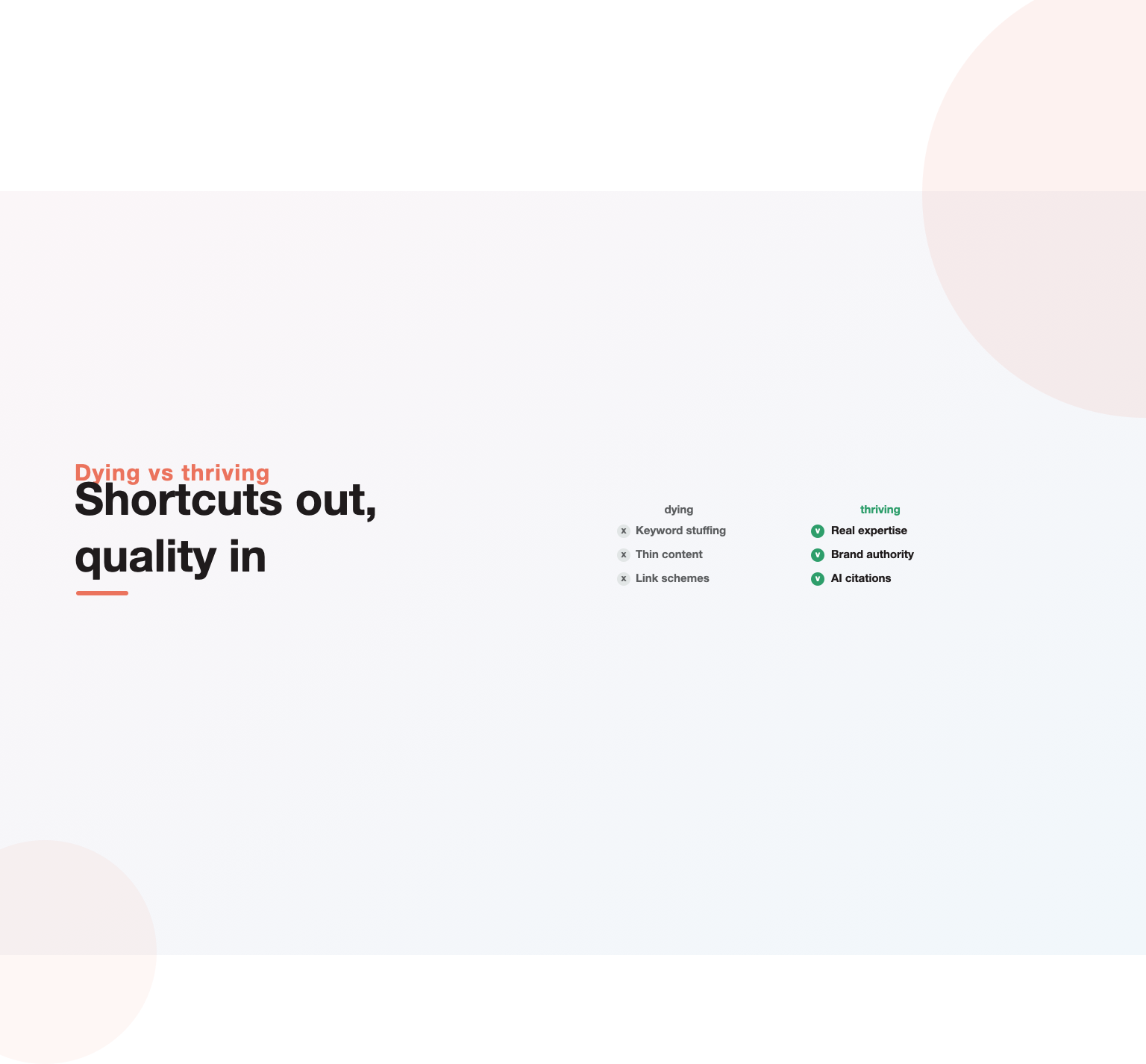
- What is actually dying is low-effort SEO: keyword stuffing, thin content, and easy manipulation that smarter systems now ignore or penalize.
- What is thriving is quality-led SEO: genuine expertise, brand authority, and content good enough to rank and to be cited by AI, which is harder to fake than ever.
- The right response is not to abandon SEO but to raise your standard and expand it to AI search, since the fundamentals that win are the same ones AI systems reward.
Where the “SEO is dead” claim comes from
The current wave of “is SEO dead” arguments has understandable roots, because several real changes are happening at once. AI Overviews now appear above traditional results for many queries, answering the question directly and pushing organic links down the page, which can reduce clicks to websites. AI chatbots like ChatGPT and Perplexity answer questions conversationally without sending anyone to a search engine at all, capturing intent that once flowed through search. And Google’s ranking systems have grown sophisticated enough that the tactics that used to produce quick wins, the shortcuts a real understanding of how SEO works never relied on, simply stop working, which feels, to anyone relying on them, like the ground giving way.
Layered on top of these is a genuine rise in zero-click searches, queries answered on the results page itself so the user never visits a site. When you combine AI answers absorbing informational queries, chatbots siphoning off others, and old tactics failing, it is easy to assemble a case that the channel is collapsing. Each of these pressures is real, and dismissing them is its own kind of denial. The mistake is not in noticing the changes but in the leap from “search is changing” to “SEO is dead,” because the same evidence, looked at fully, tells a more nuanced and more useful story.
What the data actually shows
Start with the size of the opportunity, because that is what the “is SEO dead” argument quietly ignores. Total query volume is not declining; people run billions of searches every day, and the total keeps growing as more of life moves online. Organic search remains one of the largest sources of website traffic and a leading channel for discovering products, services, and information, ahead of social and rivaling or beating paid in many contexts. A channel that still drives that much qualified demand is not a dead channel, whatever is changing about how it looks.
Even the disruptors depend on the thing they are supposedly killing. AI Overviews and answer engines do not generate knowledge from nothing; they summarize and cite content from the web, the same content SEO produces and optimizes, which means being the source those systems draw on is itself a search-visibility goal. Zero-click searches are real but concentrated in simple informational queries, the weather, a definition, a quick fact, that rarely converted to valuable traffic anyway, while commercial and complex queries still send people to sites to compare, evaluate, and buy. Read in full, the evidence does not show search dying; it shows search changing shape while the underlying demand, and the need to be visible for it, stays firmly intact.
What is actually dying in SEO
The “is SEO dead” claim is not pure myth, because a version of SEO really is dying, and it deserves to. Keyword stuffing, thin content churned out to target a phrase, exact-match manipulation, spammy link schemes, and the whole toolkit of gaming search rather than serving users are failing as ranking systems get better at recognizing quality and intent. The easy wins are gone: you can no longer rank a shallow page by hitting a keyword density or buying a batch of links, the way old link tactics once promised, and anyone whose SEO depended on those shortcuts is experiencing something that genuinely feels like death.
AI accelerates this because it raises the floor on content. When an AI Overview can instantly assemble a competent summary of basic information, thin content that merely restates the obvious has no reason to exist or to rank, since the machine does that job already. Generic, low-effort articles that once scraped traffic from informational queries are exactly what AI answers absorb, so the content most exposed to the AI shift is the content that added the least value in the first place. What is dying, then, is not SEO but the low-quality, manipulative, and generic practices that were always living on borrowed time, now finally being cleared out.
What is thriving in SEO
On the other side of the same shift, a great deal of SEO is not just surviving but thriving, and it is the quality-led kind. Genuine expertise, original insight, data, and depth, content that is authentically the best answer to a query, the product of a real content strategy, is more valuable than ever, because it is what ranks, what earns trust, and what AI systems cite. As the floor rises, the reward for being genuinely excellent grows, since there is more distance between a real authority and the commodity content the machines now handle. The sites investing in real quality are gaining ground precisely as the shortcut-takers lose it.
Brand and authority are thriving too. Both search and AI systems increasingly favor recognized, trusted sources, so building a real brand, demonstrable expertise, and topical authority pays off across both traditional and AI search. Optimizing to be cited by answer engines, the emerging disciplines of answer engine and generative engine optimization, is a growth area built directly on SEO foundations, which is why forward-looking teams treat AI visibility as an extension of their SEO services rather than a separate scramble. The pattern is consistent: everything that rewards genuine value is rising, and only the parts that rewarded manipulation are falling, which is the opposite of a dead channel.
How AI search changes the game without ending it
The most useful way to understand this moment is that AI is changing the game, not ending it, and the change rewards the same fundamentals SEO has always valued. AI systems need content to summarize and cite, and they choose clear, credible, well-structured, authoritative sources, which is a description of good SEO. So the work of being visible in AI answers is largely the work of good SEO done well: comprehensive content, clear structure, genuine expertise, and strong authority, applied with an awareness of how machines read and cite, which increasingly overlaps with making content crawlable to systems that do not run JavaScript. The channel is expanding to include AI surfaces, not disappearing.
What changes is the need to optimize for how AI presents information and to broaden how you measure visibility. Answer-first writing, clear structure, and citable, factual content help you appear in AI answers, and tracking presence in those answers becomes part of the job alongside rankings and clicks. None of this abandons SEO; it extends it, which is why the practical response to AI is to get better at the fundamentals and add the new surfaces, not to walk away. The teams treating this as the death of search are missing that the same investment that wins classic rankings is what wins AI citations, so the smart move is to double down, not retreat.
The zero-click reality, in context
Zero-click searches deserve an honest look, because they are the strongest piece of the “is SEO dead” case and also the most misunderstood. It is true that a growing share of searches are answered on the results page, and that this reduces clicks for the queries affected. But the queries most likely to be answered without a click are the simple, informational ones, a fact, a definition, a conversion, that rarely drove valuable traffic or conversions in the first place, so losing those clicks costs far less than the raw numbers suggest. The traffic that mattered most was never the quick-fact traffic.
Meanwhile the searches that drive real business value, commercial research, comparisons, complex questions, and purchase decisions, still send people to websites, because a one-line answer cannot satisfy someone evaluating a purchase or researching a serious decision. There is also a subtler benefit: appearing in a zero-click answer or AI Overview builds visibility and brand authority even when it does not produce an immediate click, seeding recognition that pays off later in the journey. The mature reading of zero-click is not that traffic is vanishing but that the mix is shifting toward higher-intent visits, which is a reason to adapt your measurement and expectations, not to conclude the channel is dead.
What to do now instead of panicking
If SEO is not dead but genuinely changing, the right response is to raise your standard and broaden your scope rather than abandon the channel. Commit to genuine quality: create content that is authentically the best, most useful, most credible answer to the queries you target, grounded in real keyword research rather than guesswork, because that is what now ranks, earns trust, and gets cited. Invest in brand and topical authority through interlinked topic clusters, since recognized expertise is what both search and AI systems increasingly reward, and it is the hardest thing for competitors or machines to replicate.
Then extend your SEO to the AI surfaces. Optimize your content to be citable in AI answers, track your visibility there alongside traditional metrics, and treat answer engine and generative engine optimization as natural extensions of your existing work rather than a separate discipline. Shift your measurement toward business outcomes, leads and revenue, rather than raw traffic, so you judge the channel by what it actually delivers as the click mix changes, using the kind of outcome-focused SEO reporting that ties rankings to revenue. This is not a retreat but an upgrade, and the sites that make it will find that a rising quality bar works in their favor, because being excellent is a durable advantage in a way that gaming search never was.
Not dead, but fragmenting into new disciplines
A more precise way to describe what is happening is that SEO is not dying but fragmenting, spinning off new disciplines that share its foundations. Optimizing to be cited inside answer engines has become its own practice, answer engine optimization, and optimizing for generative assistants like ChatGPT and Gemini has become another, generative engine optimization. Neither replaces SEO; both extend it to new surfaces using the same core work of creating credible, well-structured, authoritative content that machines and people alike can trust.
For a business, this fragmentation is an opportunity rather than a threat, because the same investment now pays off across more surfaces than before. A single piece of genuinely excellent content can rank in traditional search, appear in AI Overviews, and be cited by chatbots, so the return on quality has multiplied even as the return on shortcuts has vanished. Seen this way, the “is SEO dead” question is almost backwards: the discipline is not contracting but expanding into a family of related practices, and the businesses that build real authority get to compete for visibility everywhere at once instead of just on a page of blue links.
How to future-proof your SEO
The way to stop worrying about whether SEO is dead is to build the kind of program that thrives regardless of how search evolves. Get the technical foundations genuinely solid, using a technical SEO checklist so your site is fast, crawlable, and understandable to both search engines and AI systems, since those fundamentals underpin every kind of visibility. Then commit to depth over breadth: fewer, richer pages that fully own their topics beat a pile of thin content that AI now handles better than you can, and where scale is warranted, build it on real data through programmatic pages rather than filler.
Beyond the mechanics, invest in the assets that compound and resist disruption: a recognized brand, demonstrable expertise, and topical authority that both search and AI systems trust. Measure by business outcomes and set realistic expectations, since this is a long game that rewards patience in line with how long SEO takes to work, not a channel that collapses because a headline says so. A program built this way does not need to fear the next “is SEO dead” cycle, because it is made of exactly the things each disruption rewards. Whenever the question “is SEO dead” comes back around, and it will, the businesses that quietly kept raising their standard are the ones already positioned to win the ground everyone else abandons.
The verdict on “is SEO dead”
Put the pieces together and the verdict is clear: SEO is not dead, but it has changed enough that the question keeps getting asked. The underlying demand is intact and growing, organic traffic still drives real business, a big part of why SEO remains worth the investment, and the AI systems that supposedly threaten SEO run on the very content SEO creates. What has died is the low-effort, manipulative version of the practice, and its death is a cleanup that benefits everyone doing the work properly. The channel is harder and higher-quality than it used to be, which is bad news only for those who relied on it being easy.
So when someone asks “is SEO dead,” the accurate answer is that lazy SEO is dead and good SEO is more valuable than ever, because the reward for being the genuine best answer has grown while the shortcuts have closed. The businesses that internalize this, raising their standard and extending into AI search, will not just survive the shift but gain from it, taking the ground vacated by everyone who mistook a transformation for an ending. Declaring SEO dead is a way of opting out at exactly the moment the opportunity is concentrating in the hands of those who stay and do it well.
A short history of SEO death predictions
It helps to remember that “is SEO dead” is one of the oldest headlines in marketing. SEO was declared dead when Google rolled out the Panda and Penguin updates and wiped out thin content and spammy links. It was declared dead when mobile search overtook desktop, when voice assistants arrived, when featured snippets began answering queries, and when social media was supposed to replace search entirely. Each time, the specific tactics that had grown lazy stopped working, and each time the channel adapted and came back larger, because the underlying human behavior, turning to search to find things, never went away.
The pattern is consistent enough to be a rule: when people ask “is SEO dead,” what has actually happened is that a shortcut died and the bar rose. The AI shift is a bigger change than most of its predecessors, but it fits the same pattern, punishing the low-effort practices that were already fragile while rewarding the fundamentals that always mattered. Knowing this history is not a reason to be complacent about AI, which is a genuine transformation, but it is a reason to be skeptical of the death sentence, because the people who adapted through every previous “death” are the ones who compounded their advantage while their competitors gave up.
Is SEO dead for small businesses?
Small businesses often feel the “is SEO dead” fear most acutely, worried that AI answers and big-brand dominance leave no room for them, but the reality is more encouraging. Local and niche search remains a powerful, high-intent channel where a focused small business can outrank far larger competitors by being genuinely the most relevant, useful answer for a specific place or specialty. AI Overviews and answer engines still surface and cite local and specialized sources, so a small business that builds real authority in its niche can be the one the machines quote.
The change for small businesses is the same as for everyone: the easy, generic approach no longer works, but genuine quality and specificity do, and those are exactly where a focused small business can beat a lumbering large one. Rather than competing on volume for broad terms, the winning move is depth in a niche, real expertise, and a strong local or specialist presence, which both ranks and gets cited. For a small business willing to do the work properly, SEO is not dead but arguably more accessible, because the rising bar clears out the low-effort competition that used to crowd the results.
Is SEO dead for ecommerce and B2B?
For ecommerce and B2B, the “is SEO dead” question has a particularly clear answer, because both depend on exactly the high-intent, high-value searches that AI is least able to replace. In ecommerce, shoppers still search to compare products, read reviews, and make purchase decisions that a one-line AI answer cannot satisfy, so ecommerce SEO remains a direct driver of revenue even as AI handles simple product questions. The category and product pages that rank are still where buying happens, and structured, data-rich stores are exactly what AI shopping features draw on.
In B2B, the long, considered, multi-stakeholder buying process is the opposite of a zero-click query, so B2B SEO continues to feed pipeline as buyers research thoroughly before they decide, increasingly using AI to build shortlists that cite authoritative sources. In both cases the pattern holds: the searches that drive real money are the ones least threatened by AI answers, and being the trusted, in-depth source is what wins across traditional and AI search alike. Far from being dead, SEO for commercial and B2B intent is where the value is concentrating as the low-value informational traffic migrates to AI.
Key Takeaways
- SEO is not dead: search volume is growing, organic still drives major traffic and revenue, and AI systems are fed by the content SEO produces.
- What is dying is low-effort SEO, keyword stuffing, thin content, and manipulation, which smarter ranking systems and AI now ignore or absorb.
- What is thriving is quality-led SEO, genuine expertise, brand authority, and citable depth, because the rising bar rewards being genuinely excellent.
- Zero-click mostly affects low-value informational queries, while high-intent commercial searches still send buyers to websites, so the traffic mix shifts rather than disappears.
- The right response is to raise your standard and extend SEO into AI search, since the fundamentals that win rankings are the same ones that win AI citations.
Frequently asked questions
Is SEO dead in 2026?
No, SEO is not dead. Search volume continues to grow, organic search remains one of the largest sources of website traffic and a leading channel for discovery, and even AI Overviews and answer engines rely on the content SEO produces to generate their answers. What has changed is the standard: easy, low-quality tactics no longer work, so the version of SEO that depended on shortcuts is dying while quality-led SEO is thriving.
Will AI and ChatGPT replace SEO?
AI is changing search rather than replacing SEO. AI systems like ChatGPT and Perplexity answer questions by summarizing and citing web content, so being the source they draw on is itself a visibility goal built on SEO foundations. Rather than replacing the discipline, AI extends it into new surfaces, and optimizing to be cited by AI answers uses the same fundamentals, comprehensive, credible, well-structured content, that win traditional rankings.
Are AI Overviews killing organic traffic?
AI Overviews reduce clicks for some queries, particularly simple informational ones, but they are not killing organic traffic wholesale. The queries most often answered without a click rarely drove valuable traffic anyway, while commercial and complex searches still send people to websites to compare and decide. Appearing in an AI Overview also builds visibility and authority even without an immediate click, so the effect is a shift in the traffic mix rather than the end of organic.
What kind of SEO is actually dying?
The SEO that is dying is the low-effort, manipulative kind: keyword stuffing, thin content produced only to target a phrase, exact-match tricks, spammy link building, and anything that games search rather than serving users. Smarter ranking systems and AI answers have made these tactics ineffective or counterproductive, and the generic content they produced is exactly what AI now absorbs. Their decline benefits everyone practicing genuine, quality-led SEO.
What kind of SEO still works?
Quality-led SEO works better than ever: genuinely expert, in-depth, original content that is the best answer to a query, backed by real brand and topical authority. Because the bar has risen, the reward for being authentically excellent has grown, since there is more distance between a real authority and the commodity content machines now handle. Optimizing that same quality content to be cited in AI answers extends its value across both traditional and AI search.
Should I still invest in SEO?
Yes, but invest in the right kind. The channel still captures enormous demand, and the rising quality bar actually favors businesses willing to create genuinely excellent content and build real authority, because it clears out the shortcut-takers they used to compete with. The smart approach is to raise your standard, extend into AI search visibility, and measure by business outcomes rather than raw traffic, which turns the current shift into an advantage rather than a threat.
How is SEO changing rather than dying?
SEO is changing in how results appear and how visibility is measured, not in whether it matters. Results now include AI Overviews and answer-engine citations, so optimization expands to cover being cited by AI, and measurement broadens from clicks toward presence in AI answers and business outcomes. The underlying work, creating credible, comprehensive, well-structured content and building authority, is the same, which is why the shift rewards the fundamentals rather than ending them.
Does zero-click search mean SEO is pointless?
No, because zero-click search mostly affects simple informational queries that rarely produced valuable traffic, while high-intent commercial and research queries still send people to websites. Appearing in zero-click answers and AI Overviews also builds brand recognition and authority that pays off later in the buyer journey. The rise of zero-click is a reason to adapt your expectations and measurement toward higher-intent visits and brand visibility, not evidence that SEO no longer works.
Ready to put this into practice?
Talk to the team that runs SEO, AI search and paid growth programs every day.
Book a Strategy Call →