 Skip to content

CRM vs Marketing Automation: What’s the Difference?
CRM vs marketing automation explained: what each does, how they differ, where they overlap, which to prioritise first by your bottleneck, and how to integrate them into one record.
Quick Answer
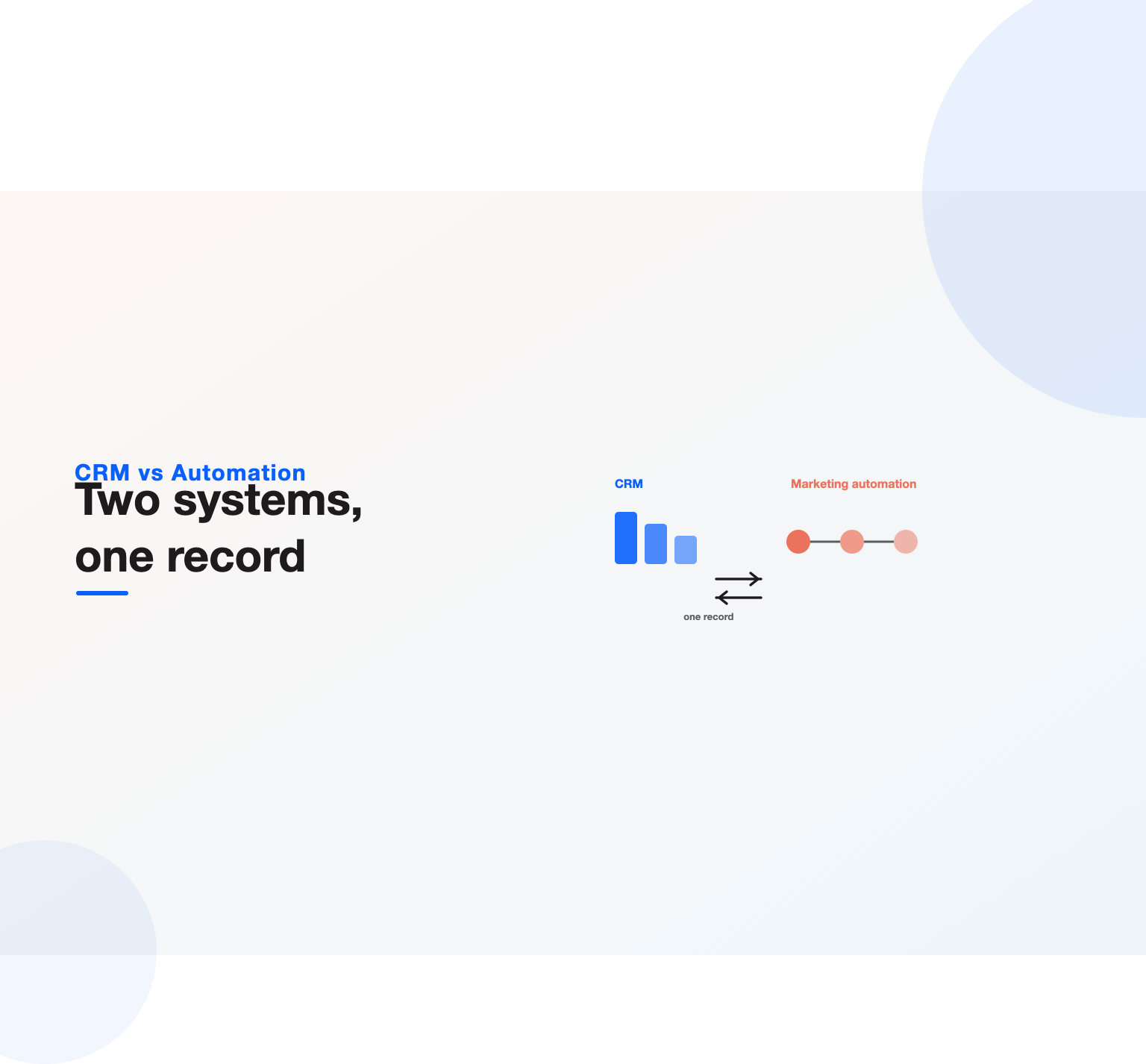
In the CRM vs marketing automation comparison, a CRM is the system of record for relationships and deals, used mainly by sales to track contacts, pipeline, and history, while marketing automation is the engine for messaging at scale, used mainly by marketing to run email and lifecycle campaigns triggered by behaviour. These solve different problems and most growing businesses need both, integrated, so the CRM holds the truth about each customer and marketing automation acts on it. The choice is rarely either-or; it is which to prioritise first and how to connect them.
Key Highlights
- A CRM manages relationships, contacts, deals, and sales pipeline; marketing automation manages messaging at scale.
- CRM is sales-led; marketing automation is marketing-led, though the best setups blur the line.
- They overlap on contact data, which is why integration, not choosing one, is usually the real question.
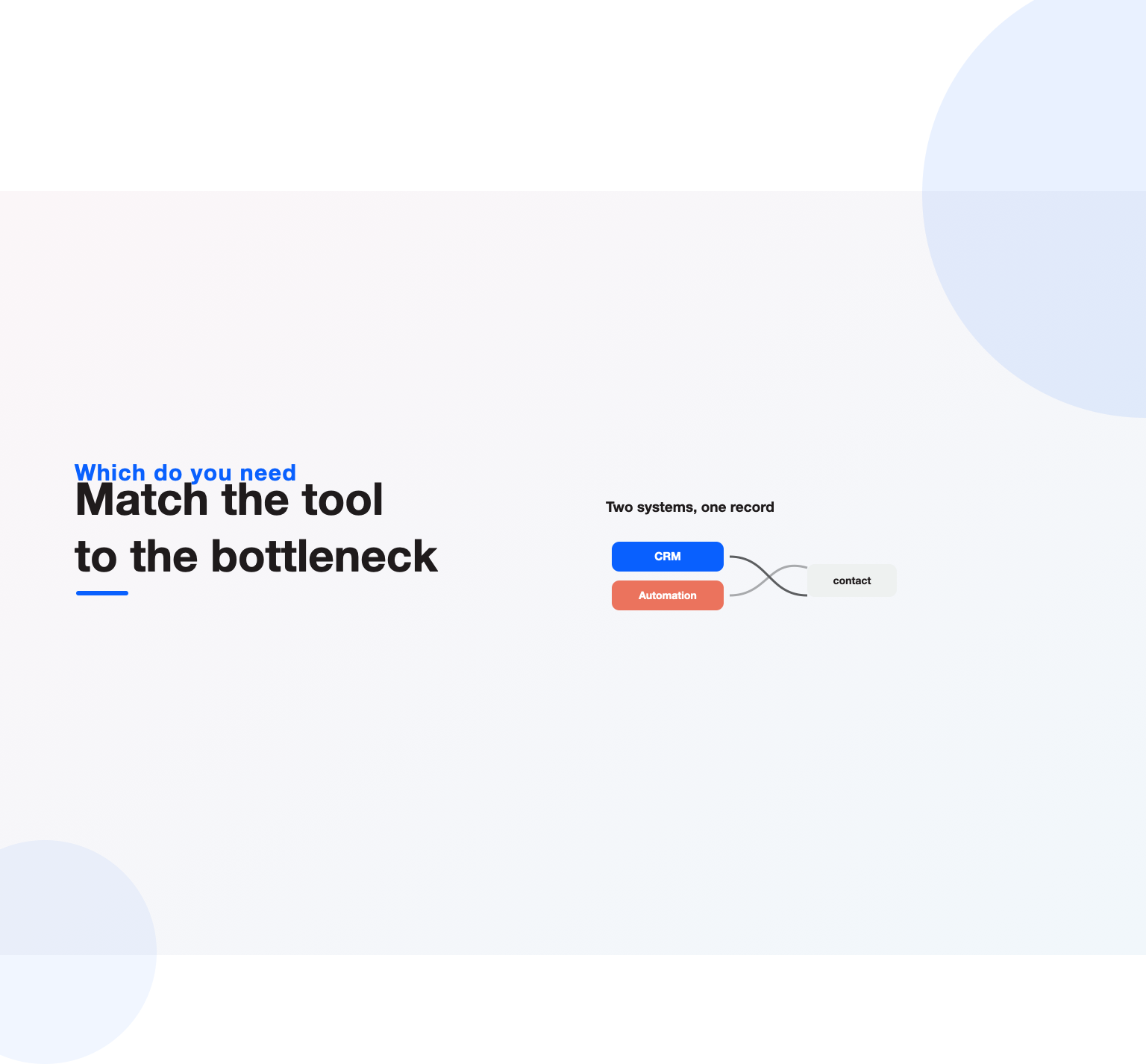
- Start with a CRM if sales and pipeline are the bottleneck; start with automation if lead nurture and lifecycle email are.
- Many platforms now bundle both, but a bundle is only worth it if you will use both halves well.
- The goal is one clean contact record the CRM owns and marketing automation acts on.
What a CRM actually is
A CRM, or customer relationship management system, is the system of record for a business’s relationships. It stores every contact and company, the deals in progress, the history of interactions, and the tasks and notes that sales and account teams rely on to manage relationships over time. When a salesperson asks who a lead is, what was last said, and where the deal stands, the CRM answers. The background on customer relationship management captures this well: it is fundamentally about managing and growing relationships, with the pipeline and the history at its centre.
In this split, the CRM’s defining trait is that it is relationship-centric and usually sales-led. Its jobs are tracking deals through stages, forecasting revenue, logging every touch, and giving the people who talk to customers a single accurate picture. It is less about sending messages at scale and more about managing the individual relationships that turn into revenue, which is why it tends to be owned by sales and revenue operations rather than by marketing.
What marketing automation actually is
Marketing automation is the engine for reaching and nurturing contacts at scale. It sends email and lifecycle campaigns, runs behaviour-triggered flows like cart recovery and onboarding, segments audiences, scores leads by engagement, and personalises messages automatically. Where a CRM manages individual relationships, marketing automation manages messaging to many people at once, driven by rules and behaviour rather than by a salesperson. The background on marketing automation frames it as software that automates repetitive marketing across channels.
In the comparison, marketing automation’s defining trait is that it is message-centric and marketing-led. Its jobs are nurturing leads who are not yet ready to buy, running the lifecycle programs that drive activation and retention, and producing the engagement data, opens, clicks, and behaviour, that feeds lead scoring. It is built to act on data at scale, which is exactly the capability a CRM lacks, and it is why the two are complements rather than substitutes for most businesses.
The core differences side by side
The heart of the question is a handful of clear differences. Setting them side by side makes the distinction concrete, and turns an abstract debate into a practical division of labour you can actually design your stack around.
- Primary user: CRM is sales-led; marketing automation is marketing-led.
- Core job: CRM manages relationships and deals; marketing automation manages messaging and nurture at scale.
- Unit of work: CRM works one relationship at a time; marketing automation works thousands at once through rules.
- Data direction: CRM is the system of record for who a contact is; marketing automation acts on that record and feeds engagement data back.
- Typical trigger: a CRM action is a salesperson updating a deal; an automation action is a behaviour firing a flow.
- Success metric: CRM is judged on pipeline and closed revenue; automation on engagement, nurture, and marketing-sourced pipeline.
Seen this way, the CRM vs marketing automation debate dissolves into a division of labour: the CRM owns the truth about relationships, and marketing automation acts on that truth at scale. The two are halves of one revenue system, not rivals for the same job, which is why the interesting question is less which to choose and more how to make them work together.
Where CRM and marketing automation overlap
The reason the comparison confuses people is the genuine overlap. Both hold contact data. Both can send emails. Both track some interactions. Many modern platforms bundle the two, so the marketing sees a single product doing both jobs. The overlap is real, but it hides the difference in emphasis: a CRM that sends email does so as a sales follow-up to one person, while marketing automation sends as a campaign to a segment.
The overlap matters most at the contact record, which both systems want to own. This is exactly where integration becomes essential, because if the CRM and the automation platform each keep their own version of a contact, the two drift apart and the whole stack loses trust in its data. Resolving that overlap, deciding the CRM owns the record and marketing automation syncs to it, is the single most important architectural decision in the setup, and getting it wrong is what leaves teams with two databases that disagree.
When to prioritise a CRM first
For a business deciding where to start, the CRM vs marketing automation choice comes down to the bottleneck. Prioritise a CRM first when your constraint is sales: you have leads and deals but no reliable way to track them, salespeople forget follow-ups, forecasting is guesswork, and nobody can say where a given deal stands. If revenue is leaking in the pipeline rather than at the top of the funnel, the CRM is the more urgent investment.
This is typical for B2B and higher-value, sales-led businesses, where relationships and deal management are the heart of revenue. A CRM brings order to that, and it is the foundation marketing automation will later plug into, so starting there is often the right sequence even if you plan to add automation soon. Getting the CRM right first, and if needed moving to a better one cleanly, which our CRM migration guidance covers, means the automation you add later has a solid record to act on rather than a mess to inherit.
When to prioritise marketing automation first
The other side of the CRM vs marketing automation choice: prioritise marketing automation first when your bottleneck is marketing. You have traffic and contacts but no systematic nurture, leads go cold, you send the same newsletter to everyone, and you are leaving revenue in abandoned carts and un-onboarded signups. If the loss is happening in how you message people rather than in how sales tracks deals, automation is the more urgent investment.
This is typical for ecommerce and self-serve or lower-touch businesses, where the volume of contacts is high and the buying process is driven by messaging rather than by a salesperson. Marketing automation captures the revenue that manual messaging misses, and it does so quickly through flows like cart recovery. Our guide to marketing automation benefits covers what that value looks like, and if you are choosing a platform, our note on how to choose marketing automation software walks through the decision.
Do you need both?
For most businesses past the earliest stage, the honest answer to the CRM vs marketing automation question is both, integrated. The CRM holds the definitive record of each customer and the deals in progress; marketing automation acts on that record to nurture, message, and score at scale, and feeds engagement data back so the CRM’s picture stays current. Together they form a closed loop where marketing hands sales well-nurtured, well-scored leads, and sales outcomes inform marketing.
The caveat is that both are only worth having if you will use both well. A business too small to have a sales team may not need a CRM yet; one that does not message at scale may not need automation yet. Buying both before you can use either is a common and expensive mistake. The right answer is sequenced: start with the one that addresses your bottleneck, use it well, then add the other and integrate them when the need is real, so each is earning its keep rather than sitting half-used.
Bundled platforms: one tool or two?
A twist in the CRM vs marketing automation decision is that many platforms now offer both in one product. Such a bundle can be genuinely convenient, one contact record by design, no integration to maintain, and a single vendor, which removes the hardest architectural problem at a stroke. For many growing businesses, an integrated suite is the simplest path to having both halves working together.
But a bundle is only a benefit if you will use both halves well. Some businesses buy an all-in-one suite for its CRM and barely touch the automation, or vice versa, paying for capability they never switch on. And a bundled tool that is excellent at one job may be mediocre at the other, so a best-of-breed CRM integrated with a best-of-breed automation platform sometimes beats a jack-of-both suite. The right call in the CRM vs marketing automation decision depends on how much you need of each and how well the bundle does the half you care about most, which is a judgement to make against your own priorities, not the vendor’s pitch.
Making them work together
Whichever you start with, the value of the CRM vs marketing automation pairing is realised only when they are integrated cleanly. The principle is simple: the CRM is the single source of truth for who a contact is, and marketing automation syncs to it rather than keeping a rival copy. Engagement data, opens, clicks, scores, flows from automation back into the CRM so sales sees the full picture, and deal and lifecycle-stage data flows from the CRM into automation so campaigns are targeted correctly.
Done well, this creates the unified customer view that both systems, and increasingly a dedicated customer data platform, are ultimately after. Done badly, with a shallow or one-way sync, you get the worst of both: two systems that disagree and a team that trusts neither. If your stack has grown into a tangle of tools that do not talk to each other, our note on martech consolidation is a useful reality check before adding another. Integration, not the choice of tool, is where most of the value in the CRM vs marketing automation setup is won or lost.
A lead’s journey through both systems
The clearest way to see the division of labour is to follow one lead. A visitor downloads a guide, and marketing automation captures them, starts a nurture sequence, and begins scoring their engagement as they open emails and revisit the site. None of this needs a salesperson. When the score crosses a threshold that signals real intent, the contact is handed to sales inside the CRM, with the full history attached, and a salesperson takes over the relationship, logging calls and moving the deal through stages.
If the deal stalls, the CRM can hand the contact back to marketing automation for a re-nurture track until the timing improves. Each system does the part it is built for: automation works the many at scale until intent appears, the CRM works the individual relationship once it does. Seen as a journey rather than a spec sheet, the two stop looking like competitors and start looking like a relay, each passing the contact to the other at exactly the right moment, which is exactly how a well-integrated stack behaves and why pairing them within a broader automation program pays off far more than running either one alone ever could.
What each typically costs
Cost shapes the decision, so it helps to know the rough shape of each. CRMs range from free or low-cost tiers for small teams up to substantial per-seat pricing for large sales organisations, and the cost scales mainly with the number of users. Marketing automation typically prices on the size of your contact list and email volume, so its cost scales with your audience rather than your headcount. That difference matters: a small sales team with a huge marketing list will find automation the larger line item, while a big sales team with a modest list will find the CRM dominates.
Budgeting for both means planning for two different scaling curves, and it is another reason to sequence rather than buy everything at once. Right-sizing each to what you will actually use keeps the total sane, and choosing the automation side well, which our guide to choosing marketing automation software covers, avoids paying for a tier you do not need. The cost question, like the tool question, comes back to matching spend to your real bottleneck.
Signs your two systems are not talking
Because integration is where the value lives, it is worth knowing the symptoms of a broken one. Sales complains that leads marketing calls hot look cold to them. The same contact exists twice with different details in the two systems. Marketing cannot see whether a nurtured lead ever became a deal. Sales manually re-enters data that automation already captured. Reports from the two tools disagree on basic numbers.
Any of these means the CRM and automation are not sharing a clean record, and the fix is almost always in the sync rather than in either tool. A shallow or one-way integration is a common culprit, as is a stack that has grown by accretion into tools that were never meant to work together. Our note on martech consolidation is a useful starting point for untangling that, and where the underlying problem is a CRM you have outgrown, a clean CRM migration often resolves the data issues that were quietly undermining both systems.
How the pairing changes as you grow
The right balance between the two shifts with company stage. Very early, a simple contact tool or a light CRM may be all you need, with basic email alongside it. As marketing scales and lead volume grows, automation earns its place to handle nurture and lifecycle messaging that manual sending cannot. As the sales team grows, the CRM becomes indispensable for managing a pipeline too large to track in a spreadsheet. Later still, the emphasis moves to integration and to a unified customer view across every channel.
Recognising which stage you are at prevents both over- and under-investing. A five-person startup does not need an enterprise CRM and a heavy automation suite; a scaling company with a real sales team and a large list needs both, well integrated. Reading your stage honestly, and adding each system when its bottleneck actually bites, is how the pairing stays proportionate to the business rather than becoming an expensive stack nobody fully uses. The benefits of getting this right compound, much as the wider marketing automation benefits do, because a clean, staged setup keeps paying off as you scale.
Which tools fall on which side
It helps to ground the categories in the kinds of tools you will encounter, without treating any as a recommendation. On the CRM side sit the platforms built around contacts, deals, and pipeline, the systems a sales team lives in day to day. On the marketing automation side sit the platforms built around email, flows, segmentation, and scoring, the systems a marketer builds campaigns in. Many well-known products started firmly on one side and added features from the other, which is how the categories came to overlap in buyers’ minds.
A growing number are deliberately both, offering a unified contact record with sales and marketing features on top, which is the bundled model. When you evaluate any tool, the useful question is not what the vendor calls it but which side it is genuinely strong on and whether that matches your bottleneck. A platform that is a superb CRM with light marketing features suits a sales-led business; one that is a superb automation engine with light CRM features suits a marketing-led one; and a true all-rounder suits a business that needs both and values one record over best-of-breed depth. Our guide to choosing the automation side applies the same test in detail.
A short checklist to decide
To turn all of this into a decision, run through a few questions honestly. Where is revenue leaking, in the sales pipeline or in your messaging? Do you have a sales team managing deals, or a marketing function managing campaigns, or both? How large is your contact list, and how large is your sales headcount, since those drive the cost of each system differently? Do the tools you are considering share a contact record, or will you need to integrate them?
Your answers point to the sequence: fix the leaking side first, add the other when its bottleneck bites, and insist on clean integration whichever path you take. If you already run both and they disagree, the priority is not a new tool but a better sync, often surfaced by a stack review. And if the automation half is where you are starting, the value it unlocks is laid out in our guide to marketing automation benefits. Answered plainly, these questions usually make the right move obvious, because they anchor the decision to your business rather than to the marketing around the tools.
Common mistakes in the decision
- Treating it as either-or. Most businesses need both; the real question is sequence and integration, not which one wins.
- Buying both too early. Purchasing a CRM and automation before you can use either well strands the spend.
- Ignoring integration. Two systems with their own contact records that do not sync cleanly is worse than one done properly.
- Buying a bundle you half-use. An all-in-one suite is only a saving if you use both halves; otherwise it is capability you pay for and ignore.
- Starting with the wrong bottleneck. Adding automation when the loss is in the sales pipeline, or a CRM when the loss is in messaging, solves the wrong problem.
Avoiding these is most of getting the CRM vs marketing automation decision right, and each comes back to the same principle: match the tool to your actual bottleneck, and integrate whatever you run. The teams that get this right are rarely the ones with the biggest stack; they are the ones who chose deliberately, connected their systems properly, and used each for the job it does best. If you are building or untangling that stack now, a clear-eyed automation and CRM setup is worth more than any single feature comparison, because the value lives in how the pieces work together, not in which logo you pick.
Key Takeaways
- A CRM is the sales-led system of record for relationships and deals; marketing automation is the marketing-led engine for messaging at scale.
- They overlap on contact data, so the real question in CRM vs marketing automation is integration, not choosing one.
- Prioritise a CRM first when the bottleneck is sales and pipeline; prioritise automation first when it is nurture and lifecycle messaging.
- Most businesses past the earliest stage need both, integrated, with the CRM owning the record and automation acting on it.
- Bundled suites can simplify integration but are only worth it if you use both halves well.
- The goal is one clean contact record, synced both ways, so sales and marketing act on the same truth.
- Match the tool to your bottleneck and integrate whatever you run; that is where the value is won.
Frequently asked questions
What is the difference between CRM and marketing automation?
A CRM is the system of record for relationships and deals, used mainly by sales to track contacts, pipeline, and interaction history one relationship at a time. Marketing automation is the engine for messaging at scale, used mainly by marketing to run email and lifecycle campaigns triggered by behaviour across thousands of contacts at once. The CRM manages who a customer is and where the deal stands; marketing automation acts on that information to nurture and message. And so they are complements, not substitutes.
Do I need both a CRM and marketing automation?
Most businesses past the earliest stage do, integrated together, because they solve different problems: the CRM manages relationships and pipeline while automation handles nurture and lifecycle messaging. The exception is very early or very simple businesses, where one may suffice for now. The key is to start with the one that addresses your current bottleneck, use it well, then add and integrate the other when the need is genuine, rather than buying both before you can use either.
Should I get a CRM or marketing automation first?
Start with whichever addresses your bottleneck. If revenue is being lost in the sales pipeline, missed follow-ups, no forecasting, no single view of a deal, prioritise the CRM. If it is being lost in messaging, cold leads, no nurture, abandoned carts, prioritise marketing automation. B2B and sales-led businesses often start with the CRM; ecommerce and lower-touch businesses often start with automation. Either way, choose the one that fixes your most urgent problem, then integrate the other later.
Can one platform do both CRM and marketing automation?
Yes, many platforms bundle both, which removes the integration challenge and gives you one contact record by design. That is convenient and often the simplest path for a growing business. The caveats are that a bundle is only a saving if you use both halves, and that a suite strong at one job may be weaker at the other, so sometimes a best-of-breed CRM integrated with a best-of-breed automation tool is better. Judge it on how well the bundle does the half you most need.
How do CRM and marketing automation work together?
The CRM is the single source of truth for who each contact is and where their deal stands, and marketing automation syncs to it rather than keeping a separate copy. Automation sends engagement data, opens, clicks, and lead scores, back into the CRM so sales sees the full picture, while deal and lifecycle data flows from the CRM into automation so campaigns target the right people. This two-way sync creates one unified customer view that both sales and marketing act on.
Is marketing automation part of a CRM?
Sometimes, but not always. Some CRMs include marketing automation features, and some marketing automation platforms include light CRM features, which is why the categories blur. Conceptually, though, they are distinct: relationship and deal management versus messaging at scale. Whether they live in one platform or two integrated ones is an implementation choice; the important thing is that the contact record is shared and consistent, so the two functions act on the same accurate data rather than drifting apart.
Ready to put this into practice?
Talk to the team that runs SEO, AI search and paid growth programs every day.
Book a Strategy Call →