 Skip to content

How to Choose Marketing Automation Software (Australia)
How to choose marketing automation software in Australia: rank outcomes, weigh CRM fit, score five criteria, model true AUD cost, meet the Privacy Act, and run a real trial.
Quick Answer
To choose marketing automation software in Australia, start from the specific outcomes you want (lead nurture, lifecycle email, lead scoring, or full campaign orchestration), then shortlist tools that fit your CRM, your team’s skill, and your budget in Australian dollars. Weigh five things: genuine feature fit, integrations, ease of use, total cost including onboarding, and data handling under the Australian Privacy Act. The right tool is the smallest one that covers your use cases and your team will actually adopt, not the one with the longest feature list.
Key Highlights
- Define outcomes and required use cases before you look at a single vendor; the use cases are your scoring rubric.
- CRM fit is the highest-weighted criterion, because automation that does not sync cleanly to your CRM creates more work than it saves.
- Total cost in Australian dollars means the platform fee plus onboarding, integrations, and the contact-tier jumps that bite as your list grows.
- Data handling matters legally here: the Australian Privacy Act and the Privacy Principles govern how you store and use contact data.
- Adoption beats features; a tool your small team can run day to day out-performs a powerful platform nobody masters.
- Run a scored trial against real workflows, not a demo, before you commit to an annual contract.
Start with outcomes, not features
The most common mistake is shopping for features before defining outcomes. Every serious decision about how to choose marketing automation software begins with a short, honest list of what you want the tool to achieve in the next year. Do you need to nurture leads that are not sales-ready yet? Send lifecycle and transactional email reliably? Prioritise leads so sales calls the right ones first? Orchestrate multi-step campaigns across email, SMS, and WhatsApp? Each outcome implies different must-have features, and writing them down turns a vague hunt into a scored comparison.
Rank those outcomes. A young Australian ecommerce brand usually needs lifecycle email and abandoned-cart flows first, while a B2B services firm needs lead scoring and CRM-synced nurture. When your outcomes are ranked, the feature checklist writes itself, and you can ignore the impressive capabilities that do not serve your top two or three goals. That discipline is what stops you paying for an enterprise suite to do a job a mid-tier tool does better for your team.
Know the four types of tool before you shortlist
Marketing automation is not one category, and knowing which type you are buying shortcuts most of how to choose marketing automation software. Broadly there are four kinds, and the right type is set by your outcomes and your existing stack.
- Email-first tools centre on lifecycle email, broadcasts, and simple flows. They suit ecommerce and content businesses whose main job is sending the right email at the right time, and they are usually the easiest to adopt.
- All-in-one marketing platforms add landing pages, forms, lead scoring, and multi-channel journeys. They fit growing businesses that want one system for most marketing, at a higher price and learning curve.
- CRM-native automation lives inside your CRM, so contacts and engagement share one record. This is often the cleanest choice for B2B teams already committed to a CRM, and it removes the sync headache entirely.
- Enterprise orchestration suites handle complex, multi-team, multi-channel programs at scale. They are powerful and expensive, and they assume a dedicated operations specialist, so they are the wrong default for a lean team.
Name your type first. A small Australian retailer forcing an enterprise suite, or a large B2B operation trying to run everything from an email-first tool, both fail for the same reason: mismatch between the tool’s category and the job. Once the type is clear, the shortlist shrinks to a handful of real candidates, and a related decision, whether you also need a CRM migration to make the data work, becomes obvious early rather than mid-project.
Weigh CRM fit above almost everything
For most businesses the single highest-weighted criterion is how cleanly the automation tool works with your CRM. Marketing automation and your CRM share the same contacts, and if the sync is shallow or one-directional you will spend your days reconciling two databases that disagree. A tool that is natively built on your CRM, or has a deep two-way integration with it, is worth more than a more powerful tool that only connects through a brittle third-party bridge.
So establish your CRM reality before you shortlist. If you already run a CRM your sales team lives in, that constraint should shape the whole search, because moving both systems at once is a project few small teams survive. Marketing automation is a system of record for engagement the way a CRM is a system of record for relationships, and the two concepts, which you can read more about in the background on marketing automation and customer relationship management, only deliver when they share one clean contact record. If your CRM and automation are already fighting, our note on martech consolidation is worth reading before you add another tool to the tangle.
Weigh the five criteria that actually decide it
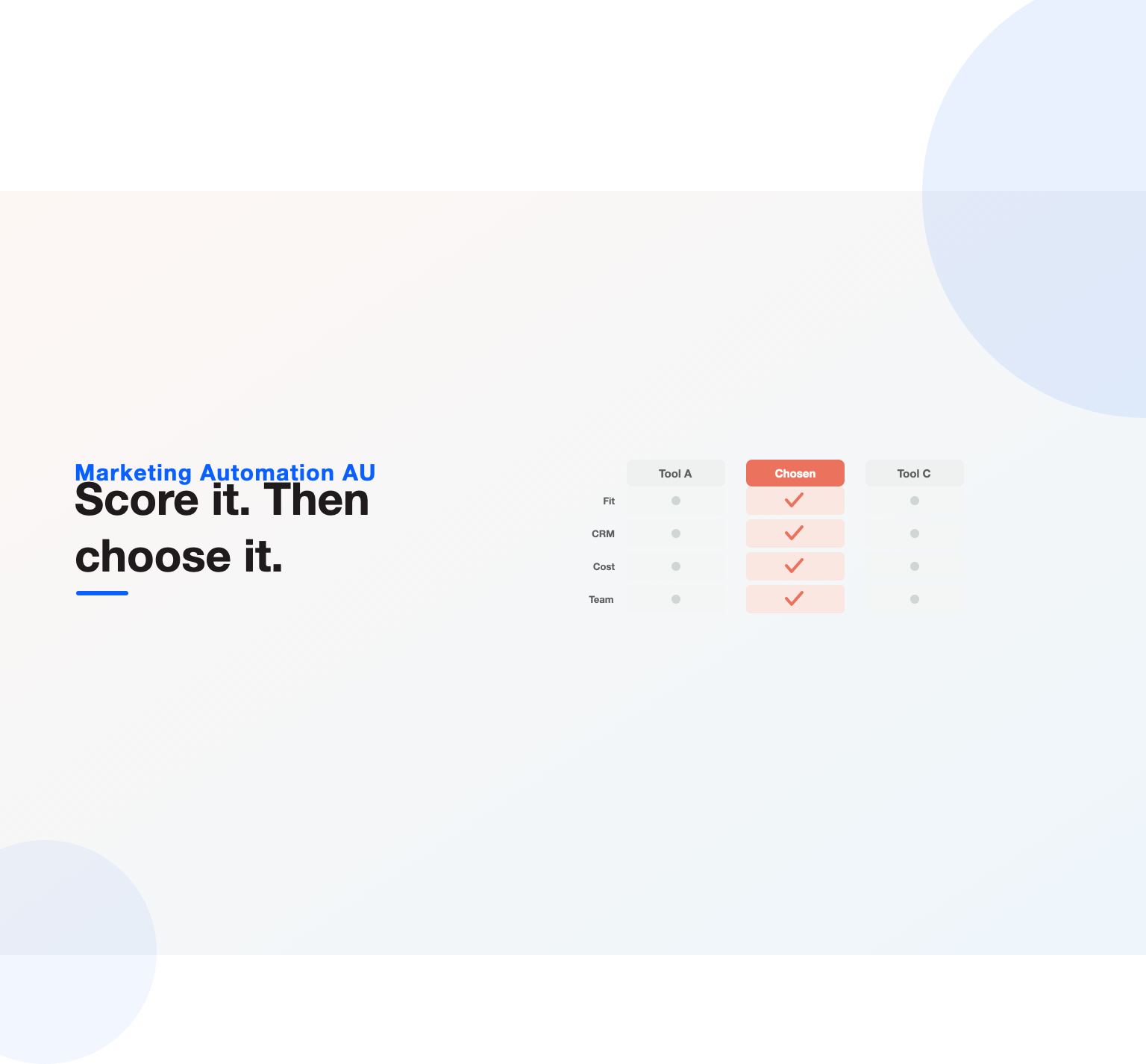
With outcomes ranked and CRM fit understood, judge every shortlisted tool against five weighted criteria. This is the core of how to choose marketing automation software without being swayed by a good salesperson.
- Feature fit (weight high): does it do your top outcomes well, not just list them? A tool that does your three priorities excellently beats one that does thirty things adequately.
- Integrations (weight high): native, deep connections to your CRM, your store or CMS, and your ad and analytics stack. Shallow integrations are technical debt you inherit on day one.
- Ease of use and adoption (weight high): can your actual team build a flow without a consultant every time? Power your people cannot use is waste.
- Total cost in AUD (weight medium-high): platform fee plus onboarding, integration work, and the contact and email-volume tiers that escalate as you grow.
- Data handling and support (weight medium): where data is stored, compliance with Australian privacy law, and whether support is reachable in your timezone.
Give each criterion a weight that reflects your situation, score each tool one to five, and let the numbers challenge your gut. A scored matrix is unglamorous, but it is the difference between a defensible decision and buying the tool with the best sales team.
Get the total cost right, in Australian dollars
Sticker price is the smallest part of the bill, and Australian buyers are often quoted in US dollars, which hides both the exchange rate and the true cost. When you assess how to choose marketing automation software on cost, build the full picture. The platform subscription is the headline. Onboarding and implementation are frequently a separate, sizeable fee. Integration work to connect your CRM and store may need a developer. And most tools price by contacts and email volume in tiers, so the plan that is affordable at five thousand contacts can triple at twenty thousand.
Model your cost at the list size you expect in twelve to eighteen months, not today, because migrating tools to escape a pricing cliff is painful. Ask every vendor for a written quote in Australian dollars that itemises subscription, onboarding, and the next two contact tiers. A tool that looks cheap monthly can be the expensive choice once the real total lands, and the reverse is also true, so compare like for like on the fully loaded number. The same return-on-spend discipline that governs good conversion rate optimisation applies here: judge the tool on outcomes per dollar, not on features per dollar.
Treat data handling as a legal requirement, not a footnote
In Australia how you store and use contact data is governed by law, and the tool you choose is part of your compliance posture. The Australian Privacy Act and the Australian Privacy Principles set out how organisations must handle personal information, and the regulator, the Office of the Australian Information Commissioner, publishes the Australian Privacy Principles that your marketing data practices must meet. Personal information is a broad category under this framework, as the OAIC explains in its guidance on what counts as personal information, and a contact list is squarely inside it.
Practically, this shapes the shortlist in three ways. Ask where the vendor stores data and whether data residency options exist, because some Australian organisations prefer or require local or compliant storage. Confirm the tool supports consent capture and easy unsubscribe, since Australian anti-spam rules require consent and a functional opt-out on commercial electronic messages. And check the tool lets you honour access and deletion requests, because you remain accountable for the data even when a vendor holds it. A tool that makes compliance easy is worth a premium; one that makes it hard is a liability priced as a bargain.
Match the tool to your team, not your ambition
The best tool on paper is useless if your team cannot run it. Adoption is where most marketing automation investments quietly fail, so weigh it heavily. A lean Australian marketing team of one or two people is better served by an approachable tool with strong templates and support than by an enterprise platform that assumes a dedicated operations specialist. Be honest about the skill and time your team actually has.
Consider who will build and maintain the flows day to day. If that is a generalist marketer juggling ten other jobs, prioritise a clean interface, good documentation, and responsive support in your timezone. If you have a specialist or an agency partner, you can absorb more power and complexity. The point of automation is to give your team leverage, and a tool that demands more expertise than you have removes leverage instead of adding it. When in doubt, choose the simpler tool and grow into a bigger one later, rather than paying for capability you cannot yet use.
Run a real trial, then decide
Never choose on a demo alone. A vendor demo shows the tool at its best in someone else’s hands; a trial shows it in yours. The final step in how to choose marketing automation software is a structured trial against your real workflows, and it is the step buyers most often skip and most often regret skipping.
During the trial, build one genuine flow end to end, a welcome series or an abandoned-cart sequence, connected to your real CRM and a small segment of real contacts. Note how long it took, where you got stuck, and how fast support answered. Grade the trial against the same weighted matrix you built earlier, so the decision stays evidence-based rather than emotional. Compare your top two tools head to head on the same task. If a shortlisted tool cannot complete your priority flow smoothly in a trial, it will not do it smoothly in production, no matter what the demo promised.
When the scores are in, decide and commit, but negotiate the contract with your twelve-month list size and the itemised AUD quote in hand. If you would rather have the selection, setup, and ongoing optimisation handled for you, that is exactly what our marketing automation services do, and our roundup of the best marketing automation tools is a useful starting shortlist. For teams leaning heavily on messaging, it is worth pairing your platform choice with a clear WhatsApp marketing strategy and a longer-term email marketing plan so the automation has channels worth automating.
A weighted scorecard you can copy
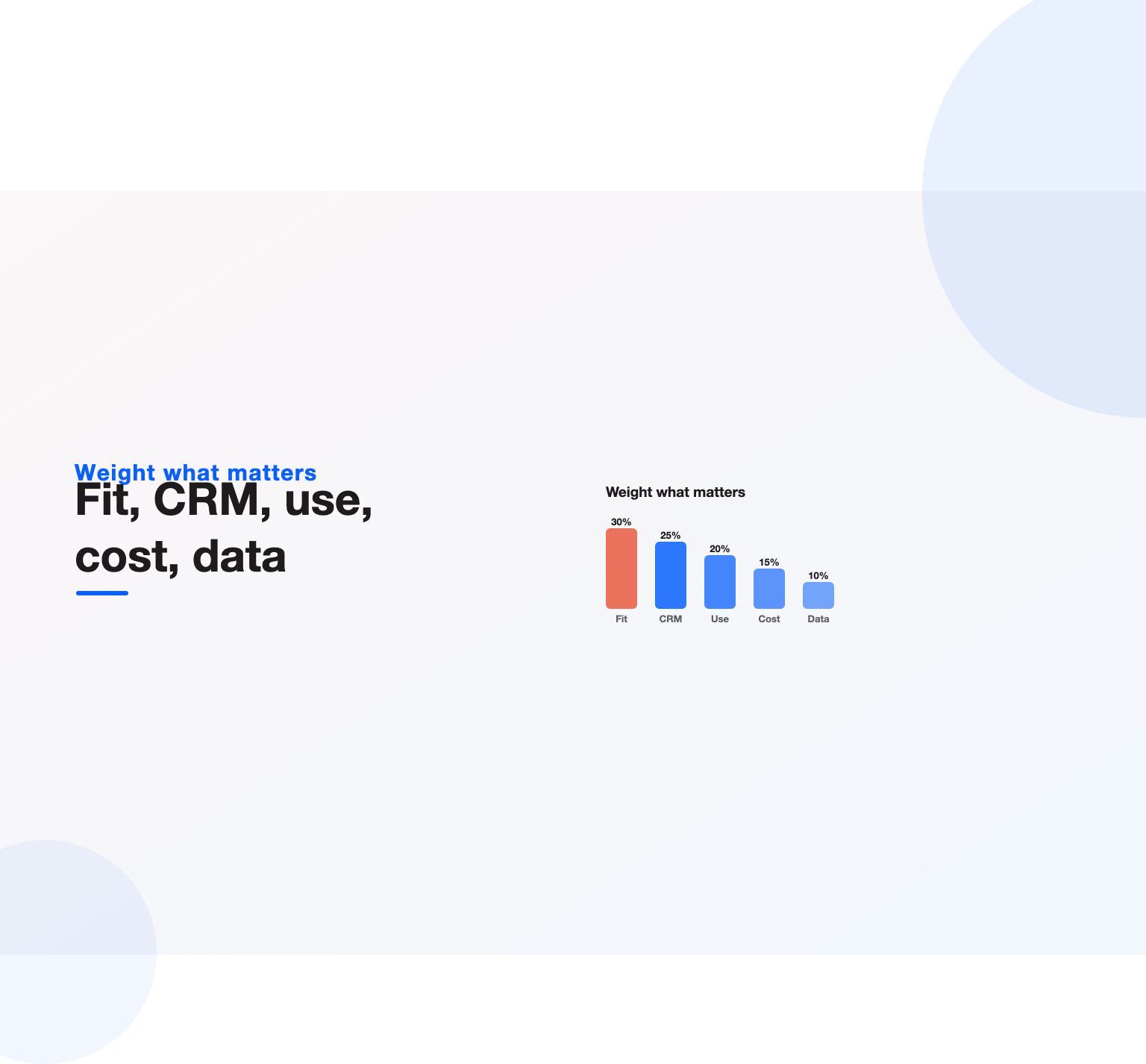
To make how to choose marketing automation software concrete, here is a scorecard you can lift straight into a spreadsheet. Score each shortlisted tool one to five on each row, multiply by the weight, and total. The weights below suit a typical growing Australian business; adjust them to your own priorities before you score.
| Criterion | Weight | What a 5 looks like |
|---|---|---|
| Feature fit to top outcomes | 30% | Does your two or three priorities excellently, not just lists them |
| CRM and stack integration | 25% | Native, two-way sync with your CRM, store, and analytics |
| Ease of use and adoption | 20% | Your actual team builds a flow unaided in a trial |
| Total cost in AUD | 15% | Fully loaded cost at your future list size is competitive |
| Data handling and support | 10% | Privacy-compliant, clear data residency, timezone support |
The scorecard is deliberately boring, and that is the point. It forces you to compare tools on the same criteria at the same time, so a persuasive demo cannot quietly reweight your decision. Keep the completed sheet; it is also the document that justifies the spend to whoever signs the cheque.
Ecommerce and B2B need different answers
Two Australian businesses can follow the same process and correctly choose different tools, because the outcomes differ by model. For an ecommerce brand, the priorities are store integration, lifecycle and abandoned-cart flows, segmentation by purchase behaviour, and increasingly SMS and WhatsApp alongside email. The tool that wins is the one that plugs into the store cleanly and makes revenue-driving flows easy, and it should pair naturally with a broader conversational messaging approach where that fits the audience.
For a B2B services or software business, the priorities shift to lead scoring, CRM-synced nurture, form and landing-page tools, and sales-and-marketing alignment. Here CRM-native or CRM-integrated automation usually wins, because the handoff from marketing to sales is the moment revenue is made or lost, and it should sit inside a wider demand generation engine rather than running as an island. Deciding how to choose marketing automation software therefore starts with an honest label for your business, because the same feature can be essential to one model and irrelevant to the other.
Signs you have outgrown your current tool
Sometimes the question is not the first purchase but whether to switch, and the signals are consistent. You are exporting and re-importing lists to get around limits. Your tool cannot sync a field your sales team needs. You are paying enterprise prices for features you never switched on, or the reverse, patching a cheap tool with manual work that costs more than an upgrade. Deliverability is slipping and support cannot explain why.
When two or three of those are true, revisit how to choose marketing automation software with fresh outcomes, because your needs have moved. Switching is disruptive, so time it for a quiet season, plan the data migration carefully, and run the new tool in parallel briefly before you cut over. The cost of staying on the wrong tool is usually larger and quieter than the cost of moving, but only move on evidence from the scorecard, not on frustration alone.
Do you actually need it yet?
An honest guide has to ask the question vendors will not: are you ready for marketing automation at all? If your list is small, your sends are occasional, and you have no defined lifecycle to automate, a capable email tool plus your CRM may cover you for now, and the money is better spent on demand and traffic. Automation pays off when you have enough volume and enough repeatable journeys that manual sending is the bottleneck, not before.
A simple test: can you name three flows you would automate tomorrow and the audience for each? If yes, you are ready, and the process above applies. If not, spend a quarter building the audience and the content first, perhaps through stronger demand generation and a disciplined email marketing foundation, then buy the automation to scale what already works. Buying a platform to create demand you do not yet have is the most expensive way to discover you were not ready, and it is a common one. When you do reach the threshold, revisit our shortlist of the leading tools and run the process in earnest.
Common mistakes Australian buyers make
- Buying features, not outcomes. Paying for an enterprise suite to do a mid-tier job because the feature list impressed.
- Ignoring CRM fit. Choosing a powerful tool that syncs poorly with the CRM your sales team actually uses.
- Underestimating total cost. Missing onboarding fees, integration work, and the contact-tier jumps, especially when quoted in US dollars.
- Skipping the trial. Committing on a demo and discovering the friction only after signing an annual contract.
- Overbuying for the team. Choosing more power than the team can adopt, so most of the tool goes unused.
- Treating privacy as an afterthought. Not checking data handling against Australian privacy obligations until an audit or a breach forces it.
Avoid these six and you avoid the large majority of regretted purchases. The thread running through all of them is the same: decide on evidence about your own situation, not on a vendor’s story about theirs.
Questions to ask every vendor
A short, consistent question set keeps demos honest and comparable. Ask each vendor the same things and write down the answers, because the gaps between their responses are more revealing than any feature sheet.
- How deep is your integration with our specific CRM, and is it native or through a third party? Ask for a live look, not a logo on a slide.
- What is the fully loaded first-year cost in Australian dollars, including onboarding and our next two contact tiers?
- Where is our data stored, and what data-residency and privacy controls do you offer for Australian customers?
- What does onboarding actually involve, who does it, and how long until we send our first real campaign?
- Can a non-technical marketer on our team build a multi-step flow, and can we try that in a trial with our data?
- What are your deliverability rates and what happens to our sending reputation if we grow quickly?
Vendors that answer plainly and let you verify in a trial are the ones worth shortlisting. Evasive or heavily caveated answers on cost, integration, or data are themselves data, and they usually predict the friction you will feel after signing.
Plan the first 90 days before you sign
The value of any platform is realised in adoption, not purchase, so plan the first ninety days before the contract is signed rather than after. Decide which single flow you will launch first, who owns the build, and what success looks like in that window, and make the vendor commit to an onboarding plan that gets you there. A tool that takes three months to send a first campaign has already cost you a quarter of the year’s return.
Sequence the rollout so momentum builds. Ship one high-value flow first, usually a welcome or cart-recovery sequence, prove it works, then layer in scoring, segmentation, and additional channels once the team is comfortable. Connect the platform to your CRM and analytics from day one so results are attributed honestly and the automation is judged on revenue rather than sends. Treat the first ninety days as the real trial, with the difference that you are now building assets you will keep. Teams that plan this window get value in weeks; teams that improvise get a powerful tool that sits half-configured while the subscription clock runs, which is the quiet way most marketing automation investments disappoint. A little planning here protects the entire spend. Set a simple ninety-day scorecard of your own, one number per flow, and review it fortnightly with whoever owns the tool, so drift is caught early and the platform keeps earning its fee. The businesses that win with automation are not the ones with the most advanced tool; they are the ones that chose a tool matched to their situation, adopted it quickly, and kept measuring it honestly against real outcomes rather than vanity metrics. That habit, more than any single feature, is what turns the purchase into a durable advantage.
Key Takeaways
- Define and rank your outcomes first; the ranked use cases become the scoring rubric for every tool.
- Weight CRM fit highest, because automation that does not sync cleanly to your CRM costs more than it saves.
- Rate five criteria, feature fit, integrations, ease of use, total AUD cost, and data handling, with weights that fit your situation.
- Build the full cost in Australian dollars at your future list size, including onboarding, integrations, and tier jumps.
- Treat data handling as a legal requirement under the Australian Privacy Act, not a footnote.
- Choose for adoption by your actual team, and run a real trial on a genuine workflow before you commit.
- If you would rather not run the process yourself, have a specialist select and set up the platform for you.
Frequently asked questions
How do I choose marketing automation software for a small Australian business?
Start by ranking the two or three outcomes you need most, usually lifecycle email and lead nurture for a small team. Shortlist tools that integrate natively with your existing CRM, are simple enough for a generalist to run, and price affordably in Australian dollars at your expected list size. Then run a short trial building one real flow. For a small team, adoption and CRM fit matter far more than the length of the feature list.
What features matter most in marketing automation software?
The features that serve your ranked outcomes, not a universal list. For ecommerce that usually means lifecycle and abandoned-cart email, segmentation, and store integration; for B2B it means lead scoring, CRM-synced nurture, and form and landing-page tools. Across the board, reliable deliverability, a clean workflow builder, and deep CRM integration matter more than exotic capabilities you will never switch on.
How much does marketing automation software cost in Australia?
It varies widely, from modest monthly plans for small lists to enterprise contracts, and the sticker price is only part of it. Budget for the subscription plus onboarding, any integration development, and the contact and email-volume tiers that rise as your list grows. Get an itemised quote in Australian dollars at the list size you expect in twelve to eighteen months, because tools are frequently quoted in US dollars and priced to escalate with scale.
Does Australian privacy law affect which tool I choose?
Yes. The Australian Privacy Act and the Australian Privacy Principles govern how you handle personal information, and a contact list qualifies. Choose a tool that supports consent capture and easy unsubscribe, lets you honour access and deletion requests, and is transparent about where data is stored, including any data-residency options. You remain accountable for the data even when a vendor holds it, so compliance features are a genuine selection criterion, not a nicety.
Should I choose the tool built into my CRM or a standalone platform?
If your CRM offers automation that covers your ranked outcomes, the native option usually wins on data cleanliness and simplicity, because there is one contact record and no sync to maintain. Choose a standalone platform when your outcomes need capabilities the CRM lacks and the standalone tool has a deep, two-way integration with that CRM. Avoid a powerful standalone tool that only connects through a shallow bridge; the reconciliation work erases its advantage.
How long should a marketing automation trial run?
Long enough to build and send one real flow end to end, typically two to four weeks. Connect it to your real CRM and a small segment of real contacts, not sample data, and complete a genuine welcome or cart-recovery sequence. Track how long it took, where you got stuck, and how quickly support responded, then score the trial against your weighted matrix. A tool that struggles with your priority flow in a trial will struggle with it in production.
Ready to put this into practice?
Talk to the team that runs SEO, AI search and paid growth programs every day.
Book a Strategy Call →