 Skip to content

Marketing Automation Benefits: What You Actually Gain
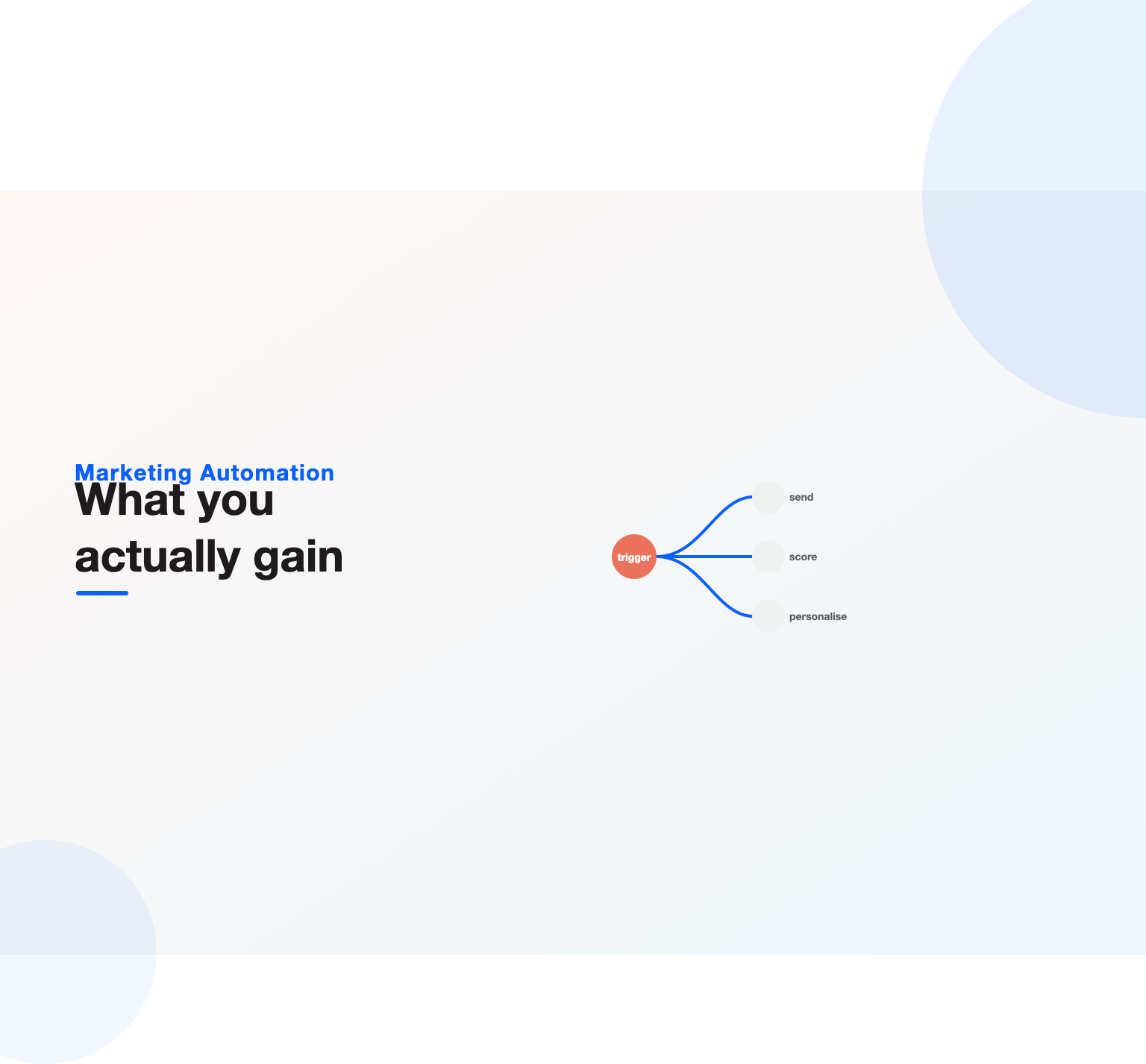
The real marketing automation benefits: time saved, more revenue from timely messaging, better lead nurture and scoring, personalisation at scale, cleaner data, and measurable results.
Quick Answer
The marketing automation benefits that matter most are time saved on repetitive work, higher revenue from timely lifecycle messaging, better lead nurture and scoring, consistent personalisation at scale, cleaner data and alignment between marketing and sales, and clear measurement of what drives pipeline. In short, marketing automation lets a small team run the messaging of a much larger one, sending the right message to the right person at the right time, automatically, so revenue grows without headcount growing at the same rate.
Key Highlights
- Marketing automation benefits start with time: repetitive sends and follow-ups run without manual effort.
- Revenue rises because lifecycle messages, cart recovery, onboarding, re-engagement, fire at the right moment.
- Lead nurture and scoring mean sales spends time on the contacts most likely to buy.
- Personalisation at scale becomes possible, tailoring messages to behaviour without hand-crafting each one.
- Data and reporting improve, tying activity to pipeline so you can see what actually works.
- The gains compound when automation is connected to the CRM and the rest of the stack, not run in isolation.
Time saved on repetitive work
The first of the marketing automation benefits, and the one teams feel soonest, is time. Every marketing team runs a set of repetitive tasks: welcome emails, follow-ups, list segmentation, reminders, and reports. Done by hand, these consume hours that could go to strategy and creative. Automated, they run themselves, triggered by a signup, a purchase, or a date, without anyone remembering to send them.
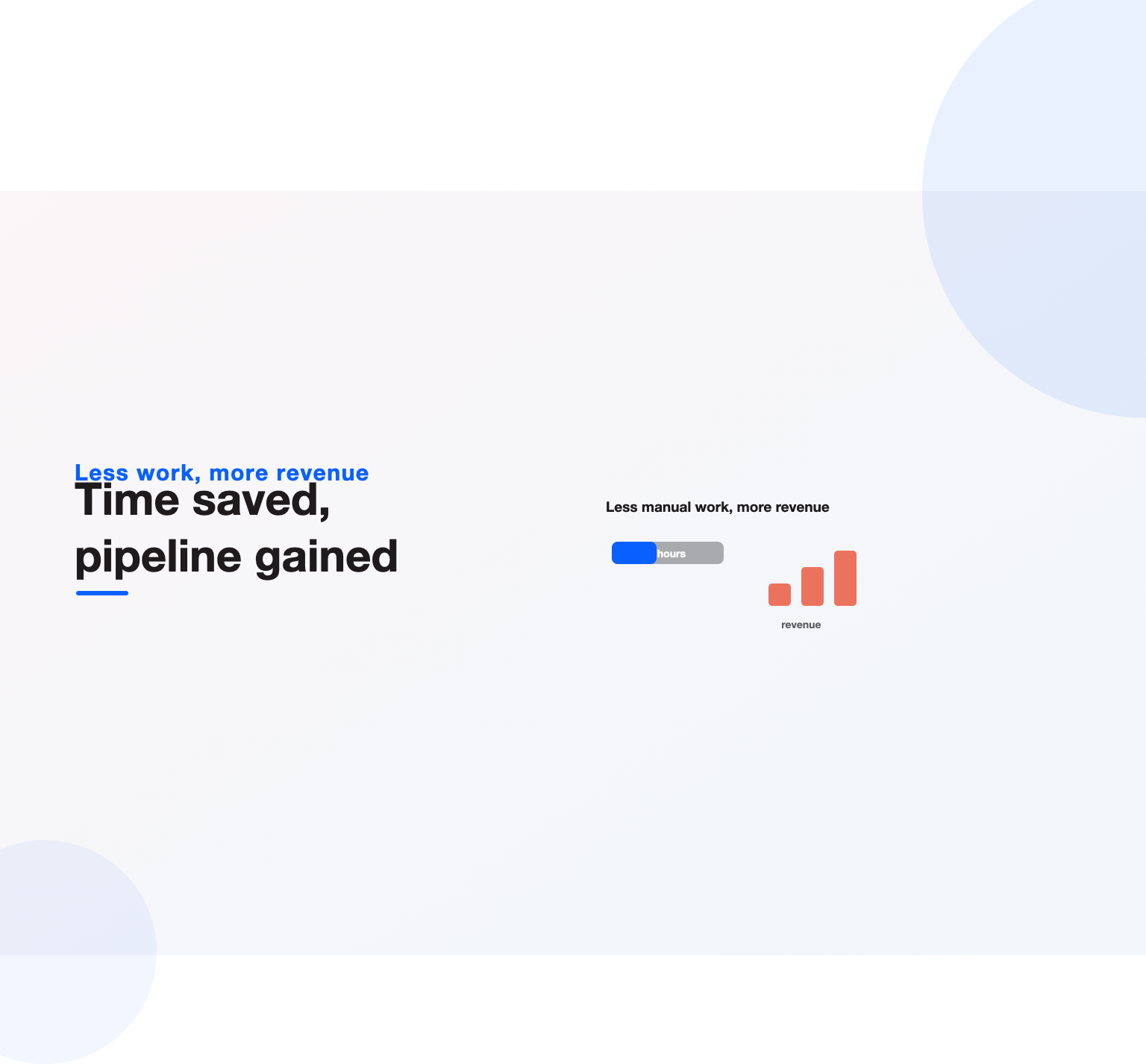
The reclaimed time is not just a convenience; it changes what a small team can achieve. A two-person team with good automation can run lifecycle programs that would otherwise need several more people, because the software handles the volume and the timing. The marketing automation benefits here compound over time: the flow you build once keeps working every day after, so the effort is front-loaded and the payoff recurs. For a lean team, that leverage is often the single most persuasive reason to adopt automation at all. Consider the arithmetic: if a marketer spends ten hours a week on sends that could be automated, that is more than a full working month reclaimed over a year, redirected from mechanical execution to the strategy and creative that actually move the numbers. Multiply that across a team and the time benefit alone often covers the cost of the platform several times over, before a single revenue gain is counted.
More revenue from timely messaging
The benefits that show up most clearly in the numbers come from timing. A message sent at the right moment, an abandoned-cart nudge an hour after the cart is left, an onboarding sequence the day someone signs up, a re-engagement offer when a customer goes quiet, converts far better than the same message sent to everyone on a schedule. The software is what makes that timing possible at scale, firing each message from the customer’s own behaviour rather than a calendar.
Cart recovery alone often pays for the whole system, reclaiming a meaningful share of otherwise-lost orders. Onboarding sequences lift activation and retention; re-engagement wins back customers who would have churned silently. None of these require more traffic or more spend, only the right message at the right moment, which is exactly what automation delivers. This is why the revenue here is not incremental tinkering but often a real step-change in what existing demand produces.
Better lead nurture and scoring
For businesses with a sales team, some of the most valuable gains are in nurture and scoring. Not every lead is ready to buy when they first arrive, and without nurture most simply go cold. Automation keeps them warm with relevant, spaced content until they are ready, so a lead captured today is not wasted just because the timing was not immediate.
Lead scoring adds the other half: the system tracks engagement, opens, clicks, pages visited, and scores each lead so sales can focus on the ones most likely to convert. This focus is worth a great deal, because a salesperson’s time is expensive and finite. Instead of chasing every contact equally, the team works the warmest leads first, which lifts both conversion and morale. The result is a marketing and sales handoff that runs on evidence rather than guesswork, one of the quieter but more valuable advantages for any B2B or considered-purchase business.
Personalisation at scale
Among the gains that were impossible before the tools is genuine personalisation at scale. Sending one relevant message to one person is easy; sending the right message to tens of thousands of people, each based on their own behaviour and stage, is not, at least not by hand. The tools make it routine, using data and rules to tailor content, offers, and timing to each contact automatically.
Personalisation is not just using a first name. It is showing a returning customer different content than a first-time visitor, recommending based on past purchases, and adjusting the message to where someone is in their journey. Such relevance is what keeps engagement high and unsubscribes low, and it is only sustainable through automation. As lists grow, the personalisation payoff grows with them, because the alternative, generic blasts to everyone, performs worse the larger and more varied the audience becomes.
Cleaner data and sales alignment
Less obvious but genuinely valuable is what happens to your data. A good automation platform, connected to the CRM, keeps one clean record of each contact and their every interaction, rather than scattered notes across tools. A single source of truth is what makes everything else, scoring, personalisation, reporting, reliable, because it all draws from the same accurate picture.
It also aligns marketing and sales, a relationship that fails more often on bad data than bad intentions. When both teams see the same contact history, the same lead scores, and the same definitions, the handoff works and the finger-pointing stops. The background on marketing automation and on the CRM it connects to both stress this shared-data foundation, and in practice it is where many of the compounding gains actually originate, because clean, shared data is the raw material everything else runs on.
Clearer measurement and reporting
You cannot improve what you cannot see, and a practical benefit is visibility. Because automation runs your messaging through one system tied to outcomes, you can see which flows, messages, and segments actually drive revenue, not just opens and clicks. That turns marketing from a cost centre defending its budget into a channel that can show pipeline and revenue contribution.
This measurement also makes the whole program improvable. When you can see that one onboarding variant activates more users, or one nurture track converts more leads, you double down on what works and cut what does not. Over time that feedback loop is where a large share of the value accumulates, because a system you can measure is a system you can keep improving, quarter after quarter, rather than a set-and-forget spend you can never quite justify.
Consistency and fewer mistakes
A subtler entry on the list is consistency. Manual marketing is error-prone: a follow-up forgotten, a segment messaged twice, a promotion sent to people who already bought. The system enforces the process, so every customer gets the right sequence every time, without the lapses that creep in when busy people do repetitive work by hand.
Consistency like this protects both revenue and brand. A customer who reliably gets a helpful onboarding sequence forms a better impression than one whose experience depends on whether someone remembered to send it. And because the rules are set once and applied uniformly, the experience holds up as volume grows, where a manual process would break. Reliability at scale is not glamorous, but it is one of the advantages that quietly separates a professional operation from an ad hoc one.
Where the benefits are easiest to capture
The marketing automation benefits are broad, but some are far easier to capture first, and starting there builds the momentum to justify the rest. Abandoned-cart recovery for ecommerce, and lead-nurture sequences for B2B, are the classic high-return starting points, because the message is obvious and the payoff is quick. Welcome and onboarding sequences are close behind, lifting activation with a single well-built flow.
Start with one or two of these rather than trying to automate everything at once. A single cart-recovery flow that recovers real orders, or one nurture track that warms leads sales were losing, proves the value and funds the next step. Trying to build a complete lifecycle program on day one usually stalls; capturing one clear benefit and expanding from it is how the marketing automation benefits actually compound in practice. If you would rather have the program built and run for you, our marketing automation services cover setup through optimisation, and choosing the right platform first is covered in our guide to how to choose marketing automation software.
A week before and after
The benefits are easiest to grasp as a before-and-after. Before automation, a marketer’s week is punctuated by manual sends: remembering to email new signups, pulling a list to follow up with last week’s leads, checking who abandoned a cart and deciding whether it is worth a message. Much of it slips, because busy people forget, and the messages that do go out are late.
After automation, those same jobs run themselves. The welcome email fires the instant someone signs up; the cart nudge goes out an hour after abandonment; the lead follow-up is sequenced and scored without anyone touching it. The marketer’s week shifts from doing the sends to improving them, from execution to strategy. That shift, repeated across every repetitive task, is the day-to-day face of the benefits, and it is why teams that adopt automation rarely go back to doing the work by hand.
The benefits for B2B versus ecommerce
Which benefits matter most depends on the model. For a B2B or considered-purchase business, the biggest gains are lead nurture and scoring: keeping prospects warm through a long sales cycle and pointing sales at the warmest ones, which is where automation pairs closely with a real demand generation engine. For an ecommerce store, the biggest gains are behavioural: cart recovery, post-purchase flows, and reorder prompts that lift revenue per customer.
The mechanism is the same, right message, right moment, automatically, but the flows and metrics differ, so the benefit you chase first should match your model. A store obsessing over lead scoring, or a B2B firm building cart flows it does not need, wastes the tool. Matching the automation to how you actually make money, and connecting it to a broader marketing automation program, is what turns generic capability into a benefit your business actually feels.
What the benefits cost to obtain
No honest account of the benefits skips the cost of getting them. There is the platform subscription, the setup and integration effort, and the ongoing work of building and refining flows. The benefits are real, but they are not free or instant, and a team that expects otherwise is often the one that reports disappointment. Budgeting for setup and for the first few months of building, before the compounding shows, is part of capturing the value rather than an obstacle to it.
The way to keep the cost proportionate is to choose a platform matched to your needs rather than the longest feature list, which our guide to choosing marketing automation software walks through. Overbuying is the most common way teams pay for benefits they never use; right-sizing the tool to the flows you will actually run keeps the return healthy from the start.
Signs you are leaving the benefits on the table
Many teams own automation software and capture only a fraction of what it offers, so a few signals are worth checking. You send the same newsletter to everyone with no segmentation. You have no welcome or cart-recovery flow live. Your sales team works every lead equally because there is no scoring. Your automation tool and CRM do not share data, so records disagree. You cannot say which flow drives the most revenue.
Any of these means the benefits are sitting unclaimed. The encouraging part is that each gap points straight at a high-return fix, usually a single flow or integration that pays for itself quickly. A store or team that recognises itself here does not need a bigger tool; it needs to actually use the one it has, starting with the one flow that addresses its biggest gap. That is almost always faster and cheaper than switching platforms in search of benefits the current one already offers.
The benefits depend on doing it well
It would be dishonest to list the marketing automation benefits without the condition attached: they depend on doing it well. Applied badly, automation, blasting everyone, poor data, no strategy, amplifies mistakes at scale rather than delivering benefits. The tool is a lever, and a lever multiplies whatever force you apply, good or bad.
So the benefits are real but conditional on consent-based lists, clean data, a clear strategy for what each flow should achieve, and connection to the rest of your stack rather than running as an island. A common failure is buying powerful software and using a fraction of it, or bolting it on without integrating it, which strands the data and the benefits alike. Treated as a system with strategy and clean data behind it, marketing automation delivers; treated as a magic button, it disappoints. That distinction is worth stating plainly, because it is the difference between the marketing automation benefits described here and the disappointment some teams report.
The benefits across the customer lifecycle
One way to see the full value is to walk the customer lifecycle and name the benefit at each stage. At acquisition, automation captures a new contact and starts a welcome flow instantly, making a strong first impression without manual effort. During consideration, nurture sequences keep the brand present with useful, spaced content. At purchase, behavioural triggers recover carts and confirm orders. After purchase, onboarding drives activation, and lifecycle flows drive repeat business and reviews.
At every stage the benefit is the same shape, the right message at the right moment without someone sending it by hand, but the cumulative effect across the whole journey is far larger than any single flow. This is why automation pairs so naturally with the other retention channels: a coordinated program running email alongside a WhatsApp flow and a longer email marketing track captures value at points a single channel would miss, and the orchestration is only possible because automation handles the timing.
Where the data benefit really pays off
The cleaner-data benefit deserves a closer look, because it quietly underpins the rest. When every interaction across channels lands on one contact record, the business gains a unified view of each customer, the foundation that scoring, personalisation, and honest reporting all depend on. The industry name for the mature version of this is a customer data platform, and the background on the customer data platform concept explains why unifying data is treated as a strategic goal in its own right.
Getting there is often blocked by tools that do not talk to each other, which is why integration matters so much and why a messy stack undercuts the benefits. If your systems have grown into a tangle, our note on martech consolidation is a useful reality check, and a clean move to the right platform, covered in our CRM migration guidance, often unlocks benefits that were stranded by bad plumbing rather than missing features. The lesson is that the data benefit is less about buying more software and more about connecting what you have so the customer picture is whole.
Measuring the benefits honestly
To keep the case grounded, tie each benefit to a metric and review it on a real cadence. Time saved shows up as hours the team redirects from sending to strategy. Revenue shows up as the share of sales attributable to automated flows, cart recovery, onboarding, re-engagement, tracked separately so their contribution is visible. Lead quality shows up as a higher conversion rate on the leads sales actually works. And efficiency shows up as more output from the same team, the clearest sign the leverage is real.
Reviewing these monthly keeps the program honest and fundable, because it turns vague claims into numbers a finance team recognises. It also reveals which flows to double down on and which to cut, so the benefits keep growing rather than plateauing. The same relentless-improvement habit behind good conversion rate optimisation applies here: measure, keep what works, and reinvest, and the automation program compounds into a bigger advantage each quarter rather than settling into a fixed, half-used cost.
How the benefits fit the wider stack
The marketing automation benefits multiply when the platform is connected to everything else rather than siloed. Tied to the CRM, scoring and handoff work. Tied to your store or product, behavioural triggers fire accurately. Tied to your other channels, email, WhatsApp, and ads, the customer gets a coherent experience rather than disconnected messages from tools that do not talk to each other.
This is why automation sits at the centre of a modern retention stack rather than off to the side. It is the orchestration layer that makes lifecycle marketing across channels possible, and its benefits grow with each channel it coordinates. A store pairing automation with a strong WhatsApp strategy and disciplined email, for instance, captures more of the marketing automation benefits than one running each channel separately, because the orchestration itself, sending the right message on the right channel at the right time, is where much of the compounding value lives.
Why the benefits compound over time
A final point worth making is that these gains are not a one-time bump; they compound. Each flow you build keeps running, so this quarter’s welcome sequence still works next year while you add new flows on top. Each improvement, a better subject line, a smarter trigger, a cleaner segment, raises the return of a flow that will keep sending for years. And the data accumulating in the system makes every future flow smarter, because you know more about each customer than you did before.
That is the difference between automation and a manual campaign: a campaign runs once and ends, while an automated program becomes an asset that grows more valuable the longer it runs and the more you refine it. It is the same logic that makes owned channels beat rented ones, and it is why teams that start early and improve steadily open a gap competitors find hard to close. A store or team that treats automation as a living system, connected to a proper automation program and chosen with the discipline our selection guide describes, ends up with a compounding advantage rather than a static tool. The benefits, in other words, are largest for the teams patient enough to let them build.
Key Takeaways
- The first marketing automation benefit is time: repetitive sends and follow-ups run without manual effort, giving a small team the reach of a larger one.
- Revenue rises from timely, behaviour-triggered messaging like cart recovery, onboarding, and re-engagement.
- Lead nurture and scoring focus sales on the contacts most likely to convert.
- Personalisation at scale keeps engagement high as lists grow, which manual sending cannot sustain.
- Cleaner shared data and marketing-sales alignment underpin most of the other benefits.
- Better measurement turns marketing into a channel you can improve against revenue.
- The benefits are real but conditional on clean data, strategy, and integration; start with one high-return flow and expand.
Frequently asked questions
What are the main benefits of marketing automation?
The main benefits are time saved on repetitive tasks, more revenue from timely behaviour-triggered messaging, stronger lead nurture and scoring, personalisation at scale, cleaner shared data with better marketing-sales alignment, clearer measurement of what drives pipeline, and greater consistency with fewer human errors. Together they let a team send the right message to the right person at the right time automatically, so results grow without headcount growing at the same pace, provided the automation is built on clean data and a clear strategy.
Does marketing automation actually increase revenue?
Yes, primarily through timing and relevance rather than more spend. Behaviour-triggered flows such as abandoned-cart recovery, onboarding, and re-engagement reach people at the moment they are most likely to act, converting far better than scheduled blasts. Cart recovery alone often pays for the whole system by reclaiming otherwise-lost orders. The revenue benefit comes from capturing demand that already exists more effectively, which is why it typically shows up as a step-change rather than a marginal gain.
Is marketing automation worth it for a small business?
Often yes, because the time-saving benefit is proportionally larger for a small team. Automation lets two people run lifecycle programs that would otherwise need several more, and a single high-return flow like cart recovery or lead nurture can justify the cost quickly. The key is to start small, one or two flows that address a clear need, rather than buying a powerful platform and using a fraction of it, which is the most common way small businesses fail to see the benefits.
What is the difference between marketing automation benefits and features?
Features are what the software can do, such as workflow builders, scoring, and segmentation; benefits are the outcomes those features produce, such as time saved, revenue gained, and better-qualified leads. It is easy to be sold on a long feature list and never capture the benefits, because benefits depend on using the features well, with clean data and a clear strategy. Judge a platform on the outcomes it will realistically deliver for your situation, not the length of its capability list.
How quickly do marketing automation benefits appear?
The time-saving benefit is almost immediate once a flow is live, and revenue benefits from flows like cart recovery can appear within weeks. The larger, compounding benefits, better data, improved scoring, and a measurable, continually improving program, build over months as you add flows and refine them. It rewards a start-small-and-expand approach: capture one clear benefit quickly to prove the value, then reinvest the time and revenue it frees into the next flow.
What stops businesses from getting the benefits?
The usual causes are poor data, no strategy, and failure to integrate. Automation built on a dirty or bought list amplifies problems; software bolted on without connecting to the CRM strands the data that scoring and personalisation need; and buying a powerful platform with no plan for what each flow should achieve leaves most of it unused. The benefits are real but conditional, so consent-based data, a clear plan, and integration with the wider stack are what separate the teams that gain from the ones that are disappointed.
Ready to put this into practice?
Talk to the team that runs SEO, AI search and paid growth programs every day.
Book a Strategy Call →