 Skip to content

MarTech Consolidation: How to Shrink Your Stack and Raise Performance
How enterprise teams consolidate martech: audit overlap, cut redundant tools, renegotiate contracts and keep performance rising.
Quick Answer
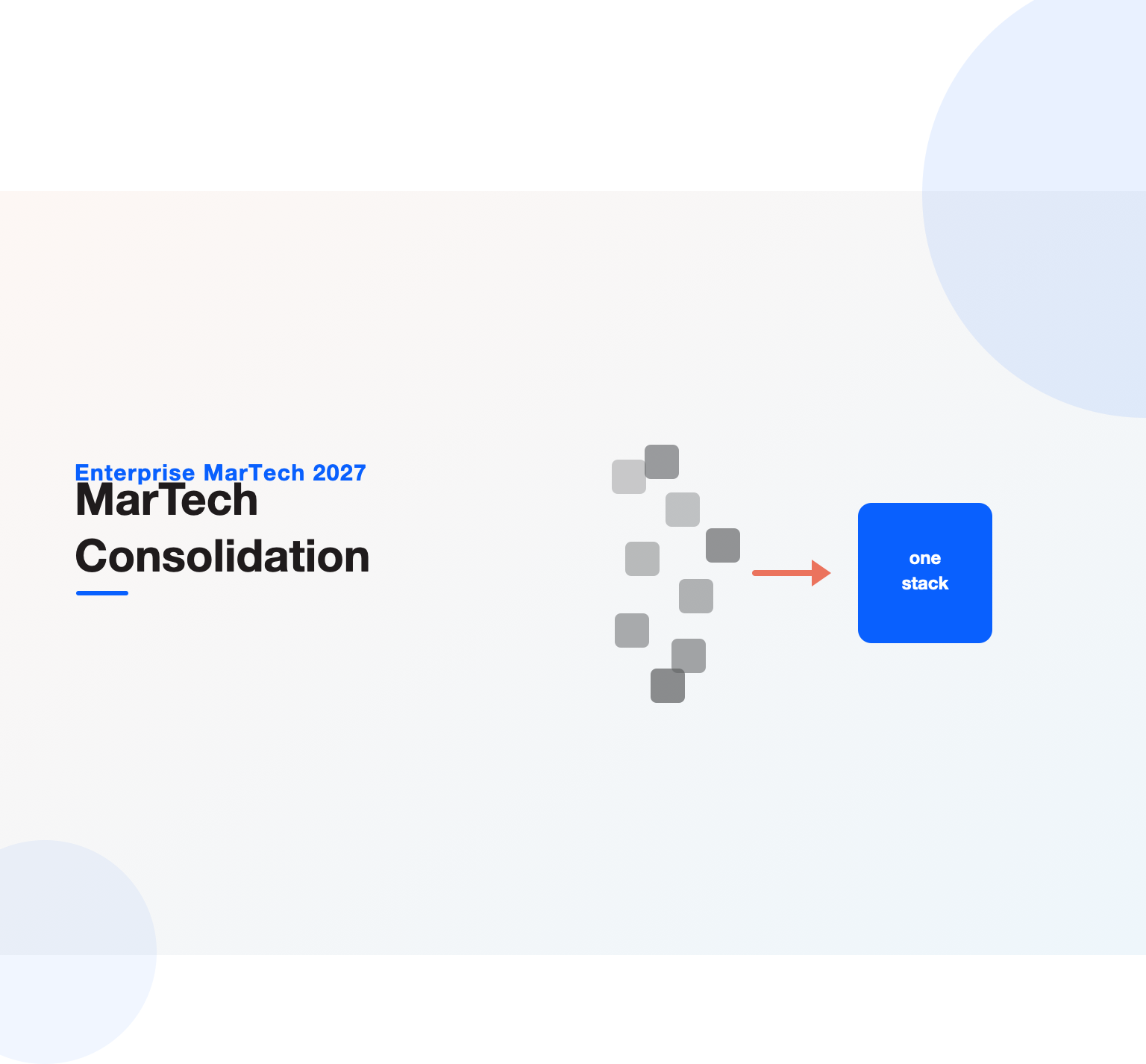
Martech consolidation is the structured process of auditing your marketing technology stack, identifying tools that duplicate a capability or go unused, and deliberately retiring them so the remaining tools can be properly integrated and adopted. It matters because most stacks grew by accretion rather than design, leaving companies paying for overlapping vendors, fragmented data, and integration debt. Done well, consolidation lowers cost, improves data quality, and raises the efficiency of the whole system, which is why it consistently delivers a higher return than buying another tool. The goal is not the smallest possible stack but the leanest stack that still covers the value chain and actually gets used. Put simply, consolidation trades a large, half-used footprint for a smaller one that works, and the difference shows up in both the budget and the results.
Our research on 183 SaaS tech stacks found the median company runs just two marketing-layer tools, a useful reference point before consolidating.
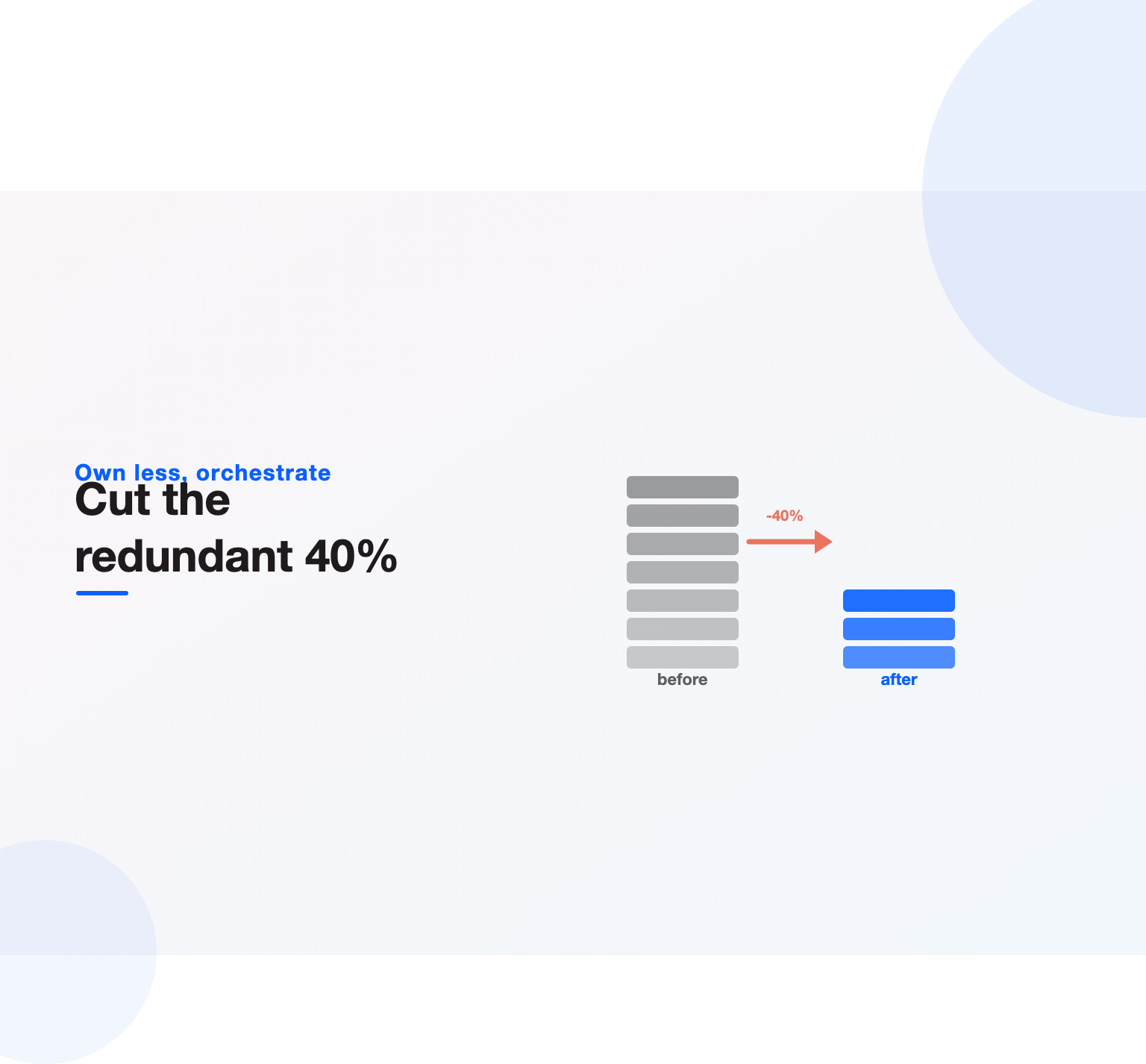
The fastest way to improve marketing performance in 2027 is not to buy something new. It is to remove what you already own and do not use. In our State of Enterprise MarTech 2027 report we benchmarked the observable stacks of 190 enterprise SaaS companies and found the average scored just 43 out of 100 on a seven-dimension efficiency index, with stacks typically carrying thirty to forty percent redundant tooling. That redundancy is not free. It shows up as a bloated bill, conflicting data, integration nobody maintains, and a marketing operation too complicated for anyone to run well. Martech consolidation is the deliberate work of shrinking that footprint back to the tools that earn their place and connecting the survivors into a system. This guide explains what it is, why it has become the highest-return move in enterprise marketing, and how to run it without breaking what works.
Key Highlights
- In practice, martech consolidation removes redundant and unused tools so the survivors can be integrated and adopted, turning a sprawling footprint into a system that works.
- The average enterprise stack scores 43 out of 100 and carries thirty to forty percent redundancy, which makes consolidation the cheapest high-return move available to most marketing teams.
- The savings are real but secondary; the larger prize is cleaner data, fewer broken integrations, and a stack a new hire can understand and use.
- Successful consolidation is sequenced and evidence-led: audit first, cut what duplicates or goes unused, migrate carefully, then integrate and drive adoption of what remains.
- Consolidation is a recurring discipline, not a one-time purge, because without an owner and a gate on new purchases, sprawl quietly returns.
What martech consolidation actually is
In many cases, martech consolidation is often mistaken for cost-cutting, but that framing undersells it and leads teams to do it badly. At its core it is an exercise in system design. A stack that grew tool by tool over a decade is not a system; it is a pile of capabilities, many overlapping, few connected, and a large share barely used. It is the act of turning that pile back into a designed system by removing the pieces that do not belong and wiring the rest together. The redundant analytics tool, the second email platform a team bought because it did not know the first existed, the point solution that duplicates a feature already in the marketing cloud, these are the targets. Removing them is not austerity; it is the precondition for the stack functioning as a whole.
This is why martech consolidation is best understood as the counterpart to integration rather than the opposite of investment. You cannot meaningfully integrate a stack with three tools doing the same job, because there is no single source of truth to integrate around. You cannot drive adoption of a platform when its function is smeared across four overlapping products. That clearing of the ground lets the money already spent finally produce a coherent result. The benchmark makes the case plainly: the leaders are not the companies with the most tools but the ones whose tools are used and connected, and consolidation is how a sprawling stack becomes that.
Why martech consolidation became urgent
For fifteen years the martech market grew relentlessly, from a few hundred products in 2011 to more than fifteen thousand today, and enterprise buying behavior grew with it. Every new problem got a new tool, every new team brought its own preferences, and almost nothing was ever removed. The result is the sprawl the benchmark measures. What changed to make martech consolidation urgent now is a combination of pressures arriving at once: finance scrutinizing every renewal, data privacy raising the cost of fragmented and duplicated customer data, and the realization that the AI and activation capabilities everyone wants require a clean, unified foundation that a sprawling stack cannot provide. It is the price of entry for almost everything on the modern roadmap.
There is also a simpler driver: the pain finally became visible. When a stack is small, redundancy hides. When it reaches dozens of tools with overlapping functions and unmaintained connections, the symptoms become impossible to ignore. Reports disagree because tools count things differently. Campaigns are slow because data has to be reconciled by hand. Nobody can answer basic questions about what the company owns or uses. At that point martech consolidation stops being a nice-to-have efficiency project and becomes a prerequisite for the marketing organization to function. The companies acting now are the ones that recognized the symptoms rather than waiting for a budget crisis to force the issue.
What consolidation delivers
The most immediate return from martech consolidation is financial, and it is often large. Retiring the redundant thirty to forty percent of a stack directly reduces license spend, and it removes the hidden costs of administering, securing, and integrating tools that were never needed. But the financial return, striking as it is, is the least interesting part of the story. The deeper value is in what a leaner stack makes possible. When there is one analytics tool instead of three, its numbers become the numbers, and arguments about whose data is right disappear. When there is one customer data foundation instead of four fragments, personalization and activation become achievable. When the integration surface shrinks, the connections that remain can actually be maintained.
Consolidation also produces a benefit that rarely appears on a spreadsheet but changes everything in practice: comprehensibility. A stack that a new marketer can learn in a week is a stack that gets used to its full potential. A sprawling one, where capability is scattered and half the tools are mysteries, guarantees underutilization no matter how much was spent. By shrinking the stack to the tools that matter and making their roles clear, martech consolidation raises adoption across the board, which is where the efficiency score, and the marketing performance behind it, actually improves. The lean stack is not just cheaper; it is more capable, because more of it gets used.
Not sure which marketing channels are worth your budget?
Our team reviews your current setup and shows you where the opportunities are. See how our digital marketing consulting work.
How to run a martech consolidation, step by step
A consolidation that works follows a disciplined sequence rather than a round of arbitrary cuts. The first step is a complete audit: inventory every tool including the shadow purchases finance does not know about, map each to the marketing value chain, and measure how much each is actually used through login data, seat utilization, and interviews. This produces the evidence consolidation depends on, because you cannot safely remove what you have not first understood. The audit almost always reveals the same picture the benchmark describes: heavy redundancy, a measurement-rich and activation-poor stack, and a long tail of tools nobody opens.
The second step is to decide what to cut, using clear criteria rather than politics. A tool is a candidate for removal if it duplicates a capability present elsewhere, if its usage is negligible, or if the value it provides does not justify its total cost including integration and administration. The third step is careful migration: before switching anything off, ensure the surviving tool genuinely covers the retired one’s essential function, move the data and workflows, and communicate the change to the teams affected. The fourth step, and the one teams most often skip, is integration and adoption of what remains, because a smaller stack only pays off if the survivors are connected and used. For most teams, martech consolidation that stops at cancellation, without the integration and adoption work, leaves most of the value on the table.
What to keep and what to cut
The hardest judgments in a consolidation are not the obvious duplicates but the borderline cases, and a simple principle helps: keep the tools that form the spine of the stack and cut the ones that hang off it without earning their place. The spine is the small set of platforms the whole operation depends on, typically the core marketing platform, the customer data platform that unifies customer data, the analytics and experimentation layer, and the systems of record the business runs on. These are rarely candidates for removal because everything else connects to them. The cuts come from the surrounding layer of point solutions, redundant purchases, and single-feature tools whose function the spine already covers or could cover with minor configuration.
A useful test for a borderline tool is to ask what would actually break if it were removed, and whether that function could be absorbed by a platform already in the stack. Frequently the honest answer is that little would break, because the tool was bought to solve a problem a broader platform already addresses. In short, martech consolidation is the process of asking that question systematically across the whole footprint. The discipline is to resist the sunk-cost instinct that keeps a tool alive because it was expensive to buy, and to judge every tool only on the value it produces now relative to the cost and complexity it adds. A tool that fails that test belongs on the cut list regardless of its price tag or its internal champion.
The pitfalls that derail martech stack consolidation
Consolidation efforts fail in a handful of predictable ways, and knowing them is half of avoiding them. The most common failure is cutting on cost alone, treating the exercise as a procurement drill and removing tools without confirming the surviving stack covers their function, which creates gaps that get filled by new purchases and rebuilds the sprawl. A second failure is stopping at cancellation and never doing the integration and adoption work, so the stack is smaller but no more coherent. A third is politics: tools survive because they have an internal champion rather than because they earn their place, and the consolidation quietly protects the very redundancy it was meant to remove. Each of these turns a promising martech consolidation into a disappointment.
The subtler pitfall is treating consolidation as a one-time project. A stack cleaned once and then left ungoverned drifts straight back toward sprawl, because the conditions that created the bloat, decentralized buying, new tools for every problem, and no owner for the whole, never went away. Sustainable consolidation installs a gate: no new tool enters without a named business case and a retirement plan for whatever it replaces, and someone owns the stack and reviews it on a cadence. Without that discipline the savings erode within a year or two and the exercise has to be repeated from scratch. The organizations that get lasting value treat martech consolidation as an operating habit, not an event.
Martech consolidation and the CRM question
One decision sits at the center of many consolidation efforts: what to do about overlapping systems that hold customer records, because these are both the most valuable and the most entangled tools in the stack. Duplicate or poorly integrated customer databases are a classic consolidation target, but they are also the riskiest to touch, since a botched migration can disrupt sales and marketing operations for months. When consolidation involves merging or migrating these systems, it deserves specialist care and a careful migration plan rather than a hurried switch-off. The prize is worth the caution: a single, clean source of customer truth is the foundation the activation and AI layers everyone wants depend on, and it is often the largest single win a consolidation can deliver.
This is also where martech consolidation connects most directly to revenue rather than just cost. Fragmented customer data is not merely inefficient; it actively suppresses performance, because personalization, lead scoring, and attribution all degrade when the underlying records are split and inconsistent. Unifying around one trustworthy customer foundation does not just save a license fee; it unlocks capabilities that were impossible while the data was fragmented. For many enterprises this is the moment consolidation stops being a defensive efficiency play and becomes an offensive growth move, which is exactly how the leaders in the benchmark treat it.
Turning consolidation into a lasting advantage
The organizations that get the most from martech consolidation do not treat it as a diet the stack goes on and then abandons. They build the discipline into how marketing operates, giving the stack a clear owner, usually within a marketing operations function, who is accountable for its efficiency the way a portfolio manager is accountable for a portfolio. That owner runs the regular audit, guards the gate on new purchases, and keeps the integration and adoption work moving so the survivors keep earning their place. Under that discipline the stack does not drift back toward sprawl; it stays lean, connected, and comprehensible, and its efficiency score climbs rather than decays.
Handled this way, consolidation becomes a durable competitive advantage rather than a one-off saving. While competitors keep adding tools and accumulating the integration debt and data fragmentation that come with them, the disciplined organization compounds the opposite: cleaner data, faster execution, higher adoption, and a marketing operation that leadership can actually understand and trust. That gap widens over time, because sprawl compounds and so does its absence. Companies that want help running a consolidation, or building the operating discipline that keeps a stack lean afterward, can work with a partner through our digital marketing consulting services, where the benchmark’s framework becomes a specific plan for a specific stack. The move that looks like subtraction turns out to be the surest way to add performance.
How consolidation cleans up your data
The least visible but most valuable outcome of martech consolidation is what it does to data quality. In a sprawling stack, customer data is duplicated across overlapping tools, each with its own definitions, its own identifiers, and its own partial view of the customer. The consequence is that no number can be fully trusted, because a different tool will report it differently, and teams waste enormous effort reconciling figures that should have agreed in the first place. Removing the redundant tools collapses those competing versions of the truth into one, which is why data integrity improves the moment the duplicates are gone rather than only after some later cleanup project. A leaner stack is a more honest stack.
That newfound data integrity is what makes the rest of the roadmap achievable. Reliable attribution is impossible when the underlying events are recorded inconsistently across duplicate tools, and personalization degrades when customer records are split. By unifying the data around a smaller set of trusted systems, consolidation turns analytics from a source of arguments into a source of decisions. The teams that treat the data cleanup as the real point of the exercise, rather than a side effect of trimming the bill, are the ones that convert a cost-saving project into a genuine performance gain, because clean, unified data is the raw material every downstream capability runs on.
Sequencing consolidation within a wider plan
A consolidation should not happen in isolation; it works best as the first move in a broader effort to raise the stack’s efficiency. The natural sequence is to audit, then consolidate, then integrate and drive adoption, and only then consider new capability with a specific business case. Placing the trimming at the front is deliberate, because every later step is easier against a lean, understood stack than against a sprawling one. Trying to integrate before consolidating means wiring up tools you are about to remove; trying to add AI or activation before consolidating means building on a fragmented foundation. Getting the order right is what separates a project that compounds from one that has to be redone.
This sequencing is also how a consolidation connects to growth rather than sitting apart from it as a pure efficiency drill. Once the stack is lean and the data is clean, the same organization can invest with confidence in the capabilities that actually move revenue, whether that is experimentation, demand generation, or the activation layer, through focused growth and conversion programs. The consolidation is what makes those investments pay, because they land on a foundation that can support them. Read this way, trimming the stack is not the opposite of ambition; it is the groundwork that makes ambition affordable and effective.
Want a marketing plan built around your numbers?
Book a free 30-minute strategy call and leave with a clear next step for your business.
Measuring whether it worked
A consolidation deserves the same measurement discipline as any other marketing investment, and the metrics are straightforward. The obvious one is cost: the reduction in license, administration, and integration spend after the redundant tools are gone. But the more important measures are the ones that show the stack got better, not just cheaper. Track the efficiency score using the same dimensions the benchmark uses before and after, so the improvement in utilization and connection is visible. Track adoption of the surviving tools, because rising usage is the proof that the remaining stack is comprehensible and valued rather than merely smaller.
Beyond the numbers, the qualitative signals matter too. After a successful consolidation, reports stop disagreeing, campaigns ship faster because data no longer has to be reconciled by hand, and new team members become productive sooner because the stack is legible. If those signals do not appear, the consolidation likely stopped at cancellation without doing the integration and adoption work, and the fix is to finish the job rather than to conclude the effort failed. Measured honestly across cost, efficiency, adoption, and these operational signals, a well-run martech consolidation shows up as a stack that is smaller, cheaper, and unmistakably more capable than the one it replaced. It is worth capturing a simple before-and-after snapshot of tool count, spend, efficiency score, and time-to-launch, because a documented improvement is what earns the mandate to keep the discipline funded and to extend it into the next phase. Numbers that leadership can see are what turn a one-time win into a standing program.
A practical first ninety days
For teams ready to start, martech consolidation becomes far less daunting when it is scoped into a short, concrete first phase rather than an open-ended overhaul. A workable ninety-day plan spends the first month on the audit, producing a complete inventory scored against the same efficiency dimensions the benchmark uses, so the redundancy is documented rather than assumed. The second month turns that evidence into decisions: a ranked cut list built on clear criteria, a check that each survivor covers the removed tool’s essential function, and a migration plan for anything with data or workflows attached. The third month executes the low-risk removals, begins the higher-risk migrations carefully, and starts the integration and adoption work on the tools that remain. Ending the quarter with a smaller, better-connected stack and a documented gate on new purchases is a realistic and valuable outcome.
What makes this timeline achievable is restraint about scope. The first ninety days should not try to consolidate everything; they should tackle the clearest redundancies and the highest-value integrations, prove the approach, and build the operating habit. The harder cases, particularly systems of record and anything tangled into a broader stack build or automation strategy, can follow in later phases once the discipline is established and the early wins have earned the effort credibility. Approached this way, martech consolidation stops being an intimidating one-time upheaval and becomes a repeatable quarterly rhythm that steadily raises the efficiency of the stack while the rest of the market keeps adding to theirs.
Related reading
- The State of Enterprise MarTech 2027
- The MarTech Audit: Seven Signs Your Stack Is Underperforming
- The Modern MarTech Stack: Built to Measure, Not Convert
- Customer Data Platforms: The Missing Activation Layer
- Marketing Technology Trends 2027: What the Data Actually Shows
Key Takeaways
- Run an audit that scores your stack and documents the redundant 30-40%.
- Cut tools that duplicate a capability or go unused, using clear criteria not politics.
- Migrate carefully, then integrate and drive adoption of the survivors.
- Install a gate on new purchases and give one owner the ongoing discipline.
Frequently asked questions
What is martech consolidation?
Equally, martech consolidation is the structured process of auditing your marketing technology stack, identifying tools that duplicate a capability or go unused, and deliberately retiring them so the remaining tools can be integrated and adopted. It turns a stack that grew by accretion into a designed system, which is why it improves data quality and efficiency, not just cost.
Why is consolidation better than buying another tool?
Because the average stack already scores 43 out of 100 and carries thirty to forty percent redundancy, so the highest-return move is usually making existing tools work rather than adding more. It lowers cost, cleans data, and raises adoption of the survivors, whereas a new purchase into a sprawling stack tends to add integration debt and duplicate a capability already owned.
How do you decide which tools to cut?
Use clear criteria rather than politics. A tool is a candidate for removal if it duplicates a capability present elsewhere, if its usage is negligible, or if its value does not justify its total cost including integration and administration. A useful test is to ask what would actually break if it were removed and whether a platform already in the stack could absorb its function.
What is the biggest risk in a consolidation?
Cutting on cost alone without confirming the surviving stack covers the removed tool’s function, which creates gaps that get filled by new purchases and rebuilds the sprawl. Other common failures are stopping at cancellation without doing the integration and adoption work, and letting politics protect redundant tools. Careful migration and clear criteria prevent these.
How much can consolidation save?
Savings vary, but because stacks typically carry thirty to forty percent redundancy, the license reduction alone is often substantial, and the removed administration, security, and integration overhead adds more. The larger value, though, is in cleaner data, fewer broken integrations, and higher adoption, which improve marketing performance beyond the direct cost saving.
Is martech consolidation a one-time project?
No. A stack cleaned once and left ungoverned drifts back toward sprawl, because decentralized buying and the reflex to add a tool for every problem never stop. Sustainable consolidation installs a gate on new purchases and gives the stack a clear owner who reviews it on a cadence, so it stays lean rather than needing to be redone every few years.
How long does a consolidation take?
A focused first phase fits comfortably in ninety days: a month to audit and score the stack, a month to build the cut list and migration plans, and a month to execute the low-risk removals and begin the higher-risk migrations. Full consolidation of a large, entangled stack takes longer and is best done in phases, tackling the clearest redundancies first to prove the approach before touching systems of record. Scoping the first quarter tightly is what keeps the effort from stalling.
Who should own the consolidation?
A single accountable owner, usually within a marketing operations function, should own both the consolidation and the ongoing discipline that keeps the stack lean afterward. Without one clear owner, cuts get relitigated, the gate on new purchases goes unenforced, and sprawl returns within a year or two. The owner runs the recurring audit, guards new purchases, and keeps the integration and adoption work moving, treating the stack’s efficiency as a standing responsibility rather than a one-off project.
Where does the CRM fit into consolidation?
Overlapping or poorly integrated customer databases are a high-value but high-risk consolidation target, because a botched migration can disrupt operations for months. When consolidation involves merging these systems it deserves a careful migration plan, since the prize, a single clean source of customer truth, is the foundation the activation and AI layers depend on and often the largest win available.
Ready to put this into practice?
Talk to the team that runs SEO, AI search and paid growth programs every day.
Book a Strategy Call →