 Skip to content

B2B Content Marketing Strategy That Builds Pipeline
A B2B content marketing strategy tied to pipeline: start from the buyer and a point of view, map content to stage and role, pair with search, distribute deliberately, and measure to revenue not traffic.
Quick Answer
A B2B content marketing strategy is a deliberate plan for using content to reach a business buying group, build authority, and move accounts toward a purchase, rather than publishing articles and hoping. The strategy that works starts from a sharp understanding of the buyer and the problem, sets a distinctive point of view, maps content to each stage and each role in the buying committee, chooses the few channels where those buyers actually are, and measures everything to pipeline rather than to traffic. The strongest B2B content marketing strategy treats content as a compounding asset that lowers the cost of acquiring customers over time, connects tightly to search and demand generation, and is run as a disciplined program rather than a scatter of one-off posts.
Key Highlights
- A B2B content strategy is a plan tied to pipeline, not a publishing schedule.
- It starts from a sharp buyer definition and a distinctive point of view.
- Every piece is mapped to each funnel stage and to each role in the buying committee.
- A few well-chosen channels beat a presence spread thin across many.
- The library compounds with SEO, lowering acquisition cost as authority builds over time.
- Everything is measured to influenced pipeline and revenue, not vanity traffic.
Start from the buyer, not the content
Before any editorial calendar, a strong content strategy starts from a sharp understanding of who you are trying to reach and what problem you solve for them. Business buying involves a committee, an economic buyer, a technical evaluator, an end user, each of whom cares about different things, so the strategy has to know these roles and their questions before it decides what to publish. Anything built without this understanding is generic, and generic content is invisible to a busy professional audience.
This foundation shapes everything downstream. Knowing the buyer tells you what problems to write about, what language resonates, what objections to address, and what proof each role needs to move forward. It also keeps the strategy honest about its purpose, which is to influence a considered purchase, not to entertain a general audience. A business that skips this step and jumps straight to publishing usually produces a steady stream of content that no specific buyer needed, which is the most common reason a B2B content marketing strategy generates traffic but no pipeline. Getting the buyer right first is unglamorous but decisive, because every later choice depends on it.
A distinctive point of view
The B2B content that earns attention and gets remembered has a point of view, not just information. In a market where every competitor publishes the same safe best-practice articles, a distinctive, well-argued perspective is what makes a buyer stop, think, and associate your company with genuine expertise. This does not mean being contrarian for its own sake; it means having a real, defensible position on how the problem you solve should be approached, and expressing it clearly.
A point of view is what turns content marketing from a commodity into an asset, because it is the thing competitors cannot easily copy. It also makes the content engine coherent: a clear perspective gives every piece a reason to exist and a consistent voice, rather than a grab-bag of topics with nothing tying them together. In B2B especially, where buyers are experts who can spot hollow content instantly, a genuine point of view backed by real experience is what builds the credibility a considered purchase depends on. Without one, the strategy tends to blend into the noise, however competent each individual piece is.
Map content to the buyer’s journey
A core discipline of any B2B content marketing strategy is mapping content to the stages of the buyer’s journey, because a buyer early in their research needs something very different from one comparing vendors. Early-stage content educates and builds awareness of the problem; middle-stage content helps the buyer evaluate approaches and options; late-stage content makes the case for your solution with proof, comparisons, and ROI. A strategy that publishes only one kind leaves gaps that stall accounts.
In B2B, this mapping has an extra dimension: the buying committee. Different roles enter the journey at different points and need different content, the practitioner wants depth and technical credibility, the economic buyer wants business outcomes and risk reduction. A complete content program covers both the stage and the role, so that whoever in the account encounters your content finds something relevant to their concern. Building the content this way, as a considered set that carries a whole committee from awareness to decision, is what separates a strategy that moves pipeline from a blog that merely attracts readers who never buy.
Why content and search go together
No B2B content marketing strategy is complete without search, because search is how most buyers find content in the first place and how it keeps working long after publication. The pairing of content and search engine optimization is close: content gives search something worth ranking, and search gives content an audience that compounds over time. A piece optimised for the questions your buyers actually type earns traffic for years, which is what makes content such an efficient long-term investment compared with channels that stop the moment you stop paying.
The discipline is to build content around the real questions and terms your buyers search, informational queries for the awareness and consideration stages, and commercial ones for the decision stage, so the same body of work feeds both discovery and conversion. Building that search presence deliberately, the way a disciplined SEO program does, turns a content library from a set of posts into an engine that earns qualified traffic and lowers acquisition cost as it grows. An engine that ignores search leaves most of content’s compounding value on the table, relying on promotion to reach an audience search would have delivered for free.
Choose a few channels, well
A B2B content marketing strategy has to decide not just what to create but where to put it, and the honest answer is a few channels chosen for where your buyers actually are, not a presence spread thin across every platform. For most B2B audiences, that means owned search and a company blog, LinkedIn for distribution and thought leadership, and email for reaching known contacts, with others added only where there is a real reason. Spreading effort across every channel usually means doing none of them well.
The principle is to match the channel to the buyer and the content, then commit to it properly. LinkedIn suits B2B thought leadership and precise professional reach; a well-run social media presence there compounds familiarity with the exact people you want to reach, and targeted LinkedIn advertising can amplify your best pieces to named accounts when organic reach alone is too slow. Search delivers buyers actively looking; a disciplined email marketing programme nurtures the contacts you have already earned. A focused such a strategy picks the two or three channels that fit and runs them consistently, because consistency on a few channels builds the presence that occasional activity across many never will, and it keeps a small team from burning out trying to be everywhere at once.
Distribution, not just creation
A common flaw in a B2B content marketing strategy is treating publishing as the finish line, when in reality creating the content is only half the work and distributing it is the other half. A brilliant piece that no one sees produces nothing, so the strategy must plan deliberately for how each asset reaches its audience: through search, through sharing on the channels your buyers use, through email to your list, and through repurposing into the formats different people prefer.
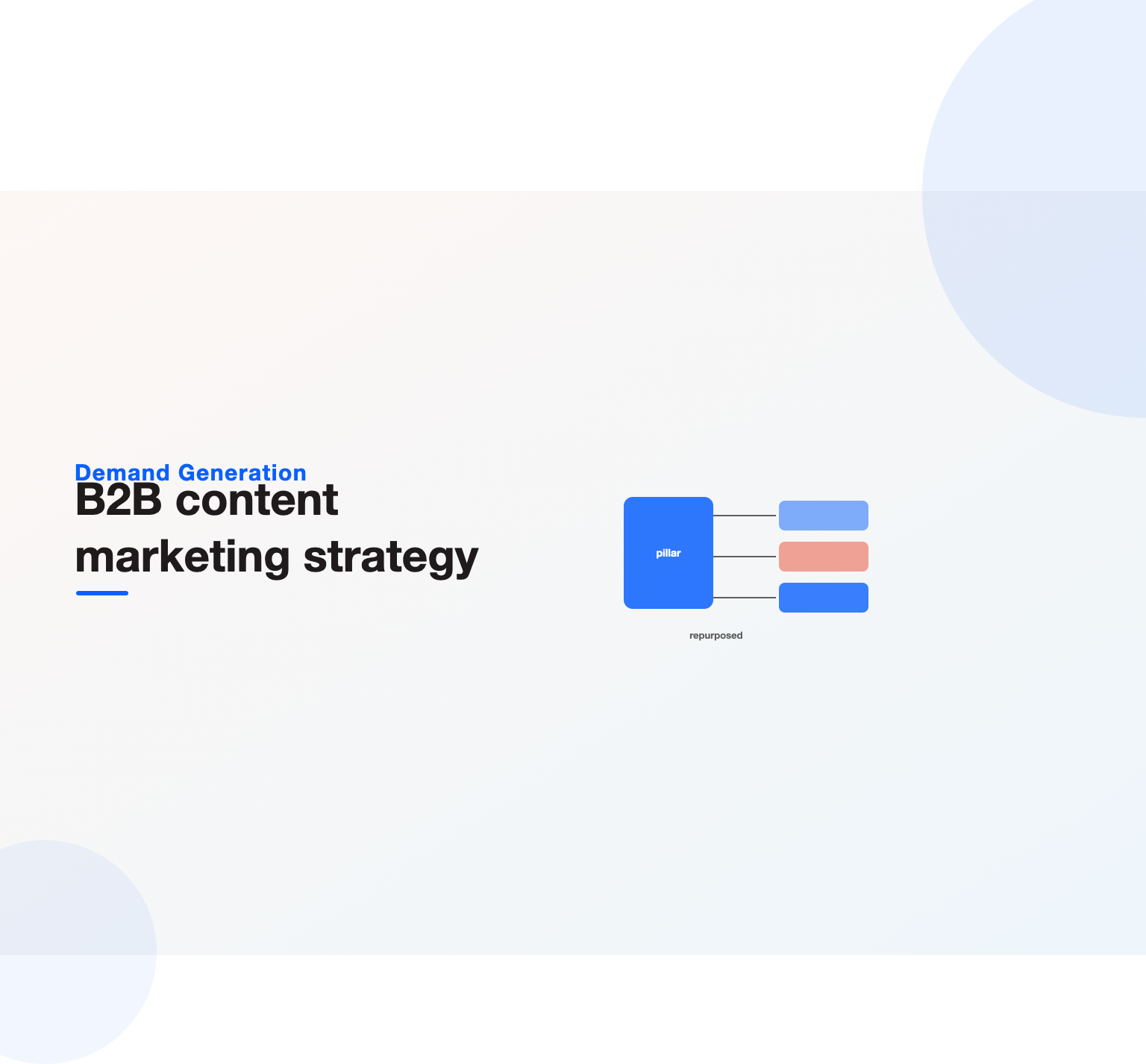
Repurposing is especially high-leverage in B2B, because a single substantial piece, a research report, a detailed guide, can become a series of social posts, an email sequence, a webinar, and a set of shorter articles, each reaching a different slice of the audience from the same core work. This multiplies the return on every piece created, which matters when a small team cannot produce endless net-new content. Programs that budget as much attention for distribution and repurposing as for creation gets far more from the same effort, because it stops treating each publish as a one-time event and starts treating each asset as something to be worked repeatedly until its value is fully extracted.
Formats that work in B2B
While the strategy matters more than any format, it helps to know which formats tend to earn their place in B2B. Long-form guides and pillar pages build authority and rank well in search; original research and data reports earn links, citations, and the kind of attention that makes a market pay notice; case studies provide the proof a buying committee needs near a decision; and webinars and detailed technical content persuade the practitioners who evaluate you. Each does a specific job at a specific stage.
The formats to be wary of are the ones chosen for fashion rather than fit, producing video because it is trendy when your buyers read, or churning short posts that say nothing because a schedule demands them. A sound B2B content marketing strategy chooses formats by the job they do for a specific buyer at a specific stage, not by what is currently popular. In practice a mix works best: substantial cornerstone pieces that build authority and rank, supported by shorter content that maintains presence and feeds distribution, all tied together by the point of view and the buyer journey the strategy is built around, so the library adds up to more than the sum of its posts.
Running the strategy in the Indian market
In the Indian market, a B2B content marketing strategy has some local texture worth planning for. Buyers research thoroughly and place heavy weight on trust and relationships, which makes genuinely useful, credible content especially powerful, because it builds the trust a cautious buyer needs before engaging. Material that demonstrates real expertise and local understanding tends to outperform generic global material that ignores the realities of the Indian market.
Distribution has local texture too. LinkedIn is strong for B2B here, search is growing fast as buyers research online, and channels like WhatsApp increasingly carry content distribution and follow-up because they are woven into how Indian professionals communicate. Long, multi-stakeholder cycles raise the value of content that nurtures a buying group over time rather than pushing for a quick conversion. Pairing a credible content engine with a coordinated demand generation program tuned to how business marketing actually works locally is what turns content into pipeline in India rather than into traffic that never converts. The mechanics of capturing that created interest are covered in our guide to how to generate leads, which pairs naturally with this content-led approach.
Measuring a content strategy properly
The content program must be measured to pipeline and revenue, or it drifts into producing content that looks busy but influences nothing. Traffic, rankings, and engagement are useful diagnostics, they show whether content is being found and read, but they are not the goal. The metrics that matter are how content influences pipeline: the leads it captures, the accounts it engages, and its influence on deals over the long consideration cycles B2B involves.
This requires attribution patient enough to credit content that shaped a buyer’s thinking months before they converted, which is harder than counting page views but far more honest. It also requires connecting content to the funnel it feeds, so you can see which pieces and topics actually move accounts rather than merely attracting readers. Measured this way, a B2B content marketing strategy improves steadily, because you can double down on the content that influences pipeline and cut the content that only generates traffic. Underpinning this with clean data and a coordinated revenue operations foundation is what makes the measurement trustworthy enough to act on.
Building the editorial engine behind it
Behind every strong strategy sits an editorial engine that turns a plan into a steady flow of quality work, and neglecting it is why many programs stall after a burst of early enthusiasm. That engine is a small set of disciplines: a topic backlog tied to the buyer’s questions and search demand, a realistic cadence a lean team can sustain, an editorial standard that keeps every piece genuinely useful, and a review step that protects the point of view from being diluted into safe, generic prose. Consistency matters more than intensity, because a market notices a steady presence and forgets an occasional flurry.
The other half of the engine is the operational plumbing that connects publishing to the rest of the funnel. Each piece needs a clear next step, an offer, a related resource, a path deeper into the site, so that a reader who engages can be captured and nurtured rather than left to wander off. Wiring content into a coordinated marketing automation setup and a tidy customer database is what lets the program see which pieces influence pipeline and feed engaged readers into nurture. Pairing the editorial standard with disciplined internal linking and the technical hygiene a good SEO program maintains keeps the whole library discoverable and mutually reinforcing, so each new piece lifts the ones already published rather than sitting in isolation.
Governance, refresh, and quality over time
A library that only ever grows eventually decays, because search intent shifts, facts date, and early pieces rarely match the standard the program later reaches. Mature programs plan deliberately for maintenance: auditing the library on a regular cadence, refreshing the pieces that still matter, consolidating overlapping ones, and retiring the few that no longer earn their place. This keeps the whole body of work credible and competitive, which protects the rankings and the authority the strategy depends on.
Governance is the quieter discipline that keeps quality steady as more people contribute. A clear style, a documented point of view, and a light approval step prevent the drift toward bland, committee-pleasing prose that erodes the very distinctiveness that made the content work. As the team grows, these guardrails matter more, not less, because they are what let scale happen without a loss of voice. Treating the library as a living asset to be curated rather than an archive to be added to indefinitely is what separates a program that compounds in value from one that slowly fills with forgotten posts nobody maintains, and it is the habit that keeps a content strategy paying off years after it began rather than fading once the initial push is over.
Common mistakes in B2B content marketing
- Publishing without a buyer. Anything built without a sharp buyer definition is generic and invisible to a professional audience.
- No point of view. Safe, undifferentiated content blends into the noise however competent it is.
- One stage only. Publishing only awareness or only decision content leaves gaps that stall accounts.
- Creation without distribution. Treating publishing as the finish line wastes most of each asset’s potential reach.
- Chasing traffic, not pipeline. Optimising for page views produces content that looks busy but influences nothing.
- Spreading thin. A shallow presence on every channel beats a committed presence on none.
Each mistake is the inverse of a sound principle, which is why studying a strong content strategy is also the fastest way to learn what to avoid.
Aligning content with sales
In B2B, content and sales succeed or fail together, so a strategy built in isolation from the sales team leaves much of its value unrealised. Sales talks to buyers every day and knows the real objections, the questions that stall deals, and the proof that moves a committee, which is exactly the raw material the best content is made from. A strategy that mines this knowledge produces content that answers what buyers actually ask, rather than what marketing imagines they ask, and it gives sales genuinely useful assets to share during a live deal.
The relationship runs both ways. Content shortens sales cycles by educating and building trust before the first call, and by arming reps with case studies, comparisons, and answers they can send at the right moment; sales, in turn, tells content which pieces actually help close and which topics keep surfacing unanswered. Formalising this loop, often as part of a coordinated demand generation program with a shared view of the funnel, is what turns content from a marketing silo into a revenue tool the whole go-to-market team relies on. The wider tactics this feeds are covered in our guide to B2B lead generation strategies, of which a content engine is usually the quiet foundation.
Turning this into a first 90 days
To make it concrete, a realistic first quarter for a team building the strategy looks like this. In month one, do the foundational work: define the buyer and the buying committee, articulate a distinctive point of view, and map the topics and search terms that matter to each stage and role. This planning is what keeps the following months focused rather than reactive, and it is the step most programs skip to their cost.
In month two, publish the first cornerstone pieces, substantial, search-optimised guides that build authority on the topics your buyers care about most, and set up distribution through search, LinkedIn, and email. In month three, add supporting content that maintains presence and feeds distribution, begin repurposing the cornerstone pieces into other formats, and stand up the reporting that traces content to pipeline. By ninety days the strategy has a foundation, a growing library anchored by cornerstone assets, working distribution, and the measurement to refine it, from which it expands deliberately toward whatever the pipeline data rewards rather than whatever is easiest to produce next.
How the pieces fit together
A B2B content marketing strategy is not a list of tactics but a system, and its value comes from how the parts connect. The buyer definition and point of view give every piece direction; the journey mapping ensures the library covers every stage and role; search and distribution get the content in front of the right people; and measurement to pipeline closes the loop so the strategy learns. A gap anywhere weakens the whole: content with no distribution goes unseen, distribution with no point of view is forgettable, and everything with no measurement drifts.
Seen this way, content marketing in B2B is really the engine that feeds the wider growth program, creating the awareness and trust that demand generation and lead generation then capture and convert. That is why it is worth reading alongside our guide to demand generation strategies, of which a content engine is usually the core, and our guide to how to generate leads, which covers the capture side content ultimately feeds. Built and connected this way, a content strategy stops being a cost centre that produces posts and becomes the compounding asset that lowers the cost of every customer the business acquires.
Key Takeaways
- A content strategy is a plan tied to pipeline, not a publishing schedule.
- It starts from a sharp buyer and buying-committee definition and a distinctive point of view.
- Every piece is mapped to every funnel stage and every role, so it moves whole accounts.
- Search and content are inseparable; together they compound and lower acquisition cost over time.
- A few well-chosen channels, plus deliberate distribution and repurposing, beat spreading thin.
- In India, credible, locally-aware content paired with LinkedIn, search, and WhatsApp distribution wins.
- Measure to influenced pipeline and revenue, not traffic, and refine by what actually converts.

Frequently asked questions
What is a B2B content marketing strategy?
It is a deliberate plan for using content to reach a business buying group, build authority, and move accounts toward a purchase, tied to pipeline rather than to a publishing schedule. It defines the buyer and buying committee, sets a distinctive point of view, maps content to each funnel stage and role, chooses the few channels where those buyers are, and measures everything to influenced pipeline and revenue. In short, it is the difference between publishing articles and hoping, and running content as a disciplined, compounding growth program.
What makes B2B content marketing different from B2C?
Business buyers evaluate as a committee rather than as a single consumer, so it must speak to several roles with different concerns, and it supports a considered, high-value purchase over a long cycle rather than an impulse. That makes depth, credibility, and a genuine point of view matter more than reach or entertainment, because the audience is small, expert, and can spot hollow content instantly. B2B content also leans harder on search, LinkedIn, and email than on the broad social channels that often drive B2C, and it is judged by influenced pipeline rather than raw traffic.
How much content does a B2B strategy need?
Fewer, better pieces almost always beat high volume in B2B, because the audience is specific and values depth over quantity. A sound approach anchors the library with substantial cornerstone pieces that build authority and rank in search, supported by lighter content that maintains presence and feeds distribution. What matters is coverage of the buyer’s stages and roles and consistency over time, not a large number of posts. Repurposing each substantial piece into several formats extends its reach further, so a small team can sustain a strong presence without producing endless net-new content.
How long before a B2B content strategy shows results?
Good content is a compounding, long-horizon investment, so meaningful results usually take several months as search rankings build and content influences accounts through long consideration cycles. Some capture-oriented pieces aimed at high-intent search can produce leads sooner, but the authority-building core pays off over quarters, not weeks. That is why a content strategy should be judged on influenced pipeline growing over time rather than on a single month’s traffic, and why cutting it early for lack of instant returns is one of the most common and costly mistakes in B2B marketing.
What role does SEO play in a B2B content strategy?
Search is central, because it is how most buyers find content and how content keeps working long after it is published. The two work as one: content and SEO are inseparable: content gives search something worth ranking, and search gives content a compounding audience. Building content around the real questions and terms your buyers search, informational for awareness and consideration, commercial for the decision stage, lets the same body of work feed both discovery and conversion. A B2B content strategy that ignores search relies on promotion to reach an audience that search would have delivered far more efficiently and durably.
How do I measure a B2B content strategy?
Measure it to influenced pipeline and revenue, not to traffic or engagement, which are useful diagnostics but not the goal. Track how content captures leads, engages target accounts, and influences deals over the long B2B cycle, which requires attribution patient enough to credit content that shaped a buyer’s thinking months before they converted. Connecting content to the funnel it feeds lets you double down on the pieces and topics that move accounts and cut those that only attract readers, which is how the strategy improves steadily rather than drifting into busy work.
Ready to put this into practice?
Talk to the team that runs SEO, AI search and paid growth programs every day.
Book a Strategy Call →