 Skip to content

Demand Generation Strategies That Build Pipeline
The demand generation strategies that build pipeline: a content engine, high-intent search, account-based marketing, webinars, retargeting, nurture, and sales alignment, and how to choose and sequence them.
Quick Answer
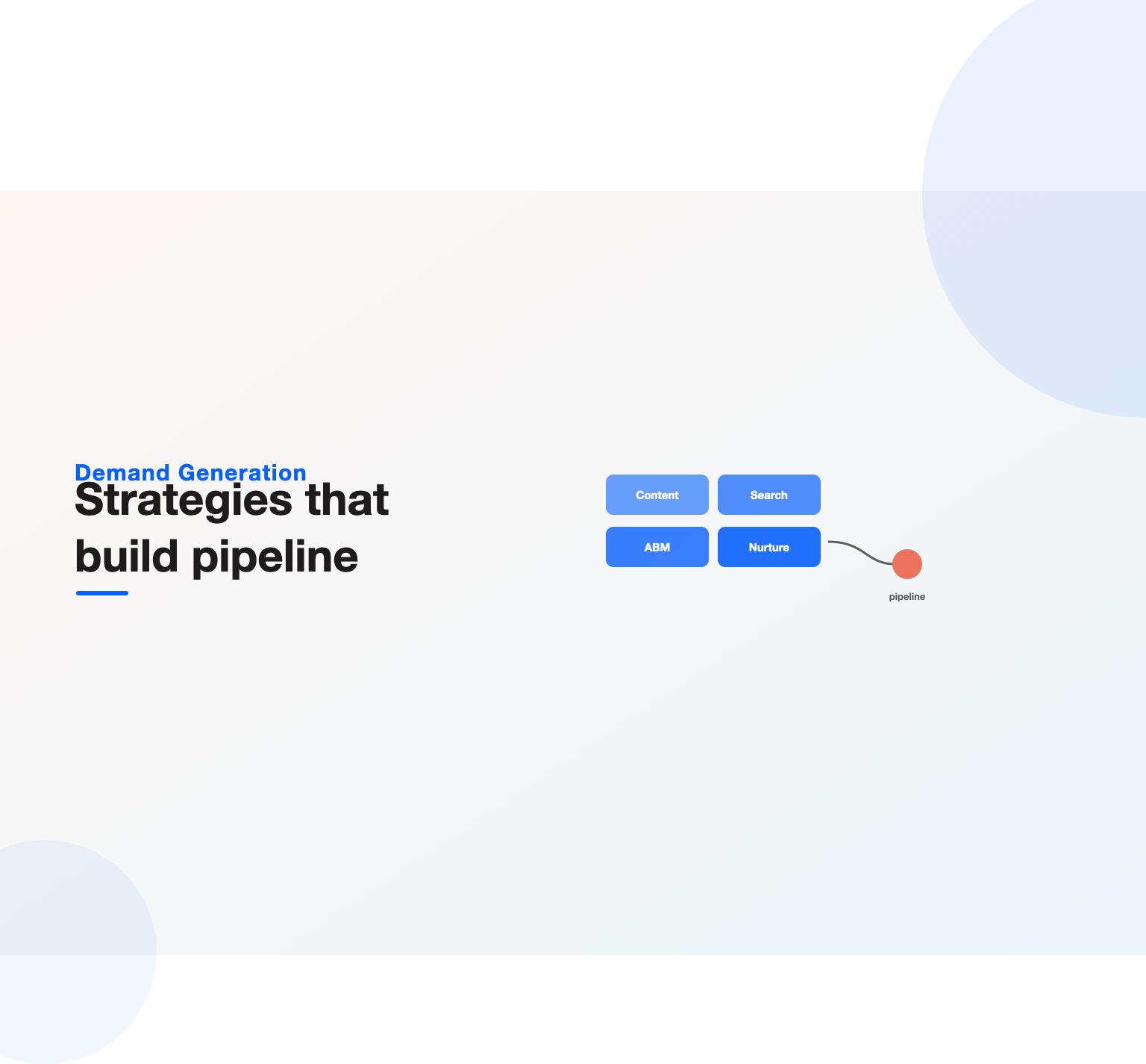
The demand generation strategies that work are the ones that create interest and capture it across the whole funnel: publish a strong content and thought-leadership engine, own high-intent search, run account-based marketing for priority accounts, use webinars and events to build trust, retarget engaged visitors, nurture with lifecycle email and scoring, and align tightly with sales on what a qualified lead is. The best programs combine a few of these deliberately, measure everything to pipeline and revenue, and treat demand generation as a compounding system rather than a set of one-off campaigns.
Key Highlights
- Winning demand generation strategies balance demand creation (awareness) with demand capture (conversion).
- A content and thought-leadership engine is the core creation strategy; search and retargeting capture the interest.
- Account-based marketing focuses effort on the accounts most worth winning.
- Webinars, events, and community build the trust that shortens later sales cycles.
- Nurture, scoring, and sales alignment convert created interest into qualified pipeline.
- Every strategy is measured to pipeline and revenue, and the mix is tuned by what actually converts.
Start with the foundations, not the tactics
Before any of the specific demand generation strategies, two foundations decide whether they will work. First, a sharp definition of your ideal customer and the problem you solve, because every strategy targets that person and misfires without it. Second, agreement with sales on what a qualified opportunity is and how leads are handed over, because strategies that generate interest sales will not accept are wasted effort dressed up as activity.
These are not glamorous, but they are the difference between demand generation strategies that build pipeline and ones that just make noise. A precisely defined audience makes content sharper, targeting tighter, and messaging more resonant; a shared definition of a qualified lead means marketing and sales pull in the same direction. Skipping these foundations is the most common reason otherwise-sound demand generation strategies underperform, so they come first, before a single campaign is planned. Get them right and every strategy that follows works harder, because it is aimed at a clearly defined buyer and pointed at a goal marketing and sales both recognise; get them wrong and even the most sophisticated tactics fire at the wrong target and produce activity nobody can convert into revenue.
A content and thought-leadership engine
The core of most strong demand generation strategies is a content engine that creates demand by educating the market. This is not blogging for its own sake; it is a deliberate body of genuinely useful content marketing, and a distinctive point of view, that makes your company the recognised authority on the problem you solve. It reaches buyers long before they are ready to purchase, planting the interest that later becomes pipeline.
Done well, content works across the funnel: educational pieces create awareness, comparison and buyer-guide content helps consideration, and bottom-of-funnel content captures intent. It also builds the organic search presence that quietly compounds, which is why content and SEO are inseparable in serious demand generation strategies. Building that presence deliberately, the way a disciplined SEO program does, turns content from scattered posts into an engine that earns awareness and captures demand at once, and keeps working for years after each piece is published.
Owning high-intent search
Among demand generation strategies, capturing high-intent search is the fastest to produce pipeline, because it meets buyers at the moment they are actively looking. This means ranking organically and, where it pays, advertising for the commercial queries your buyers type when they are ready, and pairing that visibility with landing pages built to convert rather than merely inform.
The discipline here is to distinguish informational queries, which serve demand creation, from commercial ones, which serve demand capture, and to build the right page for each. A buyer searching a solution category wants a clear, convincing commercial page; one searching a how-to question wants a genuinely useful guide that earns trust and a later return. The strongest demand generation strategies cover both, so the same search investment feeds awareness and conversion, and every high-intent click lands somewhere designed to turn it into a lead rather than a bounce, which is where conversion rate optimisation earns its place.
Account-based marketing
For B2B businesses with a defined set of high-value target accounts, account-based marketing is among the highest-return demand generation strategies. Instead of casting wide, it concentrates effort on the specific accounts most worth winning, coordinating marketing and sales to reach the buying group at those accounts with tailored, relevant messaging across channels.
The logic is that a handful of the right enterprise accounts can be worth more than thousands of unqualified leads, so it is rational to invest disproportionately in them. Effective account-based demand generation strategies combine research on each target account, personalised content and outreach, coordinated marketing and sales motions, and patience, because these deals are considered and slow. It is not a fit for every business, high-volume, low-value sales do not justify the effort, but where the customer base is a finite set of valuable accounts, focusing demand generation strategies on them rather than on volume is usually the smarter allocation.
Webinars, events, and community
Some of the most durable strategies build trust through direct engagement: webinars, events, and community. A webinar that genuinely teaches something positions your company as an authority and captures an engaged, self-selected audience. In-person or virtual events deepen relationships that shorten later sales cycles. And a community, a forum, a group, an ongoing conversation, keeps your brand present and trusted over time in a way no advertisement can.
These strategies work because trust is the currency of considered purchases, and nothing builds trust like genuine, useful engagement. They are slower and more effort-intensive than a quick campaign, but the demand they create is higher quality and more durable, because it rests on relationship rather than a fleeting impression. In markets where buyers research thoroughly and rely on peers, which describes most B2B and much of the Indian market, these engagement-led approaches often outperform louder, more transactional ones over any serious time horizon.
Retargeting and nurture
Much of the interest your other strategies create is not ready to convert immediately, and retargeting and nurture are what stop it from leaking away. As a form of lead generation, retargeting keeps your brand in front of people who engaged but did not act, gently returning them to the funnel. Nurture, usually run through lifecycle email, keeps the not-yet-ready warm with relevant, spaced content until their timing is right.
These are the connective tissue between demand creation and capture, and neglecting them wastes the interest the harder creation work produced. Lead scoring adds precision, tracking engagement so sales is alerted only when a lead is genuinely warm, which respects sales time and lifts conversion. Most of this runs on marketing automation, and the return it produces is exactly the kind laid out in our guide to marketing automation benefits. Without this layer, even excellent demand creation quietly leaks value between interest and pipeline.
Sales alignment and lead scoring
The strategies that create and capture interest only produce revenue if the handoff to sales works, which makes alignment a strategy in its own right. This means a shared, written definition of a qualified lead, a clear process for handing leads over, and a feedback loop where sales reports which leads converted so marketing sharpens its targeting. Without it, marketing celebrates leads sales discards, and the whole engine leaks at the seam.
Lead scoring operationalises the alignment, translating the agreed definition into a score that routes only genuinely ready leads to sales. Done well, this turns the marketing-sales relationship from a source of friction into a coordinated revenue engine, and it is why the strongest these strategies are run with sales in the room, not thrown over a wall. Connecting the funnel end to end, often through disciplined revenue operations, is what makes the created and captured demand actually convert to closed revenue rather than stalling at the handoff.
Choosing which strategies to run
You cannot run every one of these tactics at once, and trying to is the surest way to do none of them well. The choice depends on your business. A company with high-value target accounts should weight account-based marketing; a high-volume, self-serve business should weight content, search, and nurture. A business early in its demand generation should build the demand-capture foundation, search and conversion, first for near-term pipeline, then layer in the slower creation strategies.
The principle is to pick a few tactics that fit your model and your stage, run them well, and connect them, rather than dabbling in all of them. Start with the foundations, add the capture strategies that produce near-term results, then invest in the creation and engagement strategies that compound. Let results guide expansion, doubling down on what produces pipeline and cutting what does not. A focused set of well-executed strategies beats a broad set of half-run ones every time, which is the single most useful rule in choosing among them.
Demand generation strategies for Indian B2B
In the Indian B2B market, the mix of these approaches has some local texture. Buyers research thoroughly and place heavy weight on trust and relationships, which rewards content, thought leadership, and engagement-led strategies over aggressive short-term capture. Search and LinkedIn are strong channels for both creation and capture, and WhatsApp increasingly plays a role in nurture and fast follow-up, given how Indian buyers prefer to communicate.
Sales cycles are often long and involve multiple stakeholders, which raises the value of nurture and account-based approaches that keep a buying group engaged over time. The practical implication is that Indian B2B programs skewed entirely to lead capture, buying lists or chasing form-fills, tend to underperform ones that invest in genuine demand creation and disciplined nurture, because the market rewards trust built patiently. Pairing content-led creation with a coordinated demand generation program tuned to these local realities is what turns scattered activity into a predictable pipeline here.
Measuring your the approaches
Every one of these tactics must be measured to pipeline and revenue, or you cannot tell which are working. Track each strategy through the funnel: the awareness or engagement it creates, the leads it captures, the quality of those leads, and ultimately the pipeline and revenue it influences. The north-star metrics are pipeline created and revenue influenced, not activity or raw lead counts, which can rise while revenue does not.
This measurement is what lets you tune the mix, shifting investment toward the strategies that produce qualified pipeline and away from those that only produce activity. It also requires sales alignment, because only sales can confirm which leads became real opportunities. Programs measured this way improve steadily; programs measured on activity plateau because nobody can see what actually drives revenue. Treat measurement not as reporting but as the feedback loop that makes the whole set of strategies smarter each quarter, and the engine compounds rather than stalling.
How the strategies fit together
The tactics here are not a menu to pick one from; they are parts of a single engine, and their value comes from how they connect. Content and thought leadership create the awareness that retargeting and nurture keep warm, which high-intent search and conversion finally capture, which sales converts to revenue. Account-based marketing overlays this for priority accounts, and webinars and community deepen the trust that makes every other stage convert better.
Seen as a system, the question stops being which tactic is best and becomes how well the tactics hand off to one another. A gap anywhere leaks value: awareness with no capture wastes interest, capture with no nurture loses the not-yet-ready, and everything with no sales alignment stalls at the handoff. This is why the definitional groundwork matters, and why our companion guide on what demand generation is is worth reading alongside this one: the tactics only make sense as parts of the full-funnel whole they serve.
Sequencing the work over time
Because you cannot launch everything at once, sequence matters as much as selection. A sensible order starts with the foundations, ideal customer and sales alignment, then builds demand capture, search and conversion, because it produces the near-term pipeline that funds patience for the rest. With that base earning, invest in the content engine and the nurture layer, which compound over the following quarters, and add account-based marketing or events once you have the resources and data to target them well.
This sequencing keeps the program producing results while the slower parts mature, which is what keeps it funded long enough to compound. A program that tries to stand up content, account-based marketing, events, and nurture simultaneously usually does all of them shallowly and shows little for months, while one that sequences shows early capture wins and layers creation on top. Pairing the capture base with a disciplined SEO foundation and the nurture layer with marketing automation is the practical spine of the sequence.
The channels behind each approach
It helps to connect the approaches to concrete channels. The content engine runs on your blog, organic search, and a newsletter; high-intent capture runs on search, organic and paid, and conversion-focused landing pages; account-based marketing runs on targeted advertising, personalised outreach, and coordinated sales motions; webinars and community run on your own platforms and industry events; and nurture runs on lifecycle email and, increasingly in markets like India, on WhatsApp for fast, high-attention follow-up.
Choosing channels follows from where your buyers actually are, not from what is fashionable. A B2B audience clusters on search and LinkedIn; a broader audience may reward more social and community. Paid channels such as LinkedIn ads accelerate reach where organic is too slow, and a lifecycle layer across email keeps interest warm between touches. The plan dictates the channel, not the reverse, and matching them well is what makes each tactic pull its weight.
The tooling and operations behind it
Behind the tactics sits the operational layer that makes them run: a CRM as the system of record, a marketing automation platform for nurture and scoring, analytics to measure the funnel, and the integrations that let these share one clean view of each contact. Without this plumbing, the work fragments, leads fall between tools, reports disagree, and nobody can see what works, so the operational layer is a precondition, not a detail.
Getting it right often means aligning marketing and sales systems through deliberate revenue operations, so the funnel is measured end to end and the handoff is clean. The payoff of the nurture and scoring layer specifically is laid out in our guide to marketing automation benefits. The lesson is that world-class tactics on a broken operational base underperform simple ones on a clean base, so the plumbing deserves attention before ambition outruns it.
Common mistakes with these strategies
- Only capture, no creation. Competing for the small in-market pool while ignoring the larger future one; the pipeline plateaus.
- Running everything at once. Dabbling in every strategy does none well; focus beats breadth.
- Skipping the foundations. Vague ideal customer and no sales alignment undermine every strategy that follows.
- Measuring activity, not pipeline. Optimising lead volume can raise numbers while revenue stalls.
- Neglecting nurture. Creating interest but not nurturing it leaks the value between interest and pipeline.
- Expecting instant results. The creation strategies compound over months; judging them on a single month misreads them.
Each mistake is the inverse of a sound principle, which is why studying strong these tactics is also the fastest way to learn what to avoid.
Budgeting across the strategies
A practical question is how to split budget across the approaches, and the honest answer is that it shifts with stage and goal. Early on, weight spend toward demand capture, search and conversion, because it produces the near-term pipeline that proves the program and funds the rest; a common early split leans heavily to capture with a smaller, growing investment in creation. As the program matures and the content engine starts compounding, the balance tilts toward creation, because its returns keep growing while capture competes for a fixed in-market pool.
The mistake to avoid is funding only what shows immediate return, which starves the creation work that builds future pipeline, and then wondering why growth plateaus. Treat a portion of the budget as an investment in demand that will convert next quarter and beyond, not this month, and protect it from being raided whenever a short-term number wobbles. The businesses that compound are the ones that hold that discipline through the quarters before the creation work pays off, rather than cutting it the first time a monthly target looks soft. Measured to pipeline rather than leads, that patience is easy to defend, because the trend line, not the single month, tells the real story.
Adapting the mix as you scale
The right mix is not fixed; it evolves as the business grows. A young company with little authority leans on capture and a focused content start, because it cannot yet win on brand. A scaling company invests heavily in the content engine and nurture, building the authority and the lifecycle machine that lower its cost of acquisition over time. An established company with strong brand and a real sales team adds account-based marketing and events, concentrating effort on the highest-value accounts where its authority already opens doors.
Reading your stage honestly prevents both over- and under-investing: a startup running enterprise account-based marketing it cannot staff, or a mature company still relying only on capture, both misallocate. The engine stays the same, create, capture, nurture, convert, measure, but the emphasis moves as the company matures. Revisiting the mix each quarter, and shifting weight toward whatever is producing qualified pipeline, keeps the program matched to the business rather than frozen in the shape it took when it began. That willingness to re-balance, guided by what the funnel data shows, is itself one of the most valuable habits a demand generation program can build, because markets and businesses both change faster than any fixed plan can anticipate.
Turning a strategy into a first 90 days
To make this concrete, a realistic first quarter for a team building the engine looks like this. In month one, lock the foundations, a sharp ideal-customer definition and a written, sales-agreed definition of a qualified lead, and stand up demand capture: the highest-intent search terms covered with strong commercial pages, and a clean conversion path. This alone often starts producing pipeline while everything else is built.
In month two, launch the content engine with a clear point of view and the first genuinely useful pieces, and wire up nurture so no captured interest goes cold. In month three, add lead scoring and the reporting that traces the whole funnel to pipeline, and pick one higher-effort approach, account-based marketing or a webinar series, to pilot. By ninety days the team has a capture base earning now, a creation engine beginning to compound, a nurture layer connecting them, and the measurement to see what works. From there it widens deliberately, doubling down on whatever the pipeline data rewards, which is exactly how a scattered set of tactics becomes a compounding engine rather than a list of things tried once and abandoned.
Key Takeaways
- Winning tactics balance demand creation with demand capture across the whole funnel.
- A content and thought-leadership engine plus owned high-intent search are the core creation-and-capture strategies.
- Account-based marketing concentrates effort on the accounts most worth winning for B2B.
- Webinars, events, and community build the trust that shortens later sales cycles.
- Retargeting, nurture, scoring, and sales alignment convert created interest into qualified pipeline.
- Choose a few strategies that fit your model and stage, run them well, and connect them, rather than dabbling in all.
- Measure every strategy to pipeline and revenue, and tune the mix by what actually converts.
Frequently asked questions
What are the most effective these approaches?
The most effective are a content and thought-leadership engine for demand creation, owned high-intent search for demand capture, account-based marketing for high-value B2B accounts, webinars and community for trust, and retargeting plus nurture with lead scoring to convert created interest into pipeline, all underpinned by sales alignment. No single one is enough; the best programs combine a few that fit the business and connect them into a coherent engine measured to pipeline and revenue rather than raw lead volume.
How do I choose which strategies to use?
Choose by your business model and stage. A company with a finite set of high-value accounts should weight account-based marketing; a high-volume, self-serve business should weight content, search, and nurture. A program just starting should build demand capture, search and conversion, first for near-term pipeline, then add the slower creation strategies that compound. Pick a few that fit, run them well, connect them, and let results guide expansion, rather than trying to run every tactic at once.
What is the difference between demand creation and demand capture strategies?
Demand creation strategies build awareness and interest among people who are not yet buying, through content, thought leadership, webinars, and community. Demand capture strategies convert the interest that already exists into pipeline, through high-intent search, retargeting, and conversion-focused landing pages. Both matter: capture alone competes for a small in-market pool and plateaus, while creation alone starves near-term revenue. Strong programs run both, using creation to grow future pipeline and capture to convert the present one.
How long do these approaches take to work?
Capture strategies like high-intent search can produce pipeline relatively quickly because they convert existing interest, while creation strategies like content and community compound over months as awareness and trust build. That is why demand generation is a long game and why a sensible sequence builds capture first for near-term results, then invests in creation for the compounding payoff. Judging the creation strategies on a single month’s leads misreads them; the honest measure is qualified pipeline growing over quarters.
Do these tactics work for small businesses?
Yes, though the mix differs. A small business rarely has the resources for heavy account-based marketing or large events, so it should concentrate on a sharp content engine, owned search, and disciplined nurture, which are affordable and compound. The foundations matter even more at small scale: a precise ideal customer and tight sales alignment make limited resources go further. Focus on two or three strategies executed well rather than spreading thin, and expand as results justify the investment.
Which metrics show the strategies are working?
The metrics that matter are pipeline created and revenue influenced, traced back through the funnel to the strategies that produced them. Leading indicators like engagement, lead quality, and conversion rates between stages help you see where the funnel leaks, but the north star is qualified pipeline and revenue, not raw lead volume or activity. Because only sales can confirm which leads became real opportunities, measuring these strategies well depends on marketing-sales alignment and a shared definition of a qualified lead.
Ready to put this into practice?
Talk to the team that runs SEO, AI search and paid growth programs every day.
Book a Strategy Call →