 Skip to content

Facebook Ad Copy: How to Write Ads That Convert
Facebook ad copy converts when it speaks to one person, opens with a strong hook, and makes one clear promise. Learn hooks, awareness matching, frameworks, voice and testing.
Quick Answer
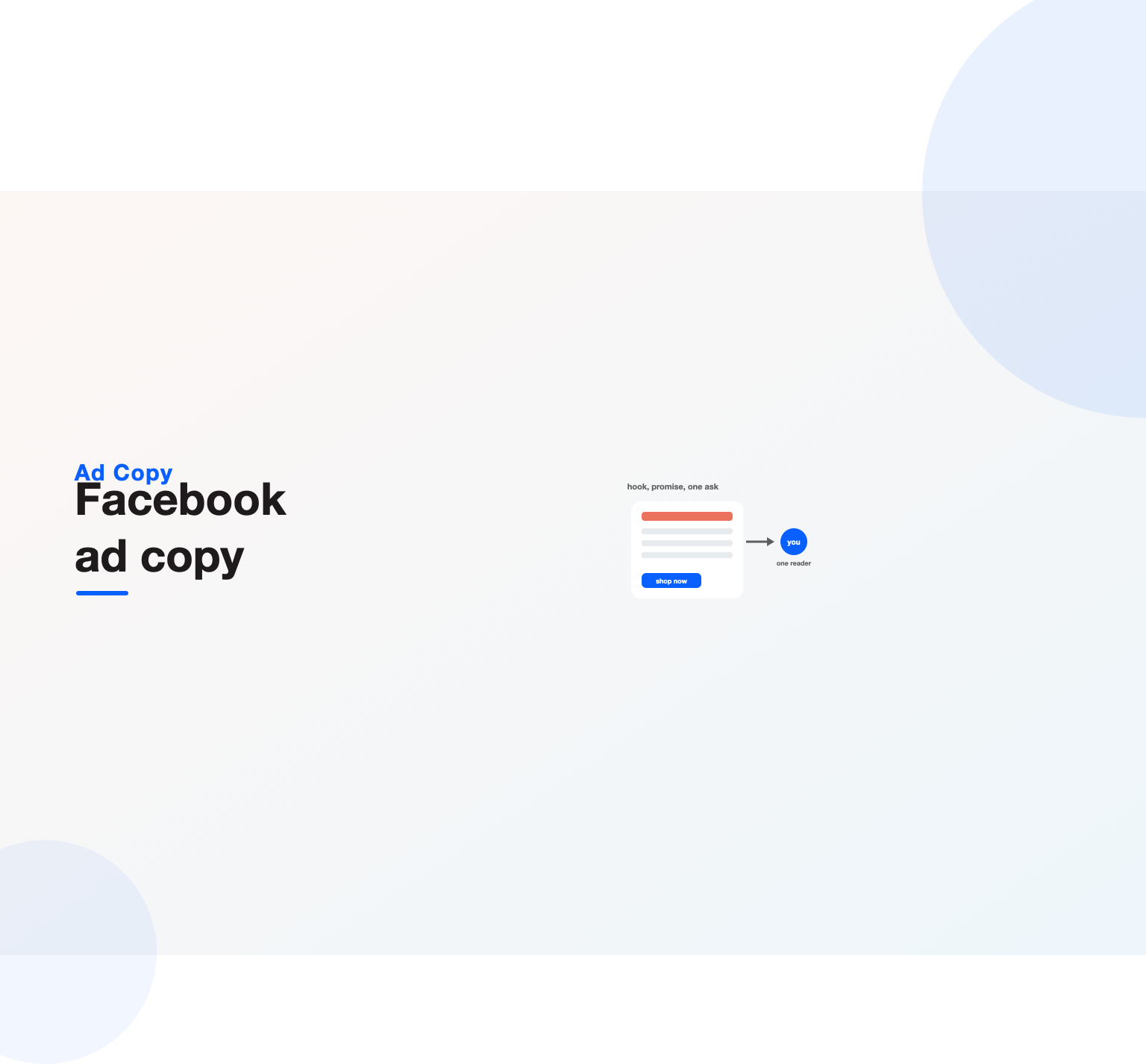
Facebook ad copy is the written text of a Meta ad, the primary text, headline, and description, and its job is to make the right person stop, feel understood, and act. Strong facebook ad copy does not sound like advertising; it speaks to a specific person about a specific problem or desire, leads with a hook that earns the next line, and makes one clear promise backed by a reason to believe it. Because most people decide in a second whether an ad is for them, the opening words carry disproportionate weight, and copy that opens with a sharp, relevant hook beats copy that warms up slowly. Good copy also works with the creative rather than repeating it, matches the awareness level of the audience, and drives toward a single obvious action. On a platform where automation now handles targeting, the words you write are one of the few levers fully in your control, which makes facebook ad copy a genuine performance lever rather than decoration. This guide covers what makes copy convert: hooks, structure, voice, matching message to awareness, proven frameworks, and how to test copy so the winners are found by evidence rather than opinion.
Key Highlights
- Strong facebook ad copy speaks to one specific person about one specific problem, and never sounds like generic advertising.
- The hook, the first line, carries most of the weight, because people decide in a second whether to keep reading.
- Copy should make one clear promise with a reason to believe it, and drive toward a single obvious action.
- Matching the message to the audience’s awareness level, cold versus warm, changes what the copy needs to say.
- Copy and creative work together, so the words should complement the visual rather than repeat it.
- Testing genuinely different angles, not tiny wording tweaks, is how winning copy is found.
Write to one person, not an audience
The first principle of effective facebook ad copy is to write as if speaking to one specific person, because copy aimed at everyone connects with no one. When you picture a single real person, their situation, their frustration, the words they would use, the writing gets sharper and more human, and it reaches the reader as a message meant for them rather than a broadcast. Generic copy that tries to appeal to a broad audience ends up bland, while copy grounded in one person’s reality feels personal even when millions see it, which is the paradox good direct-response writing has always exploited.
Knowing that person well is what makes this possible, so the research behind the copy matters as much as the writing. Understanding the reader’s actual problems, the language they use, the objections they carry, and the outcome they want lets you write copy that mirrors their thinking back to them, and that recognition is what earns attention. The best copy often uses the customer’s own words, drawn from reviews, support conversations, and sales calls, because nothing resonates like hearing your own thoughts said clearly. Writing to one well-understood person is the foundation everything else builds on, and it is a discipline that separates copy that converts from copy that merely fills the space, the kind of thinking that also powers strong facebook ad creative.
The hook is almost everything
In a fast-scrolling feed, the opening line of facebook ad copy does most of the work, because a reader decides in a heartbeat whether to stop, and no amount of brilliant copy below rescues a weak first line nobody reads. The hook has to be relevant to the right person and compelling enough to earn the next sentence, whether it names a problem sharply, makes a surprising claim, poses a question the reader wants answered, or promises something they want. A hook that speaks directly to the reader’s situation stops the right scroll, while a vague or self-centered opening lets them slide past.
Because the hook matters so much, it deserves the most attention and the most testing, and treating the first line as an afterthought wastes the whole ad. Different hooks pull in different people, so the same offer can succeed or fail entirely on how it opens, which is why experienced writers generate many hooks for one piece and let testing decide. Leading with the reader and their problem, rather than with the product or the brand, is the single most reliable way to strengthen a hook, since people care about themselves before they care about you. Getting the opening right is the highest-leverage move in ad copy, and it rewards the effort of writing far more first lines than you keep.
Make one promise and one ask
Cluttered facebook ad copy that makes many claims and asks for several things at once converts worse than copy built around a single clear promise and a single action. When an ad tries to say everything, it dilutes the one message that would have landed, and when it asks the reader to do several things, it makes the easy choice, doing nothing, more likely. Focusing the copy on one compelling promise, the main reason this person should care, and one obvious next step gives the reader a clean, simple decision instead of a confusing menu.
The promise carries more weight when it comes with a reason to believe it, because a claim without support reads as empty. Pairing the core promise with proof, a specific result, a number, social proof, a guarantee, turns an assertion into something credible, and specificity almost always beats vague superlatives. A single believable promise backed by evidence, ending in one clear call to action, is a simple structure that consistently outperforms cluttered copy, and it holds across objectives, whether the goal is a sale or a lead. This clarity of promise and ask is the same discipline that makes lead generation copy actually qualify the people it attracts rather than just maximizing clicks.
Match the message to awareness
A crucial and often missed factor in copy is the reader’s awareness level, because someone who has never heard of your solution needs very different words than someone already comparing options. A cold audience, unaware of the product or even the problem, needs copy that starts with their situation and builds interest before any pitch, since leading with product details to people who do not yet care falls flat. A warmer audience that already knows the problem, or your brand, can handle a more direct offer, because the groundwork is done.
Getting this wrong is a common reason good copy underperforms, since the words can be well written yet aimed at the wrong stage of awareness. Pitching hard to a cold audience feels premature, while copy that over-explains to a warm audience wastes their readiness to act, and both leave results on the table. Matching the message to where the reader actually is, meeting cold audiences with problem-first copy and warm ones with a clearer offer, is what makes copy land, and it is why the same account often needs different copy for prospecting and retargeting. This awareness-matching is central to effective facebook retargeting, where the reader already knows you and the copy can speak to that.
Sound human, not like an ad
People scroll their feed to connect and be entertained, so facebook ad copy that reads like a human wrote it outperforms copy that sounds like corporate advertising. A conversational, natural voice, the way you would explain something to a friend, tends to connect, while stiff, jargon-heavy, or hype-filled writing signals an ad and invites the reader to scroll past. Talking the way real people do, with clear words and a genuine voice, is not a stylistic nicety but a performance factor, because it earns the attention that formal copy loses.
Authenticity extends to honesty, since overhyped claims and empty superlatives increasingly repel readers who have learned to distrust them. Copy that is specific, honest, and human, that makes a real promise in a real voice, builds the trust that persuasion depends on, while exaggeration undermines it. Cutting the hype, the buzzwords, and the throat-clearing, and writing plainly and truthfully to a real person, is what makes facebook ad copy feel like a message worth reading rather than an ad worth avoiding. This human voice is a lever anyone can pull, and it costs nothing but the discipline to write simply, which is why it belongs at the center of how copy is written across every format, including facebook video ads where the script is copy too.
Use proven frameworks as scaffolding
Writers do not have to invent structure from scratch, because proven copywriting frameworks give facebook ad copy a reliable shape that guides the reader from attention to action. Time-tested structures, problem then agitation then solution, or attention then interest then desire then action, work because they follow how persuasion naturally unfolds: catch attention, deepen the reader’s engagement with the problem or desire, then present the solution and the next step. Using a framework keeps copy focused and complete, ensuring it does the persuasive work rather than wandering.
Frameworks are scaffolding, not a cage, so the goal is to use them to structure genuine, specific writing rather than to fill in a template mechanically. Structure that carries a real voice about a real problem about a real problem gets the benefit of proven persuasion without sounding formulaic, while copy that treats a framework as fill-in-the-blanks reads as generic. Learning a few reliable structures and using them to organize honest, reader-focused copy is how experienced writers stay both effective and fast. The framework provides the bones; the research and voice provide the life, and both together are what disciplined Meta Ads management brings to the words as much as to the targeting.
Copy and creative are one message
Facebook ad copy never works in isolation, because the reader experiences the words and the visual together as a single message, so the two must reinforce rather than repeat each other. When the copy and the creative tell a coherent story, the image or video catching attention and the words carrying the meaning, the ad lands with more force than either could alone. When they clash or simply duplicate each other, the ad wastes the chance to say more, since copy that just describes the image adds nothing the reader did not already see.
Thinking of copy and creative as partners changes how you write, because the words can do what the visual cannot: add context, make the promise explicit, handle an objection, or deliver the call to action. The strongest ads use the visual to stop the scroll and the copy to convert the attention it captured, each doing its part of a shared job. Writing copy that complements the creative, rather than restating it, is a mark of ads made with real craft, and it is why the words and the visuals should be planned together rather than in separate silos. This partnership is at the heart of how strong facebook ad creative and its copy are built as one.
Test angles, not just words
The reliable way to improve facebook ad copy is to test it, but the tests that matter compare genuinely different angles, not trivial wording tweaks that rarely move anything. Swapping a word or changing punctuation seldom changes results meaningfully, while testing a different hook, a different core promise, or a different emotional angle can transform performance. Framing tests around real strategic differences, does the problem-led angle beat the outcome-led one, does social proof beat a guarantee, produces learning that compounds, whereas fiddling with small edits mostly wastes traffic.
Reading tests honestly is the other half, since the goal is to learn what resonates, not to confirm a favorite line. Letting a test gather enough data before judging it, and paying attention to which angle won and why, builds a growing understanding of what moves this specific audience, which makes every future piece of copy stronger. The writers who improve fastest are the ones who test boldly and read results without ego, treating copy as a hypothesis to be validated rather than an opinion to defend. Testing real angles and learning from them turns facebook ad copy from guesswork into a discipline that gets sharper over time, and it feeds directly into the broader work of facebook ads optimization.
Headline and description do specific jobs
Beyond the primary text, the ad copy includes the headline and description, and each has a distinct job that rewards deliberate writing rather than an afterthought. The headline, which sits near the call-to-action button, is prime space for the core promise or the single most compelling reason to act, so wasting it on a brand name or a generic phrase throws away one of the ad’s most visible lines. A headline that restates the main benefit or sharpens the offer gives the reader a final reason to click at the moment of decision.
The description supports the headline with a secondary detail, a proof point, a qualifier, or a nudge, that reinforces the case without repeating it. Because these shorter fields are read at the point of action, precision matters more than cleverness, and every word should earn its place. Crafting the headline and description with the same care as the primary text, each doing a specific job in the reader’s decision, is a mark of copy made with craft, and it is the kind of detail that lifts results across a whole account. Treating every field of the ad as deliberate copy, rather than filler around the main text, is a simple edge that many advertisers leave unused.
Where copywriting sits with the automation
On modern Meta, the automation handles much of the targeting and delivery, which makes the words one of the few levers still fully in the advertiser’s hands, and that raises the value of good copy rather than lowering it. Because the system decides who sees an ad, the job of the copy is to convert the attention the automation delivers, turning a well-targeted impression into a click and a customer. The better the copy, the more the automation has to work with, since strong ads earn the engagement and conversions that teach the system who to reach next.
This relationship makes copywriting and creative the real creative fuel of the account, the inputs that most determine performance now that manual targeting matters less. An advertiser who invests in better copy is improving one of the highest-leverage inputs available, and doing so compounds with every other strength in the account. Understanding that the words are not decoration but a core performance input, working hand in hand with the automation, is what reframes copywriting as a serious discipline rather than a finishing touch, and it is central to how thoughtful facebook ads optimization treats creative as the main driver.
A simple process for writing an ad
Turning these principles into practice benefits from a repeatable process, because good copy comes more reliably from a method than from waiting for inspiration. Start with research: gather the reader’s own words from reviews, support tickets, and sales conversations, and clarify the one person you are writing to and the single promise you can make them. That groundwork does most of the heavy lifting, since copy grounded in real language and a clear promise almost writes itself compared with copy invented from a blank page.
From there, write several very different hooks, choose a framework to structure the body, make the one promise with a reason to believe it, and end with a single clear ask, then cut anything that does not move the reader forward. Draft more options than you need, especially for the hook, and let testing rather than opinion pick the winners, feeding what you learn back into the next round. Following a process like this, research, then hooks, then a structured single-promise body, then testing, makes writing faster and results more consistent, and it is exactly the disciplined approach that professional Meta Ads management brings to the copy behind every campaign.
Common ad copy mistakes
Most weak facebook ad copy fails for a few recurring reasons, and recognizing them makes copy easy to strengthen. Leading with the product or brand instead of the reader tops the list, since people care about their own problems first, and an opening about you rather than them loses the scroll. A weak or missing hook is close behind, because copy that opens slowly never earns the read. Cluttered messaging that makes many claims and asks for several actions dilutes the one point that would have landed and paralyzes the decision.
The remaining mistakes are about voice and evidence. Writing that sounds like corporate advertising, stuffed with jargon and hype, signals an ad and invites the scroll, while claims made without any reason to believe them read as empty. Ignoring the reader’s awareness level, pitching hard to people who do not yet care, and writing copy that merely repeats the creative round out the list. Fixing these, by leading with the reader, opening with a strong hook, making one believable promise and one ask, writing in a human voice, and matching the message to awareness, addresses nearly every common failure, which is why the fundamentals matter far more than any clever trick. Getting them right is what separates copy that performs from copy that fills the space, whatever the offer or industry.
Adapt the copy to the objective
The same principles apply across campaigns, but the emphasis in the copy shifts with what the ad is trying to achieve, so a thoughtful writer adjusts the angle to the objective rather than reusing one message everywhere. For a direct sale, the words lean on the offer, the proof, and the reason to buy now, making the value and the next step unmistakable. For a lead, the copy has to attract the right person and gently qualify them, since attracting anyone with a too-broad promise fills the pipeline with people who never convert, which is why the words matter as much downstream as up front.
Context changes the copy as much as the goal does. An ecommerce ad selling a product from a catalog can be short and offer-led, the kind of message that drives efficient facebook ads for ecommerce, while a considered B2B or high-value purchase often needs copy that builds more of a case. Judging performance also depends on reading the right numbers for the objective, which ties the words back to disciplined facebook ads reporting so you know which angle actually worked. Adapting the message to the goal and the context, rather than writing one generic version, is what makes copy pull its weight across a varied account, including well-run Meta ads for D2C brands.
Key Takeaways
- Write facebook ad copy to one specific, well-understood person, using their own language, not to a broad audience.
- Put the most effort into the hook, since the first line decides whether anyone reads the rest.
- Make one clear promise backed by a reason to believe it, and drive toward a single obvious action.
- Match the message to the reader’s awareness level, problem-first for cold audiences, offer-forward for warm ones.
- Write in a human, honest voice and let the copy complement the creative rather than repeat it.
- Test genuinely different angles, not tiny word changes, and read the results without ego.
Frequently asked questions
What makes Facebook ad copy convert?
Ad copy converts when it speaks to one specific person about a problem or desire they actually have, opens with a hook that earns attention, makes one clear promise backed by a reason to believe it, and drives toward a single obvious action. It should sound human rather than like corporate advertising, use the reader’s own language, and match their awareness level, problem-first for cold audiences and offer-forward for warm ones. The words also need to work with the creative rather than repeat it. No single trick converts; it is the combination of reader focus, a strong hook, a believable promise, and a clear ask that does the work. In practice, the most reliable way to improve an ad is to nail the hook and the single promise first, since those two decisions account for most of the difference between an ad that performs and one that gets scrolled past, and everything else supports them. Pairing that written clarity with a scroll-stopping visual, the domain of strong facebook ad creative, is what turns attention into action.
How long should Facebook ad copy be?
There is no fixed ideal length, because the right length is whatever holds attention and makes the case without padding. Short copy works when the offer is simple and the hook does the job, while longer copy earns its length when there is a real story to tell, objections to handle, or a complex value to explain, provided every line keeps the reader moving. The mistake is not being long or short but being boring or unclear, so write as much as the message genuinely needs and cut anything that does not pull its weight. Test both when unsure, since different audiences and offers reward different lengths. A useful habit is to write the copy at whatever length says the whole thing well, then edit it down hard, because the discipline of cutting usually produces a tighter, stronger ad than trying to hit an arbitrary word count. Let the message, not a rule, decide how long the copy runs.
How is ad copy different from ad creative?
Ad copy is the written text of the ad, the primary text, headline, and description, while ad creative is the visual, the image or video. They are distinct crafts that work as one message: the creative typically stops the scroll and the copy converts the attention it captures, adding context, making the promise explicit, and delivering the call to action. The best ads plan the two together so they reinforce rather than repeat each other. Treating copy and creative as one coherent message, each doing what the other cannot, is what makes an ad land with more force than either element alone. The same logic extends to video, where the script is copy and the footage is creative, which is why strong facebook video ads are written and shot as one idea rather than assembled from parts.
Should I use the same copy for cold and warm audiences?
No, because a cold audience and a warm one are at different awareness levels and need different messages. Cold audiences, who may not know your product or even recognize the problem, need copy that starts with their situation and builds interest before any hard pitch, while warm audiences who already know the problem or your brand can handle a more direct offer. Using the same copy for both usually means it is either too aggressive for the cold audience or too soft for the warm one. Separate copy matched to each stage, especially for prospecting versus retargeting, consistently performs better. In practice this means keeping a problem-first set of ads for cold prospecting and a more direct, offer-led set for warm audiences, an approach that pairs naturally with disciplined facebook retargeting where the reader already knows who you are.
How do I test Facebook ad copy?
Test genuinely different angles rather than trivial word changes, since swapping a word rarely moves results while a different hook, promise, or emotional angle can transform them. Frame each test around a real strategic question, does the problem-led angle beat the outcome-led one, does social proof beat a guarantee, and let it gather enough data before judging. Read the results honestly to learn what resonates with this specific audience, then feed that learning into the next round of copy. Testing this way turns copywriting into a discipline that compounds, because each test makes the next piece of copy stronger. Over time, the record of which angles won builds a real understanding of the audience, and that understanding is what lets you write better facebook ad copy faster, so the testing feeds a virtuous loop rather than starting from scratch each time. Feeding those learnings into budget and creative decisions is part of steady facebook ads optimization.
Ready to put this into practice?
Talk to the team that runs SEO, AI search and paid growth programs every day.
Book a Strategy Call →