 Skip to content

Facebook Ads for Lead Generation: Quality Over Cheap
Facebook ads for lead generation can flood you with cheap leads or deliver quality ones. Learn instant forms, qualifying questions, offers, fast follow-up and measuring to the customer.
Quick Answer
Facebook lead ads are ad formats built to capture leads directly on Meta, letting someone submit their details, name, email, phone, through an instant form that opens inside Facebook or Instagram without ever visiting your website. Because the form pre-fills with the information Meta already has and the person never leaves the app, facebook lead ads remove almost all the friction of a traditional landing-page form, which usually means more leads at a lower cost per lead. The trade-off is that easier submission can mean lower-intent leads, so the real skill in lead generation on Meta is not just collecting leads cheaply but collecting quality leads that actually convert into customers, which comes from good targeting, a clear offer, qualifying questions where useful, and fast follow-up. You can also generate leads by sending traffic to a landing page instead of using instant forms, and the right choice depends on your goal and follow-up. This guide explains how facebook lead ads work, how to get quality leads rather than just cheap ones, how to follow up and measure them, and how to turn them into paying customers.
Key Highlights
- Facebook lead ads capture leads through an instant form inside the app, so people never leave Facebook or Instagram to submit.
- Pre-filled forms and no landing page remove friction, usually lowering cost per lead versus traditional forms.
- Easier submission can lower lead quality, so the real goal is quality leads that convert, not just cheap ones.
- Targeting, a clear offer, and qualifying questions shape lead quality more than the form itself.
- Fast follow-up is critical, since lead interest fades quickly and speed to contact drives conversion.
- Instant forms and landing-page lead generation each fit different goals, so choose by intent and follow-up.
How Facebook lead ads work
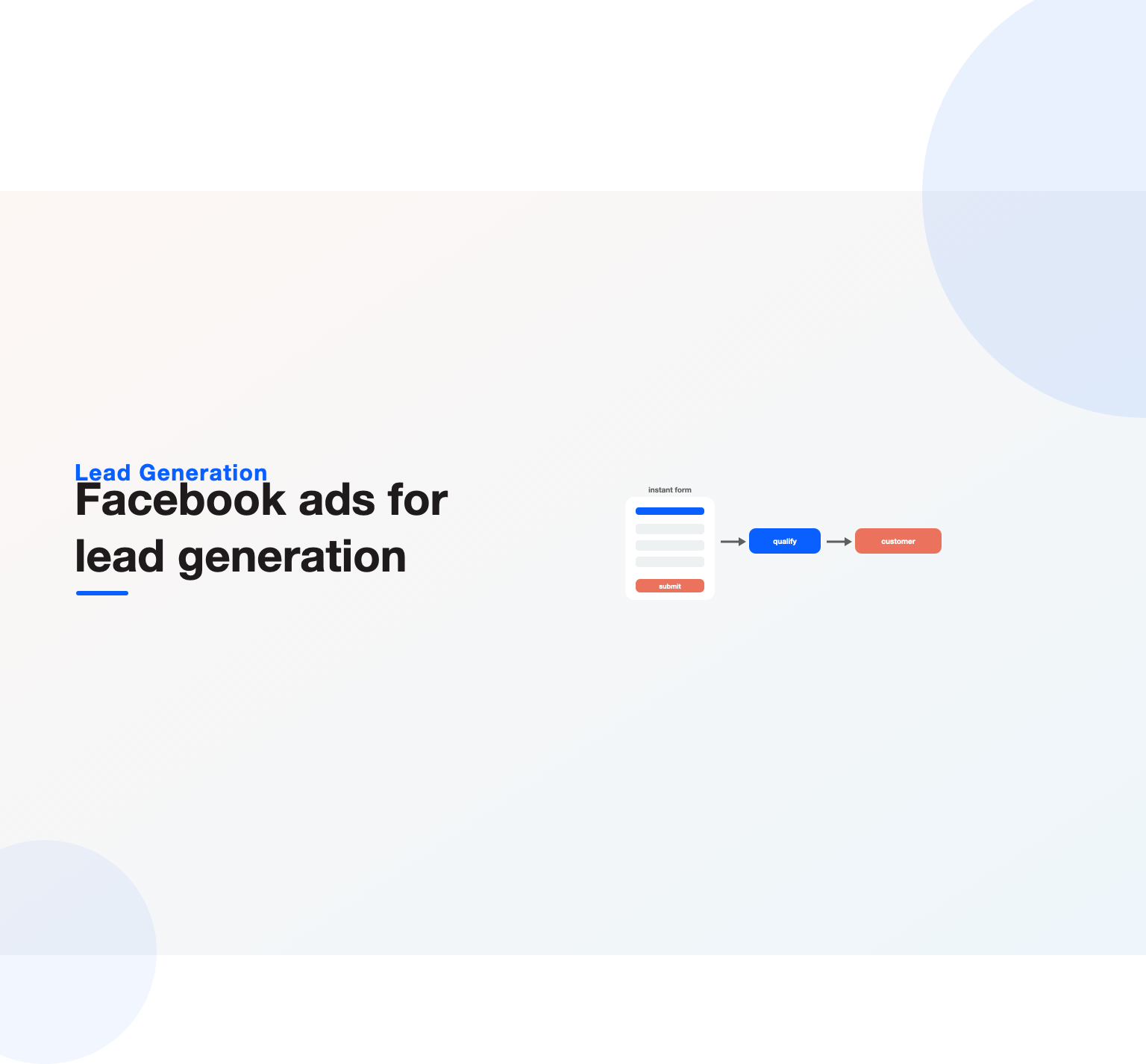
The defining feature of facebook lead ads is the instant form, a form that opens right inside Facebook or Instagram when someone taps your ad, so they can submit their details without ever leaving the app or visiting a website. Because Meta already knows a lot about its users, the form pre-fills fields like name and email, so submitting takes just a couple of taps, which dramatically lowers the friction that causes people to abandon a traditional landing-page form. This low-friction path is why lead ads often generate more leads at a lower cost per lead than sending people to an external form, sometimes dramatically so, which is exactly why they are so popular and also why they need careful handling to stay valuable.
Setting them up involves choosing the lead objective, designing the ad, and building the instant form with the fields and any questions you want, then connecting the leads to wherever you will follow up. The mechanics are straightforward and quick to set up, but the ease of submission is a double-edged sword: it lifts volume but can lower intent, since someone can submit in seconds without much commitment. Understanding that trade-off is the key to using facebook lead ads well, because the goal is not the most leads or the cheapest leads but the most qualified leads, a distinction at the heart of effective Meta Ads management.
Quality over cheap leads
The most important principle in Meta lead generation is that cheap leads are not the goal; quality leads that convert into customers are, and confusing the two is the most common way lead campaigns disappoint. Because instant forms make submitting so easy, facebook lead ads can produce a flood of low-cost leads that look great on a cost-per-lead basis but rarely turn into business, so an advertiser optimizing purely for cheap leads can end up busy chasing prospects who were never serious. The right measure is always cost per qualified lead, or better, cost per customer, not the raw cost per lead, a distinction that separates a lead program that grows a business from one that merely looks busy, and one that matters as much for a high-value real estate inquiry as for a low-ticket sign-up.
Getting quality rather than just volume comes from several levers: targeting the right people, making the offer clear so only genuinely interested people submit, and using qualifying questions to filter out the uncommitted. A campaign tuned for quality may show a higher cost per lead than one optimized for cheap volume, yet deliver far more customers, which is why judging lead generation by downstream conversion rather than upfront cost per lead is essential. This focus on qualified outcomes over vanity volume is what separates lead campaigns that build a business from those that just fill a spreadsheet, and it applies across every vertical, from service businesses like Meta ads for home services to fitness brands running Meta ads for gyms and fitness studios.
Using qualifying questions
One of the most effective ways to improve lead quality with facebook lead ads is to add qualifying questions to the instant form, which introduces a small amount of friction that filters out the uncommitted while capturing information that helps you prioritize. Asking a relevant question, budget, timeline, specific need, requires a moment of thought that casual submitters often will not bother with, so the leads who complete it tend to be more serious, and the answers help you focus follow-up on the best prospects. This deliberate friction trades some volume for meaningfully higher quality, which is almost always a trade worth making for a business that has to spend real time following up on each lead.
The balance is not to over-ask, since every extra question reduces submissions, but to ask the few that genuinely separate serious prospects from idle ones. A single well-chosen qualifying question can dramatically lift the quality of leads without collapsing volume, whereas a long form defeats the low-friction advantage of the format. Tuning the questions to your business, enough to qualify, not so many that you deter good leads, is a core skill in Meta lead generation, and testing different questions reveals the right balance for your case. Used well, qualifying questions turn facebook lead ads from a cheap-lead machine into a qualified-lead engine, which is what actually drives revenue rather than a pile of contacts that never answer.
Targeting and the offer
Lead quality starts before the form, with who you reach and what you offer, so targeting and the offer shape your leads as much as the form itself. Reaching the right audience, through Meta’s targeting and increasingly its automation, means your leads come from people genuinely likely to want what you sell, while a poorly targeted campaign fills your pipeline with people who will never buy no matter how fast or polished the follow-up. The offer matters just as much: a clear, specific offer attracts people interested in that specific thing, while a vague giveaway attracts anyone with a spare thirty seconds.
The offer also sets expectations that carry through to conversion. An offer closely tied to your actual product, a consultation, a quote, a relevant guide, brings in leads with real intent toward buying, whereas an unrelated incentive, a generic prize or freebie, brings in leads interested in the incentive rather than your business. Matching the offer to genuine buying intent is one of the strongest levers on lead quality, since it filters people at the source before you spend a cent following up, and pairing it with sharp targeting and the kind of strong facebook ad creative that stops the right people mid-scroll brings in genuine prospects before the form even loads, and the same instinct guides retail lead capture on Meta ads for D2C brands. This upstream quality control matters across sectors, including considered-purchase ones like Meta ads for SaaS.
Follow-up speed decides conversion
Collecting leads is only half the job; what you do with them determines whether they become customers, and the single biggest factor is speed. Lead interest fades fast, so contacting a lead within minutes rather than hours or days dramatically increases the chance of converting them, because you reach them while their interest is still fresh and before a competitor does. A lead from facebook lead ads that sits unactioned for a day is often a wasted lead, no matter how cheaply it was acquired, which is why fast follow-up is not a nice-to-have but the difference between a lead program that works and one that quietly burns money on contacts nobody ever reaches in time.
Making fast follow-up reliable usually means connecting your leads directly to wherever your team acts on them, your CRM or sales tools, so leads flow through instantly rather than being downloaded manually and contacted late. Automating that connection, and having a clear process to contact new leads immediately, is what turns cheap leads into customers, and it is often where lead programs fall down, not in the ad but in the gap between capturing a lead and reaching them. Building fast, reliable follow-up is as important as the campaign itself, and it is a core part of running cost-efficient lead generation, whatever the vertical, including Meta ads for real estate where speed to a new inquiry is everything.
Instant forms versus landing pages
You can generate leads on Meta in two main ways, through instant forms with facebook lead ads or by sending traffic to a landing page on your site, and the right choice depends on your goal and follow-up. The instant-form path maximizes volume and minimizes cost per lead by removing friction, which suits businesses that can qualify and convert leads through follow-up and want maximum reach. Landing pages add friction by asking people to leave the app and load a page, which lowers volume and raises cost per lead, but the people who complete a landing-page form have shown more intent, so the leads can be higher quality.
The decision comes down to whether you want maximum volume you will qualify later, or fewer but more committed leads upfront, and how strong your follow-up is. The in-app forms suit high-volume lead generation with good follow-up to sort quality; landing pages suit businesses wanting higher-intent leads or needing the page to inform and sell before capturing the lead. Many advertisers test both to see which delivers more actual customers per dollar, which is the measure that matters. Choosing between the two deliberately, rather than defaulting, is part of designing lead generation that fits your business, a decision experienced management weighs for each account, including Meta ads for D2C brands.
Measuring what actually matters
The metric that matters in Meta lead generation is not cost per lead but cost per qualified lead and, ultimately, cost per customer, because a campaign can look cheap on cost per lead while producing almost no revenue. Tracking leads through to whether they qualify and convert, and feeding that information back, is what lets you judge campaigns honestly and optimize toward the leads that become customers rather than the cheapest submissions. Without that downstream measurement, you are flying blind, optimizing for a number that may have no relationship to business results.
This measurement also lets the automation help you. When you feed conversion data back, whether a lead qualified or became a customer, into Meta, the system can optimize toward higher-quality leads rather than just cheap ones, which is a powerful lever many advertisers never bother to set up and quietly leave on the table. Connecting your CRM outcomes back to the campaigns, so both you and the automation learn which leads are worth the most, is what turns lead generation from a volume game into a revenue engine, the same measurement discipline that keeps any Meta account honest and connects directly to sound automation and conversion tracking. Those who measure to the customer, not the lead, run far better lead programs than those who stop at cost per lead.
Connecting leads to your CRM
A lead sitting in Meta is not much use until it reaches the people who will act on it, so connecting your instant forms to your CRM or sales tools is a practical necessity rather than a technical nicety. When leads flow automatically into the system your team already works in, they can be contacted immediately and tracked through to conversion, whereas leads that have to be downloaded and imported by hand are contacted late and often lost. Setting up that automatic connection is one of the highest-leverage, least glamorous steps in a lead program, and skipping it quietly undermines everything upstream of it.
The connection also enables the measurement that makes optimization possible. Once leads flow into your CRM and their outcomes, qualified, converted, or not, are recorded, you can tie those outcomes back to the campaigns that produced them and even feed them to Meta so the automation optimizes for quality. This closed loop, ad to lead to CRM to outcome and back, is what separates a mature lead program from a pile of unactioned contacts, and building it is central to running lead generation that produces revenue rather than just submissions, whatever the vertical, including Meta ads for ecommerce brands that capture leads for higher-value products.
Nurturing leads that are not ready yet
Not every lead is ready to buy the moment they submit, and treating those who are not as failures wastes much of what a lead program captures. Some people submit out of genuine but early interest, and reaching them with a helpful follow-up sequence, useful information, a gentle reminder, an answer to their likely questions, keeps you present until they are ready to act rather than writing them off after one unanswered call. A lead that does not convert this week may convert next month if the relationship is kept warm rather than dropped.
This is where lead generation connects to the wider funnel, because the same warm relationships can be re-engaged through retargeting and email, turning a single submission into an ongoing conversation. Coordinating fast first contact for the ready buyers with patient nurturing for the not-yet-ready, and supporting both with retargeting, is what extracts the full value from every lead you pay to capture. Businesses that nurture rather than discard their slower leads get more customers from the same spend, an approach that pays off across sectors, including considered-purchase ones like Meta ads for coaches and course creators.
Optimizing for the right conversion event
A subtle but powerful lever is choosing what you ask Meta to optimize for, because the system will chase whatever conversion event you set. Optimizing for lead form submissions tells the automation to find people likely to submit, which maximizes volume but can attract the low-intent submitters who make a form easy to fill and hard to convert. Optimizing instead for a deeper event, a qualified lead or an actual sale where you can track it, tells the system to find people likely to become customers, which usually raises cost per lead but lowers cost per customer, the number that actually matters.
The catch is that deeper events happen less often, so the automation needs enough of them to learn, which is why feeding qualified-lead and customer data back into Meta is so valuable, it gives the system the signal to optimize for quality rather than raw submissions. Those who move their optimization down the funnel as their data allows, from form fills toward qualified leads and sales, steadily improve the quality of what their campaigns deliver, aligning the automation with revenue rather than vanity volume, which is the same principle that a clear view of facebook ads cost brings to the whole account, in lead generation as much as any other objective.
Common lead generation mistakes
Several recurring errors keep advertisers from getting real value from facebook lead ads. The most damaging is optimizing for the cheapest leads instead of quality, filling a pipeline with low-intent submissions that never convert while congratulating yourself on a low cost per lead. Close behind is slow or nonexistent follow-up, letting hard-won leads go cold in the gap between capture and contact, which wastes the whole effort. Skipping qualifying questions where they would help, and running a vague offer that attracts anyone rather than genuine prospects, both flood the pipeline with poor leads.
Other common mistakes include never measuring beyond cost per lead to whether leads actually convert, failing to feed conversion data back so the automation can optimize for quality, and choosing instant forms or landing pages by habit rather than by what delivers customers. The thread through these errors is treating lead generation as a volume game rather than a quality-and-conversion one. Those who optimize for qualified leads, follow up fast, use qualifying questions and a targeted offer, and measure to the customer get lead programs that build a business, while those chasing cheap leads fill spreadsheets with contacts that never buy, a difference a careful account review reliably reveals.
When to get help with lead generation
Running facebook lead ads is achievable for a capable marketer, and for a smaller business, setting up instant forms with a qualifying question, a targeted offer and fast follow-up is a realistic, high-return project. The core ideas, optimize for quality rather than cheap leads, qualify at the form, follow up immediately, and measure to the customer, are more about disciplined thinking than technical difficulty, and doing it yourself keeps you close to which leads actually convert.
Expert help pays off as lead volume and complexity grow, when connecting leads to a CRM, feeding conversion data back for optimization, and testing forms against landing pages become substantial work, or when scaling quality lead generation across audiences and offers requires careful management. An experienced practitioner builds the qualification, follow-up and measurement that turn cheap leads into customers, and optimizes toward qualified outcomes rather than vanity volume, so folding lead generation into ongoing Meta Ads services, whether for a store or a professional practice like Meta ads for lawyers, often produces far more customers per dollar than a volume-focused setup. Whichever route you take, the essentials of facebook lead ads stay the same: chase quality not cheap leads, qualify at the form, target a clear offer, follow up fast, and measure to the customer.
The single mindset shift that most improves Meta lead generation is to stop counting leads and start counting customers. A lead is a promise, not a result, and the whole apparatus, the targeting, the offer, the qualifying question, the fast follow-up, the CRM connection, the nurturing, exists to convert that promise into revenue. The advertisers who keep their eyes on cost per customer make every one of those decisions better, choosing the offer that attracts buyers, the question that filters, the follow-up that closes, while those fixated on cost per lead optimize a number that can move in exactly the wrong direction. Cheap leads are easy; profitable customers are the point, and building the whole program around that truth is what turns lead ads from a vanity channel into a genuine engine of growth for a business.
Key Takeaways
- Facebook lead ads capture leads through a low-friction instant form inside the app itself, usually lowering cost per lead.
- The goal is quality leads that convert, not the cheapest leads, so optimize toward qualified outcomes.
- Use qualifying questions and a clear, relevant offer to filter for genuine prospects at the source.
- Follow up within minutes, since lead interest fades fast and speed to contact drives conversion.
- Choose instant forms or landing pages by which delivers more customers per dollar, not by habit.
- Measure cost per customer, not cost per lead, and feed conversion data back so the automation optimizes for quality.
Frequently asked questions
What are Facebook lead ads?
Facebook lead ads are ad formats built to capture leads directly on Meta through an instant form that opens inside Facebook or Instagram when someone taps the ad, so they can submit their details, name, email, phone, without ever visiting your website. Because Meta pre-fills the form with information it already has and the person never leaves the app, lead ads remove almost all the friction of a traditional landing-page form, which usually means more leads at a lower cost per lead. The trade-off is that easier submission can produce lower-intent leads, so the real skill is capturing quality leads that convert into customers, through good targeting, a clear offer, qualifying questions, and fast follow-up, rather than just collecting cheap leads.
Are Facebook lead ads worth it?
For many businesses, yes, provided you focus on quality and follow-up rather than just cheap volume. Lead ads can generate leads at a low cost per lead because the instant form removes friction, but that same ease can attract low-intent submissions, so the value depends on qualifying leads and converting them. Businesses that use qualifying questions, a targeted offer, and fast, reliable follow-up, and that measure cost per customer rather than cost per lead, often find lead ads highly effective. Those that optimize purely for the cheapest leads and follow up slowly usually find them disappointing. The format is worth it when treated as a quality-and-conversion channel, not a volume game.
How do I get better quality leads from Facebook?
Improve quality at several points. Target the right audience so your leads come from people genuinely likely to buy, and use a clear, specific offer tied to your actual product rather than a generic incentive that attracts anyone. Add one or two qualifying questions to the instant form, which introduces just enough friction to filter out casual submitters while capturing information to prioritize follow-up. Then follow up fast, within minutes, since interest fades quickly. Finally, measure cost per qualified lead and cost per customer rather than cost per lead, and feed conversion outcomes back to Meta so the automation optimizes toward quality. Together these lift lead quality far more than the form alone.
Should I use instant forms or a landing page?
It depends on your goal and follow-up. Instant in-app forms maximize volume and minimize cost per lead by keeping people in the app with a pre-filled form, which suits businesses that want maximum reach and can qualify and convert leads through strong follow-up. Landing pages add friction by asking people to leave the app and load a page, which lowers volume and raises cost per lead, but the people who complete a landing-page form have shown more intent, so leads can be higher quality, and the page can inform, reassure and sell before asking for anything. Many advertisers test both and compare actual customers per dollar, which is the measure that matters in the end, rather than choosing by habit or convenience.
Why do my Facebook leads not convert?
Usually one of a few reasons. If you optimized for the cheapest leads, the instant form’s low friction may have produced many low-intent submissions that were never serious, so the leads were poor from the start. Slow follow-up is another common cause, since lead interest fades fast and a lead contacted a day later is often already gone. A vague offer that attracts anyone, weak targeting, or no qualifying questions all flood the pipeline with people who will not buy. The fixes are to optimize for qualified leads, use a targeted offer and qualifying questions, follow up within minutes, and measure to the customer so you can tell good campaigns from cheap-but-useless ones.
How fast should I follow up with Facebook leads?
As fast as possible, ideally within minutes. Lead interest fades quickly, and contacting someone while their interest is still fresh, and before a competitor reaches them, dramatically increases the chance of converting them, whereas a lead left for hours or days often goes cold and becomes a wasted acquisition. The practical way to achieve this is to connect your leads directly to your CRM or sales tools so they flow through instantly, and to have a process, automated or staffed, to contact new leads immediately rather than downloading and calling them later. Fast, reliable follow-up is one of the very biggest factors in whether a lead program produces customers, and it is often exactly where programs fall down.
Ready to put this into practice?
Talk to the team that runs SEO, AI search and paid growth programs every day.
Book a Strategy Call →