 Skip to content

Programmatic SEO: How to Scale Pages Without Thin Content
Programmatic SEO generates thousands of targeted pages from data and a template. How to find patterns, build the data layer, avoid thin-content penalties, and rank at scale, with real examples.
Quick Answer
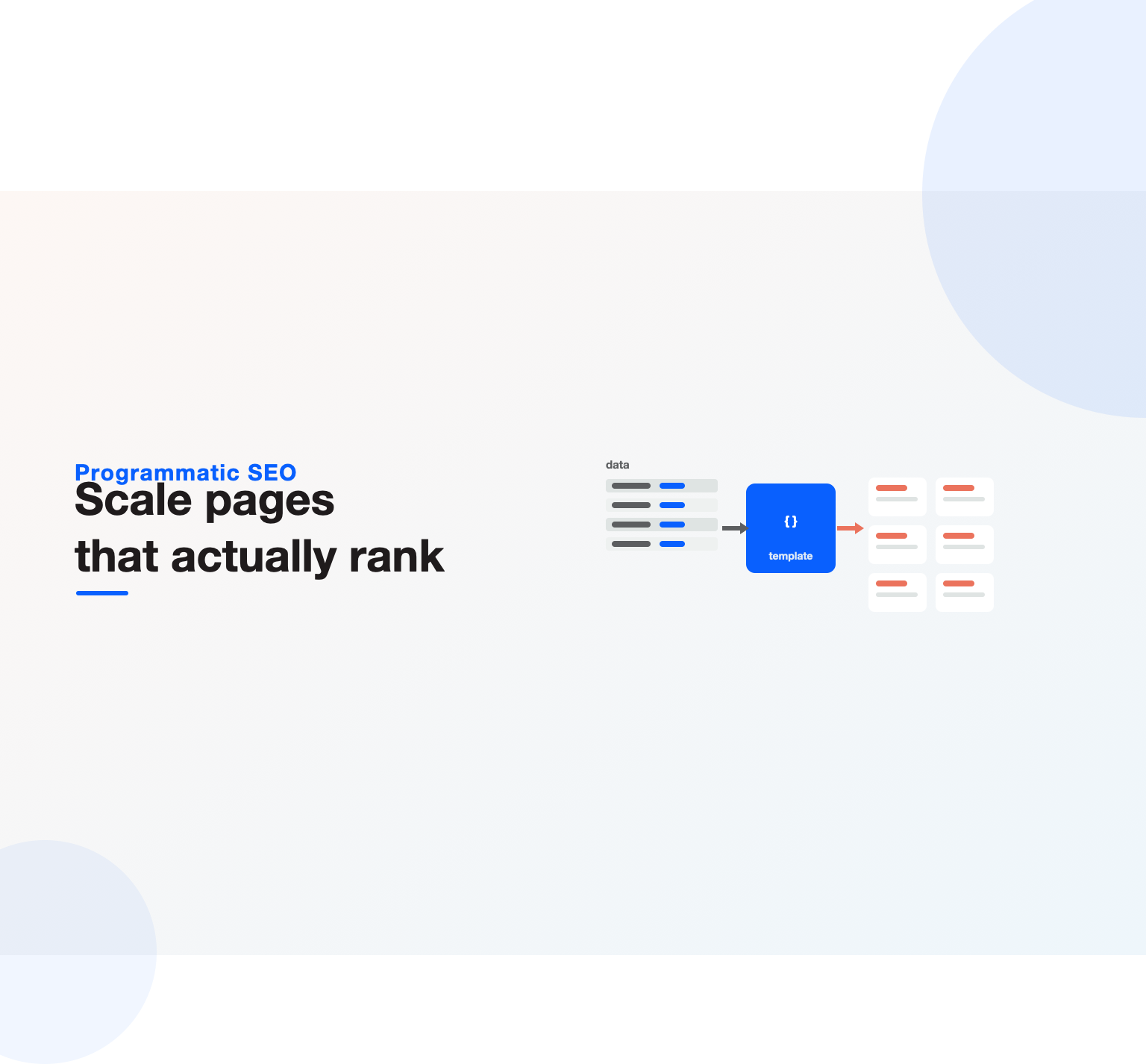
Programmatic SEO is the practice of generating large numbers of targeted landing pages from a structured data set and a page template, so a site can rank for thousands of similar, long-tail queries that would be impossible to target by hand. Instead of writing one page at a time, you find a repeatable search pattern, “[city] apartments,” “[tool] vs [tool],” “[job] salary in [state],” pair it with a reliable data source, and build a template that turns each data row into a genuinely useful page. Done right, it scales organic reach enormously; done carelessly, it produces thin, duplicative pages that search engines ignore or penalize, so the whole discipline turns on data quality and real page value, not on volume for its own sake.
Key Highlights
- Programmatic SEO scales by pairing a repeatable query pattern with a structured data set and one template, turning rows of data into thousands of targeted pages.
- It only works when each generated page is genuinely useful and unique enough to deserve indexing; thin, near-identical pages are the fast route to being ignored or penalized.
- The opportunity lives in long-tail queries with a clear pattern and real demand, the searches too numerous and specific to target with hand-written content.
- Data quality is the whole game: the pages are only as good, accurate, and distinctive as the data set behind them.
- At scale, technical execution, crawl budget, internal linking, indexing control, decides whether the pages get discovered and kept in the index at all.
What programmatic SEO is, and what it is not
Programmatic SEO is the systematic creation of many landing pages from a template and a database, each page targeting one variation of a repeatable query. The classic shape is a head term plus a variable modifier: “things to do in [city],” “[software] alternatives,” “[breed] puppies for sale.” Each combination is a real search with real intent, and there are far too many of them to write individually, so you build one excellent template and let the data populate it across every valid combination.
What it is not is mass-producing spun or empty pages to flood the index. That distinction matters because it is the line between a durable asset and a liability. A programmatic page still has to satisfy the searcher: a “salary for [job] in [city]” page needs accurate, specific salary data, useful context, and a reason to exist beyond the keyword. The technique is neutral; the outcome depends entirely on whether each page earns its place. The same generation engine can produce a genuinely useful reference that ranks for years or a warehouse of filler that one algorithm update wipes out, and the only variable that decides which is whether real, distinctive data stands behind every page. Treating programmatic SEO as a content-quality problem solved at scale, rather than a volume play, is what separates the sites that win from the ones that get filtered out. In that sense it is an extension of ordinary SEO fundamentals, applied through templates and data instead of one page at a time.
How programmatic SEO works: data, template, pages
Every programmatic SEO project has three parts. First is the keyword pattern, the repeatable query structure you are targeting, which defines the shape of every page. Second is the data set, the structured source, a spreadsheet, database, API, or scraped-and-cleaned collection, that supplies the unique substance for each page. Third is the template, the page design that takes one row of data and renders it into a complete, useful page with dynamic title, headings, body content, and internal links. Multiply the template across the data set and you have your pages.
The craft is in how those three fit together. The pattern must map to genuine demand, the data must be rich enough that each page is meaningfully different and actually helpful, and the template must present it so it reads like a page someone deliberately made, not a mail-merge. A good programmatic page blends the data-driven core with supporting elements, context, related links, sometimes curated or user-generated content, so it stands on its own. When the data is thin or the template is bare, every page looks like every other, and that sameness is exactly what search engines are built to filter. So the work is less about the generation mechanics, which are straightforward, and more about assembling a data set and template good enough that scale becomes an advantage rather than a red flag.
When programmatic SEO makes sense, and when it does not
This approach fits a specific situation: a large set of similar queries, each with real search demand, that share a structure and can be answered from data you can obtain or build. Travel, real estate, jobs, ecommerce, local services, and software comparisons are natural fits because the queries are numerous, patterned, and data-backed. If people are genuinely searching “[x] in [location]” or “[product] for [use case]” thousands of ways, and you have or can assemble trustworthy data for each, programmatic SEO can open reach that hand-written content never could.
It does not fit when the demand is not really there, when the queries do not share a clean pattern, or when you cannot get data good enough to make each page distinct and useful. Forcing pages for combinations nobody searches produces a mass of zero-traffic URLs that dilute the site and waste crawl budget. Building pages on thin or duplicated data produces the near-identical pages that get filtered. The honest test before starting is whether a human, handed the data for a single page, would consider that page genuinely useful; if the answer is no, no amount of scale will fix it, and the effort is better spent on fewer, richer pages.
Finding programmatic SEO opportunities
Opportunity-finding starts with spotting the repeatable patterns in how your market searches. Look for head terms that take a modifier, location, category, brand, use case, attribute, and then estimate how many real variations exist and whether they carry demand. Keyword tools reveal the head-tail structure; your own site search, competitor URL structures, and marketplaces reveal how buyers actually phrase things. The goal is to find a pattern broad enough to justify the build but specific enough that each page can genuinely satisfy its query, which is the same demand-mapping mindset covered in our keyword research guide, scaled to patterns instead of single terms.
Prioritize patterns by three things at once: the volume of real demand across all variations, how winnable those queries are given your authority, and whether you can source data strong enough to make each page distinctive. A pattern with huge volume but no obtainable data is a dead end, and so is one with perfect data but no searchers. The sweet spot is a pattern where demand is real, competition is beatable because incumbents cover it thinly, and your data gives you an edge, more accurate, more complete, or more current than what already ranks. That combination is where programmatic SEO produces outsized returns rather than a warehouse of ignored pages.
The data layer: your real competitive advantage
Data is where programmatic SEO is won, because the pages inherit the quality, accuracy, and uniqueness of their source. You can build a data set several ways: license or buy it, aggregate public and API sources, generate it from your own product or user data, or compile and clean it manually for a smaller high-value set. Proprietary or hard-to-replicate data is the strongest position, because it makes your pages genuinely better than competitors who all pull from the same public sources, which is why your own first-party data is often the best foundation.
Whatever the source, quality control is non-negotiable. Inaccurate data produces pages that mislead users and destroy trust, incomplete data produces thin pages, and stale data produces pages that quietly become wrong. Build validation, deduplication, and refresh cycles into the pipeline so the data set stays accurate and current as it grows, and enrich it with additional fields that let the template create fuller, more distinctive pages. The stores and marketplaces that dominate their categories with programmatic SEO almost always have a data advantage underneath, and treating the data set as the core asset, not an afterthought, is the difference between pages that rank for years and pages that never index.
The template: designing pages that avoid thin content
The template turns each data row into a page, and its design decides whether those pages read as valuable or as filler. A strong template does more than drop variables into boilerplate: it uses the data to generate a genuinely specific title and headings, presents the core information clearly, and surrounds it with elements that add value, relevant context, comparisons, visualizations, related pages, and where appropriate curated or user-generated content like reviews. The aim is a page that a person searching that exact query would find complete and useful, not one that obviously came from a factory.
The thin-content trap is the failure mode to design against from the start. If stripping out the few variable words leaves two pages that are essentially identical, search engines will treat them as duplicates and index few of them. The defense is to maximize the unique, data-driven substance on each page and minimize repeated boilerplate, so difference comes from real information rather than swapped nouns, which is the same principle behind good on-page optimization applied at scale. Build the template so every page has enough distinct, useful content to stand alone, test it against a range of data rows before generating thousands, and you sidestep the single most common reason programmatic SEO projects fail.
Programmatic SEO examples that work
Concrete examples make the pattern obvious. Zapier generates pages for app-integration combinations, “connect [app A] with [app B],” ranking for a vast long tail of tool-pairing searches backed by its own integration data. Tripadvisor and similar travel platforms generate place-and-category pages from listing and review data, covering endless “things to do in [place]” and “best [category] in [city]” queries. Wise ranks for currency-conversion patterns using live exchange-rate data, and marketplaces like Zillow generate location and property pages from listing databases.
What these have in common is not the scale but the substance: each page is powered by data that is genuinely useful for that exact query, integrations that really exist, reviews people actually wrote, rates that are actually live. Smaller sites use the same playbook on tighter niches, a bootstrapped site like Nomad List built a following on cost-of-living and city data, and countless SaaS companies rank on “[competitor] alternatives” and “[template] for [use case]” pages backed by real product information, the same comparison intent that review platforms like G2 scale to entire categories. The lesson from every successful case is the same: programmatic SEO succeeds when the data makes each page worth visiting, and copying the tactic without that data foundation is exactly what does not work.
Technical execution: crawling, indexing, and internal linking at scale
Generating pages is easy; getting thousands of them crawled, indexed, and kept in the index is the hard technical half of programmatic SEO. Crawl budget becomes a real constraint, so you need clean architecture, efficient templates, and XML sitemaps that expose your canonical pages, plus discipline about not generating worthless combinations that waste crawling on pages nobody searches. Indexation has to be earned page by page: search engines will drop generated pages they judge low-value, so monitoring how many of your pages actually get and stay indexed is a core health metric, not an afterthought.
Internal linking is what makes a large programmatic set discoverable and authoritative. The pages must be woven into the site with a logical structure, hub pages linking to clusters, related pages linking to each other, so crawlers can find them and authority flows through them rather than leaving them as orphaned islands. This is the same discipline our approach to links and internal equity describes, applied to thousands of pages at once, and a run through a technical SEO checklist catches the scale-specific problems, duplicate handling, canonicalization, crawl waste, before they bury the good pages. Skimp on this technical layer and even excellent pages sit undiscovered.
The thin-content risk and staying on the right side of Google
Search engines have no objection to pages being generated from templates; the objection is to pages that add no value, and that is where programmatic SEO gets a bad reputation. Google’s guidance targets scaled content that exists to manipulate rankings rather than help users, so a project that generates genuinely useful, data-rich pages is safe, while one that mass-produces thin or duplicative pages is squarely in the crosshairs. The distinction is value, not method, and it is entirely within your control.
Staying safe is a matter of discipline you build in from the start. Generate pages only for queries with real demand and real data behind them, make each page genuinely useful and distinct, and resist the temptation to chase volume by generating combinations that serve no one. If a set of pages is not earning impressions or is not getting indexed, that is a signal to prune or improve rather than to generate more. Treating quality as the constraint, and being willing to build fewer pages when the data does not support more, is what keeps programmatic pages a durable asset instead of a risk that one algorithm update erases.
Measuring programmatic SEO
Measurement for a large generated page set works at the pattern and segment level, not page by page. Track how many of your programmatic pages are indexed versus generated, since indexation rate is the clearest early signal of whether search engines find the pages worthwhile. Then watch impressions, clicks, and conversions by page template or pattern, so you can see which patterns are pulling their weight and which are dead weight to prune. Individual page performance matters less than how the whole pattern performs.
This segment-level view turns a sprawling set of pages into something you can manage and improve. If one pattern indexes well and converts, you expand and enrich it; if another barely indexes, you improve the data and template or retire it. Tie the output to business outcomes, leads, signups, or sales from the generated pages, so the program is judged on value created rather than pages produced. Handled this way, this approach becomes a measurable, iterative channel where you double down on what works and cut what does not, rather than a one-time dump of pages you never revisit. The programs that compound are the ones treated as living systems: a monthly review of indexation and impressions by pattern, a pipeline that refreshes the underlying data, and a standing willingness to prune the patterns that never earned their place in the index.
Programmatic SEO and AI search
Structured, data-rich pages are exactly what AI search systems like to draw on, so a well-built programmatic set is well positioned for the AI era, with one important caveat. Clean, accurate, structured data and clear pages help machines understand and cite your information, and comprehensive coverage of a query space means you are present for many of the specific questions users ask AI tools. The same data quality that makes page generation at scale rank in search makes it useful to answer engines.
The caveat is that AI answers raise the bar on genuine value even higher, because thin pages that scraped by in classic search are unlikely to be surfaced or cited by systems built to find the best answer. That reinforces the through-line of this whole discipline: build for real usefulness and the pages work everywhere, cut corners and they work nowhere for long. If you want a the technique program built on solid data and technical foundations, our generated-page programs consulting designs and ships it end to end, and the wider SEO services team connects it to the rest of your organic strategy so the generated pages reinforce, rather than dilute, the whole site.
Building your first project, step by step
A first project is best kept narrow and provable rather than sprawling. Start by validating one pattern: confirm that the query variations you are targeting have real search demand and share a clean structure, and sketch what a single finished page would contain before building anything. Then assemble the data for a small pilot, a few dozen rows, and hand-check that each row would make a genuinely useful page. This pilot step is where most costly mistakes are caught, because it forces the honest question of whether the pages deserve to exist before you commit engineering to generating thousands.
With the pattern and pilot data validated, build the template against several different rows so you can see how it holds up when the data varies, including sparse rows that expose thin-content risk. Generate the pilot set, publish it, submit it for indexing, and watch how much of it gets and keeps indexed over a few weeks. Use that signal to decide whether to scale, enrich the data and template first, or abandon the pattern. Only once a small set proves it can index and earn impressions do you expand to the full data set, and comparing the return against other channels the way our look at SEO versus PPC frames it usually makes the case for investing in the patterns that work.
Common programmatic SEO mistakes
A handful of errors account for most failed projects. The biggest is generating pages on thin or duplicated data, so that stripping the variable words leaves near-identical pages that search engines refuse to index. The second is chasing volume into combinations with no real demand, filling the site with zero-traffic URLs that waste crawl budget and drag on overall quality. The third is neglecting internal linking, which leaves thousands of pages orphaned and undiscovered no matter how good they are. The fourth is letting data go stale, so pages that were accurate at launch quietly become wrong and lose trust.
The subtler mistakes are strategic. Teams often skip the pilot and generate at full scale before proving the pattern indexes, then struggle to diagnose a mass of underperforming pages all at once. Others treat the project as a one-time build rather than an asset to monitor, prune, and enrich, and watch it decay. And many underestimate how much the data source matters, copying a competitor’s tactic without the data advantage that made it work. Avoiding these traps is mostly about restraint: build for demand and value you can prove, and be willing to ship fewer pages, which is the same clear-eyed judgment that makes the difference between SEO being worth the investment or not.
Key Takeaways
- This playbook scales organic reach by generating many targeted pages from a query pattern, a structured data set, and one template, not by writing pages by hand.
- It succeeds only when each page is genuinely useful and distinct; thin, near-identical pages are the fast route to being filtered or penalized, so quality is the real constraint.
- Find patterns with real long-tail demand, winnable competition, and data you can source that gives each page an edge, and skip patterns that fail any of the three.
- Data quality is the core asset, and technical execution, crawl budget, internal linking, and indexation, decides whether the pages get discovered and kept.
- Build for genuine value and the pages rank in search and get cited by AI answer engines alike; cut corners and they work nowhere for long.

Frequently asked questions
What is programmatic SEO?
Programmatic pages is the practice of generating large numbers of targeted landing pages from a structured data set and a single template, each page targeting one variation of a repeatable search query. It lets a site rank for thousands of similar long-tail queries, like “[city] apartments” or “[tool] alternatives,” that would be impractical to target by writing pages one at a time, as long as each generated page is genuinely useful.
Is programmatic SEO against Google’s guidelines?
No, not by itself. Google objects to scaled content that adds no value and exists only to manipulate rankings, not to pages being generated from templates. A project that generates genuinely useful, accurate, data-rich pages for real queries is safe, while one that mass-produces thin or duplicative pages risks being filtered or penalized. The dividing line is value to the user, not the method of creation.
How many pages do you need for programmatic SEO?
There is no fixed number; it depends entirely on how many real query variations exist with genuine demand and obtainable data. Some programs run to hundreds of thousands of pages, others to a few hundred, and a smaller set of high-quality pages will always outperform a larger set of thin ones. The right count is however many combinations you can back with data good enough to make each page worth visiting.
What data do I need for programmatic SEO?
You need a structured data set that supplies unique, accurate, useful substance for each page, sourced from your own product or user data, public and API sources, licensed data, or manually compiled collections. Proprietary or hard-to-replicate data is the strongest foundation because it makes your pages genuinely better than competitors drawing from the same public sources. Whatever the source, it needs validation and regular refreshing to stay accurate.
Why are my programmatic pages not getting indexed?
The usual cause is that search engines judge the pages too thin or too similar to be worth indexing, which happens when the data is sparse or the template leaves pages nearly identical once the variable words are removed. Other causes are crawl-budget waste from generating low-value combinations, weak internal linking that leaves pages undiscovered, and duplicate-handling problems. The fix is richer data, a more distinctive template, and cleaner technical execution.
What kinds of sites is programmatic SEO best for?
It fits any market with a large set of patterned queries backed by data: travel, real estate, jobs, ecommerce, local services, and software comparisons are classic fits. The requirement is a repeatable query structure with real demand and a data source strong enough to make each page distinct and useful. If the queries do not share a clean pattern or the data cannot support unique pages, the approach does not fit.
How long does programmatic SEO take to work?
Indexation of a new page set can begin within weeks, but meaningful traffic usually builds over several months as search engines crawl, evaluate, and rank the pages, and as you prune and enrich based on what performs. It also depends on your site’s authority and how competitive the patterns are. Like the rest of SEO, it compounds over time rather than delivering results overnight, on much the same curve described in our look at how long SEO takes to work.
Does programmatic SEO still work with AI search?
Yes, and well-built programs are positioned for it, because structured, data-rich pages are exactly what AI answer engines draw on to answer specific questions. The caveat is that AI systems raise the bar on genuine value, so thin pages that once scraped by in classic search are unlikely to be cited. Building each page to be genuinely useful is what makes this approach work in both traditional and AI search.
Ready to put this into practice?
Talk to the team that runs SEO, AI search and paid growth programs every day.
Book a Strategy Call →