 Skip to content

Ecommerce SEO: How to Rank Category and Product Pages
Ecommerce SEO gets your category and product pages ranking and converting. The full playbook: architecture, faceted navigation, product schema, technical health, and how it feeds AI search.

Quick Answer
Ecommerce SEO is the practice of optimizing an online store so its category pages, product pages, and supporting content rank in organic search and earn qualified, ready-to-buy traffic without paying for every click. It works on the same foundations as any search optimization, crawlability, relevance, and authority, but the hard parts are specific to online retail: thousands of near-identical product URLs, faceted navigation that spawns duplicate pages, thin manufacturer descriptions, seasonal and out-of-stock inventory, and category pages that must satisfy both shoppers and search engines at once. Done well, retail SEO turns your catalog into a compounding acquisition channel where the pages that sell are also the pages that rank.
Key Highlights
- Ecommerce SEO is won mostly on category and product pages, not the blog, because those are the templates that map to real buying queries and repeat across the whole catalog.
- The recurring technical problems, faceted navigation, duplicate content, crawl waste, and out-of-stock URLs, are template-level issues, so one fix can lift thousands of pages at once.
- Search intent for retail splits cleanly: category pages target broad “buy this type of thing” queries, product pages target specific model and brand queries, and content targets research questions higher in the journey.
- Product schema, fast pages, and clean architecture are not optional polish; they decide whether a large store gets crawled, indexed, and shown rich results at all.
- The stores that win treat ecommerce SEO as a system applied to templates and feeds, not a page-by-page craft, because a catalog of ten thousand products cannot be optimized by hand.
What ecommerce SEO is, and why it differs from regular SEO
At its core, ecommerce SEO is search optimization for a transactional website whose primary job is to sell products. The principles are shared with every other kind of SEO, help search engines find and understand your pages, prove those pages are the most relevant and trustworthy answer to a query, and give people a fast, clear experience once they arrive. What changes is the terrain. A typical content site has dozens or hundreds of pages that a team can shape individually. A store has categories, subcategories, filters, variants, and products that multiply into thousands or millions of URLs generated by templates and a database, not written by hand.
That scale is why ecommerce SEO leans so heavily on systems. You are rarely optimizing one page; you are optimizing a category template that renders across four hundred collections, or a product template that renders across every SKU. Get the template right and quality propagates automatically. Get it wrong and the same flaw repeats everywhere. Retail search also carries commercial intent that content sites do not: the person searching “running shoes for flat feet” is close to buying, so the traffic store SEO earns tends to convert far better than top-of-funnel reading traffic, which is a big part of why SEO is worth the investment for retailers. That combination, huge template-driven scale and high commercial intent, is what makes ecommerce search both harder to execute and more valuable when it lands.
There is one more difference worth naming early. On a store, the pages you most want to rank, category and product pages, are often the thinnest by default: a grid of items with a line of boilerplate, or a product page carrying the manufacturer description that a hundred other retailers also publish. Regular SEO advice assumes you can just write a great page. Ecommerce SEO has to solve how you make a database-generated page genuinely useful and distinct, at scale, which is a different problem entirely.
How ecommerce SEO works: the ranking factors that matter for stores
Search engines rank retail pages on the same broad signals as anything else, but the weighting and the failure modes are particular to stores. Relevance still comes first: a category page must clearly be about the product type a shopper wants, using the language real buyers use, in the title, headings, and on-page copy. Authority still matters, earned through links and brand signals, and it is often where smaller stores lose to marketplaces and big-box incumbents. Experience matters more than many merchants expect, because slow, cluttered, hard-to-use pages both frustrate shoppers and signal low quality to Google Search.
The distinctive factors are structural. Crawl efficiency decides whether a large catalog even gets discovered, since a store that wastes crawl budget on infinite filter combinations may never get its real products indexed. Indexation control decides which of your many similar URLs actually compete, and getting that wrong splits ranking signals across duplicates. Product-level structured data decides whether you appear as a plain blue link or a rich result with price, availability, and review stars. And conversion-oriented experience signals, fast loading, clear navigation, mobile usability, feed back into rankings because engines increasingly reward pages that satisfy the searcher. Strong ecommerce SEO manages all of these together rather than chasing keywords in isolation, which is why our full guide to how SEO works is a useful companion to the retail-specific tactics here.
Site architecture: the foundation of ecommerce SEO
Architecture is where ecommerce SEO is quietly won or lost, because it determines how link authority flows, how easily engines crawl the catalog, and how well your URL structure maps to the way people search. The goal is a shallow, logical hierarchy: home to category to subcategory to product, with any important page reachable within a few clicks of the homepage. A flat, well-linked structure means authority reaches deep product pages instead of stranding it near the top, and it means crawlers can find everything without burning budget on dead ends.
Practical architecture for ecommerce SEO starts with your category taxonomy, because categories are usually your highest-value ranking pages. Map them to real search demand rather than to internal merchandising whims, so a category exists for “waterproof hiking boots” if people search that way, even if your buying team files it elsewhere. Use a clean, readable URL pattern that reflects the hierarchy, keep it stable, and avoid parameters where a static path will do. Internal linking then ties the system together: category pages should link to their key subcategories and best products, related products should link to each other, and editorial content should link down into the commercial pages it supports. Getting this contextual linking right is one of the highest-leverage moves in retail search optimization, and the same discipline covered in our approach to building links and internal equity applies directly to how you route authority through a store.
Category and collection page SEO
Category pages are the workhorses of ecommerce SEO. They target the broad, high-volume queries that sit right at the point of purchase, “men’s trail running shoes” rather than one specific model, and they typically hold more ranking potential than any single product. Yet most stores ship them as bare grids with a headline and nothing else, which gives a search engine almost no text to understand or reward. The fix is to make category pages substantive without pushing products below the fold: a concise, genuinely useful introduction that frames the selection and uses natural buyer language, helpful sorting and filtering, clear internal links to related categories, and often a short block of supporting content or buying guidance lower on the page.
Intent discipline matters here. A category page should answer the “which of these should I buy” question, so it earns its ranking by helping people compare and choose, not by stuffing keywords. Handle pagination and sorting so that page two of a category does not compete with page one, canonicalize view-all or filtered variants sensibly, and make sure the primary category URL is the one search engines index. When category page SEO is done properly, it becomes the single biggest lever in most retail SEO programs, because these pages capture demand at scale and funnel shoppers straight to products.
Product page SEO
Product pages convert, so their optimization pays back quickly, but they are also where the classic store SEO trap lives: duplicate manufacturer copy. If your product description is the same text the brand ships to every retailer, you are asking search engines to pick you over dozens of identical pages, and you will usually lose. Winning product pages carry original, specific descriptions that answer the real questions a buyer has, sizing, materials, compatibility, use cases, paired with unique imagery, clear specifications, and genuine customer reviews that add fresh, keyword-rich text engines love.
Beyond the copy, product page SEO depends on structure and signals. Use descriptive, stable URLs and precise title tags that include the model and key attributes people search. Add Product structured data for price, availability, and ratings so you become eligible for rich results. Handle variants deliberately, deciding whether color or size options should be separate indexable URLs or consolidated under one canonical product, because getting variant handling wrong either splits your signals or hides pages you wanted found. Plan for the lifecycle too: out-of-stock and discontinued products need a policy, keep and mark temporarily unavailable items, redirect or repurpose permanently gone ones, so you neither lose accumulated authority nor leave dead ends. These details are unglamorous, but at catalog scale they are exactly where ecommerce search results come from.
Faceted navigation and duplicate content
Faceted navigation, the filters that let shoppers narrow by size, color, price, and brand, is the single most common source of serious retail search optimization problems. Every combination of filters can generate a unique URL, so a category with a handful of filters can silently spawn thousands of crawlable pages, most of them near-duplicates of each other and of the parent category. Left unmanaged, this wastes crawl budget on worthless URLs, dilutes ranking signals across duplicates, and can bury your genuinely valuable pages under a flood of filter noise.
Managing facets is core store-side SEO hygiene. Decide which filtered views have real search demand and should be indexable, curated, static-feeling landing pages, for example a “red running shoes” view people actually search, and which are pure utility that should not be indexed at all. Control the rest with a deliberate mix of canonical tags pointing back to the main category, robots directives, and careful internal linking so you do not pass authority into pages you do not want ranked. The principle is simple even when the implementation is fiddly: let engines crawl and index the small set of filtered pages that serve real queries, and keep them out of the combinatorial explosion. This one area of store-side SEO, handled properly, often unlocks crawling and indexing for the whole site.
Technical SEO for ecommerce: crawl, speed, and indexation
Technical work has outsized leverage in organic search for stores because stores are large and template-driven, so a single fix cascades across the catalog. Start with crawlability and indexation: a clean XML sitemap of your canonical product and category URLs, a sensible robots file, and disciplined use of canonical tags and noindex so engines spend their crawl budget on pages that matter. On a big store, crawl budget is a real constraint, and the difference between a well-pruned site and a sprawling one is the difference between fresh products getting indexed in days versus weeks.
Speed and stability come next, and they are both ranking and conversion factors. Retail pages are heavy, packed with images, scripts, and third-party tags, so optimizing Core Web Vitals through image compression, lazy loading, and lean templates directly improves both rankings and sales. Make sure the mobile experience is genuinely first-class, since most retail browsing is mobile and engines evaluate the mobile version. Fix the quiet killers that plague stores at scale, redirect chains from years of URL changes, broken internal links, orphaned products, and slow faceted pages, using a systematic crawl audit rather than spot checks. Our technical SEO checklist maps the full sequence, and applying it to a store is one of the fastest ways to move the program numbers because the fixes are template-level and compounding.
Keyword research for ecommerce SEO
Keyword research for a store is really demand mapping: you are matching your catalog structure to the language buyers use, then deciding which pages target which queries. Group keywords by intent and map them to page types, broad commercial terms to categories, specific model and brand terms to products, and question or research terms to content. This mapping prevents the two classic errors: multiple pages chasing the same term and cannibalizing each other, and valuable demand with no page targeting it at all.
The retail-specific move is to mine your own data alongside standard tools. Internal site-search queries reveal exactly what your visitors want and often expose categories you should create. Your product feed, competitor category structures, and marketplace listings show how demand is actually phrased. Prioritize by a blend of volume, commercial intent, and how realistically you can rank given your authority, favoring winnable terms over vanity head terms early on. The full method in our keyword research guide applies directly; the this work twist is simply that your keyword map should mirror your site architecture, so every meaningful cluster of demand has a clear home.
Content strategy that supports ecommerce SEO
Content is the support system around your commercial pages, not a replacement for them. Buying guides, comparisons, how-to articles, and answers to the questions shoppers ask before they purchase capture demand higher in the journey and give you a natural way to build topical authority and internal links into categories and products. A guide to “how to choose trail running shoes” can rank for research queries, earn links, and funnel readers straight to the category page that sells them, which is content doing exactly what retail SEO needs it to do.
The discipline is to tie every piece of content to a commercial goal and an internal-linking plan, so it strengthens the pages that make money rather than floating as a disconnected blog. Cover the informational questions around your products, link naturally from that content down to the relevant categories, and keep it genuinely useful so it earns citations and links on its own merit. Treated this way, content and on-page work reinforce each other, and pairing it with sound on-page SEO fundamentals keeps the whole store aligned around the terms you want to own.
Structured data and rich results for products
Structured data is close to mandatory in modern store SEO because it is how you qualify for the rich results that dominate retail search. Product markup exposes price, availability, and review ratings to search engines, which can then show star ratings and pricing right in the results, lifting click-through rates well above a plain listing. Review, breadcrumb, and organization markup add further context and eligibility for enhanced listings. On a store, this is applied at the template level so every product inherits correct markup automatically, which is both efficient and, done wrong, a source of site-wide errors, so validation matters.
Structured data is also increasingly the bridge between traditional ecommerce search and the newer world of AI-driven answers. Clean, accurate product and organization data helps machines understand your catalog precisely, which supports both rich results today and inclusion in AI-generated shopping answers as those surfaces grow. Implement it carefully, keep it consistent with what is visible on the page, and monitor it, because a schema error replicated across ten thousand products is exactly the kind of scale problem that defines retail SEO.
Link building and authority for ecommerce SEO
Authority is often the ceiling on an retail search optimization program, because relevance and technical health only take you so far against established competitors with strong link profiles. Stores earn links differently from content sites: product and category pages rarely attract links on their own, so the work runs through digital PR, genuinely linkable resources like original buying guides and data, supplier and brand relationships, and the kind of content that journalists and enthusiasts reference. Those links land on your content and homepage, and internal linking then distributes that authority down to the commercial pages that need it.
The strategic point for store-side SEO is to build authority into topics, not just to chase raw domain metrics. Links to a well-crafted guide in your niche lift the whole category cluster it supports, especially when internal links route that equity to the categories and products you want to rank. Avoid the shortcuts, bought links and low-quality directories, that create risk without durable value. The principles in our link building strategies hold for retail; the emphasis is simply on earning links to assets you can then point at your money pages, so authority compounds where it converts.
Ecommerce SEO by platform: Shopify, WooCommerce, Magento, and more
Every platform shapes organic search for stores differently, though the fundamentals never change. Shopify is fast to launch and technically solid out of the box, but its rigid URL structure, forced collection and product path patterns, and limited control over some technical elements mean the work concentrates on content, apps for schema and speed, and disciplined collection-page optimization. WooCommerce, built on WordPress, offers near-total control and a huge plugin ecosystem, which is powerful but puts the burden of performance, security, and technical hygiene on you, so speed and crawl management become the priorities.
Larger and more complex stores often run on Adobe Commerce, formerly Magento, or BigCommerce, which give deep flexibility for big catalogs and multi-store setups at the cost of complexity that demands genuine technical expertise. Headless and composable builds add another layer, decoupling the storefront from the backend and giving performance and design freedom, but they can introduce rendering and indexation risks if search is not designed in from the start. The lesson across all of them is the same: platform choice changes the mechanics and the constraints of the program, not the goals, and every stack can rank well when architecture, templates, speed, and content are handled with the platform’s specific quirks in mind.
Measuring ecommerce SEO
Measurement for a store has to go beyond rankings to the outcomes that matter: organic revenue, transactions, and assisted conversions from search. Track organic traffic and revenue by landing-page type so you can see whether category pages, product pages, and content are each pulling their weight, and segment by product line or category to find where the opportunity and the problems sit. Rankings and impressions are useful leading indicators, especially watched at the segment or template level, but they are means to the end of qualified, converting traffic.
Set up the plumbing properly: ecommerce tracking in analytics, search performance data connected and segmented, and technical-health metrics like indexation coverage and crawl stats watched as early-warning signals. Because this work works at the template level, the most useful reporting groups pages by type and tracks how each segment moves, which turns a sprawling catalog into something you can actually manage and prove value for. When you can tie organic search to revenue by segment, store SEO stops being a cost center in the reporting and becomes a channel you can defend and scale. Comparing that return against paid acquisition, the way we frame it in SEO versus PPC, makes the case for sustained investment obvious.
Common ecommerce SEO mistakes
A handful of avoidable errors account for most underperformance in retail SEO. Publishing duplicate manufacturer descriptions across products guarantees you blend into every other retailer selling the same items. Letting faceted navigation run uncontrolled buries the site in near-duplicate URLs and wastes crawl budget. Treating category pages as bare grids gives engines nothing to rank. Deleting discontinued products without redirects throws away accumulated authority and creates dead ends. Ignoring site speed on image-heavy pages costs both rankings and sales.
Two subtler mistakes hurt just as much. The first is optimizing pages individually when the site needs template-level and systematic fixes, which simply does not scale past a small catalog. The second is chasing head-term rankings your authority cannot support while neglecting the winnable, high-intent long-tail that actually converts. Avoiding these traps is most of what separates a store that quietly compounds organic revenue from one that pours effort into store SEO and sees little movement, and it is why a clear-eyed audit usually finds more value in fixing what is broken than in adding anything new.
How ecommerce SEO connects to AI search
The rise of AI Overviews, shopping assistants, and answer engines changes where retail visibility shows up, but it rewards the same foundations that strong ecommerce search already builds. Clean structured data, fast and crawlable pages, genuinely useful product and category content, and clear brand authority are exactly what machines need to understand your catalog and surface it in AI-generated shopping answers. The practical shift is in measurement and framing: stores should start tracking presence in AI answers and overviews alongside classic rankings and clicks, while continuing to invest in the shared fundamentals rather than treating AI search as a separate discipline.
This is why we treat retail search optimization as the base layer for everything downstream. A store that has fixed its architecture, tamed its facets, earned product rich results, and built topical authority is already well positioned for AI search, because those signals are what both classic engines and AI systems rely on. If you want that base built and maintained for you, our ecommerce search services handle the full program end to end, and the broader SEO services team connects it to the rest of your organic strategy so the whole channel pulls in one direction.
Key Takeaways
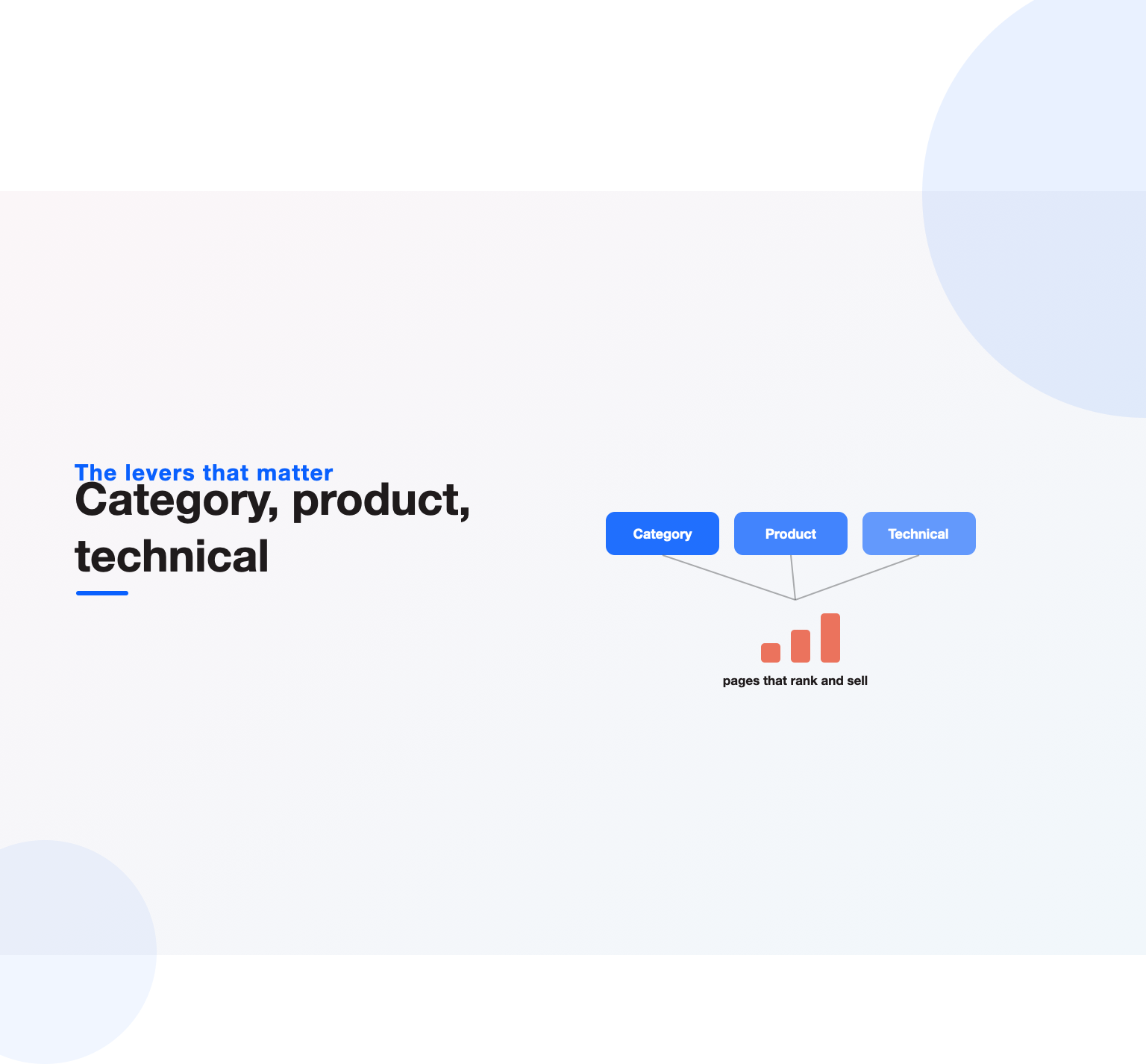
- Start with architecture and templates, not individual pages: a shallow, well-linked hierarchy and clean URL patterns let authority and crawling reach your whole catalog.
- Make category and product pages genuinely deserve to rank, substantive category intros and original product copy with reviews and schema, because these are the pages that both rank and sell.
- Tame faceted navigation and duplicate content deliberately, indexing only the filtered views with real demand and controlling the rest, to stop crawl waste and signal dilution.
- Fix technical health at the template level, crawl, speed, Core Web Vitals, and indexation, so one change lifts thousands of pages at once.
- Measure by revenue and segment, and treat store-side SEO as the foundation that also earns visibility in AI search, not a one-off project.
Frequently asked questions
What is ecommerce SEO?
Organic search for stores is the process of optimizing an online store so its category pages, product pages, and supporting content rank in organic search and earn qualified traffic from people ready to buy. It uses the same crawlability, relevance, and authority foundations as any SEO, but focuses on retail-specific problems like large catalogs, faceted navigation, duplicate product descriptions, and product structured data, so the pages that sell are also the pages that rank.
How is ecommerce SEO different from regular SEO?
The principles are the same, but the terrain is not. A store generates thousands of template-driven URLs from a database rather than a few hand-written pages, so the program is about optimizing templates, feeds, and architecture at scale rather than crafting pages one by one. It also carries high commercial intent and unique traps, thin manufacturer copy, filter-generated duplicates, and out-of-stock handling, that generic SEO advice rarely addresses.
Which pages matter most for ecommerce SEO?
Category and collection pages usually carry the most ranking potential because they target broad, high-volume buying queries and repeat across the catalog, followed closely by product pages that capture specific model and brand searches and convert well. Content pages support both by capturing research-stage demand and building the topical authority and internal links that lift the commercial pages.
How long does ecommerce SEO take to work?
Technical fixes at the template level can show results within weeks because they affect many pages at once, while competitive category and product rankings typically build over three to six months and keep compounding from there. Timelines depend on your site’s current health, your authority relative to competitors, and how consistently the work is executed, which is the same reality covered in our look at how long SEO takes.
Do I need to blog for ecommerce SEO?
You do not need a blog for its own sake, but content that answers pre-purchase questions is a powerful support for this work when it is tied to your commercial pages. Buying guides and comparisons capture research demand, earn links, and funnel readers into the categories and products that sell, so the value comes from content that strengthens your money pages, not from publishing volume.
How do I handle out-of-stock and discontinued products?
Keep temporarily out-of-stock products live and clearly marked so you retain their rankings and authority for when they return, and for permanently discontinued items redirect the URL to the closest relevant product or category so you preserve accumulated equity and avoid dead ends. A blanket policy of deleting products is one of the more expensive retail SEO mistakes because it discards value you already earned.
Does ecommerce SEO still matter with AI search and shopping assistants?
Yes, and arguably more than before, because AI Overviews and shopping assistants rely on the same signals strong store SEO builds: clean structured data, fast crawlable pages, useful content, and brand authority. The adaptation is to track visibility in AI answers alongside traditional rankings while continuing to invest in the shared foundations, since a well-optimized store is already well positioned to be surfaced by AI systems.
Should I hire an agency for ecommerce SEO?
It depends on the size of your catalog and the expertise on your team. Small stores can make real progress with disciplined in-house effort, while larger catalogs with complex faceted navigation, platform constraints, and competitive markets usually benefit from specialists who do template-level and technical ecommerce search daily. The strongest setups pair an internal owner who knows the business with external expertise for depth and scale.
Ready to put this into practice?
Talk to the team that runs SEO, AI search and paid growth programs every day.
Book a Strategy Call →