 Skip to content

How AI Search Engines Choose Which Brands to Cite
How do AI search engines choose which brands to cite? The signals that decide it, from entity recognition and extractable structure to corroboration, authority and freshness, plus how to influence each.
Quick Answer
AI search engines choose sources in stages, retrieving candidates, extracting clean facts, then selecting the ones they trust, so being cited depends on retrievability, clarity and authority together. A weakness at any stage keeps you out of the answer.
AI search engines choose which brands to cite by retrieving the most relevant passages for a question, judging which sources they can trust, and quoting the ones that state a clear, well-supported answer. In practice five signals decide it: whether the engine recognises your brand as an entity, whether your content is structured so an answer can be extracted cleanly, whether other credible sources corroborate you, how much authority and expertise you demonstrate, and how fresh your content is. This guide breaks down each signal and, more importantly, what you can actually do to influence it, so you can move from guessing why you are absent to fixing the specific thing that is holding you back.
Key Highlights
- Engines retrieve the most relevant passages, judge which sources they trust, then quote the clearest answers.
- Selection happens in two stages: being retrieved, then being trusted.
- Five signals decide it: brand recognition, extractable answers, corroboration, authority and freshness.
- Corroboration matters, other trusted sources agreeing with you strengthens your case.
- Brands never get cited when they are unknown, unclear, unsupported or stale.
How AI search engines choose which brands to cite
The short answer is that AI search engines do not pick brands; they pick passages, and the brand behind the best passage gets named. When someone asks a question, the engine gathers candidate passages from across the web, scores them for relevance and reliability, feeds the strongest into the model, and the model writes an answer that cites the sources it leaned on. So the real question is not how to get an engine to like your brand, but how to make your passage the one it reaches for. Everything below is about that.
It helps to hold one idea in mind: an answer engine is cautious. It is trying to give a correct, defensible answer, so it favours sources it can trust and claims it can corroborate. Citations are less a reward for marketing effort and more a by-product of being genuinely the clearest, most trustworthy answer available. The mechanics behind this are covered in how AEO works; here we focus on the selection itself.
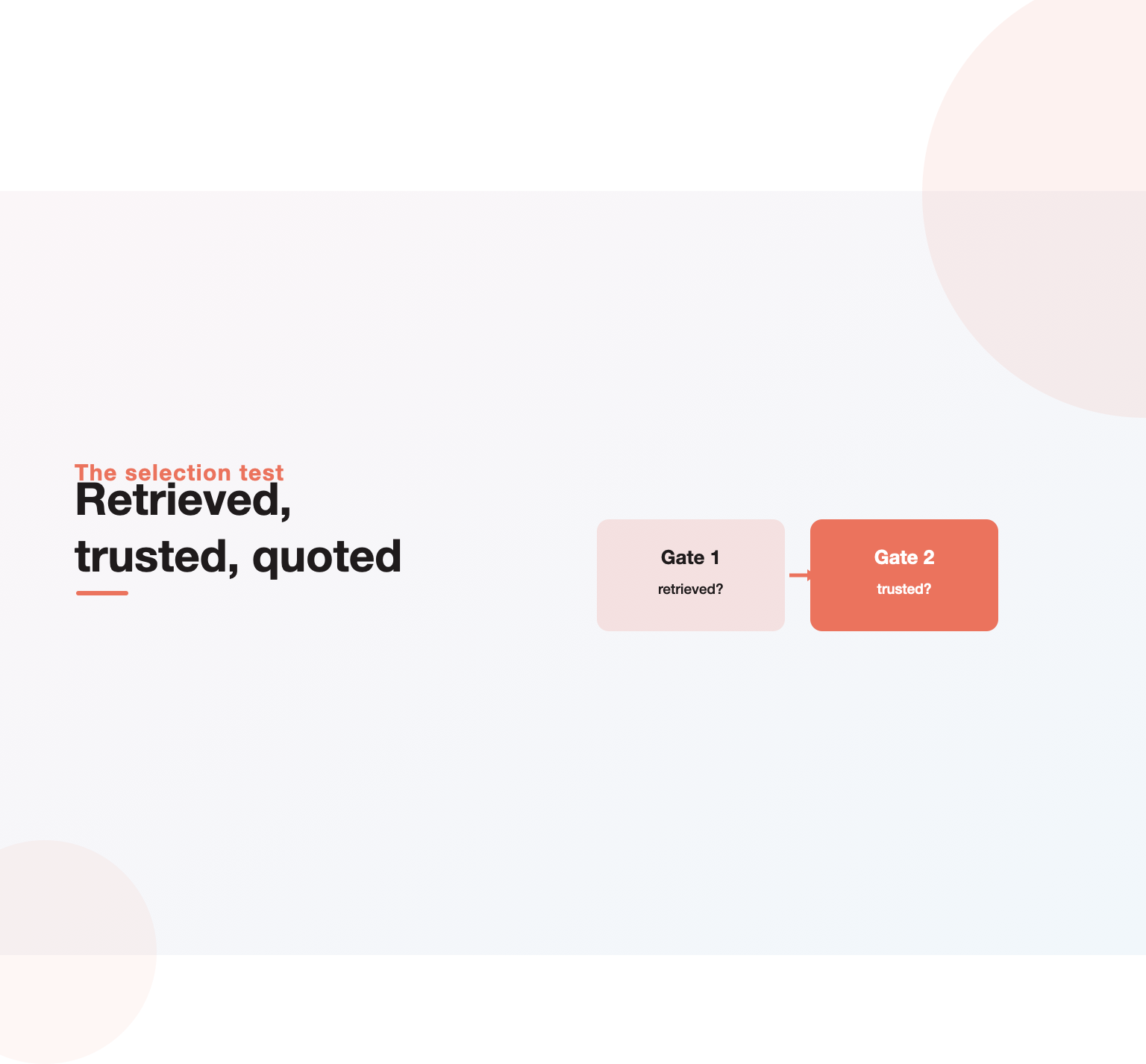
Selection happens in two stages
Before the individual signals make sense, you need the two-stage shape of the process. First is retrieval: the engine finds candidate passages that seem relevant to the question. If you are not retrieved, nothing else matters, and retrieval rewards clear topical relevance, clean structure, and enough search visibility to be found. Second is selection: from the retrieved candidates, the engine chooses which to actually ground its answer in and cite, and that choice rewards trust, corroboration, and clarity.
Most brands that are absent from answers fail at one of these two stages, and the fix is different for each. If you are never retrieved, you have a relevance and structure problem. If you are retrieved but never named, you have a trust problem. Diagnosing which stage you are losing at is the single most useful thing you can do, because it tells you which of the signals below to work on first rather than spreading effort thin across all of them.
There is a simple way to tell which stage is failing you. Ask your target question in the engine and read the sources it cites. If the sources are all pages that clearly out-rank and out-cover you on the topic, you are likely losing at retrieval, and the fix is relevance, depth and search visibility. If the cited sources are comparable to yours, or even weaker, yet you are still absent, you are losing at selection, and the fix is trust: clearer structure, stronger authorship, and better corroboration. Doing this check across ten questions usually reveals a pattern, and that pattern is your roadmap. It turns a vague sense that you are not showing up into a specific, prioritised list of what to fix first.
A worked example: two sources, one citation
Imagine a buyer asks an assistant which tool is best for managing remote teams. The engine retrieves a dozen candidate passages: a well-known software vendor’s help page, two agency blog posts, a forum thread, and a review site. It grounds its answer in three of them and names two as sources. Now ask why those two won and the others did not. The cited passages opened with a direct answer, came from sources the engine recognised, and made claims the other passages broadly agreed with. The forum thread was retrieved but ignored because it was anecdotal and uncorroborated. One agency post was retrieved but skipped because its answer sat four paragraphs down under a generic introduction.
That single query contains the whole lesson. The losing agency post did not lack knowledge; it lacked extractability and recognition. Had it led with the answer and been published under a credible named expert whose brand the engine trusted, it would very likely have been the third citation. Nothing about the engine’s decision was mysterious once you see the signals it was weighing, and every reason it passed a source over was something that source could have fixed.
Signal 1: Does the engine recognise your brand?
The first signal is entity recognition. Answer engines build an internal understanding of who you are from information spread across the whole web, not just your own site, and they lean toward brands they can identify and verify. This is sometimes called model familiarity: the more consistently and credibly your brand appears across trusted sources, the more comfortable an engine is naming you. A brand it has never reliably encountered is a risk to cite, so it hedges toward one it knows.
You influence this by making your brand legible and consistent everywhere it appears: the same clear description of what you do, the same details, real named people behind the work, and a presence in the reference sources engines cross-check. Conflicting or thin information anywhere weakens the whole picture. Our guides to model familiarity and how knowledge graphs influence citations go deep on building this recognition.
Signal 2: Can a clean answer be extracted?
The second signal is extractable structure. Even a trusted source will be passed over if the engine cannot lift a clean, self-contained answer from it. Passages that open with the answer, sit under a heading that matches the question, and make sense on their own are easy to quote. Passages where the point is buried under a long preamble, hedged across several sentences, or split between paragraphs are hard to quote, so the engine reaches for a clearer competitor instead.
This is the most fixable signal and often the highest-leverage. Leading with the answer, using question-shaped headings, keeping each idea self-contained, and adding schema that labels what each block means all make extraction reliable. None of it requires a rebuild; most existing pages can be restructured in an afternoon. Our guides to answer-first content and what makes content citable are the practical companions here.
Signal 3: Do other sources corroborate you?
The third signal is corroboration, and it is the one brands underrate most. Answer engines are reluctant to assert something that only a single source claims, because a lone claim carries risk. When several independent, credible sources agree on a point, the point becomes safe to state, and the source that states it most clearly tends to get named. This produces a counter-intuitive rule: being the clearest voice on a claim that others also support beats being the only voice on a claim nobody else makes.
Practically, this means aligning your key claims with the established consensus in your field, backing assertions with evidence, and earning mentions from other credible sources so your position is corroborated rather than isolated. Original data and research help here too, because if you become the source others cite, you become the corroborated origin of a claim rather than an outlier making it alone.
Signal 4: Authority and E-E-A-T
The fourth signal is authority, expressed increasingly through E-E-A-T: experience, expertise, authoritativeness, and trust. Answer engines are most cautious on topics where a wrong answer could cause harm, and there they lean hardest on sources that demonstrate real expertise and credibility. Named authors with genuine credentials, a track record of accurate content on the topic, and the trust signals a legitimate organisation carries all raise your odds of being the source an engine is willing to stand behind. Depth on a subject matters too, which is where topical authority and E-E-A-T come together.
Authority is the slowest signal to build and therefore the most defensible. Anyone can restructure a page today, but a recognised presence, consistent expertise, and a history of corroborated accuracy accumulate over months. Once an engine trusts you on a topic, that trust is hard for a competitor to dislodge quickly, so the authority you build now keeps earning citations long after the work is done.
Signal 5: Is your content fresh?
The fifth signal is freshness. Answer engines favour current sources, especially for questions where the answer changes over time, and they will quietly prefer a recently updated page over a stale one even if the stale page is otherwise strong. A page that was accurate two years ago but has not been touched since sends a weak freshness signal, and in a fast-moving field an engine treats that as a reason to look elsewhere.
Keeping your important pages reviewed and updated on a schedule protects your citations over time. This does not mean churning out changes for their own sake; it means genuinely maintaining accuracy, refreshing examples and data, and signalling that the page is cared for. Our guide to updating content for AI citations covers how often is enough without over-doing it.
Common reasons brands never get cited
Seen from the engine’s side, the reasons a brand stays absent are consistent and avoidable:
- The answer is buried. A long preamble before the point means there is no clean passage to lift, so the engine skips you even if the answer is eventually there.
- The brand is invisible as an entity. Inconsistent or thin information across the web means the engine cannot confidently identify who you are, so it hedges toward a brand it recognises.
- Claims stand alone. Assertions no other credible source supports read as risky, and engines avoid quoting risky claims.
- No named expertise. Anonymous content underperforms recognised, credentialed authorship on exactly the topics where trust matters most.
- Stale pages. Content that has not been maintained loses to fresher sources over time.
Each of these maps directly to a signal above, which is why the fix is usually specific rather than a rewrite. Our companion piece on the mistakes that kill your citation rate covers the full list and the remedy for each.
How to influence each signal
Put together, the five signals turn into a short, practical checklist you can work through per topic:
- Recognition: make your brand information consistent everywhere and back your content with named experts.
- Structure: lead with the answer, use question-shaped headings, add the right schema.
- Corroboration: align key claims with credible consensus and earn independent mentions.
- Authority: build genuine depth and demonstrable expertise on your core topics.
- Freshness: maintain your important pages on a schedule.
Working the list against your real buyer questions is exactly what our AI citation readiness audit and the complete AEO checklist operationalise, and the strategy sits inside the pillar guide on answer engine optimization.
How the signals work together
The five signals are not a menu to pick from; they reinforce each other, and the brands that get cited consistently tend to be strong across several at once. Recognition without structure means the engine trusts you but cannot lift a clean answer, so it quotes a clearer competitor. Structure without recognition means your passage is easy to quote but the engine is not sure it can trust you, so it hedges. Corroboration amplifies authority, because a trusted source stating a widely supported claim is the safest possible thing to cite. Freshness protects all of it, because a stale page slowly loses ground to maintained ones even if it was strong when published.
This is why a scattershot approach underperforms and a compounding one wins. Fixing structure on a page from an unrecognised brand moves the needle a little; building recognition, structuring cleanly, corroborating your claims and keeping it fresh moves it a lot, because you clear both the retrieval and the trust gate at the same time. Think of the signals as a stack rather than a checklist: each one you add raises the value of the others, and a source that is strong on all five becomes the default answer an engine reaches for without hesitation.
What you cannot control
It is worth being honest about the limits. You cannot make an engine cite you on demand, you cannot see its exact scoring, and answers vary from run to run, so a single query where you are absent is not proof of failure. Different engines also weight the signals differently, so being cited in Perplexity does not guarantee the same in Google’s AI Overviews. What you can control is being the clearest, best-corroborated, most trustworthy answer on the questions that matter to your buyers, and over time that is what moves your citation rate. Treat the trend across many questions and weeks as the signal, not any single answer. The brands that win here stop trying to game the engine and instead focus on genuinely being the best, clearest, most trustworthy answer to the questions their buyers ask, because that is exactly what the engine is built to find and reward.
We run answer engine optimization programs that work each of these signals, from recognition and structure to corroboration, authority and freshness, measured by citation rate and share of answer.
Key Takeaways
- Make pages retrievable so they enter the candidate set.
- Write answer-first so engines can extract you cleanly.
- Build authority so engines trust you enough to cite.
- Fix the stage where you are weakest first.
Frequently asked questions
How do AI search engines decide which brands to cite?
They retrieve the passages most relevant to a question, judge which sources they can trust, and quote the ones that state a clear, well-supported answer. Five signals drive it: entity recognition, extractable structure, corroboration, authority/E-E-A-T, and freshness.
Why is my competitor cited and not me?
Usually their passage is safer to quote: clearer and answer-first, better corroborated by other sources, from a more recognised brand, or more current. Each of those is fixable once you know which signal you are losing on.
Do AI engines cite based on Google rankings?
Rankings help you get retrieved, because several engines lean on established search signals to find candidates. But being retrieved is only the first stage; trust and clarity decide whether you are actually cited.
Can a small brand get cited over a big one?
Yes. Answer engines reward the clearest, best-corroborated answer on a specific topic, so a focused brand that owns a narrow subject is often cited ahead of a larger brand that covers it vaguely.
Which signal should I fix first?
Diagnose whether you are failing at retrieval or selection. If you are never retrieved, fix relevance and structure. If you are retrieved but not named, work on authority and corroboration.
Does being cited once mean I will keep being cited?
Not automatically, but citations compound. Once an engine learns to trust you on a topic it tends to keep citing you, provided you maintain freshness and accuracy, so early wins make later ones easier.
Ready to put this into practice?
Talk to the team that runs SEO, AI search and paid growth programs every day.
Book a Strategy Call →